


Updated: July 23, 2026
Every quarter, a contact center handles millions of conversations. How many does your team ever read? For most organizations, the honest answer is a rounding error.
Meanwhile, CX and IT leaders face harder questions. Which conversations drive churn, and where are agents losing winnable sales? What is quietly eroding CSAT, and why do the same issues resurface every month?
Customer experience analytics is how leaders answer those questions with evidence instead of guesswork. It turns raw conversation data into a clear picture of what customers experience and why.
The stakes are rising, too. According to Salesforce State of Service, 85% of service decision makers say service is expected to contribute a larger share of revenue this year.
The payoff is measurable. According to Forrester's 2024 US Customer Experience Index, customer-obsessed organizations report 41% faster revenue growth than organizations that are not. They also report 49% faster profit growth and 51% better customer retention.
This guide explains what customer experience analytics is, the metrics that matter, and how to evaluate a platform.
Key Takeaways
- Customer experience analytics collects and interprets data from every customer touchpoint to explain what customers experience and why.
- Most quality programs sample a tiny fraction of interactions, so leaders act on incomplete evidence.
- Modern platforms analyze 100% of conversations across voice and digital, not a sample.
- The metrics that matter tie directly to outcomes: sales, retention, resolution, CSAT, and AHT.
- The best tools recognize behavior and intent, not keywords, and close the loop into coaching and QA.
- Cresta customers like CVS Health and Oportun have moved from sampling to full-coverage analysis.
What Is Customer Experience Analytics?
Customer experience analytics is the practice of collecting, analyzing, and interpreting customer data across every touchpoint to understand and improve the experience. It spans phone, email, social, and chat interactions, plus surveys and reviews.
Done well, it moves a team from anecdotes to evidence. Instead of debating what customers want, leaders can see it in the data and act on it.
Here is the problem most programs run into: coverage. Industry benchmarks from COPC find most teams review only 2% to 5% of interactions. Decisions built on that thin a sample miss the patterns that matter most.
Modern customer experience analytics closes that gap. Platforms like Cresta Conversation Intelligence work by analyzing 100% of conversations across voice and digital channels. Full coverage removes sampling bias and gives leaders a reliable read on what is happening across the floor.
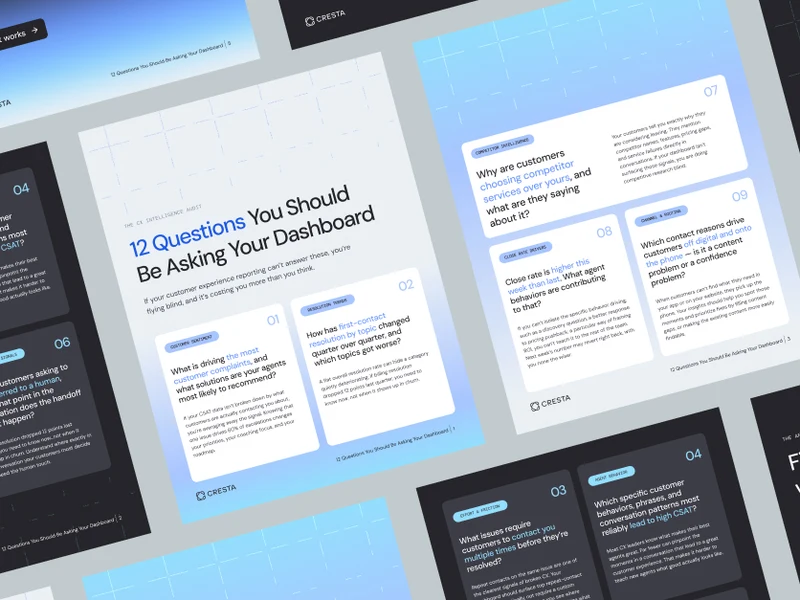
Ask your dashboard these 12 questions to uncover key insights
How Can Contact Centers Use Customer Experience Analytics?
Customer experience analytics draws on many data sources. Contact centers can analyze voice calls, chat, email, and social messages alongside survey responses and public reviews. Voice remains the richest source, which is why many teams start with speech analytics software before expanding to digital channels.
Once that data is unified, four use cases deliver most of the value.
Identify Patterns And Trends
Analytics reveal recurring themes across thousands of conversations that no manual review could catch. Cresta Insights can surface insights across every interaction, flagging emerging issues, sentiment shifts, and root causes in minutes rather than weeks.
Personalize Customer Interactions
Understanding intent and history lets teams tailor each interaction. Analytics show which approaches resolve issues fastest for which customer segments, so agents can meet people where they are.
Optimize Agent Performance
Analytics pinpoint exactly where performance breaks down. Cresta Quality Management delivers automated quality management that scores every conversation instead of a handful. Cresta Coach then adds real-time agent coaching that augments each agent in the moment.
Enhance Operational Efficiency
Analytics expose where effort is wasted: repeated contacts, avoidable escalations, and slow handoffs. Fixing those root causes lowers cost per contact and frees capacity without cutting service quality.
The Metrics That Matter In Customer Experience Analytics
Not every metric deserves equal attention. Cresta's view is outcome-driven: prioritize the metrics that move sales, retention, resolution, and satisfaction, not vanity numbers. These are the core measures a customer experience analytics program should track.
- CSAT (Customer Satisfaction): measures how satisfied customers are with a specific interaction, usually via a post-contact survey.
- NPS (Net Promoter Score): gauges loyalty by asking how likely a customer is to recommend you.
- CES (Customer Effort Score): captures how hard a customer had to work to get their issue resolved.
- FCR (First Contact Resolution): tracks the share of issues resolved in a single interaction, a strong driver of satisfaction.
- AHT (Average Handle Time): reflects how long interactions take, balancing efficiency against quality.
- Churn and retention: connect conversation signals to whether customers stay or leave.
- Outcome metrics: tie conversations to concrete results such as sales conversion and resolution rate.
The goal is not to track everything. It is to link each metric to a business outcome, then focus improvement where it changes results.
The Business Value Of Customer Experience Analytics
Customer experience analytics pays off in four connected ways.
Improved Customer Satisfaction
Full-coverage analysis shows exactly what frustrates customers and what delights them. Teams fix systemic issues at the root, which lifts CSAT and reduces repeat contacts over time.
Increased Revenue
Customer experience is a growth lever, not just a cost center. Analytics reveal where agents miss revenue moments and where service quality drives loyalty, both of which compound into the growth advantage Forrester documents.
Data-Driven Decision Making
When leaders can see every conversation, decisions stop relying on gut feel. CVS Health went from scoring 5% of calls to 100% with Cresta, giving quality teams a complete evidence base instead of a sample.
Cost Savings
Analytics find the drivers of avoidable cost: contacts that should never have happened and inefficient handling. Oportun moved from sample-based QA to full coverage monitoring with Cresta, replacing manual review with automated scoring at scale.
Features To Look For In Customer Experience Analytics
Evaluation criteria matter because most tools describe similar features on paper. Here is what separates a platform that scales from one that plateaus. Ask each vendor how they handle the following.
- Understands meaning, not keywords: it recognizes behavior and intent through context, because keyword spotting misses sarcasm, paraphrase, and churn signals.
- Covers 100% of interactions: it analyzes every conversation across voice and digital, not a sampled subset.
- Ties insight to action: it feeds a closed loop across quality management, coaching, and real-time guidance.
- Integrates with your stack: it connects to your contact center, CRM, and data tools, including Salesforce, Genesys, and Amazon Connect.
- Meets enterprise security standards: it offers data privacy certifications, access controls, and documented compliance coverage.
Cresta is built around behavioral recognition and full coverage. Its Cresta Conversation Intelligence and Cresta Agent Assist products share one intelligence layer, so insight and action stay connected.
How To Build A Customer Experience Analytics Program
A program does not need to start big. It needs to start where the impact is clearest, then expand. These steps give CX and IT leaders a practical path.
- Define the outcome first. Decide which result matters most this quarter: retention, conversion, resolution, or CSAT.
- Unify your conversation data. Bring voice, chat, email, and social into one place before analysis.
- Move from sampling to full coverage. Replace sampled review with analysis of 100% of interactions.
- Connect insight to action. Route findings into quality management, coaching, and real-time guidance.
- Measure the loop. Track whether coaching changed behavior and whether that behavior moved your target outcome.
The order matters. Teams that start with a tool before a target end up with dashboards no one uses. Teams that start with an outcome build analytics that pay for themselves.
Measuring Success And Benchmarks
Once a program is running, leaders need a baseline and a cadence. Set a starting value for your priority metric, then review it on a fixed schedule against a clear target.
- Baseline: record where CSAT, FCR, or your chosen metric sits before any change.
- Coverage: track the share of conversations analyzed, with 100% as the goal.
- Behavior change: measure how often coached behaviors appear in later conversations.
- Outcome movement: connect those behaviors to sales, retention, or resolution.
Benchmarks vary by industry, so the most useful comparison is your own trend over time. Progress against your baseline is a better signal than any external average.
The Future Of Customer Experience Analytics
AI is changing what customer experience analytics can do, and adoption is already widespread. In McKinsey's 2025 State of AI survey, 88% of organizations report regular AI use, up from 78% a year ago.
The shift extends to the front line. Gartner predicts that by 2029, agentic AI will autonomously resolve 80% of common customer service issues and cut operational costs by 30%.
For CX leaders, the lesson is practical. Analytics that cover every conversation and connect directly to action will define the next phase of customer experience work.
Book A Demo
See how Cresta analyzes 100% of your conversations and turns that insight into coaching, quality management, and better outcomes. Book a demo to walk through your own use case with our team.