
.jpg)
Every day, customer conversations reveal what is happening across a business: the product issues customers can’t resolve on their own, the policies creating confusion, and the behaviors that separate the highest-performing agents from everyone else on the frontline.
However, extracting that intelligence and turning it into insights the business can actually use has traditionally required too much manual work and too much prior knowledge. Conventional analytics systems can answer questions and pull out insights…provided someone already knows what to look for and has the available time, bandwidth, and expertise to string together multiple stages of analysis, calculation, and cross-checking results. This process can of course still be valuable, but it is also slow, prone to errors, and inherently limited by the assumptions that went into the analysis.
Today, we’re introducing the next generation of Cresta Insights: with major enhancements across AI Analyst and Topic Discovery, plus the introduction of Real-Time Trends. Together, these capabilities make Cresta’s Insights suite more authoritative, more real-time, and more agentic than ever before, helping enterprises to understand what initially drives customers to contact them, what happens during the conversations themselves, and what the business should do next.
AI Analyst: From Answering Questions to Conducting Research
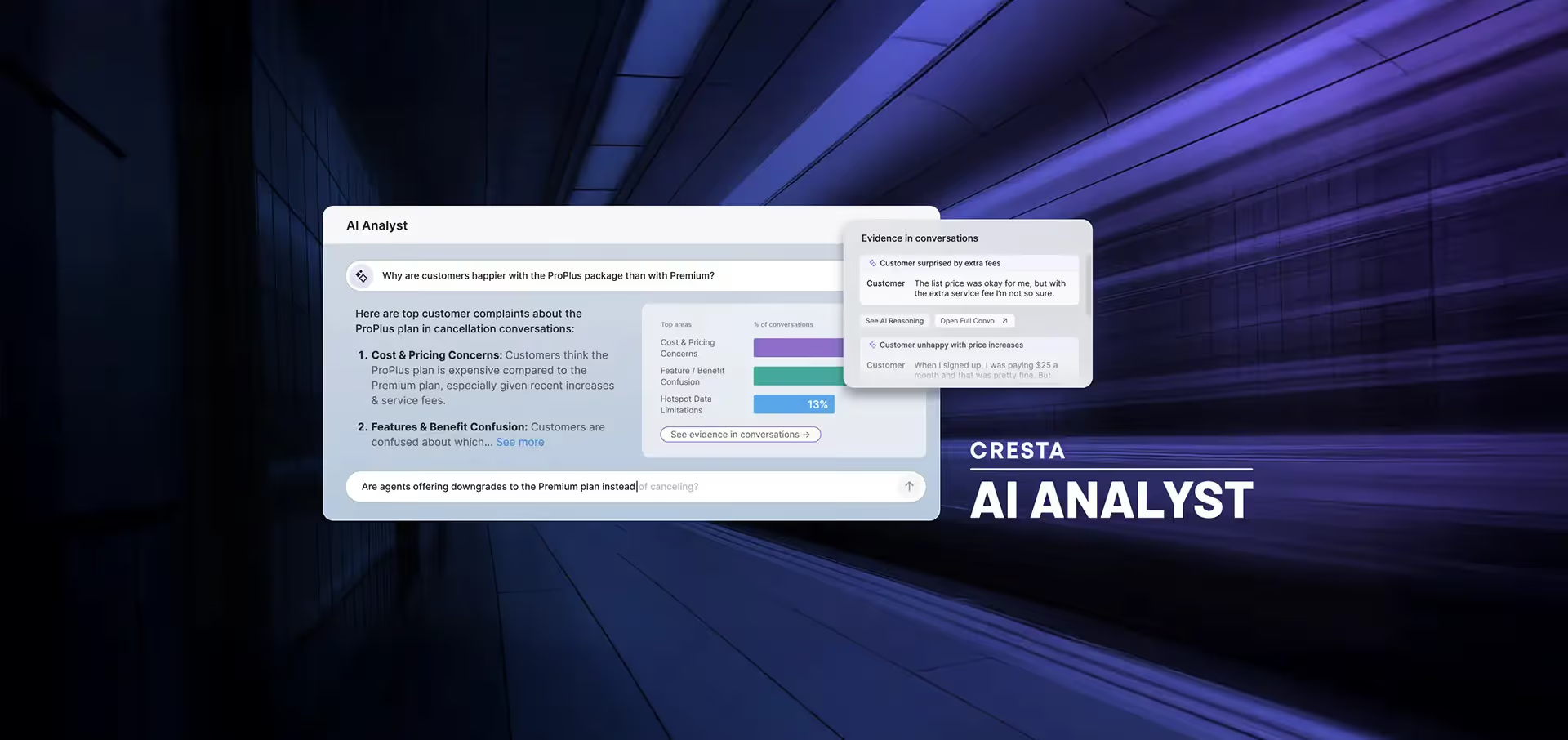
Since its release, AI Analyst has enabled business users to ask questions about their customer conversations in their own words. With today’s upgrades, it goes further and deeper by planning and executing the research required to produce a complete answer, and then recommending actions that leaders should take based on its findings.
A user can begin with a broad question such as, “How are agents handling customer questions about the recent service disruption?” AI Analyst identifies the relevant conversations, and performs multi-step reasoning, locating and scoping data, and checking whether these findings are meaningful. From there, AI Analyst runs analysis, builds comparisons, evaluates the findings, and determines what additional steps may be useful.
Rather than waiting for the user to define every filter and analytical step, AI Analyst builds a plan and carries it out autonomously. Essentially, AI Analyst is a CX research agent, working proactively on the behalf of the business.
Importantly, AI Analyst reasons across more than just customer conversation transcripts, allowing it to answer questions well below the surface level. It can incorporate conversation reasons, and specific moments like agent or customer behavior or objections, defined in Cresta Opera, outcomes, and other relevant business context.
With this richer range of input, it also produces richer outputs. Depending on the question, AI Analyst can create charts, quantitative comparisons, conversation queries, behavior discovery reports, coaching recommendations, and drafted communications. The output is specifically designed to be something a team can immediately act on and share more broadly.
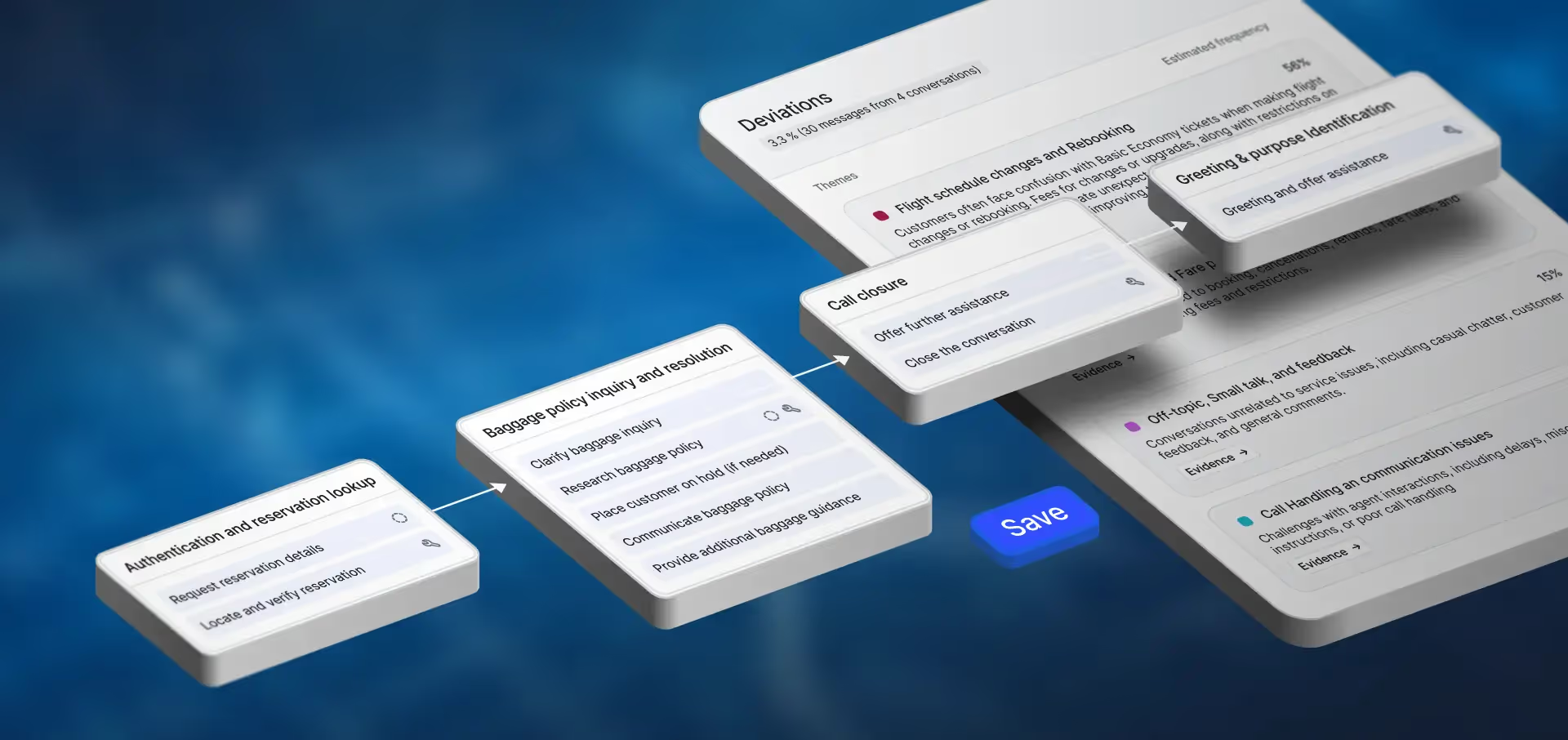
For example, during a period of industry uncertainty, a major airline used AI Analyst to examine how agents were handling customer questions about a developing issue. The analysis went beyond identifying common themes in these conversations, producing a recommended decision-tree structure that could guide agents through these conversations with customers going forward.
Teams working to protect the customer experience during a service disruption could ask which agent behaviors are emerging in those conversations, and which are most strongly associated with Cresta-inferred outcomes such as CSAT. AI Analyst surfaced those patterns specifically within calls about the disruption, all from questions asked in the user’s own words.
That reflects the broader promise of the new and improved AI Analyst: not only turning an executive question into a defensible, evidence-backed answer, but proactively recommending what the business should do next. Equipped with a synthesis of everything they need to know about their customer experience, teams are able to move from insight to action faster.
Topic Discovery: The Nuanced View of Why Customers Are Calling
Businesses need a consistent way to understand why their customers are reaching out. Historically, that has looked like building and maintaining large sets of keyword-based categories, systems that are time-consuming and often rapidly outdated.
Topic Discovery already solved a key part of that problem by running unsupervised LLM clustering on conversation reasons. With today’s update, it becomes easier to align that LLM-derived taxonomy with the business and keep it aligned over time. This authoritative view of conversation reasons can then be applied across the Cresta platform in dashboards, workflows, and analysis.
Topic Discovery generates an exhaustive taxonomy and up to three levels of subcategories. Instead of asking teams to define every contact reason in advance, the system identifies the natural structure already present in customer conversations.
In banking, an organization could use Topic Discovery to generate a taxonomy, identifying categories such as card declines, disputed transactions, account access, transfer delays, and fee questions, along with more specific subcategories beneath them. The CX team reviews the proposed structure, merges overlapping groups, and renames or rearranges several categories to match the bank’s internal terminology.
Once approved, that structure becomes a consistent taxonomy. Every closed conversation is automatically classified against it, without teams having to maintain extensive keyword libraries or repeatedly rebuild the same analysis.
Conversation reasons become a first-class attribute across Cresta; they can be used as metrics and filters in Dashboard Builder, as filters in AI Analyst, and as trigger conditions in Opera rules. This turns Topic Discovery from a standalone analysis into a foundational source of truth that can support reporting, research, operational rules, and frontline guidance across the platform.
Real-Time Trends: Detecting What No One Knew to Monitor
While a strong taxonomy provides a durable view of recurring customer needs, it cannot realistically anticipate every outage, regional disruption, policy change, product issue, or unexpected event. Real-Time Trends is built to identify those developments as they happen.
For example, imagine that a retailer launches a major promotion but forgets to turn on the relevant discount code in their checkout system. Customers understandably start calling en masse when their discount code fails at checkout. Rather than hearing about it from the agents on the floor, customer experience leaders see that spike of conversations about failing discount codes within minutes in their Real-Time Trends view, allowing them to rectify the situation and provide teams with the context they need to correct the problem.
The system continuously analyzes customer conversations for emerging phrases, unusual spikes, and cross-cutting patterns, including trends that do not already exist in a company’s taxonomy. These are often the “unknown unknowns”: issues that matter precisely because no one anticipated them or deliberately created a tracker for them in advance.
Real-Time Trends can surface those changes down to the minute. Each trend includes an auto-generated headline along with an explanation of the likely root cause, powered by AI Analyst. Users can set up email alerts so they’re in the know the instant a new issue begins to spike.
Consider an auto insurer when a sudden hailstorm sweeps through a major metro area. Customers begin calling about vehicle damage, initiating new claims, and inquiring about deductibles and rental coverage, all of which are tags that likely already exist in the insurer’s taxonomy. What the taxonomy cannot show on its own is that a single fast-moving, destructive event is driving the surge across this spike in volume. Real-Time Trends connects those signals, identifies the spike, explains the likely root cause, and alerts the teams responsible for assessing whether or not to activate the insurer’s catastrophe response playbook.
That added visibility can help accelerate the response when every hour matters. Insurers often have established CAT playbooks for mobilizing adjusters, securing rental cars and hotel rooms, coordinating contractors, and equipping agents with event-specific guidance. Real-Time Trends does not replace traditional weather monitoring or catastrophe thresholds, but it can add a direct view of how an event is affecting policyholders in real time, helping insurers circulate talking points, surface relevant Agent Assist guidance, and deploy resources before demand peaks.
From Conversation Analytics to a Decision-Making System
As the conversation intelligence market moves beyond dashboards, trackers, and retrospective reporting, enterprises increasingly need systems that can maintain a reliable understanding of customers’ needs, detect emerging changes without being explicitly told what to look for, and perform more of the analytical work required to turn those signals into data-driven decisions.
Each of today’s new and improved capabilities solves for a different angle on this evolution:
- Topic Discovery provides durable structure: a trusted view of what customer conversations are about.
- Real-Time Trends provides the real-time signal: visibility into what is changing right now, including events no taxonomy was built to catch.
- AI Analyst provides the reasoning layer: investigating the evidence, connecting it with broader context, and helping to determine what the business should do next.
Together, the three layers turn the data hidden in your customer conversations into the decisions that drive your business — faster, more confidently, and at greater depth than any other system in the market.
At scale, that can translate into lower service costs and stronger customer experiences by revealing when journeys can be simplified, where unnecessary friction can be removed, and where customers can be enabled to self-serve before a call or chat is ever needed. It also creates the conditions for stronger first-contact resolution by helping businesses understand emerging customer needs faster and guide agents more effectively in the moment.
To see these updates in action, schedule a personalized demo today!