


Seasonal demand is one of the most predictable forces in customer service operations. Travel surges in the summer. Retail spikes during the holidays. Insurance explodes during open enrollment.
CX leaders are well aware of these patterns and see these spikes coming months in advance. But, somehow, when they arrive, many organizations still struggle to keep pace.
Our latest Cresta IQ analysis of tens of millions of anonymized customer conversations found that the challenge is bigger than seasonal planning alone. Demand often moves quickly, repeatedly, and unevenly — while workforce capacity moves on a slower cadence.
A few findings stood out:
- Seasonal peaks can drive 40–70%+ increases in interaction volume, creating demand swings that are difficult to staff with precision.
- Holiday periods can produce 40–50% week-over-week drops, often followed by fast rebounds that require teams to rebalance quickly.
- Week-over-week volatility shows demand can shift materially within a single week, even outside the most obvious seasonal windows.
- Active agent levels generally move less abruptly than conversation volume, creating a timing gap between demand and workforce response.
- Seasonal demand often concentrates around repeatable needs, such as reservations, eligibility, billing, account inquiries, and status checks.
- Recent Cresta research adds another layer: even in AI-enabled customer experience, surges still create pressure: 72% of leaders say hold times increase, 53% bring in temporary staff, 35% miss SLAs, and 32% report declines in support quality.
The takeaway? Seasonality is one of the clearest places to see a broader operating challenge. Alongside predictable peaks, CX leaders and their teams are also managing repeated demand volatility that traditional staffing models struggle to absorb.
Read on for how we dug into the data to understand this challenge across industries.
The Predictable Shape of Seasonal Demand
We normalized conversation data to a baseline and analyzed percentage deviation over time, which allows us to isolate what matters operationally:
- How far demand deviates from normal conditions
- How quickly those shifts occur
- How often those patterns repeat
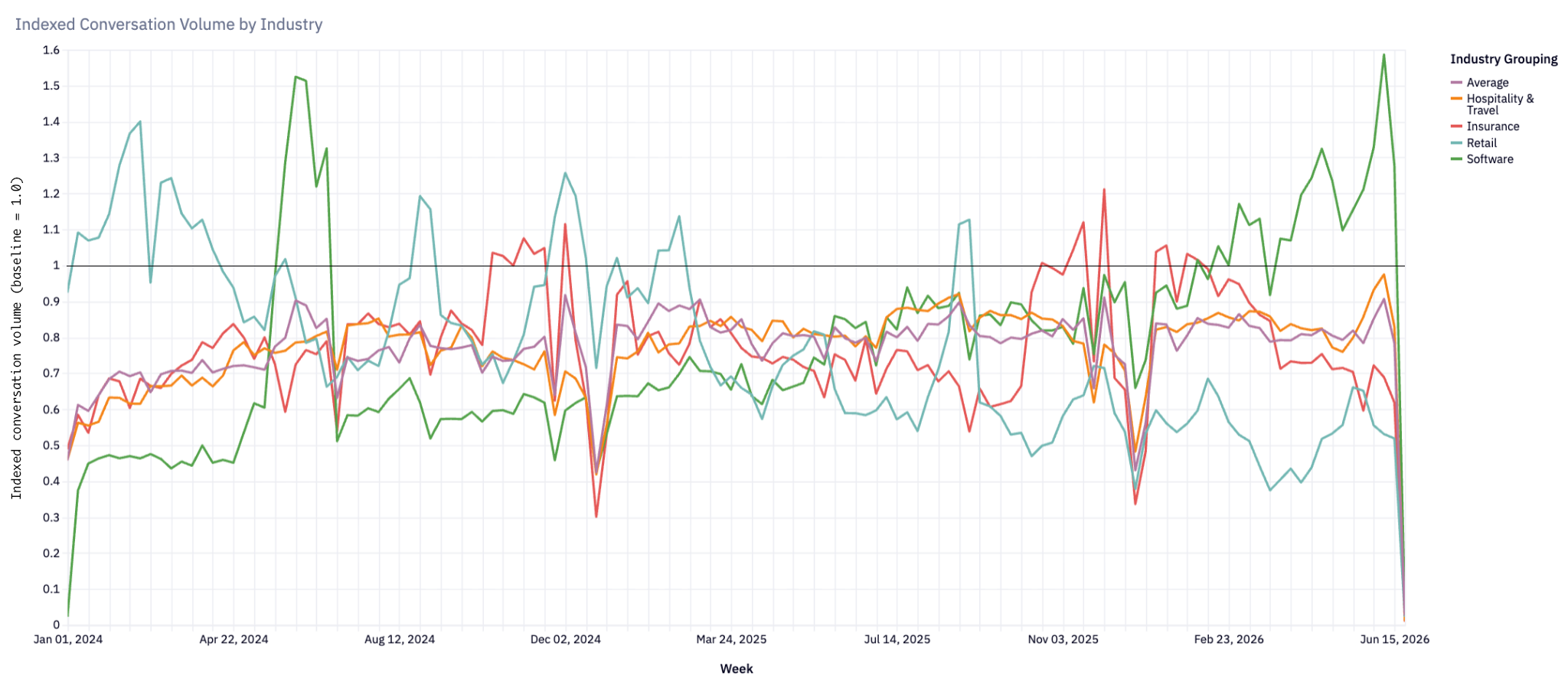
When viewed as percentage deviation from baseline, seasonal patterns become more comparable across industries.
Several dynamics stand out:
- Travel & hospitality shows a steady upward climb leading into peak travel periods, followed by sharp contractions at year-end.
- Insurance exhibits the most pronounced seasonal swings, with demand often rising meaningfully above baseline during open enrollment, before compressing back down.
- Other industries show shorter, more event-driven spikes, where demand rises and falls rapidly around holidays, promotions, or billing cycles.
The important pattern is seen in how often demand moves away from normal operating levels, how quickly those movements happen, and how difficult they are to absorb.
Weekly Volatility Reveals the Real Operational Challenge
Seasonal trends show when demand tends to rise; week-over-week (WoW) change brings to light how quickly those shifts happen.
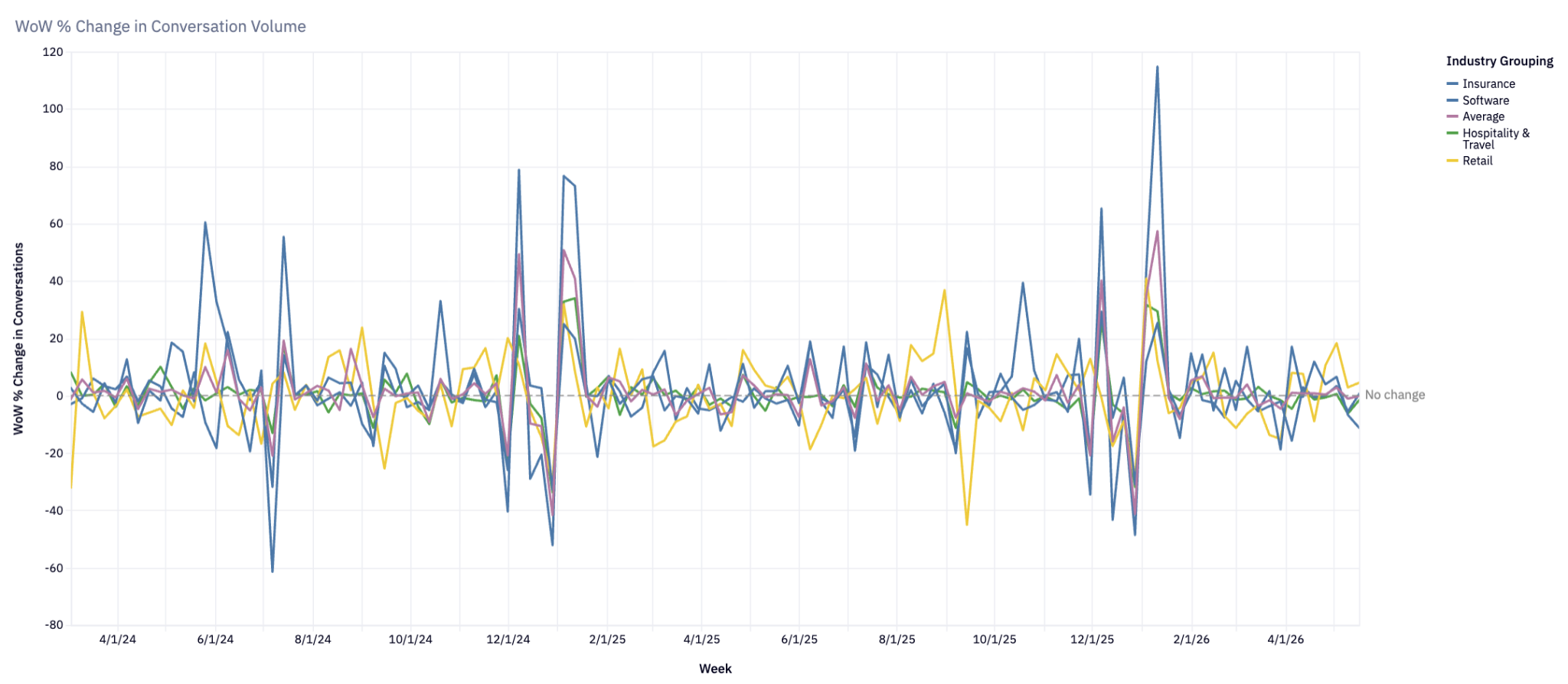
Here’s how to read this chart: 0% means demand was unchanged from the prior week. A +20% week means the contact center handled 20% more conversations than the week before. A -20% week means demand dropped by 20% week over week.
For a 5,000-agent contact center, a 20% week-over-week increase in demand would represent the workload equivalent of roughly 1,000 additional agents.
Few organizations can add or remove that much human capacity week to week, making even predictable volatility hard to manage.
Looking at WoW percentage change in conversation volume, several interesting dynamics emerge:
- Some industries experience relatively stable demand for long stretches, with sharp fluctuations during specific event windows.
- Others show more frequent swings, with demand rising or falling materially from one week to the next.
- Holiday periods create pronounced contractions followed by fast rebounds, which can be difficult for staffing models to absorb.
Contrary to how it may appear, seasonality is not always a smooth curve. It can often manifest as sudden demand volatility week over week: some predictable, some abrupt, and many large enough to create immediate pressure on staffing, queues, and customer experience delivery.
A holiday drop or post-holiday rebound may be expected, but the operating challenge comes from the speed and size of those changes, especially when they happen in quick succession.
This is also why a purely seasonal strategy can fall short.
Seasonal planning matters, but the data shows that contact centers are dealing with demand movement throughout the year. Some of those shifts align with predictable seasonal events; others appear as shorter weekly spikes and contractions. Seasonality magnifies the challenge, but it is not the only time operations are forced to rebalance.
Volatility isn’t just harder to plan for; it fundamentally changes the nature of the problem. The reality is, even knowing a spike or a contraction is coming, most workforce models are not designed to respond to that level of variability.
Workforce Scaling Doesn’t Always Move at the Same Speed as Demand
If seasonal demand were the only variable, the workforce response would be straightforward: hire ahead of the spike, and scale back accordingly afterward.
But the reality looks different.
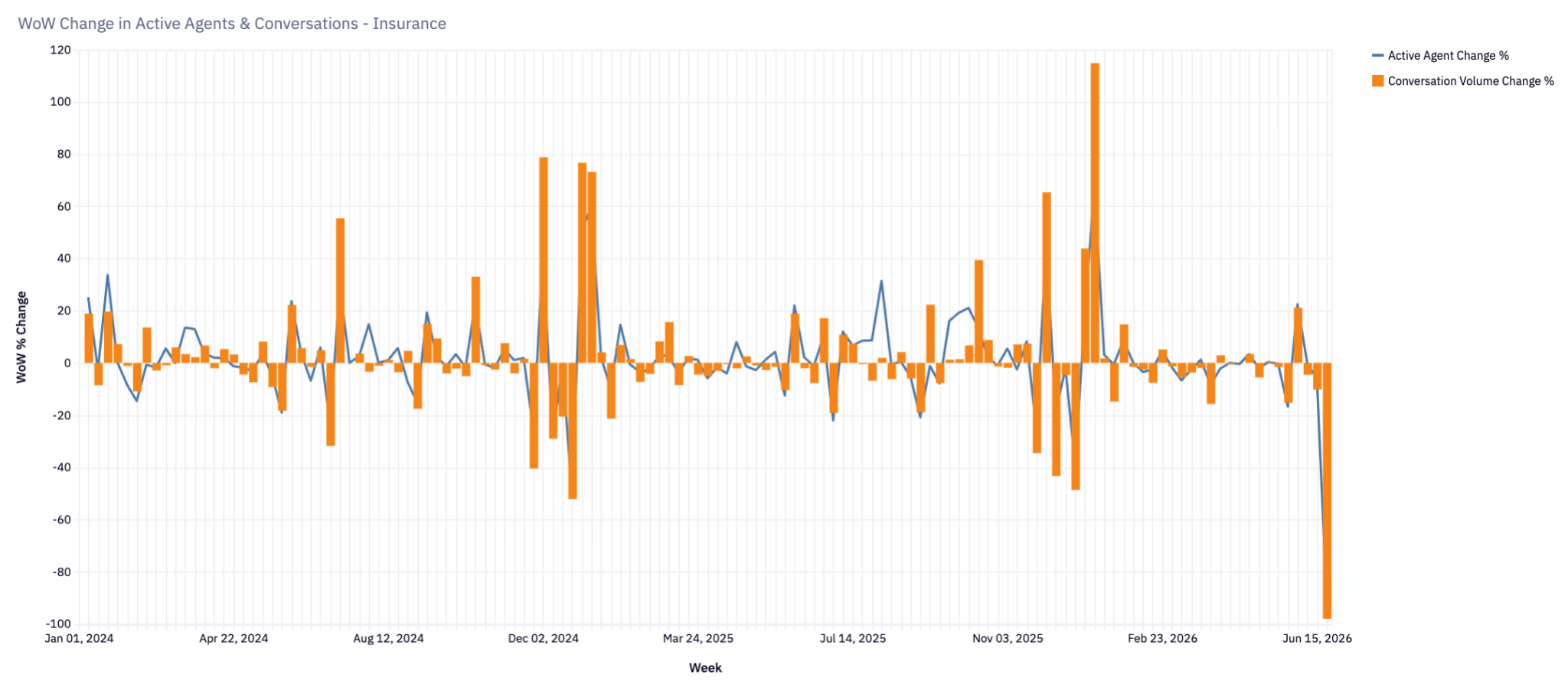
In insurance, conversation volume can move sharply week to week, while active agent changes tend to be smaller and less abrupt.
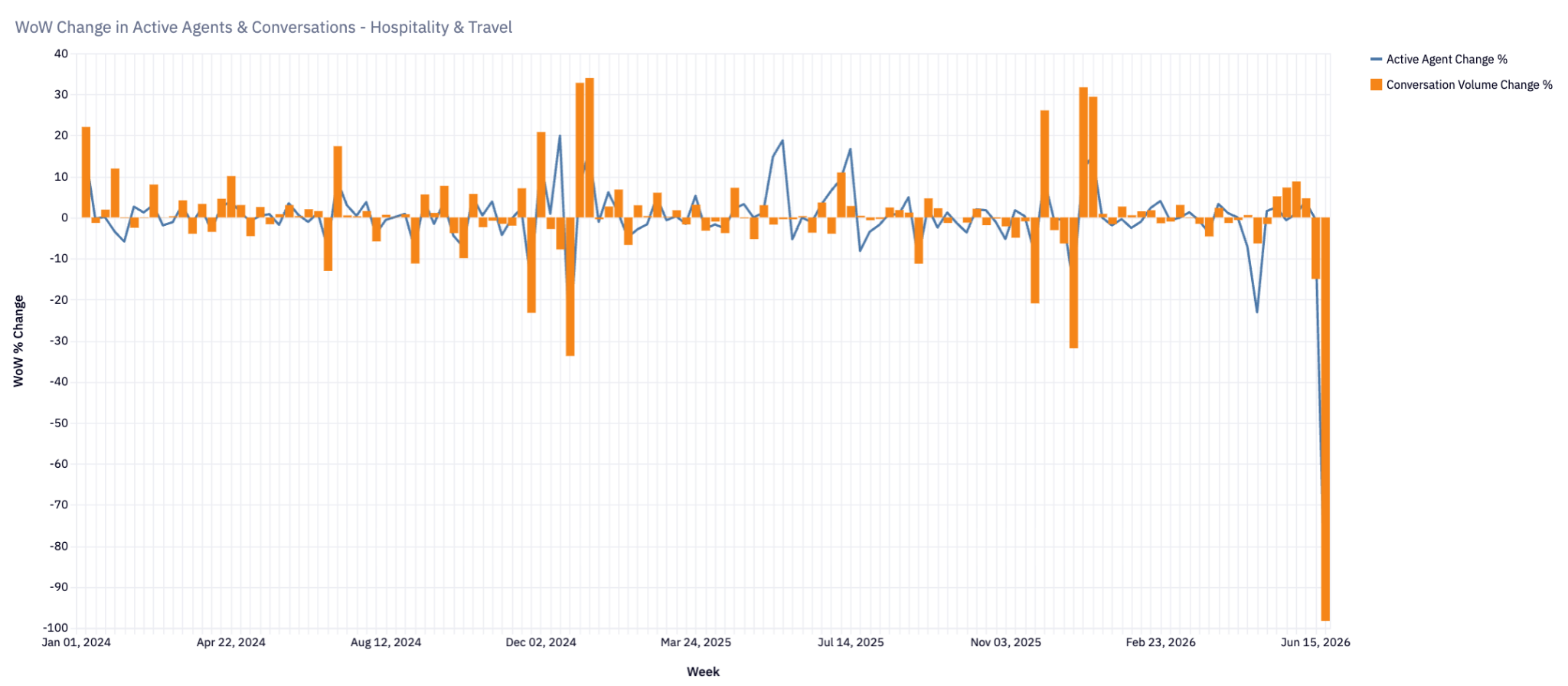
In travel & hospitality, demand shifts can happen quickly, while staffing changes move on a slower cadence.
In both insurance and travel & hospitality, we see that conversation volume can move sharply from one week to the next. Active agent counts move too, but the changes are generally smaller and less abrupt.
This creates a timing problem: demand can shift quickly, and teams can and do respond, but the response is constrained by how fast people can be hired, scheduled, trained, and activated.
Across the data, a few patterns stand out:
- Agent count typically lags behind increases in demand, ramping only after spikes are already underway
- Workforce levels often remain elevated, even after demand contracts
- In some cases, staffing continues to grow despite relatively stable or declining demand
This is where operational strain emerges. Workforce models are often built around planning cycles measured in weeks or months, while demand volatility often unfolds over days, or sometimes even hours. That mismatch is where operational strain emerges – and shines a light on a fundamental limitation: human staffing alone is not a flexible enough lever to absorb predictable demand volatility.
In this installment of Cresta IQ, the operational conditions associated with performance strain are visible: demand moves quickly, staffing responds more slowly, and seasonal capacity often depends on rapidly onboarding new or temporary agents.
Even when organizations can rapidly add people through BPO partners or temporary staffing models, ramp time is still a critical variable. New agents may expand capacity, but they rarely enter the floor with the same context, confidence, or consistency as experienced teams. Similarly, BPO partners can provide flexibility, but they do not eliminate the need to forecast, train, ramp, and rebalance capacity as demand moves.
Ramp support is an especially critical part of any seasonal strategy; real-time guidance is the difference between whether or not people can consistently perform once that volume spikes.
Capacity Adjustments Affect Workload Distribution
Another way to look at the pressure of seasonality is to examine conversations per active agent.
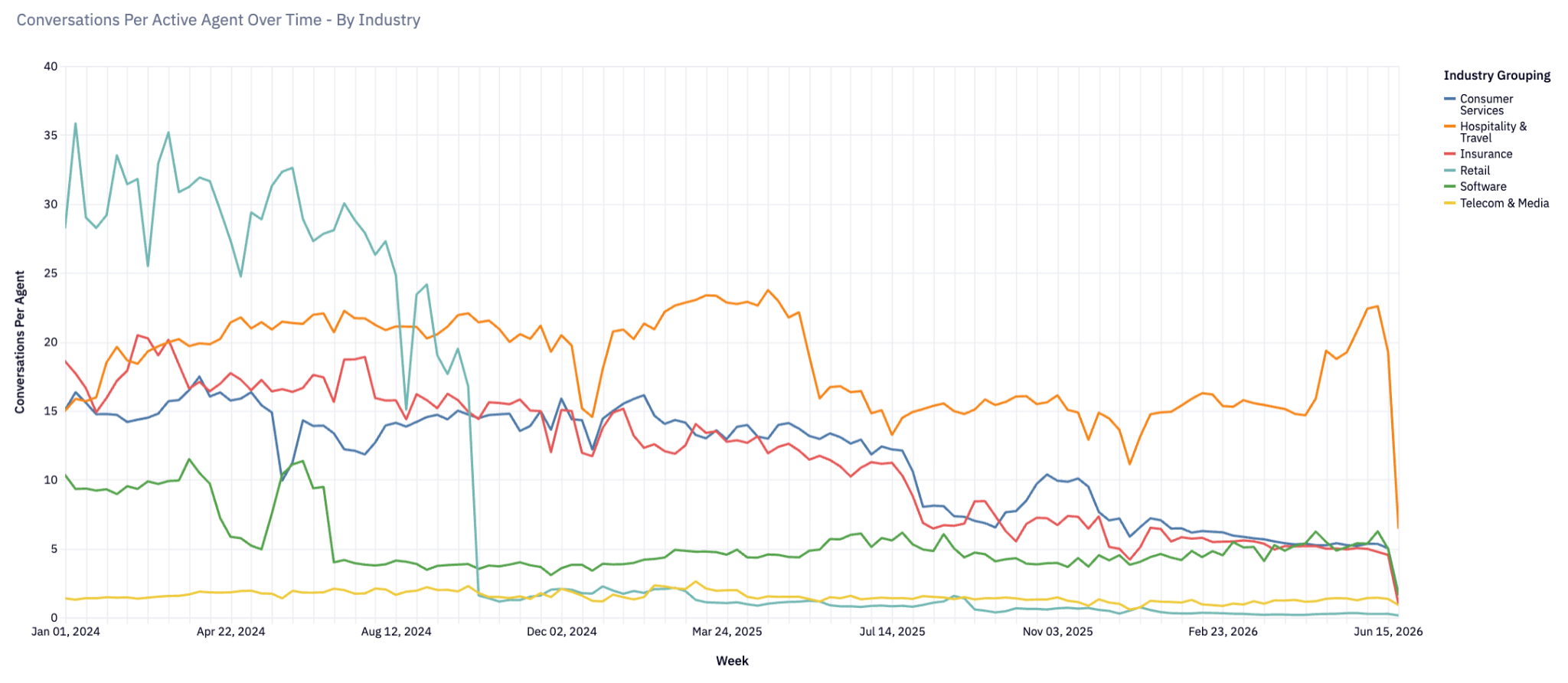
Conversations per active agent provides a directional view of workload distribution as demand and staffing levels shift over time.
While this can’t help us measure quality, resolution, or customer satisfaction, it does provide a useful operating-load proxy.
When demand moves faster than staffing, conversations per active agent rises, and when staffing expands ahead of or after a peak, conversations per active agent can fall. Both patterns point to the same underlying issue: capacity adjustments take time before, during, and after seasonal peaks.
That delay can create inefficiency on either side of a spike. Before and during the surge, teams may face heavier workloads–but after the surge, organizations may be left with more costly capacity than demand requires.
Two Ways Companies Cope with Seasonal Spikes
When seasonal demand arrives, many organizations fall into one of two strategies:
- Over-hire and absorb inefficiency
Some companies hire aggressively ahead of anticipated peak periods to ensure they can handle the surge. The upside is the comfort of capacity during the spike, while the downside is cost and wasted resources. - Under-hire and absorb service degradation
Others keep staffing lean and ride out the spike. That choice typically leads to longer wait times, agent overload, and lower-quality interactions during peak periods during the periods when customers – the true impact of which is felt most importantly by the customers.
Neither of these strategies is ideal. They all assume the same constraint: capacity must come from human staffing alone, an assumption that is increasingly outdated.
Seasonality Changes the Mix of Demand, Not Just the Volume
Volume patterns only tell part of the story; composition of demand matters too.
When seasonal demand rises, contact centers often see a larger share of conversations cluster around a relatively small set of recurring needs. That concentration creates a different kind of operational challenge: the work may be familiar, but it arrives at a scale and speed that traditional staffing models often struggle to absorb.
Looking at topic share over time in our anonymized dataset, several directional patterns stand out.
In travel and hospitality, a relatively concentrated group of topics consistently makes up the majority of demand. Across the period analyzed, account and membership inquiries, vacation package inquiries, and reservation management frequently represent the largest shares of conversations.
.png)
Together, these categories often account for well over half of observed interaction volume, while service inquiries and communication issues make up another meaningful layer of volume.
In insurance, the mix is even more concentrated. Medicare and Medicaid inquiries represent the largest share of volume throughout the year, often accounting for roughly 40–60% of conversations in the dataset. Other recurring topics, including life insurance inquiries, agent communication, and payment and billing, make up a substantial portion of the remainder.
.png)
The concentration across two distinct industries suggests that seasonal demand is not just “more calls”, but often a surge in a relatively repeatable set of needs:
- Reservation updates and travel changes
- Eligibility and coverage questions
- Billing and account inquiries
- Status checks and routine service requests
In theory, concentrated demand should be easier to plan for than a completely unpredictable mix of issues. But in practice, these interactions still create pressure because they are frequent, time-sensitive, and arrive during periods when the system is already stretched.
In a traditional staffing model, even highly repeatable interactions still require human capacity to expand.
The Missing Layer: Elasticity Across Human and AI Agents
Seasonality forces organizations to repeatedly solve the same operational problem: How do you absorb predictable spikes without permanently expanding the workforce?
Historically, the answer has been in how organizations approach hiring cycles; they recruit earlier, shorten training, and hope the workforce ramps in time.
But hiring-based elasticity is slow, expensive, and imprecise, and even when capacity expands, performance does not automatically scale with it. This is where AI fundamentally changes the equation in two important ways.
First, AI agents can absorb portions of repeatable demand directly. Unlike human staffing, AI agents don’t require:
- Hiring cycles
- Training ramp time
- Fixed schedules
They can be deployed on demand, scaled up or down instantly, and targeted to specific categories of use cases.
The topic-level data reinforces this point: during peak periods, a meaningful share of demand comes from recurring, structured interaction types such as reservation management, account inquiries, eligibility questions, billing issues, and status-related requests.
These interactions are often:
- High in volume
- Operationally predictable
- Time-sensitive
- Often structured enough to automate
By offloading these use cases to AI agents, organizations can absorb large portions of seasonal volume without expanding headcount during an already busy time for the business.
However, not every interaction, seasonal or otherwise, should be automated. Some conversations require human judgment, empathy, nuanced negotiation – distinctly human elements. During peak periods, these conversations are often handled by a workforce that includes newer agents, temporary staff, or outsourced teams that need to ramp quickly.
This is the second part of the equation: Agent Assist becomes a critical part of the seasonal strategy. For the conversations that require humans, Agent Assist can provide real-time guidance, knowledge, workflows, and summaries directly within the agent experience. Newer or seasonal agents get the real-time support they need to navigate complex interactions with more consistency, reducing the gap between ramping agents and more tenured veteran agents.
Together, AI Agent and Agent Assist create a more flexible operating model:
- AI agents handle repeatable, high-volume interactions
- Agent Assist supports human agents through complex or sensitive conversations
- Newer agents get critical support in the moments where ramp time has the potential to create risk
Instead of scaling the entire workforce uniformly, organizations can expand capacity more precisely around the interaction types and time periods where demand spikes occur.
Recent Cresta research reinforces this reality. Even in AI-enabled contact centers, demand surges continue to create pressure: 72% of leaders say hold times still increase, 53% bring in temporary staff, 35% miss SLAs, and 32% report declines in support quality.
AI is helping to absorb incremental volume, but these findings suggest that capacity alone will not guarantee resilience. Contact centers need operating models that both support humans through the highest-value work and that can scale quality when demand spikes.
The Real Lesson of Seasonality
Seasonality isn’t new, but how we understand its impact on customer experience is evolving.
Seasonality is one of the clearest places to see the problem, because the spikes are large, familiar, and often planned for months in advance.
But there’s another important lesson here: contact centers are constantly managing demand that moves faster than traditional staffing models can comfortably absorb.
Customer experience in 2026 requires a system that can flex as fast as demand does, in either direction, whatever the circumstances.
Explore how leading teams are deploying Cresta AI Agent to handle seasonal demand, improve efficiency, and elevate customer experience in our guide: Unlock the Power of AI Agents in Your Contact Center.