
10 Best Automated Call Scoring Solutions in 2026
.avif)
• Most contact centers still evaluate only a small share of conversations, leaving large gaps in performance visibility across agents, teams, shifts, and channels. Automated call scoring solutions aim to close that gap by applying AI to far more interactions than manual review can cover.
• The most useful comparison lens isn't coverage alone. The guide evaluates solutions on how well they turn broad scoring into practical manager action, specifically how clearly scoring connects to coaching, how well behaviors link to outcomes, and how much manual interpretation still falls on supervisors.
• The comparison set spans two distinct categories: focused QM and conversation intelligence tools built specifically for quality programs, and broader suites where scoring sits inside a wider workforce or contact center stack. The right choice depends on whether consolidation or quality depth is the primary driver.
• For teams running both AI and human agents, one additional question matters. Whether context carries forward when work moves from automation to a person, and whether performance can be measured across both rather than in separate workflows, shapes which platforms actually fit the operation.
• The biggest gains from automated QM come when organizations treat it as an operating model change rather than a software purchase. Most failed pilots trace back to weak baseline processes, unclear coaching routines, or managers still manually rechecking every exception before trusting the output.
What separates these solutions
The most useful comparison lens is simple. Buyers should evaluate how well a product turns broad scoring coverage into practical manager action.
That lens usually comes down to four questions. How much of the operation can the system evaluate across voice and digital channels, how clearly does scoring connect to day to day coaching, how well does the product link observed behaviors to outcomes such as conversion or first call resolution, and how much manual interpretation still falls on supervisors.
Those questions help separate products that mainly expand visibility from products that can support repeatable performance improvement. They also keep the evaluation focused on automated QM and agent performance rather than drifting into unrelated infrastructure decisions.
Comparison guide by solution type
Different products enter this market from different starting points. Some began in conversation analytics, some in workforce and quality management, and some in broader contact center software. That difference matters because the strengths and tradeoffs often reflect the vendor's original architecture and operating model.
The sections below group the comparison set into focused solutions and broader suites. That structure makes it easier to compare like with like while still giving buyers a view of the wider market.
Focused automated QM and conversation intelligence solutions
Cresta
Cresta combines automated QM scoring, Conversation Intelligence, Cresta Agent Assist, and AI Agent in one system for customer experience teams. For buyers who want scoring to feed directly into coaching and live performance support, that shared environment can matter more than raw scoring coverage alone.
Its automated QM functionality is designed to score 100 percent of conversations rather than relying on small manual samples. Conversation Intelligence also includes Outcome Insights, which correlates agent behaviors with business outcomes such as sales, resolution, and CSAT, while Coaching Hub and AI targeted coaching suggestions help supervisors decide who to coach and what to address.
Cresta also stands out for teams that want one feedback loop across automation and human performance. AI Agent can hand interactions to human agents with full conversation context, and Cresta Agent Assist continues supporting the human agent after handoff, which gives leaders one operating view across both stages of the interaction.
CallMiner
CallMiner often enters evaluations when teams want deep conversation analysis and investigation tools. It is usually a strong fit for organizations that value search, exploration, and analyst driven discovery across large conversation datasets.
The main buying question is whether that analytical depth translates into a practical workflow for frontline managers. Teams with strong analyst resources may get more value from broad exploration capabilities, while teams that need a tight weekly coaching rhythm should test how easily recurring findings become scorecard updates, manager actions, and follow through.
Buyers should also look closely at how insight moves from specialist users to daily operations. A product can surface important patterns and still leave supervisors doing substantial manual work before those findings change agent behavior.
Observe.AI
Observe.AI is frequently considered by teams building analytics led quality programs around automated evaluation. It usually appeals to buyers who want post interaction analysis paired with live support for agents and managers.
The practical evaluation question is how reliably those live interventions help in day to day operations. Buyers should test whether the right hint reaches the right person early enough to affect the conversation and whether the system makes it easy to connect those observed behaviors to business outcomes instead of generating stand alone alerts.
This distinction matters because many products can identify issues after the fact. Fewer products make it easy to turn live signals and post interaction findings into one consistent coaching process.
Scorebuddy
Scorebuddy may appeal to teams that want a staged move from manual review toward broader automated scoring. It is often evaluated by organizations that care as much about adoption and transparency as they do about automation itself.
That makes change management the core buying lens. Buyers should test how clearly scoring logic is explained to agents and managers, how calibration holds up as coverage expands, and how much supervisor discipline is still required to turn scores into sustained improvement.
This path can work well for teams that want broader review without changing every quality process at once. It can be a slower fit for leaders who already know they want analytics, coaching, and wider operational insight to run in one more connected workflow.
MiaRec
MiaRec is often considered by teams that want automated quality review with a relatively focused scope. It can make sense for organizations that value a narrower footprint and a targeted quality use case over a broader transformation of the performance management process.
The main evaluation question is whether that focused approach matches current needs and future maturity. Buyers should test how well the product supports growth into coaching, broader analytics, digital channel coverage, and more advanced performance programs as the operation evolves.
That matters because a product that feels simpler at the start can become limiting later. Teams with modest near term requirements may still find that tradeoff acceptable if they are clear about the boundaries.
Broader suite based options
Calabrio
Calabrio often makes sense for organizations that want automated scoring inside a broader workforce and operational environment. In those cases, the main attraction is not standalone analytics depth but the connection between QM, scheduling, workforce practices, and management routines.
Buyers should test whether the quality experience is strongest when used as part of the wider suite. They should also look at how many steps supervisors must take to move from a score to a coaching action, because suite breadth does not always translate into faster frontline execution.
This option usually fits buyers that prioritize operational consolidation. It may be a weaker fit for teams that want automated scoring to serve as the center of a more analytics heavy performance program.
Verint
Verint often appears in evaluations where organizations already have established analytics, compliance, or workforce processes. Its practical buying lens is governance and modernization within an existing operating model.
That means buyers should decide whether they want a product that extends current workflows or one that resets how managers run day to day coaching and performance improvement. The answer affects how much manual interpretation remains between an insight and an action.
This distinction matters in mature environments with legacy processes. Some organizations value continuity, while others are specifically trying to reduce the operational drag created by long standing quality routines.
Related: The best Verint alternatives
Talkdesk
Talkdesk usually appears in evaluations when buyers prefer to keep quality tooling inside a broader contact center platform. The main issue is flexibility over time as scorecards, channels, and compliance requirements keep changing.
Embedded tooling can reduce system sprawl in the near term. Buyers should still test how much control quality leaders have over evaluation logic and coaching workflows, especially if they expect their program to become more complex over time.
This option can work well for teams that value platform alignment first. Teams with more mature QM needs should confirm that embedded quality tools will not become a constraint as expectations rise.
NICE CXone
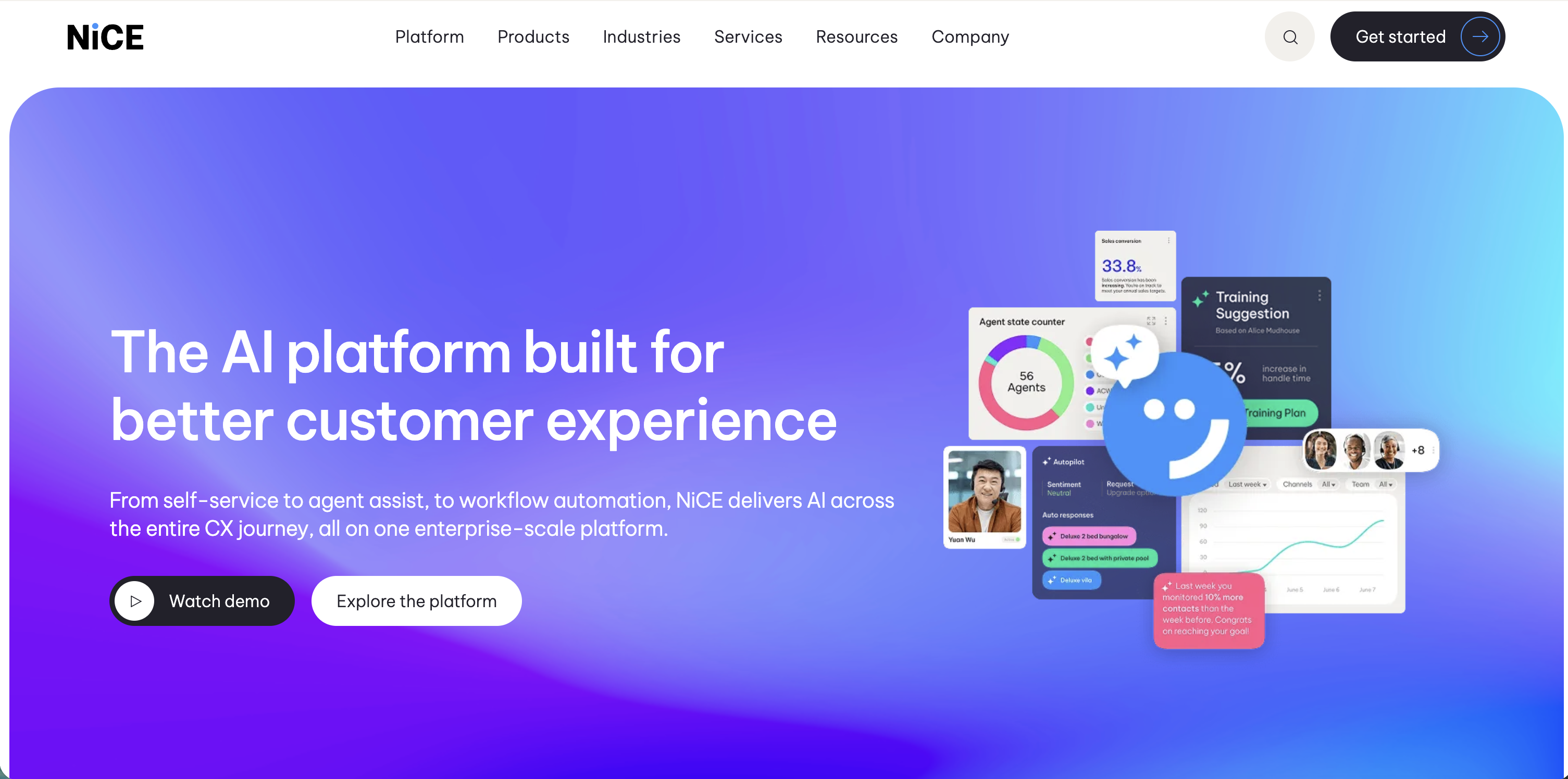
NICE CXone is best viewed here as a broader contact center platform that includes automated scoring capabilities. Buyers typically evaluate it when infrastructure standardization and suite breadth matter alongside quality management.
The key question is whether the scoring and coaching experience feels purpose built for quality leaders or mainly embedded within a larger platform purchase. That distinction shapes whether the tool will drive rapid performance improvement or provide a more general layer of oversight inside the suite.
This path can make sense for enterprises pursuing consolidation. It is less precise for buyers who want the buying process centered on automated QM and agent performance rather than on wider platform decisions.
Genesys Cloud CX
Genesys Cloud CX is often reviewed by organizations that already use Genesys for contact center infrastructure. In this guide, it belongs in the suite category where the central question is whether native scoring and analytics are sufficient for the maturity of the quality program.
A native option can simplify architecture and vendor management. Buyers should still test whether supervisor workflows and post transfer visibility give managers enough support to run continuous performance improvement instead of basic oversight.
This makes Genesys Cloud CX a practical option for teams that prefer to stay close to their existing stack. It may be less compelling for buyers who want quality management depth to be the primary decision driver.
Related: A guide to Genesys alternatives
How to choose between focused tools and suites
The right choice usually depends on the operating model you want to build. Focused tools often make the strongest case when leaders want automated scoring to directly change coaching quality, manager workflows, and performance visibility across the operation.
Suites often make more sense when vendor consolidation or shared administration matters most. They can reduce architectural complexity, but buyers should verify that convenience does not come at the cost of slower supervisor workflows or weaker links between scoring and action.
For teams that use both automation and human agents, one more question matters during evaluation. Leaders should confirm whether context carries forward when work moves from automation to a person and whether the business can measure performance across both instead of optimizing each in a separate workflow.
Making the right choice
The return from automated quality management can be substantial, but implementation risk is real. The biggest gains usually come when organizations treat automated scoring as part of an operating model change rather than as a standalone software purchase.
Many failed pilots trace back to weak baseline processes rather than technology alone. When evaluation criteria are inconsistent, coaching routines are unclear, or managers still need to manually recheck every exception, automated scoring has a harder time earning trust.
Before selecting a platform, leaders should confirm that scoring covers the channels they care about, that outputs feed directly into coaching workflows, and that the vendor can connect quality signals to outcomes the business already measures, such as first call resolution, conversion, retention, and customer satisfaction. Teams that combine automation with human support should also validate how context is preserved when conversations move from one to the other.