
After-call work (ACW): what you need to know
.avif)

- After-call work (ACW) is the notes, codes, record updates, and follow-ups an agent handles before they're ready for the next call
- To measure ACW, divide total ACW time by calls handled, then compare each call type against your own baseline so you're tracking real change
- You can reduce ACW by removing duplicate entry, simplifying codes, automating complex processes end-to-end, and more
Once a customer hangs up, the agent's job likely isn't done. They’ll have notes to write, codes to pick, and messages to send before the next call can start.
That stretch of time is called after-call work, or ACW. It shapes your support team’s handle time and queues and the quality of the records your team leaves behind.
To help you minimize ACW, we’ll break down how you can reduce it without hurting your support quality. But first, let’s align on what it is and why it’s so critical.
What is after-call work (ACW)?
It’s the work an agent finishes after a customer interaction ends. It includes tasks like writing notes, choosing a wrap-up code, updating the customer record, and setting up follow-ups.
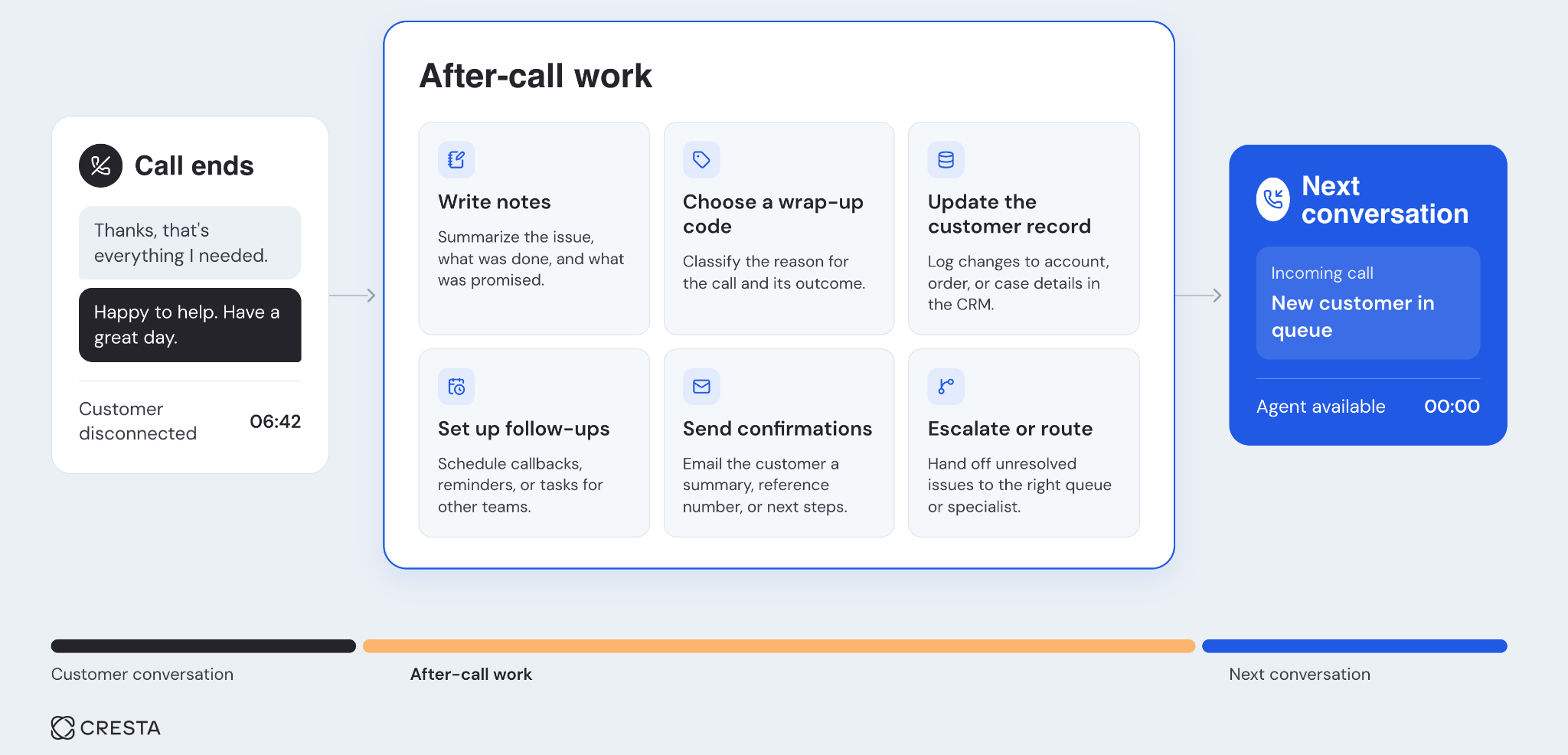
ACW goes by a few other names. You'll hear wrap time, wrap-up time, and post-call processing. In chat, email, and messaging, it's often called after contact work. Regardless of its name, the idea stays the same across channels: ACW is the bridge between the conversation that just ended and the next customer in the queue.
How to calculate after-call work
To find your ACW, add up all ACW time for a period, then divide it by the number of calls handled in that same period.
.png)
To bring this to life, let’s say a team of 5 agents handles billing calls on a given workday (our “period”).
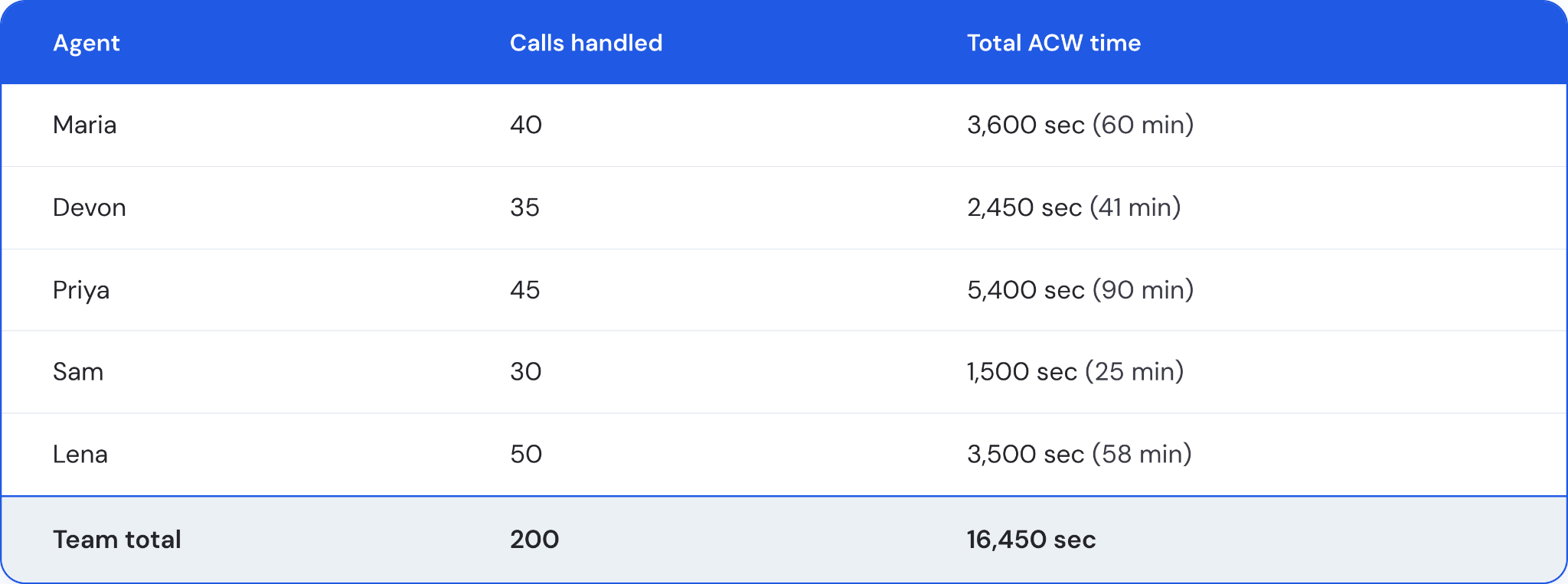
1. Add up all the ACW time for the day. Since the five agents logged 3,600, 2,450, 5,400, 1,500, and 3,500 seconds, your total comes out to 16,450 seconds.
2. Divide that total by the 200 calls the team handled in the same period. That gives you 82 seconds per call, or 1 minute and 22 seconds.
3. You can go a step further and calculate the average ACW per agent by dividing their total ACW time by their calls handled in that period. This lets you compare their ACW to the rest of the group.
It’s worth noting there's no universal standard for a good after-call work time. It depends on your industry, call complexity, and compliance rules, so a password reset and a disputed insurance claim shouldn't share a target.
Your best benchmark is your own baseline, tracked by call type over time.
Why after-call work matters
ACW affects how fast customers reach an agent and how much context the next agent has. It also affects how your team copes with tough conversations.
Here's a closer look at why it's so important:
- It heavily influences average handle time (AHT). AHT includes talk time, hold time, and ACW, so a longer wrap-up raises it directly. A higher AHT means each agent handles fewer interactions per hour; in other words, they have less capacity
- It affects service level and queue wait times. Agents can’t take new calls while in ACW, so long wrap times leave customers waiting longer in the queue. Customers will inevitably get frustrated before they reach an agent, and some hang up. That can leave issues unresolved, lead to repeat contacts, and lower satisfaction scores
- It can affect the quality of the ACW itself. When agents have to manually update records, schedule follow-ups, and complete other wrap-up tasks, they can easily forget steps or or make mistakes. That makes it harder for colleagues to pick up the work and act on it
- It impacts agent engagement and attrition. When wrap-up drags on because of heavy documentation or slow systems, agents spend more of their day on admin and less on helping customers. That can frustrate them, cause them to disengage, and push them to leave sooner than you would like, which is an expensive outcome
How to reduce after-call work
The best strategies for lowering ACW involve a combination of process fixes and adopting AI.
Remove duplicate data entry
Duplicate entry is the easiest waste to spot. If agents type the same customer details into several systems, they lose time on every call.
Connect your phone system and CRM so caller details, call reason, and history fill in automatically. Prefilled fields mean agents confirm information instead of retyping it.
Standardize wrap-up codes and templates
Long, overlapping code lists slow agents down and create messy data. Agents can end up picking whatever's closest, or whatever's at the top.
.png)
To that end, polish up your code list by:
- Only keeping the codes that drive reporting or routing decisions
- Using plain labels so agents don't have to guess between similar options
- Giving agents a simple structure, like reason, resolution, and next step
- Retiring codes nobody uses and merge the ones that overlap
Provide real-time guidance during the call
Real-time guidance tools can use AI to surface next steps, pull up the right knowledge, and capture key details as the conversation happens. This can not only accelerate their after-call work but also make their calls more successful.
.png)
Coach on ACW without punishing agents
Use ACW data to find patterns, not to punish agents.
Look for agents, teams, or call types with unusually high wrap time, then dig into why. High ACW often has a clear cause. An agent may not know a shortcut, may be unsure of a process, or may be handling harder calls than their peers.
Coach the behavior behind the measurement. Showing an agent a faster way to log a refund, for instance, helps more than telling them to hurry up.
Build workflow automations for complex follow-up work
Some ACW tasks span several systems and teams, and they can stall for days.
A long-running AI agent can now carry out these long-running workflows until they're done.
A workflow automation can start during the call, from a handoff, or from a back-office queue with no call at all. The automation also keeps track of its progress, and if it needs a document or an approval, it pauses, then resumes where it left off instead of starting over.
.png)
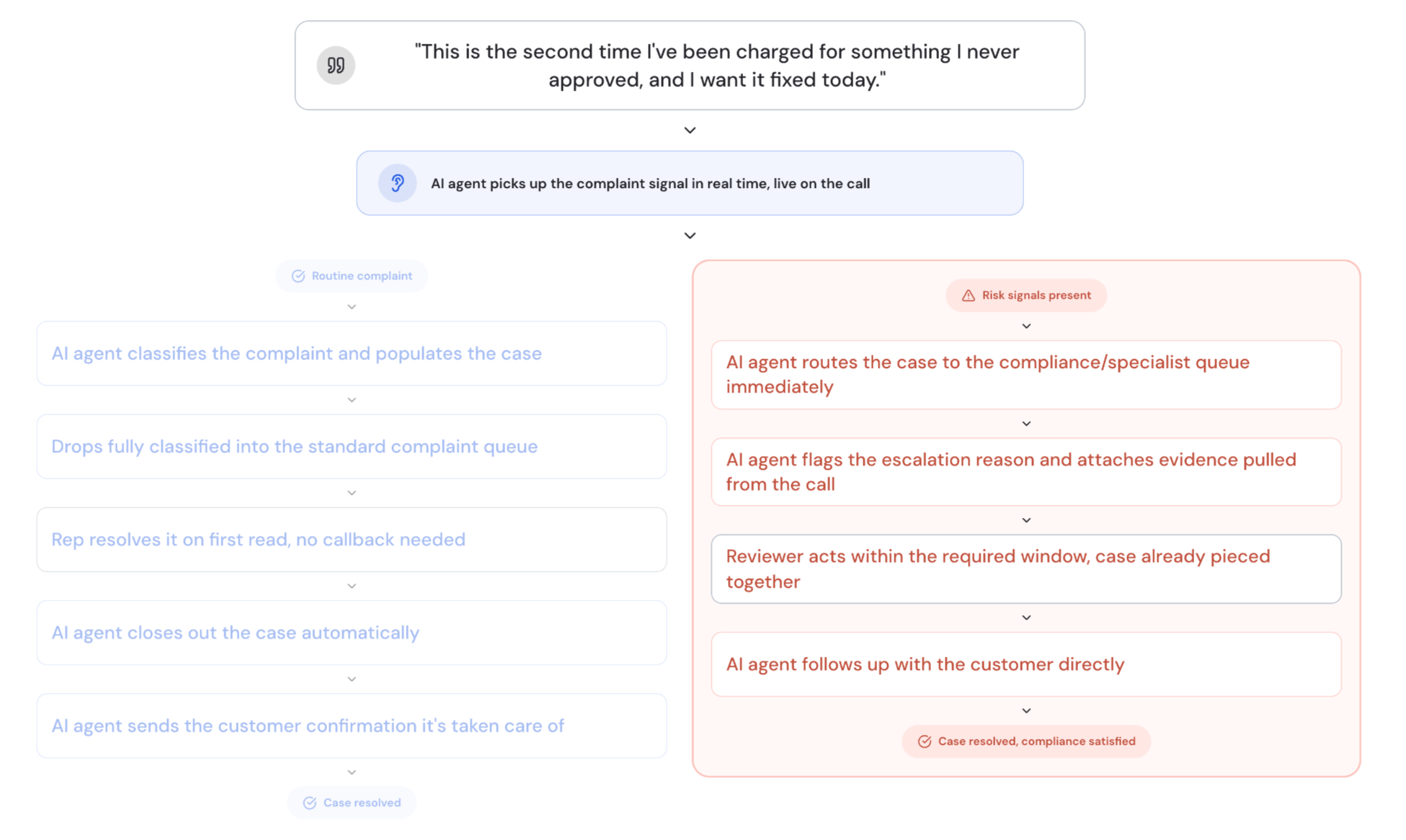
For example, imagine your support team fields calls on billing errors, late fees, and payment disputes.
The moment certain words are spoken related to those areas, a long-running AI agent listening on the call can pick up the complaint signal in real time.
Based on the sentiment detected, the AI agent can execute either of the following:
- If the billing complaint is routine, the AI agent drops the case into the standard complaint queue fully classified and populated, so the next available rep can resolve it on first read. Once the rep resolves it, the AI agent closes the case and sends the customer confirmation that it's been taken care of
- If the complaint carries risk signals, like a mention of fraud, a threat of legal action, or a repeat unresolved issue (e.g., getting repeat charges on an unapproved transaction), the agent routes it down the right escalation path immediately. Sometimes, this happens before the call even ends, and it drops the case directly into the compliance or specialist team's queue.
The long-running agent flags the reason for escalation and attaches evidence from the call, so a reviewer can act within the required window instead of spending that time piecing the case together. The agent then follows up with the customer on its own, before the situation has a chance to escalate further.
Automate after-call work with Cresta Deputy Agent
Cresta Deputy Agent is a long-running AI agent for customer operations. It takes on the follow-up work behind a call and stays with it until the workflow is complete. That means agents can close the call without carrying refunds, disputes, or claims into wrap time.
Deputy Agent works alongside the rest of the Cresta platform.
For example, it works hand in hand with Agentic Assist, Cresta’s real-time guidance solution for agents.
During a call, Agentic Assist can guide agents and capture key details. If work remains when the call ends, such as a refund request, Agentic Assist hands it to Deputy Agent along with the full context. Deputy Agent then finishes the work, checking records, getting approvals, and updating systems so the agent can move on to the next customer.
See how Cresta Deputy Agent can take follow-up work off your agents' plates by requesting a demo.