
13 strategies to improve contact center agent performance


- Focusing on efficiency metrics like handle time while ignoring quality pushes agents to rush, leaves problems unsolved, and keeps turnover high
- Don't focus only on the bottom tier: your middle performers are usually the largest group, so small gains there spread across the most conversations
- Schedule brief weekly coaching tied to recent conversations, since feedback that arrives months later is hard for agents to act on
- Agent experience is an operational lever: tools that reduce cognitive burden and connect feedback to development make it easier for agents to stay and improve
Agent performance shapes customer satisfaction, controls costs, determines whether you hit revenue targets, and influences whether your best people stick around or burn out.
But maintaining and improving their performance is often difficult, especially as your team scales.
To help you improve contact center agent performance effectively, we'll align on a shared definition, show how to measure it, and walk through strategies that target root causes.
What is contact center agent performance?
It’s how effectively an agent resolves customer needs. This is measured across efficiency and quality.
Operational efficiency covers the basic mechanics of getting work done. Quality drives long-term business outcomes.
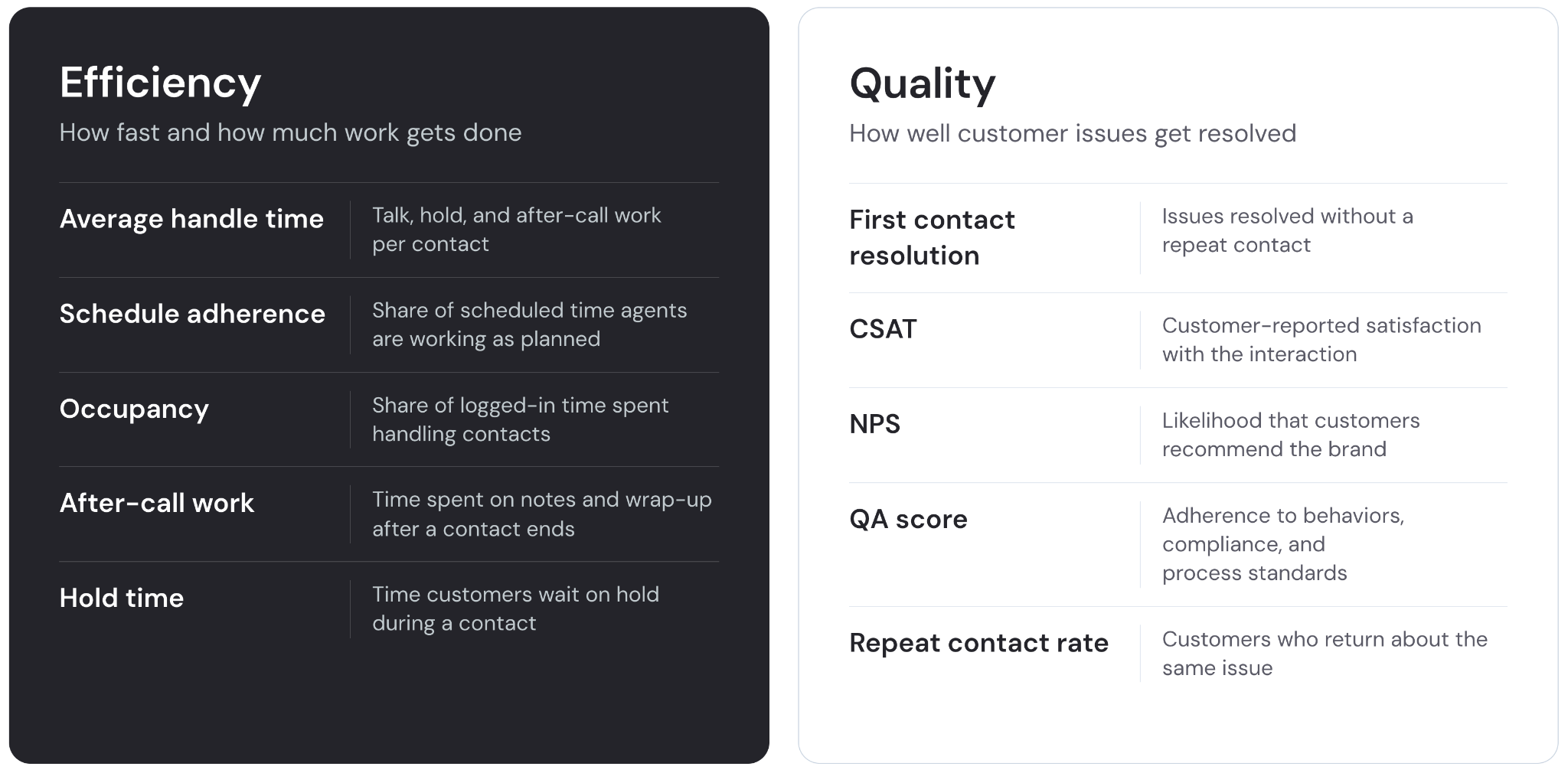
There’s an inherent trade off.
Agents that focus heavily on efficiency may sacrifice the quality that determines whether customers stick around or leave; while agents that over-index on quality may leave many frustrated customers waiting in the queue.
Your contact center needs to optimize for both, and our strategies presented later in this guide can help.
How to measure contact center agent performance
Before you can improve agent performance successfully, you need the full picture of how they’re doing.
You can gauge their effectiveness across four categories in your performance scorecard:
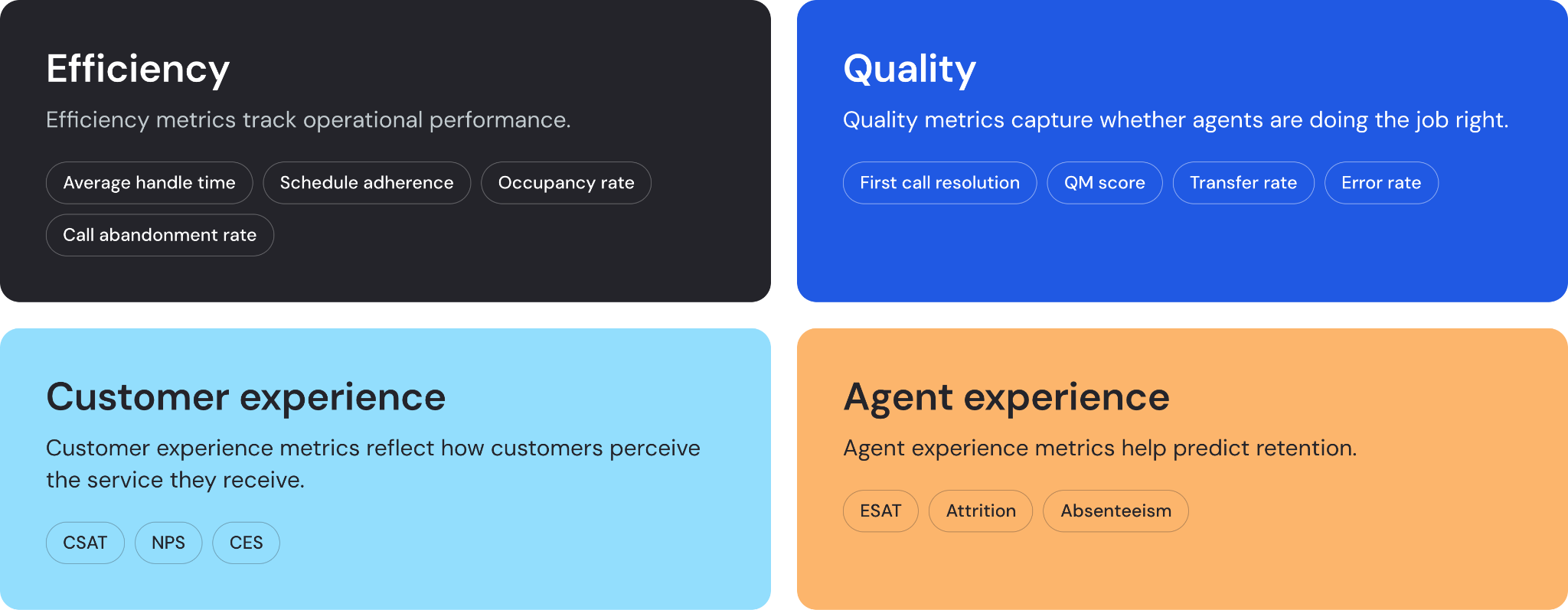
- Efficiency metrics track operational performance. Average Handle Time (AHT) is the most important metric; it measures total interaction duration including talk time, hold time, and after-call work. Schedule adherence, occupancy rate, and call abandonment rate round out this category
- Quality metrics capture whether agents are doing the job right. First call resolution (FCR) is a common example; it measures whether an agent solves a customer's issue completely during the first interaction. For context, SQM Group puts the industry FCR benchmark average at 71%. Beyond FCR, you can use quality management (QM) scores, transfer rate, and error rate
- Customer experience metrics reflect how customers perceive the service they receive. These include Customer Satisfaction (CSAT) score, Net Promoter Score (NPS), and Customer Effort Score (CES)
- Agent experience metrics, such as agent satisfaction (ESAT), attrition, and absenteeism, help predict retention. Turnover drains tenure, and every replacement restarts the ramp to proficiency, so this is a critical area to keep a pulse on
How to improve contact center agent performance
These strategies tackle the root causes of poor performance rather than just treating symptoms.
Technology and tools
The first few strategies cover the tools agents rely on during and after every conversation.
1. Quality management that analyzes every conversation
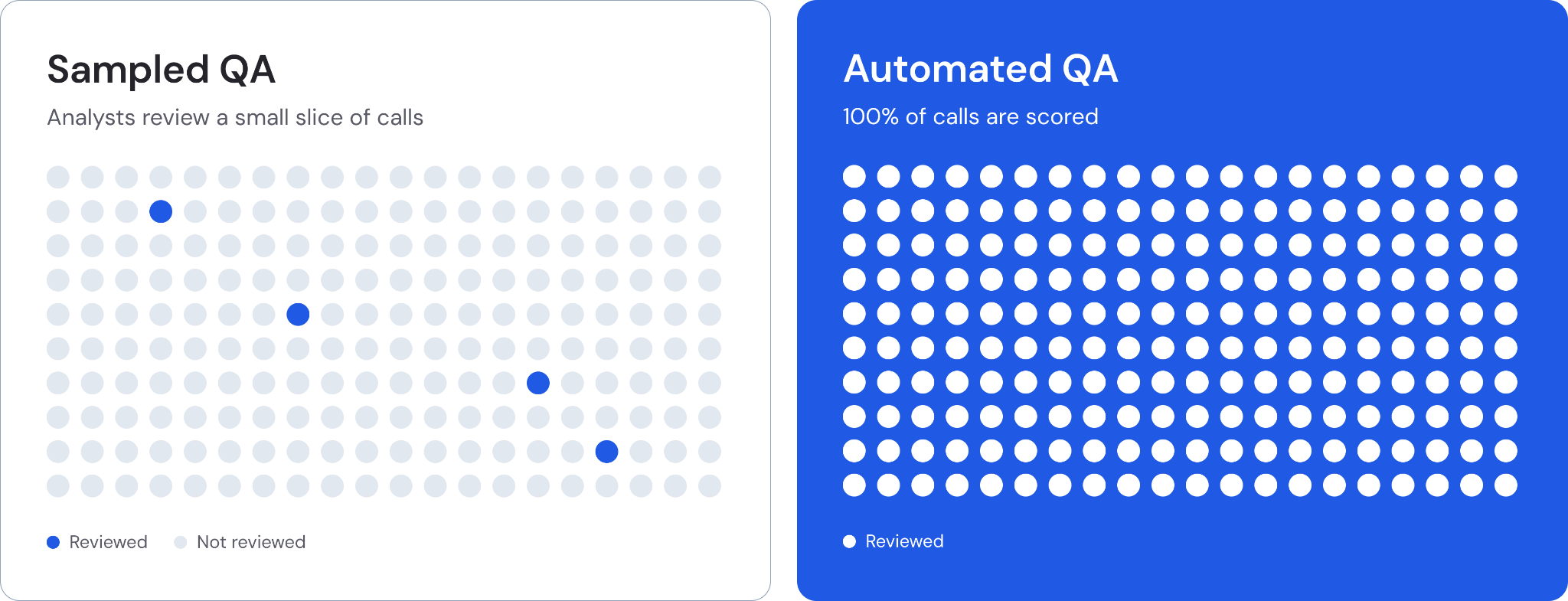
According to SQM Group's QA research, manual QA typically covers less than 2% of calls. Supervisors can only manually listen to so many recordings.
A machine learning-powered quality management solution changes this by analyzing every conversation automatically, scoring interactions against your rubrics and spotting patterns across your entire operation.
Related: How to scale quality management and coaching
2. Real-time agent assistance and knowledge delivery
Real-time agent assist surfaces answers during live conversations, drawing on your knowledge bases, CRM, help desk tools, and more. This lets agents avoid digging through the tools manually and leave the customer on the other line waiting.
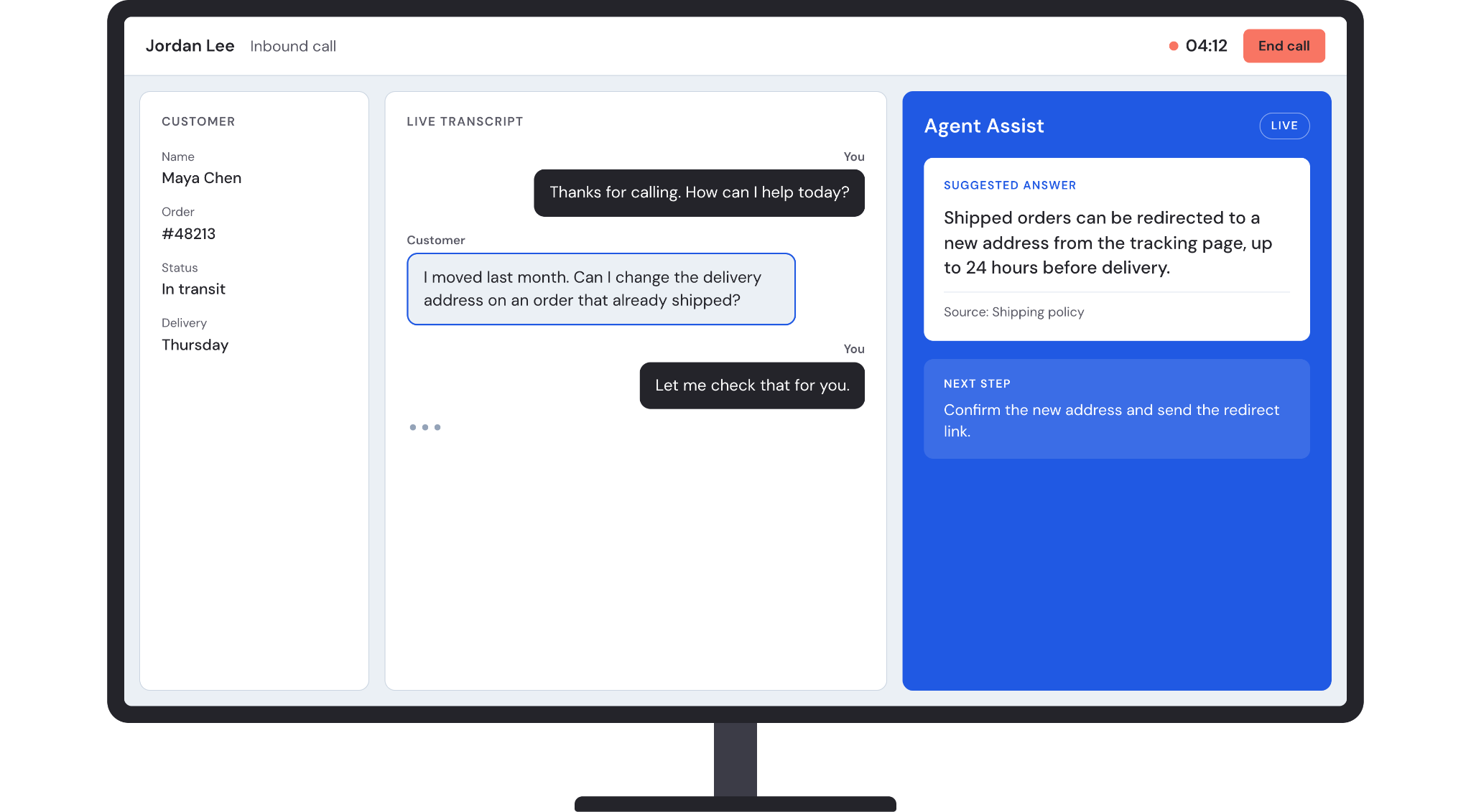
Depending on the vendor, an agent assist tool could also provide:
- Real-time guidance across voice and digital channels
- Behavioral guidance for specific situations (e.g., a customer threatens to cancel)
- Chat efficiency tools to minimize keystrokes so chat agents can handle multiple conversations at once
3. After-call work automation
After-call work (ACW), like record updates, call notes, follow-up emails, and transaction processing, all pull agents away from the next customer in the queue.
They also likely involve several teams, which can end up making the work time consuming, error prone, and lengthy (the use case below is a good example).
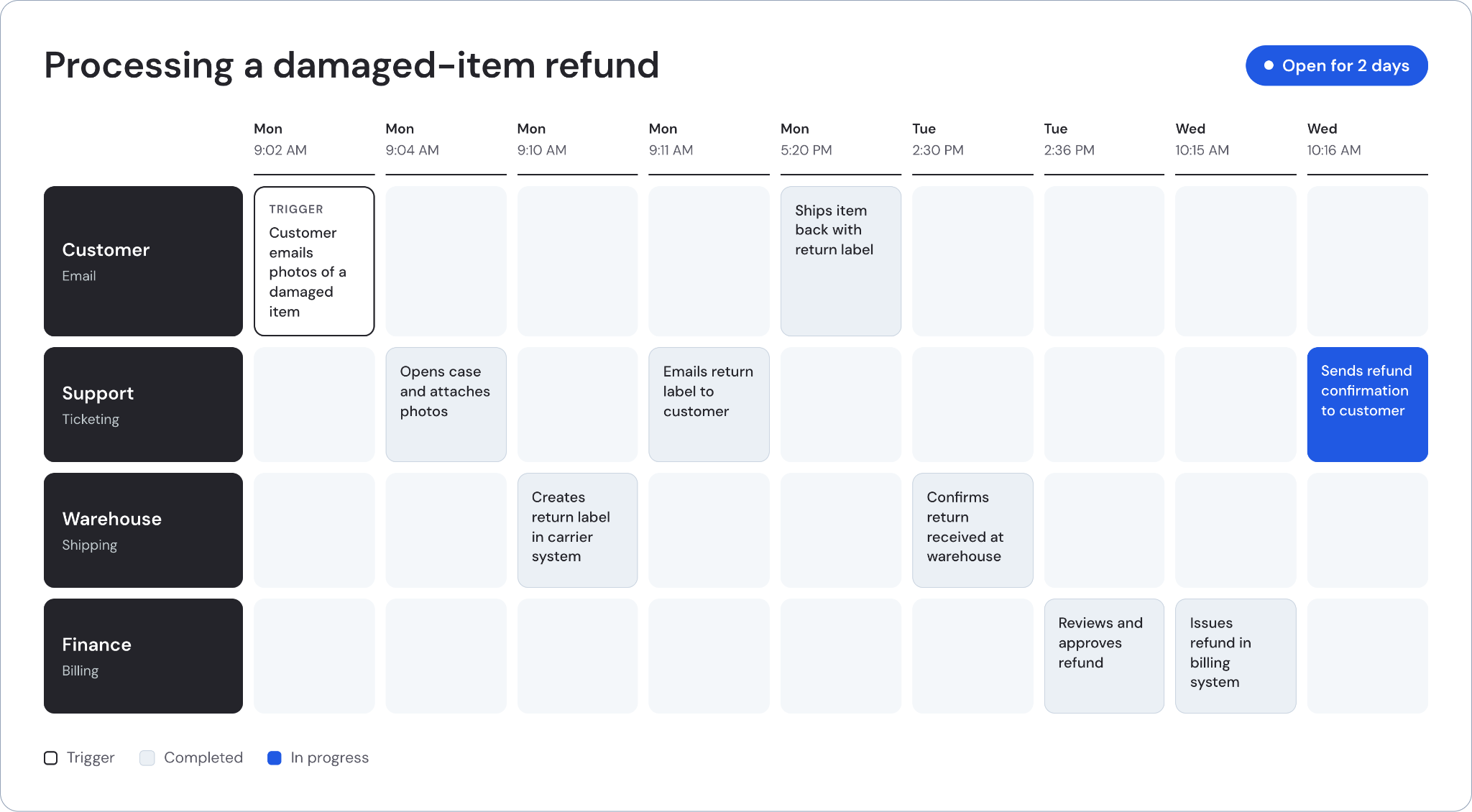
Look for a solution that offers a long-running AI agent. The AI agent should be able to pick up the work when the call ends and carry it across systems and teams until it’s done, so your agents can move straight to the next customer.
4. A connected contact center technology stack
Agent performance suffers when quality management, coaching, agent assist, analytics, and automation tools operate in isolation.
Agents end up bridging the gaps themselves, such as re-entering information across systems. Supervisors aren’t any better off. They have to piece together scorecards, call recordings, and dashboards by hand, so coaching is slow and rarely tied to what’s happening on the floor.
A unified platform changes that.
Conversation intelligence, QM, real-time agent assist, and a long-running AI agent all draw from one data foundation built on 100% of customer conversations. Insights from call analysis shape coaching, coaching shapes the guidance agents see live, and after-call work is handled automatically once the conversation ends.
Agent development and retention
Tools only go so far without skilled, motivated people using them, so the next five strategies focus on developing and keeping human agents.
5. Coaching workflows connected to performance data
The most effective call center coaching feedback examples use QM scores to pinpoint exactly which skills each agent needs to work on. Ideally, your managers can reference actual conversations that highlight where the human agent falls short so their feedback is tangible.
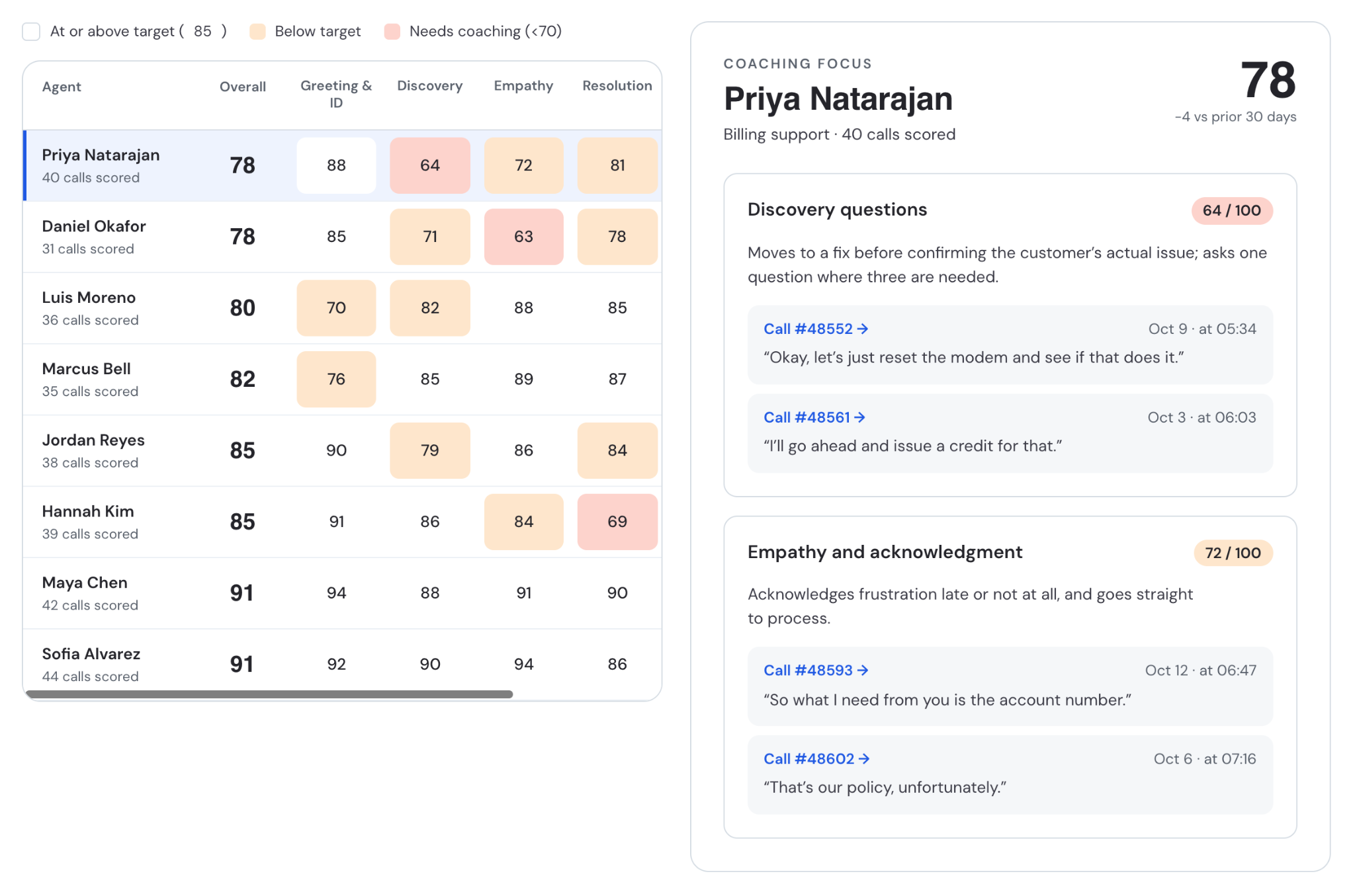
Your managers should also plan to hold brief, frequent coaching sessions so that the feedback stays fresh. Gallup's research on manager feedback finds weekly, meaningful conversations support engagement, and 15 to 30 minutes is enough.
Related: Contact center coaching guide
6. Structured training and onboarding programs
While coaching refines existing skills, training builds the foundational knowledge agents need before they ever take a live call.
Onboarding is particularly important.
Case in point: McKinsey's analysis of contact center learning found that new hires need about four to six months to reach peak proficiency. That ramp costs 5% to 10% of total agent cost allocation. That said, the upfront investment pays for itself through lower early-stage attrition and faster paths to competent performance.
Effective onboarding requires giving agents repeated practice with realistic customer scenarios, so they learn to listen before responding, acknowledge customer emotions, and work through objections.
You can then reinforce those behaviors with targeted coaching and clear evaluation criteria. And let agents retry scenarios as many times as they need, while supervisors track progress and confirm readiness before agents go live.
That foundation then needs ongoing reinforcement, since product changes, policy updates, and seasonal shifts all demand continuous learning.
7. Gamification and recognition programs
COPC's research on contact center retention finds compensation alone has a limited impact on turnover, compared with recognition quality, growth opportunities, and the work environment. It highlights Gallup and Workhuman data: employees who got high-quality recognition were 45% less likely to have left their job over two years.
Gamification is a practical way to deliver that recognition consistently. Use points, badges, leaderboards, and other playful forms of “recognition” but tie them to specific, measurable behaviors, such as resolving a complicated issue or showing empathy with a difficult customer.
8. Address agent burnout and wellness
Agent burnout typically manifests as emotional exhaustion that leads to cynicism toward customers and reduced effectiveness over time.
One pattern that catches leaders off guard is agents reporting burnout while simultaneously showing high idle time. That usually points to scheduling problems or uneven workload distribution rather than too much work.
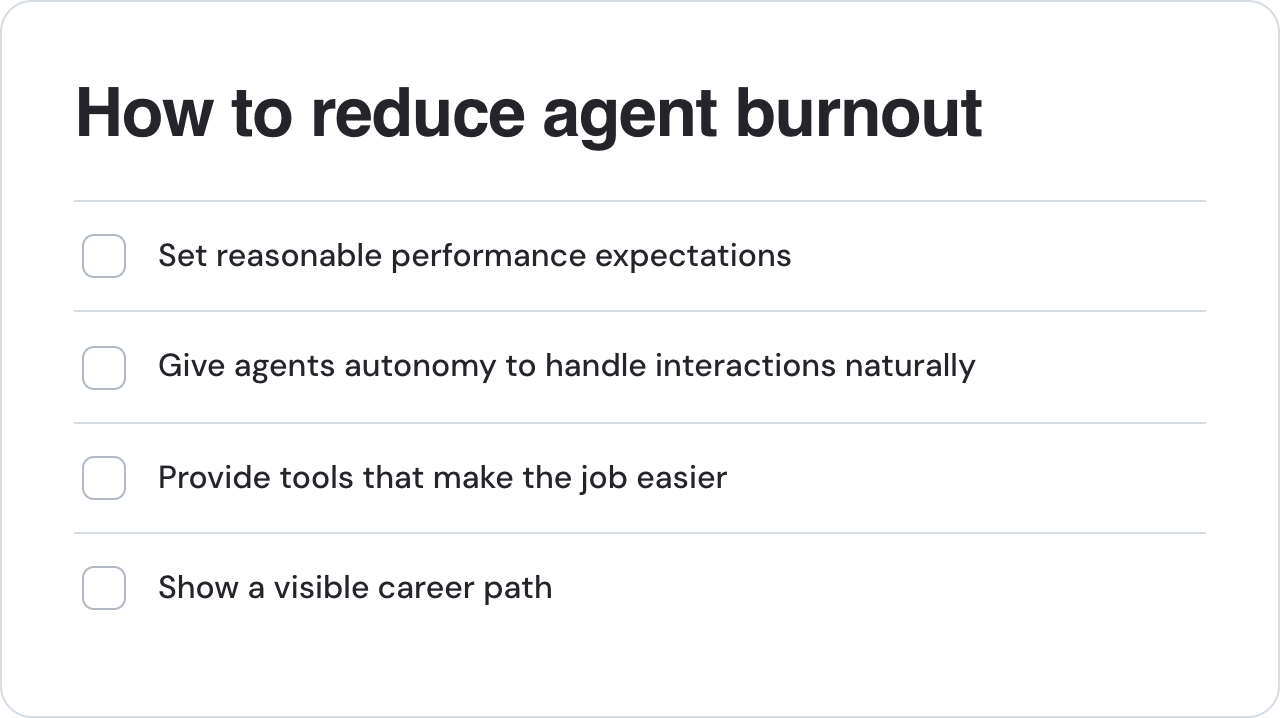
Preventing burnout comes down to a few essentials. Agents need reasonable performance expectations, enough autonomy to handle interactions naturally, tools that make the job easier, and a visible path forward in their career. When those conditions are missing, even well-scheduled agents burn out.
Cresta’s case study with Holiday Inn Club Vacations is a good example of how the right tooling can help. Using Cresta's real-time assistance and coaching with live agents, the organization’s agent satisfaction rose from 47% to 70%, and agent attrition fell from 120% to 60%.
9. Transparent career development pathways
Many agents see contact center work as a dead-end job, and that mindset contributes directly to high turnover.
Provide documented career ladders to show how someone can progress from agent to specialist, team lead, quality analyst, trainer, or manager. And offer transparent promotion criteria tied to performance metrics to turn an abstract promise into something tangible.
Operational processes
The last 3 strategies cover the operational processes that connect tools and people across the operation.
10. Workforce engagement management systems
Workforce Engagement Management (WEM) connects operational functions that are typically managed in silos, from scheduling and forecasting to performance tracking, quality management, and coaching.
When these systems work together, forecasting data informs scheduling, scheduling data feeds into performance tracking, and performance patterns trigger coaching workflows.
Scheduling and forecasting are typically handled by dedicated workforce management tools rather than by any single AI platform. Making sure these systems connect to your quality and coaching workflows ensures insights flow in both directions.
11. Customer self-service and deflection strategy
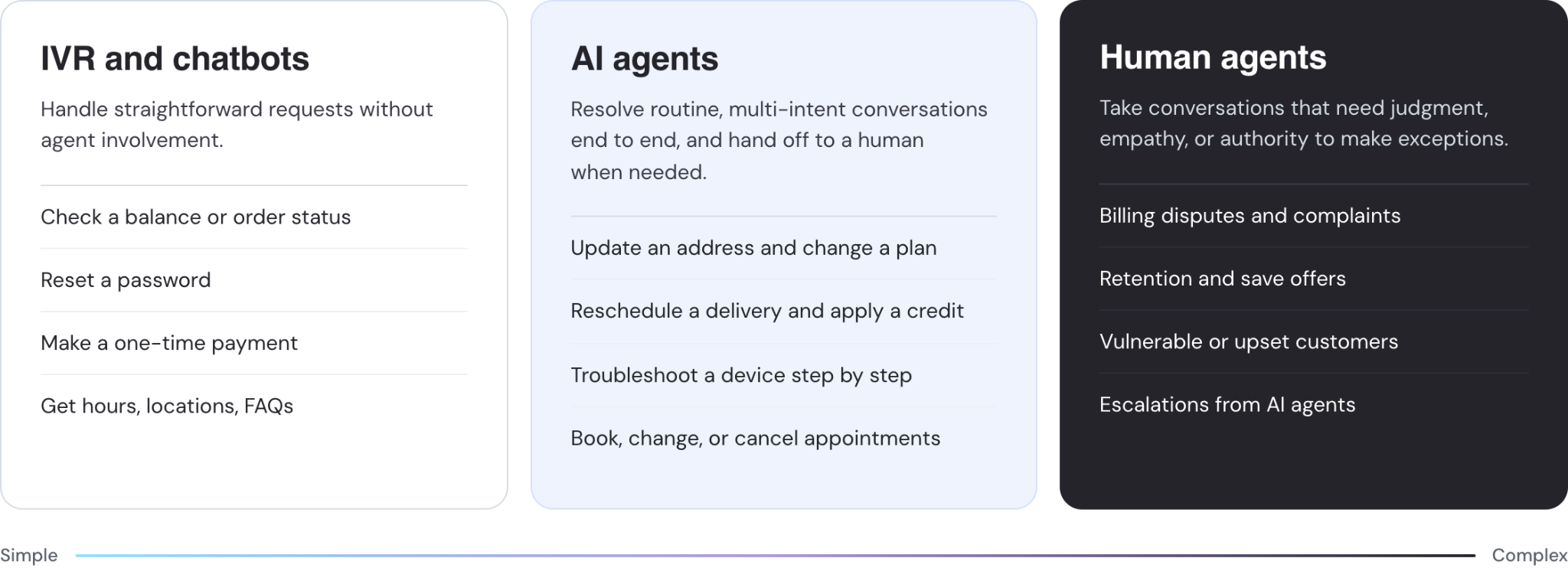
When contact centers successfully deflect low-complexity interactions to self-service channels, agents spend less time on repetitive questions and more time on complex problems that benefit from their skills. Well-designed IVR systems and chatbots can handle straightforward requests without agent involvement. For multi-intent conversations, AI agents can resolve routine requests end to end and hand off to a human when needed.
The challenge is knowing which interactions to automate. Score automation candidates by volume, flow complexity, and resolution rate before you automate.
12. Performance management for remote and hybrid teams
Distributed work introduces specific challenges for coaching visibility, consistent quality standards, and equitable treatment. Remote agents may have fewer informal learning opportunities and less access to peer support, and supervisors can't walk over and listen to a conversation or offer quick guidance between calls.
QM systems that analyze 100% of conversations are especially valuable in remote environments because they eliminate the visibility gap between on-site and remote agents. Real-time agent assistance tools fill the remaining gap by providing in-the-moment guidance that remote agents might otherwise miss.
13. Give every level of the contact center the right view
Each level makes different decisions on a different timeline. Supervisors generally coach and adjust daily, leaders spot trends over weeks, and executives set strategy over months.
With this in mind, look for reporting that can be tailored to each role, all drawing from the same underlying data:
- Supervisors: daily visibility into quality scores and adherence, so they know who to coach and when
- Contact center leadership: weekly views that connect efficiency, quality, and agent experience trends
- Executives: monthly or quarterly summaries that tie contact center performance to business outcomes like revenue and retention
Because everyone works from one source of truth, the numbers match across levels, and a trend an executive sees can be traced back to the conversations behind it.
Improve agent performance across every conversation with Cresta
Cresta, the AI operating system for CX, can help support all of the strategies above.
The platform offers:
- Agentic Assist, which augments agents with real-time guidance, knowledge, and summaries during live conversations
- Deputy Agent, a long-running AI agent that automates your most complex, ACW operations
- Conversation Intelligence, which analyzes 100% of conversations so leaders can see what top performers do differently
- Cresta Quality Management, which scores every conversation. Cresta also powers Cresta Coach to turn those insights into targeted coaching
Request a demo to see how Cresta can help your team raise performance on every conversation.