
How to Improve First Call Resolution: Proven Techniques
.avif)
• FCR is one of the few metrics that connects cost and customer experience in a single number. When agents resolve issues on the first interaction, repeat contacts drop and satisfaction improves at the same time, making it one of the most reliable levers in a contact center.
• Most FCR failures trace back to the same root causes: poor knowledge access during live conversations, agents lacking the authority to resolve issues without unnecessary escalations, and customers landing with the wrong agent for their issue type.
• The fastest path to improvement is giving agents the ability to actually solve problems themselves. That means reducing unnecessary approval requirements, improving real-time knowledge access, and routing interactions to the agents best equipped to handle them from the start.
• Accurate measurement is harder than most teams realize. How you define the metric, whether you count across channels, and what counts as a repeat contact all affect the number significantly and need to be consistent before you can track improvement over time.
First call resolution stands out among contact center metrics because it improves both efficiency and satisfaction at the same time, reducing costs while making customers happier.
Yet knowing what FCR is and measuring it isn't enough on its own. Many contact centers track the number without understanding what actually moves it. To improve FCR, you need to dig into what's causing repeat contacts and put techniques in place that address those root causes.
This article covers what FCR is and why it matters, how to calculate and measure it accurately, how to set benchmarks and realistic goals, which companion metrics to track, what causes FCR to drop, and the proven techniques that drive real improvement.
What is first call resolution and why it matters
First call resolution measures whether your agent solved the customer's problem on the first try, without needing a callback.
This metric matters because it directly affects both your budget and your customer relationships. When FCR goes up, operating costs tend to go down and customer satisfaction tends to go up, usually by about the same amount. That makes FCR pretty unusual among contact center metrics, which typically force you to choose between efficiency and quality.
Even so, many contact centers don't measure FCR consistently. That's a big blind spot if you're trying to improve both costs and customer experience at the same time.
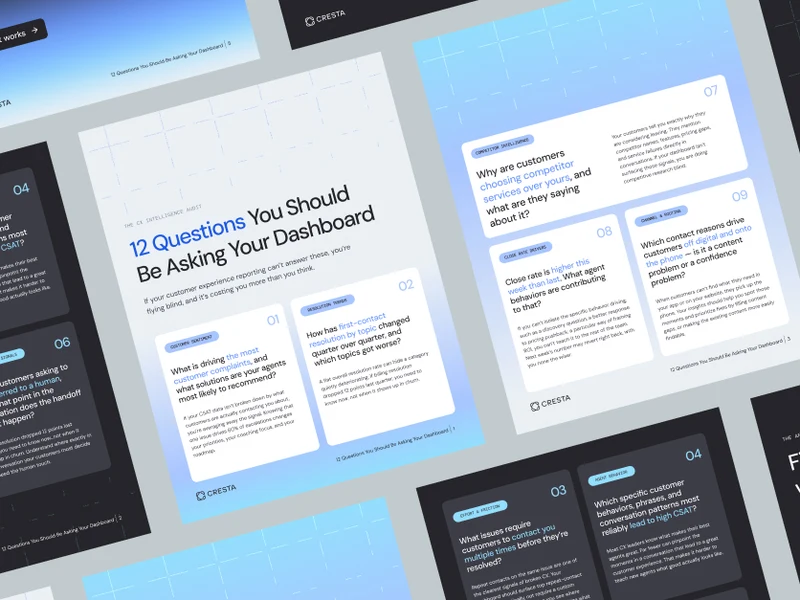
Find what drives repeat contacts by asking your dashboard these questions
How to calculate first call resolution
The standard FCR formula is straightforward.
(Issues resolved on first contact ÷ Total issues) × 100 = FCR rate
So if your team handled 1,000 issues last month and 720 were resolved without a callback or follow-up contact, your FCR rate would be 72%.
While the math is simple, the real challenge lies in defining what counts as "resolved" and how you identify repeat contacts. These measurement method choices create significant differences in the numbers you see, which is why the next section on measurement approaches matters just as much as the formula itself.
How to measure first call resolution accurately
Contact centers typically measure FCR using one of three methods, and each one produces meaningfully different results.
CRM or case-based tracking flags any new contact from the same customer within a defined window as a potential repeat. This method is easy to automate but tends to overcount failures. For example, a customer who calls Monday about billing and Friday about shipping gets logged as an FCR failure even though both issues were resolved on first contact. Conversation intelligence that can match topics across interactions helps close that gap, giving you the true repeat contact rate rather than a noisy proxy.
Post-interaction surveys take a different approach by asking customers directly whether their issue was resolved. This captures the customer's perception, which is what ultimately drives satisfaction and loyalty. The downside is low response rates, often in the single digits, and a bias toward customers with extreme experiences.
Agent-verified resolution, the third method, has the agent confirm with the customer at the end of the interaction whether the issue is fully resolved. This captures real-time feedback but can be influenced by social pressure, where customers say "yes" to end the call even when the issue isn't truly resolved.
Because each method captures something different, internal CRM tracking and customer-reported measurement often produce different FCR numbers. Understanding that gap matters because it shapes whether your improvement efforts target the right problems.
What to measure alongside FCR
FCR doesn't exist in a vacuum. Other metrics interact directly with resolution rates, affecting FCR while FCR affects them back, and understanding those relationships helps you avoid improving one number while making everything else worse.
Resolution metrics
- First call resolution rate, measuring the percentage of issues resolved on the first contact
- Repeat contact rate, tracking how often customers reach out again about the same issue
- Transfer rate, showing how frequently calls get passed between agents or departments
Transfers and hold time are often strong signals that customers are less likely to get full resolution on the first contact. These operational factors represent significant and measurable drags on resolution rates.
Efficiency metrics
- Average handle time, measuring the length of customer interactions
- Average speed of answer, tracking how long customers wait before reaching an agent
- Abandonment rate, showing how many customers hang up before connecting with an agent
Quality and satisfaction metrics
- Customer satisfaction scores, capturing how customers feel about their experience
- Quality scores, evaluating agent performance against your standards
- Post-interaction survey results, validating whether customers believe their issue was actually resolved
What makes tracking these metrics together so important is that they reveal where you might be creating problems for yourself. When you push too hard on speed metrics without quality controls, agents rush through conversations and don't fully address what's really going on.
They might close cases as "resolved" when they're not, which makes FCR numbers look better even as repeat contact rates climb. That's why you need incentive structures that balance FCR improvement with quality metrics, a topic covered in more detail in the techniques section below.
What causes FCR to drop
It's tough to improve an FCR rate that's actively going down. If you're watching your numbers slide, you need to figure out the root cause before any improvement techniques will stick. In most environments, repeat contacts stem from a mix of policy constraints, process breakdowns, knowledge gaps, and communication issues.
More specifically, FCR drops often trace back to these operational problems.
- Disconnected technology systems that force agents to jump between multiple applications with separate logins and information that doesn't match up
- Outdated knowledge bases with content that contradicts current policies or products
- Process complexity from overly complicated procedures, policy restrictions, and approval workflows that require escalation after escalation
- Insufficient training that leaves agents without the product knowledge or technical skills to handle tricky issues
- Limited agent authority that stops agents from making decisions on issues they actually understand
- Weak knowledge management with poor search functionality, gaps in coverage for common issues, and not enough upkeep
A common thread runs through most of these problems. Agents lack what they need to resolve issues on the first try. Whether the barrier is outdated information, disconnected systems, or no authority to act, the result is the same. Customers call back, and your FCR numbers take a hit.
The techniques in the next section address these barriers directly, starting with AI-powered approaches that target the knowledge and system gaps on this list.
9 proven ways to improve first call resolution
Improving FCR means tackling both technology and agent capabilities. The following techniques deliver real results when you stick with them, and many reinforce each other when applied together.
1. AI-powered assistance and proactive knowledge delivery
Modern AI platforms directly improve FCR by surfacing precise answers and workflows in real time, without making agents hunt through disconnected systems. For complex scenarios, contextual guidance walks agents through proven resolution paths during live interactions.
Cresta Knowledge Agent takes a proactive, agentic approach to this. It continuously listens during conversations, identifying knowledge moments and delivering precise, cited answers at agents' fingertips with no searching required. By combining conversation awareness with on-screen context like account status, order history, and loyalty tier, it tailors guidance to each customer scenario. It also unifies fragmented knowledge sources, reduces transfers, and provides guided workflows that walk agents through the right process step by step.
Beyond knowledge delivery, conversation intelligence and automated quality management let teams see full performance patterns. Cresta Agent Assist adds real-time behavioral guidance and AI-generated summaries, while Cresta Coach turns insights into targeted coaching. Together, these capabilities address multiple FCR barriers simultaneously.
2. IVR optimization and call flow simplification
FCR improvement starts before a customer ever reaches a live agent. Poorly designed IVR menus and call flows force customers through unnecessary steps, increase transfer rates, and sometimes route them to agents who lack the skills to help.
By reviewing IVR menu architecture, simplifying navigation paths, and testing self-service options within the IVR, you can deflect simple inquiries and ensure complex issues reach the right place faster. Optimizing what happens before agent assignment reduces the volume of misrouted calls that would otherwise drag down FCR.
3. Self-service strategy for simple issues
Not every contact needs a live agent, and a well-designed self-service strategy can improve FCR even for the interactions that do. When customers can resolve simple issues through self-service channels like knowledge portals and well-designed chatbots, the customers who self-serve get faster resolution, and the customers who do reach a live agent tend to have genuinely complex issues that benefit from human judgment.
This concentrates agent effort where it matters most and can improve FCR for the assisted interactions that remain. The key is making sure self-service actually resolves the issue rather than creating frustration that leads to a follow-up call.
4. Continuous agent coaching and development
Your agents need ongoing coaching and recognition throughout their time with you, not just during onboarding. Top-performing contact centers reinforce this by using customer satisfaction and FCR as visible performance metrics, helping agents understand exactly what goals they are working toward.
That regular cadence of coaching keeps agents getting better instead of leveling off after their initial training. When agents receive steady feedback tied to resolution outcomes, they build the habits and skills that drive first call resolution over time. AI-targeted coaching suggestions that analyze behaviors and outcomes across every interaction can make this process even more effective, pinpointing exactly who to coach and what to coach them on and replacing guesswork with data.
5. Centralized knowledge management
Your knowledge management system needs to do more than just store information. It should give agents a central, searchable place to find what they need, with regular updates and checks for accuracy. Information should be organized for quick access with FAQs, troubleshooting guides, and step-by-step procedures that agents can pull up without losing the flow of the conversation.
When agents can find accurate information fast, they resolve issues on the first contact instead of putting customers on hold, transferring calls, or promising to call back. A significant share of FCR failures trace back to poorly maintained or poorly organized knowledge, making this foundational capability one of the highest-impact investments a contact center can make.
6. Root cause analysis for repeat contacts
Data-driven root cause analysis spots patterns in repeat contacts and turns those insights into systematic fixes. The best contact centers treat this as an ongoing discipline, using both customer and employee feedback to understand what's affecting FCR.
When you understand why customers are calling back, you can fix the real issues instead of just treating symptoms. Over time, this creates compounding improvements as each fix wipes out a whole category of repeat contacts. AI-powered conversation analytics that can analyze 100% of interactions makes root cause identification much faster than manual sampling, accelerating the whole cycle.
7. Agent authority and escalation design
Giving agents the authority to make decisions on issues they understand cuts out unnecessary escalations and callbacks. In practice, this means loosening policy restrictions, simplifying approval workflows, and trusting agents to resolve issues within clear boundaries.
Just as important, though, is designing clear escalation paths for situations where agents genuinely do need help. When agents can quickly connect with subject matter experts in billing or technical support without putting the customer on hold or promising a callback, many issues that would otherwise become repeat contacts get resolved on the spot. Cross-functional collaboration systems that give agents real-time access to other departments turn potential FCR failures into first-contact resolutions.
The payoff is twofold. Agents with decision-making authority resolve more issues on the first contact because they don't have to transfer calls or wait for a manager to weigh in. And customers get faster resolution while agents feel more ownership over outcomes.
8. Comprehensive training programs
Training that goes beyond initial onboarding builds deep product knowledge and real skill with your systems. Good programs also develop soft skills like active listening and problem-solving, the kind of capabilities that separate genuine resolution from rushed ticket-closing.
Agents who truly understand the products they support and the systems they use can resolve issues faster and more accurately. Strong training closes the knowledge gaps that force customers to call back when agents don't have the answers they need.
9. Incentive alignment and recognition
FCR improves faster when it's embedded in how agents are measured and recognized. Making FCR a visible part of agent scorecards, alongside quality and satisfaction metrics, gives agents clear goals to work toward, and recognition programs for high FCR performers reinforce the right behaviors.
The incentive design matters as much as the metric itself. Pairing FCR targets with customer satisfaction scores and quality evaluations creates accountability while discouraging the shortcuts described in the metrics section above. Agents respond to what's measured, so the measurement system needs to reward thorough resolution rather than speed alone.
When pushing FCR too hard backfires
All of these techniques push FCR in the right direction, but pursuing first-contact resolution too aggressively can create its own problems.
Some issues legitimately require multiple contacts. Complex technical problems, cases that need investigation, and situations requiring third-party involvement shouldn't be artificially compressed into a single interaction just to hit a target.
Excessive pressure leads to shortcuts. When agents feel pressure to resolve everything in one touch, they may:
- Skip important verification steps
- Provide incomplete answers that technically close the case but leave the underlying issue unaddressed
Track customer effort scores alongside FCR to spot situations where the push for first-contact resolution is actually degrading the experience. The goal is always genuine resolution, not just closing cases faster.
Start improving your FCR with AI assistance
Improving FCR comes down to giving agents what they need to resolve issues on the first try. That means better training, accessible knowledge, smart routing, and the authority to make decisions. But building and maintaining all of that manually takes a lot of time and effort.
The Cresta platform speeds up FCR improvement by tackling multiple root causes at once. Cresta Knowledge Agent proactively delivers precise, cited answers during live conversations so agents can resolve issues without transfers, holds, or callbacks. The platform's Conversation Intelligence auto-scores 100% of interactions for compliance and quality, giving managers visibility into what successful resolution actually looks like. And Cresta Coach closes the loop on agent development by turning those insights into targeted coaching recommendations.
Rather than addressing FCR barriers one at a time, these capabilities work as an integrated system where knowledge delivery, performance visibility, and coaching reinforce each other.
Visit our resource library to learn more about improving contact center performance, or request a demo to see how Cresta Knowledge Agent can boost your FCR rates.