Back to all guides
Competitive Comparisons

4 Best Observe.AI Alternatives for Contact Centers

TL;DR: Observe.AI handles post-call conversation intelligence and automated QA well, but contact centers that need real-time guidance during live calls, integrated AI agent automation, or a full infrastructure replacement often outgrow it. Cresta stands out if you want real-time coaching combined with autonomous AI agents and conversation intelligence on one platform. NICE CXone makes sense if you're consolidating your entire contact center stack. CallMiner goes deeper on compliance analytics and customer journey mapping. Verint comes from the workforce engagement side, offering deep WFM and QM capabilities as part of a broad enterprise suite, though its AI capabilities are less purpose-built than newer platforms.

Observe.AI is a solid conversation intelligence platform, particularly for organizations that need automated QA across 100% of interactions with strong personally identifiable information (PII) redaction. But depending on what's driving your evaluation, you may find gaps in real-time agent guidance, AI agent automation, or platform scope that other vendors address more directly.

AI is changing how quality analysis works. Platforms that automate QA scoring across 100% of interactions are replacing manual review fast, and the ones adding real-time intervention during live calls are pulling ahead.

This guide breaks down what Observe.AI does well, where buyers commonly look for more, and four conversation intelligence alternatives worth evaluating based on your contact center's priorities.

What Observe.AI does well (and where buyers look for more)

Observe.AI is a conversation intelligence platform that analyzes customer interactions across voice, chat, and email channels. The platform uses a proprietary automatic speech recognition (ASR) engine that generates diarized transcriptions with built-in PII redaction. 

Key strengths:

  • Auto QA that scores 100% of interactions, replacing manual sampling with complete coverage
  • Proprietary ASR engine with built-in PII redaction for regulated industries
  • Screen recording for visibility into agent desktop activity
  • Support for maintaining existing manual QA workflows during automation rollout

Where buyers commonly explore alternatives:

  • Real-time guidance depth. Observe.AI offers real-time AI copilots, but organizations with complex sales motions or strict compliance requirements sometimes need deeper live intervention capabilities tied to behavioral best practices and outcome data.
  • Conversational data exploration. Observe.AI provides dashboards and reporting for post-call analysis, but contact center leaders who need to ask ad-hoc questions across their conversation data and get evidence-backed answers in minutes, rather than waiting for analyst support, may find the analytics layer insufficient. Platforms with natural language query capabilities let operations teams investigate emerging trends, test hypotheses, and prepare for executive reviews without building custom reports.
  • Unified platform scope. Observe.AI covers conversation intelligence and QM well, but it doesn't extend into AI-powered autonomous agents or the kind of integrated analyze-augment-automate workflow that some organizations are moving toward.

With those tradeoffs in mind, here's how four alternatives compare across pricing, deployment, and core differentiators.

Top Observe.AI alternatives comparison

Most platforms in this space use custom or enterprise-only pricing, so expect to go through a sales process to get accurate quotes. NICE CXone is the exception with published per-agent pricing.

Platform Best For Starting Price Key Differentiator Deployment Approach
Cresta Integrated real-time and post-call platform Custom pricing Real-time agent assist combined with autonomous AI agents and conversation intelligence in an integrated system Layers on top of existing CCaaS
NICE CXone Platform consolidation $249/agent/month Complete contact center platform with native workforce management (WFM) and omnichannel routing Full infrastructure replacement
CallMiner Compliance and journey mapping Annual hours model Strong analytical capabilities with customer journey mapping focus Layers on top of existing CCaaS
Gong Workforce engagement and QM suite Custom pricing Comprehensive WFO platform with native workforce management, quality monitoring, and AI-powered bots that layer onto existing infrastructure Layers on top of existing CCaaS (or on-premise)

The deployment approach column is the fastest way to narrow your shortlist. Three platforms layer on top of your existing CCaaS (like Observe.AI does), while one replaces that infrastructure entirely.

How we selected these Observe.AI alternatives

Conversation intelligence platforms vary significantly in scope, depth, and what they actually deliver once deployed. We evaluated these alternatives based on the capabilities that matter most to contact center operations teams making purchasing decisions right now.

Real-time guidance during live calls

Real-time guidance matters for compliance, complex sales, and new agent support, not just post-call analysis. Platforms that only offer post-call insights miss the window where intervention has the biggest impact, when agents are actively handling conversations. Cresta's 2024 State of the Agent Report found that 65% of agents want to use real-time AI hints and suggestions during customer interactions. That includes capabilities like dynamic checklists that guide agents step-by-step through critical conversation moments and automatically track adherence for supervisors. We weighted real-time capabilities heavily because contact centers with strict compliance requirements, newer agent cohorts, or complex sales motions consistently report that live guidance drives faster improvement than retrospective coaching alone.

Enterprise scalability

Enterprise scalability means handling thousands of concurrent agents and millions of monthly interactions without degraded performance. We looked for platforms with documented enterprise deployments, not just marketing claims about scale.

Integration ecosystem

Conversation intelligence platforms need to connect with your existing Contact Center as a Service (CCaaS) infrastructure, customer relationship management (CRM) systems, and workforce management tools. Pre-built connectors cut months off implementation timelines compared to custom API work. We evaluated the breadth and depth of available integrations for each platform.

Analyst recognition and verified user reviews

Third-party validation helped narrow the field. Cresta earned Forrester Wave Leader recognition for conversation intelligence in contact centers. NICE holds a Gartner Leader position for CCaaS and Verint for workforce engagement management. CallMiner also earned Forrester Wave Leader status. We cross-referenced these with user reviews on G2 and TrustRadius to check whether analyst evaluations matched actual deployment experiences.

1. Cresta: Integrated real-time guidance with AI agent automation

Cresta built its platform around real-time conversation intelligence and AI coaching from the start rather than retrofitting those capabilities onto a legacy system. The three platforms share data, models, and infrastructure, so conversation patterns identified in analytics directly inform real-time agent guidance and AI agent optimization.

Key features:

  • Cresta Conversation Intelligence with outcome inference that identifies which agent behaviors actually correlate with business results rather than tracking keyword mentions
  • Cresta Agent Assist for real-time guidance during live conversations, delivering situational coaching based on behavioral best practices
  • Cresta Quality Management with automated evaluation across 100% of interactions, replacing manual sampling
  • Cresta AI Agent for autonomous voice and digital conversations with human-in-the-loop oversight
  • Cresta AI Analyst for natural language queries across conversation data

Cresta uses custom pricing based on deployment scope and products selected. Organizations can start with a single product like Conversation Intelligence or Agent Assist and expand over time.

Who it's for: Cresta fits organizations that need deeper real-time intervention than Observe.AI's copilot provides, particularly when that guidance needs to be tied to outcome data rather than keyword triggers. It's also the strongest option for contact centers seeking a single platform that covers both AI and human agents. The same quality management, analytics, and coaching tools apply to both, and when an AI agent escalates to a human, Cresta Agent Assist continues to support that agent with full context from the automated interaction. 

Snap Finance, a consumer financing provider that needed to scale operations while maintaining service quality, achieved 23% higher CSAT and 40% average handle time (AHT) reduction after deploying Cresta across its care organization. Cox Communications, a telecom serving 6.5M+ customers that needed remote agents to hit growing revenue targets, saw a 20-30% increase in revenue per chat in residential sales after implementing Cresta Agent Assist.

2. NICE CXone: Vertically integrated CCaaS platform

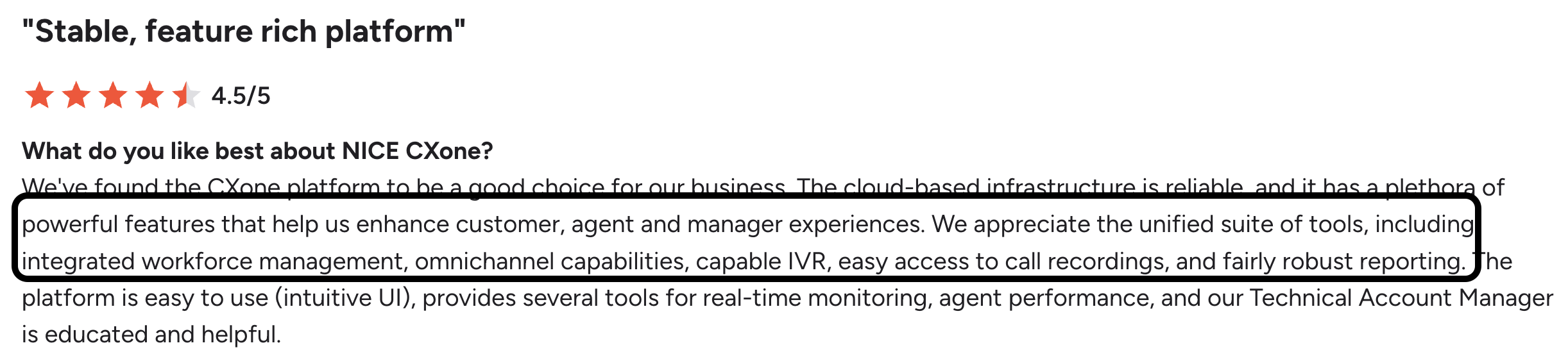
NICE CXone consolidates conversation intelligence, contact center operations, knowledge management, workforce management, and customer self-service into a single platform. Where Observe.AI and other specialized conversation intelligence vendors layer on top of your existing infrastructure, NICE replaces that infrastructure entirely. That consolidation appeals to organizations tired of managing multiple vendors, but it also means a NICE deployment is a full platform migration rather than a focused analytics project.

Key features:

  • CXone Mpower AI suite with virtual agents for automated interactions, real-time assistance features for agent guidance, and AI notetaking for conversation summaries
  • Intelligent routing, CSAT prediction, and vulnerable customer detection
  • Native workforce management and omnichannel routing across voice, chat, email, social media, and SMS

NICE CXone pricing often starts around $249 per agent per month, including core platform capabilities plus AI features.

Who it's for: NICE CXone fits when you want platform consolidation with single-vendor accountability and need native workforce management and omnichannel routing. Unlike Observe.AI, which layers analytics on top of your existing CCaaS, NICE replaces your CCaaS entirely, so this is a fundamentally different purchasing decision.

3. CallMiner: Compliance analytics and customer journey mapping

CallMiner analyzes 100% of omnichannel customer interactions using AI-powered speech analytics. The platform emphasizes customer journey mapping and comprehensive analytics for complex compliance requirements, making it better suited for enterprise compliance needs than platforms optimizing for rapid deployment.

Key features:

  • Speech analytics with automated transcription and sentiment analysis for detecting customer emotion patterns
  • Customer journey mapping across omnichannel interactions
  • 100% automated QM capabilities with trend analysis that surfaces issues before escalation
  • Security and compliance features differentiated for regulated industries including financial services, healthcare, and energy/utilities

CallMiner typically uses annual hours pricing with custom enterprise deals only.

Who it's for: CallMiner fits when customer journey mapping is a strategic priority and when you need deeper analytical capabilities for complex compliance than Observe.AI provides, particularly in financial services, healthcare, or energy and utilities.

4. Verint: Workforce engagement management suite

Verint is an enterprise platform covering workforce engagement management, quality monitoring, speech analytics, and workforce management. Where Observe.AI focuses specifically on conversation intelligence and QM, Verint bundles those capabilities into a broader workforce engagement suite that also includes forecasting, scheduling, adherence monitoring, and performance management. More recently, Verint has introduced its Open Platform strategy with specialized AI-powered bots (for coaching, transcription, summarization, and other tasks) that layer onto existing contact center infrastructure, including on-premise environments. 

Key features:

  • Quality monitoring with automated QM scoring across interactions and speech analytics with custom ASR fine-tuning
  • Workforce management with forecasting, scheduling, intraday management, and real-time adherence monitoring
  • AI-powered bots for coaching, transcription, knowledge management, and interaction summarization that deploy incrementally onto existing infrastructure
  • Voice biometrics and fraud detection for regulated industries Verint uses custom enterprise pricing with a named-user model. 

Who it's for: Verint fits when workforce engagement management is the primary buying criteria and you need WFM, QM, and analytics under one vendor. It's also worth evaluating if your contact center still runs on-premise infrastructure, since Verint's bot architecture is designed to layer onto legacy environments without requiring a full cloud migration. The tradeoff compared to Observe.AI is broader scope but more implementation complexity, and compared to Cresta, Verint's AI capabilities for real-time agent guidance and autonomous AI agents are more limited.

Finding the right Observe.AI alternative for your contact center

Your choice comes down to what's driving the switch. If Observe.AI's post-call analytics work well but you need real-time guidance during live calls and a path to AI agent automation, Cresta is worth evaluating first. If you're ready to consolidate your entire contact center stack under one vendor, NICE CXone addresses that. For deeper compliance analytics and customer journey mapping, CallMiner goes further than Observe.AI in those areas. And if your priority is bringing WFM, QM, and analytics together under a broader workforce engagement suite, particularly on legacy or on-premise infrastructure, Verint covers that ground.

Cresta was built to address the gaps that most often drive these evaluations. Cresta Conversation Intelligence uses outcome inference to connect agent behaviors to business results across 100% of interactions, not just flag keywords. Cresta Agent Assist delivers real-time coaching during live calls, giving agents situational guidance exactly when it matters. And for contact centers moving toward automation, Cresta AI Agent handles routine conversations autonomously while maintaining full visibility through the same quality management and analytics tools that cover human agents. All three work on a shared platform, so insights from conversation intelligence flow directly into agent coaching and AI agent optimization without stitching together separate vendors.

Visit our resource library to see how these capabilities work in practice, or request a demo to walk through how Cresta's approach applies to your specific operation.

Frequently asked questions about Observe.AI alternatives

How does conversation intelligence differ from speech analytics?

Speech analytics focuses primarily on transcription and keyword detection, flagging calls where specific words or phrases appear. Conversation intelligence goes further by analyzing the context, intent, and outcomes of conversations. For example, speech analytics might flag every call where an agent said "cancel," while conversation intelligence would distinguish between a customer asking about cancellation policies and one actively trying to cancel, then correlate agent responses with whether the customer was ultimately retained.

What should I look for when evaluating Observe.AI alternatives?

Start with the gaps driving your evaluation. If you need stronger real-time agent guidance, prioritize platforms with live coaching capabilities tied to outcome data. If AI agent automation is the goal, look for platforms that combine autonomous agents with human agent support. Key evaluation criteria include real-time versus post-call capabilities, percentage of interactions analyzed, integration with your existing CCaaS and CRM infrastructure, pricing transparency, and third-party validation from analysts like Forrester and Gartner or review platforms like G2.

How long does it take to implement a conversation intelligence platform?

Implementation timelines vary widely depending on the platform and your requirements. Platforms that require training custom AI models on your specific business outcomes and conversation patterns take longer upfront but typically deliver more tailored insights. Ask vendors for implementation timelines from organizations similar to yours in size and complexity.

Can conversation intelligence platforms integrate with my existing contact center infrastructure?

Yes, and integration depth is the most important factor to evaluate. Look for out-of-the-box connectors with your CCaaS provider, CRM, knowledge bases, and data warehouse rather than generic API access that requires custom development. Real-time platforms need low-latency connections to your telephony infrastructure to deliver in-conversation guidance, so verify that your specific integrations are production-ready and not in beta. Cresta, for example, offers pre-built connectors for major CCaaS providers and CRM systems including Salesforce and Pega, and supports on-premise systems and legacy hardphones.

Do I need to replace my current platform to use conversation intelligence?

No. Conversation intelligence platforms are designed to layer on top of your existing CCaaS infrastructure, adding analytics and agent guidance without disrupting your telephony, routing, or workforce management setup. Cresta's modular architecture lets organizations start with conversation intelligence alone, then expand to real-time agent assist or AI agents as needs evolve. This approach avoids the risk and cost of a full platform replacement while still delivering measurable improvements in agent performance and customer outcomes.