
Contact Center Coaching: The Complete Guide to Improving Agent Performance
.avif)

- Contact center coaching is ongoing, conversation-based feedback that addresses individual performance gaps after agents are live. It is distinct from training, which builds foundational skills upfront.
- The most effective programs tie coaching to outcome metrics (sales, retention, resolution) rather than process adherence scores alone. Roughly 20 percent of agent behaviors drive 80 percent of performance variance: identifying that 20 percent is where effective coaching starts.
- Feedback timing matters more than session length. Agents who receive timely, specific feedback improve faster than those who wait for monthly reviews.
- AI-powered coaching solves the three constraints that have always limited scale: limited conversation sampling, delayed feedback, and supervisor time.
- Real-time guidance and coaching serve different purposes. Real-time guidance helps agents during a conversation, when it still changes the outcome. Coaching helps them before the next one.
Coaching is one of those things that seems to be perpetually postponed. It's not that coaching doesn't work. Everyone agrees it improves performance and helps keep agents around longer. The problem is that traditional approaches make it really hard to stay consistent. And when feedback does happen, it often comes days or weeks after the conversation, when the details have already faded.
McKinsey found that 94% of customer-care executives expect contact center skill requirements to increase, making effective coaching more important than ever. It also notes that coaching consumes significant supervisor time, highlighting the need for smarter coaching approaches. Contact centers that figure out how to coach consistently, using data to guide their efforts, see dramatically better results over time.
This guide covers what effective contact center coaching looks like, how it differs from training and quality management, a four-phase operating framework for running it consistently, and how AI is changing the economics of the whole practice.
What is contact center coaching?
Contact center coaching is the ongoing practice of reviewing agents' actual conversations and delivering targeted, data-driven feedback to improve specific behaviors and outcomes over time.
It picks up where initial training ends. Training prepares new hires for their first calls: product knowledge, systems, policy, and process. Coaching addresses the individual performance gaps that surface in real interactions, using real conversation data rather than simulated scenarios. Training has a defined start and end. Coaching is continuous, built into a weekly rhythm, and tied to what's actually happening in conversations right now.
That distinction matters when designing a program. The two functions require different cadences, different data, and different skills from the people running them.
How Is Coaching Different from Training, Quality Management, and Real-Time Guidance?
These four concepts are used interchangeably in contact center operations. They serve different purposes, and conflating them is one of the most common reasons coaching programs underdeliver.
The connection between all four is what creates a high-performing operation. QM identifies the behaviors worth coaching on. Coaching turns that data into development. Real-time guidance reinforces what was coached in the moments that count. Training fills the structural skill gaps that coaching alone can't close.
Cresta's Conversation Intelligence and Agent Assist products are built around this distinction. QM scoring, coaching plans, and real-time guidance run off the same conversation record, so insight from analyzing every call flows directly into what agents see in the moment and into the coaching their supervisor plans for next week.
The Measure-Coach-Reinforce-Improve Framework
Effective contact center coaching follows four phases. Each builds on the one before it, creating a flywheel where better data produces better coaching, better coaching produces better behaviors, and better behaviors produce the outcomes that justify the investment.
Measure. Understand what's actually happening in conversations. This means analyzing 100 percent of interactions, not a random sample, and connecting behaviors to outcomes (sales, retention, resolution, CSAT) rather than scoring adherence alone. You cannot coach what you cannot see, and you cannot prioritize what you haven't quantified. The 80/20 principle applies directly here: roughly 20 percent of agent behaviors drive 80 percent of the performance variance across a team. Outcome-linked conversation analysis, rather than adherence scoring alone, is what makes that prioritization systematic rather than a supervisor's best guess.
Coach. Deliver targeted feedback based on observed behavior. This happens in structured sessions, brief micro-coaching touchpoints, and through the techniques described below. The core principle: coach to outcomes, not just process compliance.
Reinforce. Embed coached behaviors so they stick. Real-time guidance, peer mentoring, side-by-side support, and role-playing practice all contribute here. The goal is to give agents a live or simulated moment to apply new behaviors rather than rely on recall from a retrospective session.
Improve. Track whether the behaviors you coached actually changed, and whether that change moved the metrics you care about. If a coached behavior didn't shift outcomes, the program needs adjustment, not repetition.
Six Coaching Techniques That Drive Results
No single technique fits every situation, experience level, or team size. The strongest programs combine approaches. Here are six that consistently deliver results, mapped to the framework phases where they contribute most.
1. Side-by-Side Coaching (Reinforce)
A supervisor sits with an agent during live calls and offers feedback in the moment. Immediate correction prevents bad habits from forming, and agents can ask questions while the situation is still present.
Side-by-side coaching works best for new agents and for those working through a specific skill gap identified in QM scoring. It is resource-intensive at scale, which makes it a targeted intervention rather than a default program for the entire floor.
2. Role-Playing and Call Simulation (Coach + Reinforce)
Structured practice scenarios let agents rehearse difficult conversation types — objection handling, de-escalation, compliance disclosures, product knowledge accuracy — before encountering them live. Role-playing is particularly effective for tenured agents working on a specific behavior, because the feedback loop is immediate and there is no customer impact if the technique misfires.
Pairing simulation with conversation data makes the exercise more precise. When QM scoring identifies that a significant share of escalations follows a particular pattern, practicing that exact scenario is a better use of coaching time than a generic de-escalation module.
3. Conversational Analytics (Measure)
Conversation intelligence tools analyze every interaction and surface patterns no manager could identify by reviewing 3 to 5 percent of calls. Automated scoring flags specific moments: objection handling, compliance language, active listening behaviors, call closure technique, and product knowledge accuracy. Supervisors spend their attention on the conversations worth discussing, not on finding them.
Cresta Conversation Intelligence analyzes 100 percent of conversations and connects behaviors to outcomes, so supervisors know they are coaching the skills that actually move the metrics that matter. Vivint used outcome-linked QA to identify the behaviors that correlated with close rates, reaching a 7 percent lift in close rate while achieving 85 percent QM coverage.
4. Micro-Coaching (Coach)
Short, focused sessions of five to ten minutes covering a single behavior or skill. In high-volume contact centers, pulling agents off the phones for long meetings is operationally expensive. Micro-coaching fits into the natural pauses in a shift and keeps feedback timely.
Frequency outperforms duration. Agents who receive regular, specific feedback improve faster and stay longer than those who receive infrequent, comprehensive reviews. This advantage is especially pronounced for new agents and those in active improvement plans, where the gap between coaching conversations is most costly.
5. Peer Mentoring (Reinforce)
Top performers coach their teammates. This scales in large operations and carries a specific advantage over manager-led coaching: agents can see the technique working for someone doing the same job under the same conditions.
Peer mentoring also creates visible leadership pathways for high performers who are not ready for formal management roles, which directly affects retention.
6. AI-Powered Coaching (Measure + Coach + Reinforce + Improve)
AI-powered coaching addresses the three constraints that have always limited contact center coaching at scale: limited conversation sampling, delayed feedback, and supervisor time.
Traditional programs reviewed a handful of calls per agent per month. AI systems analyze every conversation. Traditional feedback arrived days or weeks after the call. AI systems surface it the same day. Traditional quality management consumed significant supervisor time on call scoring. Automation handles that work, freeing supervisors for development conversations.
These challenges around improving contact center agent performance aren't unique to any one organization. According to ICMI's State of the Contact Center 2024, customer expectations, expanding support channels, hybrid work, and AI adoption are reshaping contact center operations simultaneously. Rather than reducing the need for coaching, these forces are increasing demand for managers who can develop agent skills, maintain consistent service quality, and help teams adapt to increasingly complex customer interactions.
Cresta Agent Assist reinforces coached behaviors in real time during live calls. It surfaces relevant knowledge, guides agents through complex workflows, and generates AI summaries that eliminate after-call note-taking, augmenting the agent at the exact moment a coached behavior needs to fire. Cresta's AI Analyst lets supervisors ask natural-language questions about performance patterns ("Which agents have trouble closing after objections?") and get immediate answers instead of waiting for a scheduled report.
Cresta's Coaching Reports go a step further: they track coaching activity against coaching effectiveness, so operations leaders can distinguish between supervisors who need to coach more often and supervisors who need to coach differently. Those are two different problems requiring two different interventions.
The data supports the investment. In Cresta's State of the Agent Report 2024, 91 percent of agents receiving personalized coaching reported being satisfied at work, compared to 57 percent of agents receiving standard coaching. Gallup research consistently finds that managers account for a substantial share of variance in employee engagement, making the quality of coaching one of the highest-leverage investments a contact center operation can make.
Traditional vs. AI-Powered Coaching: How Do They Compare?
The practical takeaway: traditional coaching is not broken. The constraint is that it requires a level of supervisor capacity most contact centers don't have consistently. AI augments the model by handling measurement and reinforcement so supervisors can spend their time on the conversations that only a human can lead.
What Metrics Should Contact Center Coaching Programs Track?
The most meaningful coaching metrics connect specific behaviors to outcomes. Track these at the program level:
- First-call resolution (FCR): The clearest indicator of whether coaching is improving conversation quality, not just conversation length.
- Average handle time (AHT): A lagging signal reflecting both efficiency and agent confidence. Coaching toward specific behaviors, such as concise acknowledgment, faster knowledge retrieval, and clean call closure, moves this metric.
- Conversion and retention rates: For sales and retention programs, the only metric that proves coaching is working is whether agents are closing and keeping customers.
- CSAT and post-call sentiment: Customer-reported experience captures behavioral changes that QM scores don't always surface.
- Coaching frequency per agent: How often each agent receives structured feedback. Low frequency is typically a supervisor capacity problem, not a motivation problem.
- Behavior change rate between cycles: The percentage of coached behaviors that measurably shift in the subsequent review period. This is the clearest signal of coaching quality, not just coaching quantity.
- Coaching effectiveness by supervisor: Cresta's Coaching Reports distinguish supervisors who need to coach more often from those who need to coach differently, because those are two different problems requiring two different interventions.
The shift from measuring coaching activity (sessions held, hours logged) to measuring coaching outcomes (behavior change, metric movement) is what separates programs that scale from programs that plateau.
How to Structure Your Coaching Workflow
A reliable coaching workflow maps directly to the Measure-Coach-Reinforce-Improve framework. Industry benchmarks commonly cite 30 to 60 minutes of structured coaching per agent per week as an operational target, though high-frequency micro-coaching models often achieve stronger results at lower time cost per session.
Performance assessment (Measure). This runs continuously. Quality scores, CSAT, AHT, schedule adherence, and conversation recordings feed into a picture of each agent's current performance. Review cadence should track agent performance tier: high performers may need monthly check-ins; agents in active improvement areas benefit from weekly reviews. The key shift from traditional programs: assess every conversation, not a random sample. Newer agents typically benefit from more frequent touchpoints; tenured agents benefit from coaching that stretches capability rather than corrects baseline behavior.
Coaching sessions (Coach). Structured sessions run 30 to 60 minutes and follow a consistent format: review the data together, listen to specific call examples, start with what went well, address the targeted improvement area, and close with a clear action commitment. Brief weekly sessions and micro-coaching touchpoints typically outperform long monthly reviews, particularly when tied to a recent conversation the agent still remembers.
Reinforcement (Reinforce). Between formal sessions, real-time guidance, peer mentoring, and role-playing practice reinforce the behaviors targeted in coaching. This is the phase most programs skip, which is why coached behaviors often revert within two weeks of a formal session. For remote and hybrid teams, real-time guidance tools and asynchronous coaching via annotated conversation clips carry more of the reinforcement load when side-by-side coaching isn't operationally feasible.
Measurement and progress review (Improve). Track whether the specific behavior you coached actually changed in subsequent conversations, and whether that change moved the metric you care about. Comparing quality scores and outcome metrics before and after a coaching cycle tells you whether the technique worked for this agent and informs the next cycle.
Treat this as a continuous flywheel, not a quarterly event. Each round of data feeds the next round of coaching. United Airlines reduced AHT by 14.5 percent after deploying Cresta Agent Assist alongside its coaching program. Cox Communications achieved a 20 percent increase in revenue and a 40 percent increase in span of control. The compounding effect of consistent measurement and targeted coaching shows up in the metrics that leadership cares about.
Build a Coaching Program That Actually Scales
Effective contact center coaching comes down to three things: visibility into what's actually happening in conversations, feedback that reaches agents while it still changes behavior, and the operational capacity to deliver both consistently. Traditional approaches constrain all three.
The Measure-Coach-Reinforce-Improve framework gives teams a repeatable model for running coaching as an operating discipline rather than a scheduled event. Each phase builds on the one before it. The compounding effect shows up in resolution rates, handle time, conversion, and retention.
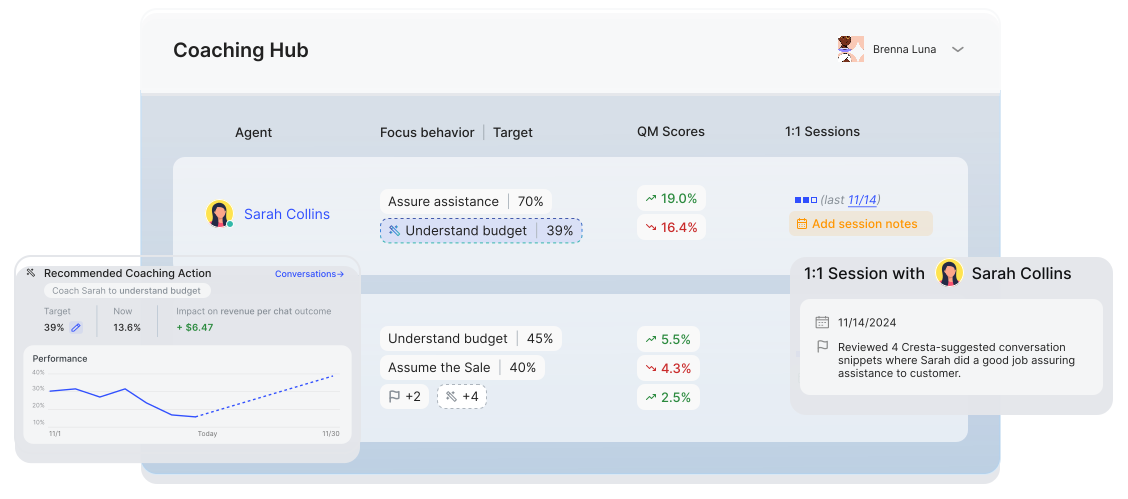
Cresta Conversation Intelligence analyzes every interaction and surfaces the behaviors worth coaching on, prioritized by actual outcome impact. Cresta Agent Assist reinforces coached behaviors in real time during live calls. Cresta Coach enables personalized, QM-driven coaching plans built on automated quality management data. AI Analyst answers natural-language performance questions immediately. And Coaching Reports track both how much coaching is happening and how effective it is, down to the individual supervisor.
The result is a coaching program that scales with the team, not against it.
Visit our resource library to explore more guides on contact center performance, or request a Cresta demo to see how AI-powered coaching can work for your team.
Cresta is dedicated to helping businesses of all sizes make informed decisions. We adhere to strict editorial guidelines to ensure that our content meets and maintains our high standards.