
The Best 7 Conversation Intelligence Platforms for Enterprise Contact Centers in 2026


- Conversation intelligence platforms that analyze 100% of interactions surface compliance risks, coaching opportunities, and contact drivers that sampled QA cannot detect.
- The most important differentiator is not transcription accuracy; it is what happens after the transcript. Look for platforms that connect insights to real-time guidance, QM scoring, coaching, and automation planning on a shared data layer.
- Real-time guidance changes outcomes during the conversation, when the agent can still act. Post-call analytics tells you what happened; it cannot change it.
- The platforms below vary significantly in how much of the contact center workflow they cover. Narrow-point solutions can deliver fast time-to-value; unified platforms compound benefit across QM, coaching, and automation over time.
- Contact center CI buyers need QM coverage, compliance workflows, CCaaS integration, and agent augmentation. If a vendor's primary use case is sales pipeline forecasting, it is the wrong category regardless of how it labels itself.
Contact centers still review a small fraction of interactions manually, leaving systemic compliance gaps, coaching blind spots, and unknown contact drivers invisible to leadership. Conversation intelligence platforms change that ratio, analyzing every interaction at scale to surface the patterns that drive handle time, churn, escalation, and CSAT. Choosing the right platform for an enterprise contact center is not a matter of finding the most features; it is a matter of finding one whose actionability matches your operational model.
That is where most evaluations stall. Leaders keep asking the same questions: Which platform actually fits an enterprise contact center at scale? How is conversation intelligence different from the speech analytics we already run? And can it replace manual QA at full coverage, not just a sample?
The pressure is not abstract. A Gartner survey of service and support leaders found 77% feel pressure from senior executives to deploy AI and 75% report increased AI budgets versus last year. The real differentiator is not analysis itself but whether a platform connects that analysis to action: real-time guidance, coaching, and automation. Some tools stop at post-call analytics. Others connect analysis to real-time guidance during the live conversation, automated coaching workflows, and a clear path to automation. That actionability gap is the most important evaluation criterion on this list.
Conversation intelligence is AI that analyzes customer conversations across voice and digital channels to surface patterns, behaviors, and outcomes. It helps teams move beyond small manual samples to improve quality management, coaching, compliance, and customer experience using evidence from a much broader set of interactions. It is most useful when insight leads to operational changes rather than reporting alone.
How to evaluate conversation intelligence platforms for enterprise contact centers
The right evaluation framework starts with these six criteria before comparing any vendor's feature list:
For compliance-sensitive industries and large contact centers, full 100% coverage is the baseline requirement. Custom API integrations with your CCaaS layer carry ongoing maintenance costs and upgrade risk that rarely appear in initial proposals; native certified connectors reduce that risk significantly.
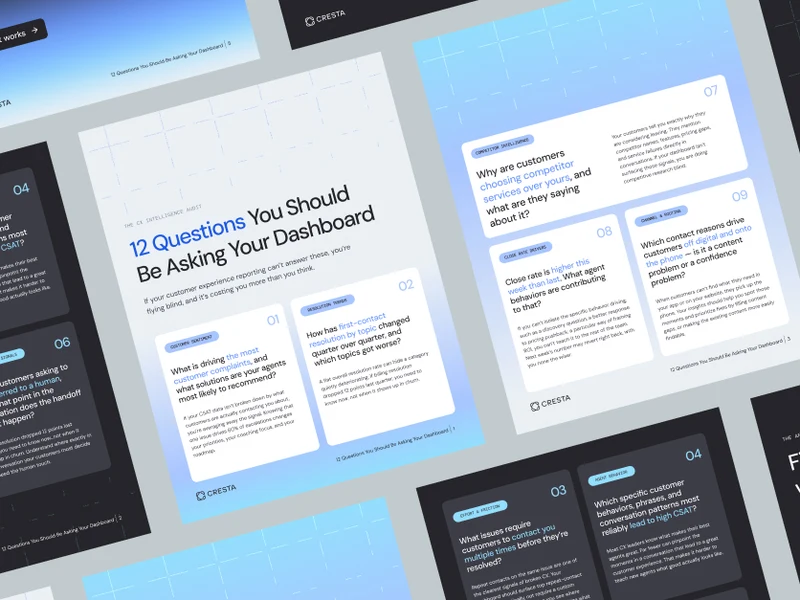
Ask each vendor these 12 questions
Why do contact centers need conversation intelligence platforms?
Contact centers need conversation intelligence to move from reviewing interactions manually to analyzing every conversation at scale, closing the compliance gaps, coaching blind spots, and contact driver blind spots that sample-based QA cannot detect.
The business case comes from operational efficiency and better customer outcomes. Teams use these tools to reduce manual QM workload, speed agent ramp time, improve consistency, identify avoidable contact drivers, and make coaching more evidence-based.
Adoption has moved into the mainstream. Per Metrigy's Customer Experience Optimization 2025-26 study of 656 companies, about half already use interaction analytics today, and more than 90% of those that use it call it the most valuable, or among the most valuable, data in the company. For enterprise contact centers, the question is less whether to analyze conversations and more how quickly insight can change what happens on the floor.
A second reason is organizational speed. When customer issues emerge across thousands of conversations, leaders need a way to identify patterns quickly and decide whether the fix belongs in training, policy, product, or automation design. Alaska Airlines, for example, moved from weeks to same-day issue identification after deploying Cresta Conversation Intelligence, pinpointing five primary drivers of long handle times in the process. That shift from weeks to same-day is the operational proof point leaders should look for: analysis that is fast enough to change what the floor does next.
Enterprise adoption reinforces the case. Cresta Conversation Intelligence runs in enterprise contact centers including United Airlines and CVS Health, where high interaction volumes and strict compliance requirements make full-coverage analysis a baseline expectation rather than a nice-to-have.
What Is Conversation Intelligence, and How Does It Work?
A conversation intelligence platform is AI that analyzes 100% of customer conversations, across voice and digital channels, to surface what is happening and why, then turns that analysis into action. It is the category that spans customer intelligence platforms built to read every interaction rather than a sampled few.
Conversation intelligence tools work in three steps. First, they transcribe conversations across voice and digital channels. Second, they apply behavioral recognition: the strongest platforms detect behaviors and intent through context and comprehension, not keyword matching, so scoring holds up on nuanced, real-world conversations rather than breaking on phrasing a rule did not anticipate. Third, they link those behaviors to outcomes, connecting specific agent actions to CSAT, resolution, sales conversion, and churn so leaders can see which behaviors move the metrics they own.
This is where a conversation intelligence solution differs from older approaches. Speech analytics is a subset focused on transcribing and searching voice recordings, historically through keyword spotting and phonetic indexing. Call recording simply stores the interaction for later retrieval. Conversation intelligence adds natural language understanding, sentiment, topic discovery, behavior tracking, and outcome correlation on top of the transcript, and it feeds coaching and QM workflows rather than leaving the recording in an archive.
Conversation intelligence platforms compared in 2026
Methodology: This article is published by Cresta. We have included our own platform alongside competitors. This guide was developed from Cresta's work with enterprise contact centers, customer deployment benchmarks, internal product expertise, third-party research, and review by CX and I implementation specialists. Information was collected as of June 2026 and is subject to change.
1. Cresta
Best for: unified insights, augmentation, and automation on one platform.
Cresta is a unified AI platform that combines Conversation Intelligence, Agent Assist, and AI Agent in one system. Organizations get analytics plus a way to act on what analytics reveal, whether that means guiding human agents in real time, identifying what to automate, or improving how AI and human agents work together after handoff.
Cresta's architecture uses task-specific models trained on each customer's own conversation data rather than generic inputs. The platform shares data, models, integrations, analytics, and governance across its three pillars, helping organizations avoid fragmented feedback loops when expanding from analysis into augmentation and automation. Because guidance, quality management, and coaching run off the same conversation record, insight from analyzing every conversation flows directly into what agents see in the moment and into how AI agents are built and optimized in Cresta Opera, its no-code orchestration engine.
"Cresta's relentless innovation establishes it as a force to be reckoned with in the conversation intelligence market." - Forrester
What's New: Knowledge Agent and Training Simulator
Cresta recently launched Knowledge Agent and Training Simulator
- Cresta Knowledge Agent proactively delivers cited answers and guided workflows grounded in live conversation and on-screen context
- Cresta Training Simulator lets agents practice against simulations built from real customer conversations. New hires ramp faster, tenured agents stay current on new processes, and every agent gets reps on the specific behaviors they struggle with on live calls.
Key Features
- Conversation Intelligence analyzes 100 percent of interactions across human and AI agents and includes AI Analyst for natural language questions
- Automated QM scoring covers every conversation, with coaching tools targeting behaviors most tied to outcomes
- Cresta Agent Assist provides real-time behavioral hints, compliance reminders, live notes, conversation summaries, guided workflows, and Knowledge Agent
- Knowledge Agent proactively delivers cited answers and guided workflows grounded in live conversation and on-screen context
- Cresta AI Agent handles voice and digital conversations including troubleshooting, collections, retention, and multi-intent interactions, with enterprise guardrails and handoff into Agent Assist
- Cresta Coach delivers coaching recommendations based on behavioral analysis and outcome correlations
- Cresta Insights correlates agent behaviors with business outcomes, showing predicted opportunity cost of each behavior
- Agent Operations Center provides human-in-the-loop supervision of hundreds of simultaneous conversations
- Custom ASR delivers over 92% accuracy through models fine-tuned on customer audio with built-in PII redaction
Pros
- Unified platform spans insights, augmentation, and automation with shared data and governance
- Outcome inference models correlate behaviors with business results like CSAT, resolution, and sales conversion
- Knowledge Agent delivers proactive, context-aware answers without agents needing to search
- Post-handoff continuity maintains visibility when AI escalates to a human agent
Cons
- Enterprise-focused pricing may put it out of reach for smaller teams
- Implementation requires partnership engagement rather than self-service setup
- Platform breadth can mean a longer evaluation for organizations seeking a narrow point solution
Who It's For
Enterprise contact centers that want to improve efficiency and customer outcomes without splitting analytics, coaching, knowledge support, and automation across separate vendors. Less suited to buyers who only need a single-module point solution.
2. Observe.AI
Observe.AI handles conversation analysis across voice, chat, and email with a proprietary ASR engine that generates diarized transcriptions with built-in PII redaction.
Key features
- Auto QM scores 100 percent of interactions automatically
- Proprietary ASR with built-in PII redaction
- Real-Time Agent Assist guides agents during calls
- Screen recording and multi-LLM orchestration for context-rich analysis
Pros and cons
Strong QM coverage and multi-channel analysis with PII redaction suited for regulated industries. Real-time guidance and outcome inference are areas the platform continues to develop. Does not offer AI agent automation for independent conversation handling.
Who it's for
Contact centers with complex manual QM programs needing automation. Healthcare organizations and financial services teams gain value from the proprietary ASR with PII redaction.
Related: A guide to Observe.AI alternatives
3. CallMiner
CallMiner is a conversation analytics platform suited for regulated industries, with strong security and compliance capabilities for financial services, healthcare, and energy organizations. Also plays in fraud detection.
Key features
- Speech analytics with automated transcription, sentiment analysis, and trend detection
- Automated quality management at scale
- Security and compliance features for regulated industries
- Coaching workflows and screen recording
Pros and cons
Strong compliance capabilities with audit trails and executive reporting. Focused primarily on post-call analytics rather than real-time guidance. Analytics has historically relied on keyword-based detection, though expanding. No AI agent automation.
Who it's for
Contact centers needing speech analytics and automated QM with strong compliance emphasis, particularly in healthcare, financial services, and energy.
4. NICE CXone
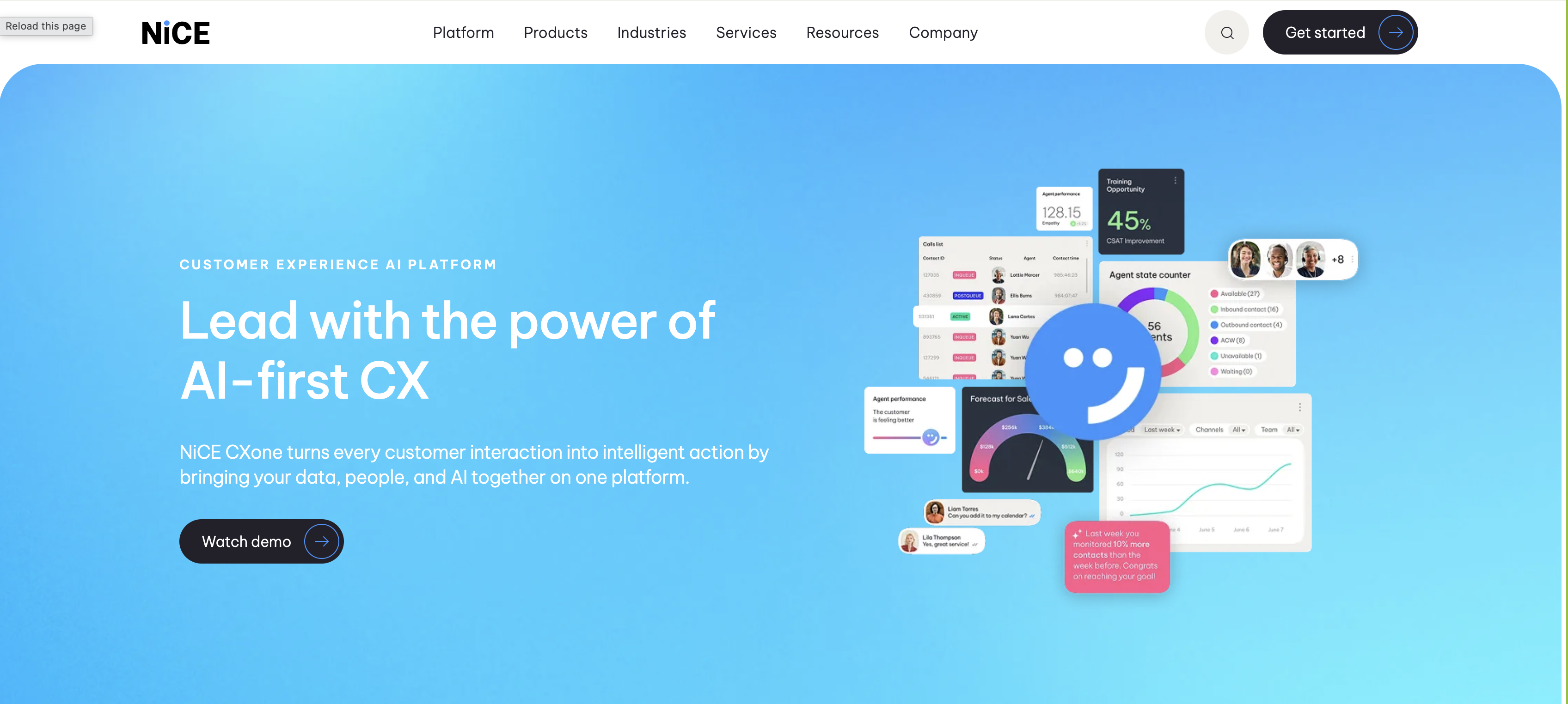
NICE CXone consolidates conversational intelligence, contact center operations, knowledge management, and self-service into a single architecture with vertically integrated CCaaS, WFM, and analytics.
Key features
- CXone Mpower provides AI-driven intelligence for customer service interactions
- Real-time insights and self-service analytics
- Unified platform combining conversation analysis, operations, and self-service tools
Pros and cons
Broad capabilities reduce multiple vendor relationships with established enterprise deployment support. Conversation intelligence is one component among many, not the primary focus. Generative AI agent capabilities are an area of active development. Organizations may pay for functionality beyond their conversation intelligence needs.
Who it's for
Organizations wanting proven deployment support who prefer a broader suite over a specialized conversation intelligence layer.
5. Verint
Verint is an enterprise workforce engagement management platform that includes conversation intelligence within a broader suite covering quality management, workforce management, real-time agent assist, and compliance analytics. Its Da Vinci AI engine powers intent detection, sentiment analysis, automated scoring, and next-best-action recommendations across channels.
What distinguishes Verint's architecture is its open platform design. Rather than requiring a CCaaS replacement, it layers analytics and WEM capabilities on top of existing telephony and contact center infrastructure, with certified integrations across major CCaaS providers. For large enterprises with substantial infrastructure investments they cannot easily swap, this positioning is a meaningful risk reduction.
Key features
- Da Vinci AI engine for intent detection, sentiment analysis, and automated scoring across channels
- Automated Quality Management with 100% interaction scoring and configurable scorecards
- Real-Time Agent Assist with in-conversation knowledge surface and compliance alerts
- Workforce Management natively integrated: forecasting, scheduling, intraday management, and adherence monitoring
- Compliance and PCI redaction for automated sensitive data handling
- Open platform architecture with certified integrations across major CCaaS providers
Pros and cons
QM, WFM, and compliance depth in one suite reduces the number of vendors a large enterprise must manage. Open architecture reduces rip-and-replace risk for organizations with existing infrastructure investment. Platform breadth means packaging and implementation timelines can be complex; buyers should probe module interdependencies and integration scope during evaluation. Primarily enterprise-tier in positioning and deployment model.
Who it's for
Large enterprises with significant existing CCaaS and recording infrastructure who want analytics, WFM, and compliance capabilities layered on top. Financial services, healthcare, telecommunications, and utilities organizations with high compliance burdens.
Related: A guide to Verint alternatives
6. Level AI

Level AI is an AI-native conversation intelligence platform built for contact centers. Founded in 2019, its architecture is built around large language models from the outset rather than retrofitting ML onto older speech analytics pipelines. The practical difference: the platform understands conversation meaning and context rather than matching keywords, which changes what automated QA can reliably score and reduces the false positive and false negative rates that erode scoring credibility over time.
The core differentiation is semantic understanding. QA managers write evaluation criteria in plain English rather than constructing Boolean keyword rules. The platform evaluates those criteria against every conversation automatically. For teams migrating from legacy speech analytics tools, the reduction in configuration overhead is a significant operational change.
Key features
- Semantic Intelligence engine uses LLMs to understand context rather than keyword spotting, reducing false positives and negatives in QA scoring
- Automated QA at 100% coverage with natural language scorecard authoring
- Real-Time Agent Assist surfaces knowledge articles, compliance reminders, and next-best-action prompts during live calls
- Agent and team-level coaching intelligence identifies coaching opportunities and groups agents by performance patterns
- Business intelligence layer for cross-conversation trend analysis, topic clustering, and CSAT prediction
- Native integrations with major CCaaS platforms, CRMs, and ticketing systems
Pros and cons
LLM-native architecture reduces the configuration burden of legacy QA tools and improves scoring accuracy on complex, nuanced conversations. Does not include workforce management, so it pairs with a WFM solution rather than replacing one. No native recording or telephony; requires integration with existing voice infrastructure. Enterprise buyers should review security certifications, data residency options, and implementation support depth during evaluation.
Who it's for
Mid-market to enterprise contact centers that want to modernize QA from manual sampling or keyword-based tools to LLM-powered full coverage. QA managers and workforce operations leaders who want to reduce scoring configuration complexity and improve accuracy consistency.
7. Qualtrics XM Discover
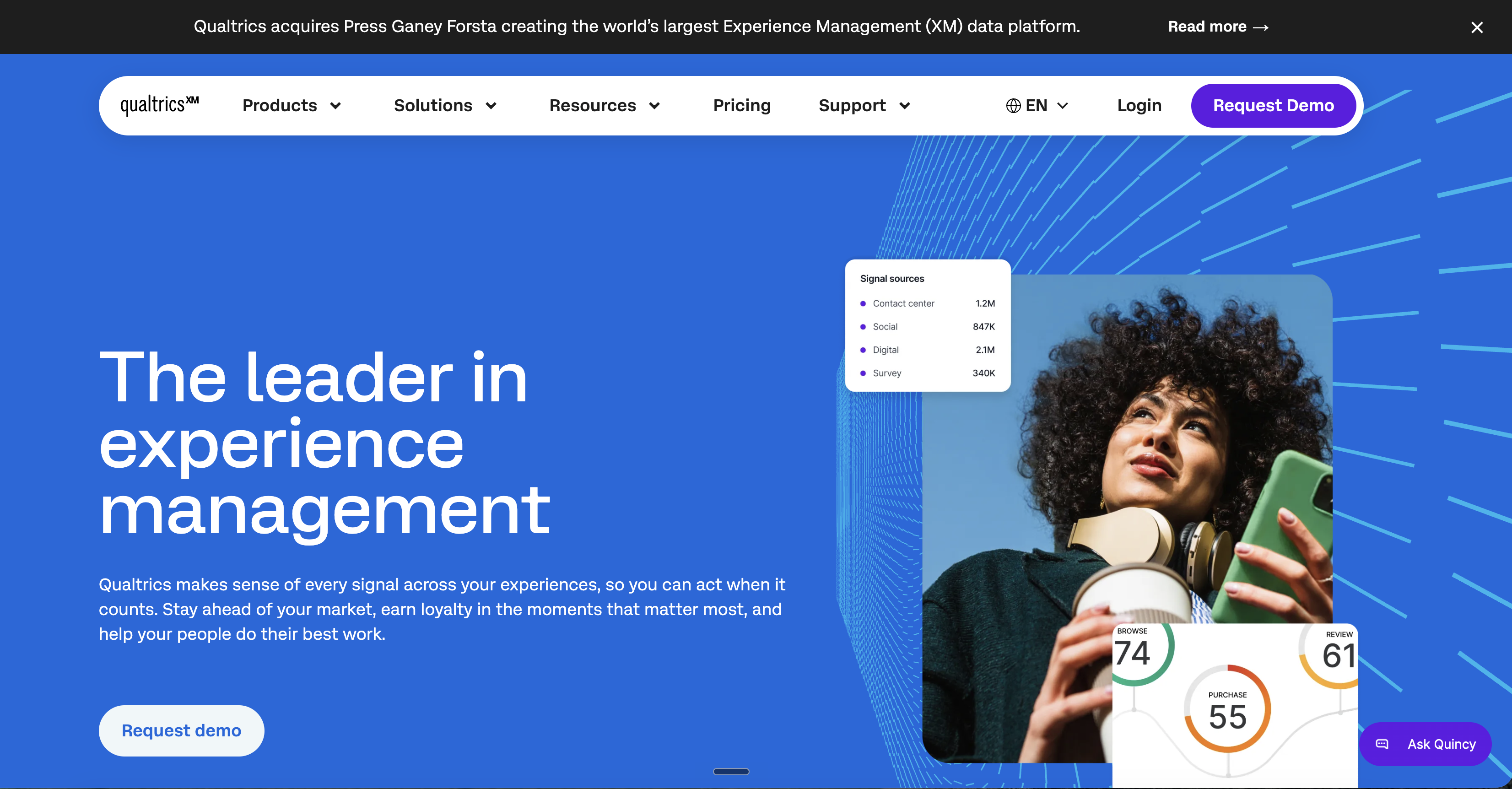
Qualtrics XM Discover (formerly Clarabridge) is a conversational analytics platform that combines AI-powered analysis of contact center interactions with broader Voice of the Customer data: surveys, online reviews, social media, and digital feedback. The fusion of structured survey data with unstructured conversation data is XM Discover's primary architectural differentiator among the platforms on this list. No other platform here natively correlates what customers say in contact center conversations with structured NPS and CSAT survey scores in the same analysis environment.
The platform's NLP engine offers emotion detection across 11-plus emotional dimensions, effort scoring, intent classification, and driver analysis that statistically maps which conversation topics and agent behaviors move CSAT and NPS. This makes it valuable for enterprise CX programs that need to connect what happens in contact center conversations to their broader customer experience metrics.
Key features
- Multi-source omnichannel ingestion: voice transcripts, chat, email, social, survey verbatims, and review sites
- Emotion detection across 11-plus dimensions beyond binary positive/negative sentiment
- Driver analysis that identifies which topics and interaction attributes statistically affect CSAT, NPS, and retention metrics
- Structured and unstructured data fusion: conversation data correlated with survey scores and operational metrics in one environment
- XM Discover Studio for dashboard building, conversation segment exploration, and root cause analysis without data engineering overhead
- Intelligent Scoring for automated QA-style evaluation against configurable rubrics
Pros and cons
Unique ability to connect contact center conversation data with broader CX program data, surveys, and reviews in a single environment: valuable for CX insights and VoC program owners who need that unified view. Does not include workforce management or real-time agent assist, making it a post-interaction analytics platform rather than a full contact center WEM suite. The primary buyer persona is a CX Insights or VoC leader rather than a contact center operations manager; buyers with purely operational QM needs may find the platform over-engineered for their use case. Implementation and time-to-value timelines can be significant as part of the broader Qualtrics XM platform.
Who it's for
Enterprise organizations running formal VoC programs that want to unify contact center conversation analysis with survey data and broader CX metrics. CX, Insights, and market research teams that already use Qualtrics for surveys and want to extend into conversational data. Less suited for contact center operations buyers who need WFM, real-time agent assist, or standalone QA tooling without the broader VoC layer.
Best Practices for Getting Value From Conversation Intelligence
Software alone does not change outcomes. Once a platform is in place, these practices help contact center teams turn analysis into measurable improvement:
- Make 100% coverage the baseline. Score every interaction, not a sample, so compliance events and coaching gaps cannot hide in the calls no one reviewed.
- Score against outcomes, not just checklists. Tie quality management rubrics to CSAT, resolution, retention, and sales conversion so the numbers reflect business impact, not box-checking.
- Close the loop from insight to behavior. Feed what analysis surfaces into coaching and real-time guidance, then measure whether frontline behavior changes in the next conversation.
- Route conversations by type. Send routine, clear-goal interactions toward automation and reserve high-emotion, high-value moments for humans supported by real-time guidance.
- Build compliance in, do not bolt it on. Make automated PII and PCI redaction, data residency, and audit trails part of the workflow from day one. Cresta's contact center compliance guidance and security and trust practices show what enterprise buyers should expect.
- Use automation discovery to decide what to automate. Let the data, not a hunch, tell you which contact drivers are ready to hand off, using automation discovery to prioritize by impact.
How do you choose the right conversation intelligence platform?
The answer depends on two variables: where you are on the contact center maturity curve, and what you need to change first. A few principles to guide the decision:
Start with the actionability question. A dashboard describing what happened last week is useful. A platform that changes what agents do in the next conversation is transformative. If the priority is in-conversation improvement, evaluate real-time capability first. If the priority is QA scale and coaching efficiency, focus on coverage model and outcome linkage.
Match platform scope to your roadmap, not just your current need. A point solution may deliver faster time-to-value, but if your roadmap includes AI agent automation or a closed-loop coaching program, a platform that shares data across those functions will compound over time. A set of separate tools will require ongoing integration maintenance as that roadmap evolves.
Probe the integration story carefully. Most contact center CI implementations stall or underdeliver because the integration with existing telephony, CCaaS, and CRM systems was underspecified during evaluation. Native, certified connectors reduce that risk significantly.
To see how Cresta Conversation Intelligence connects analysis to real-time agent augmentation and AI automation on a single platform, request a demo.
Cresta is dedicated to helping businesses of all sizes make informed decisions. We adhere to strict editorial guidelines to ensure that our content meets and maintains our high standards.