The top 7 Verint alternatives in 2026


- The seven Verint alternatives worth shortlisting are Cresta, NICE CXone, Genesys Cloud CX, Talkdesk, Observe.AI, CallMiner, and Balto
- Pick Cresta for AI trained on your own conversations, and NICE or Genesys for CCaaS consolidation. Choose Talkdesk for simpler all-in-one CCaaS, Observe.AI for manual QA programs, CallMiner for speech analytics, and Balto for live sales guidance
- Verint, now combined with Calabrio, is still strong on forecasting and scheduling, so keep it in the running if workforce management is your main need
If your contact center needs to forecast demand, schedule agents, and review interactions at enterprise scale, you’ll likely evaluate Verint, a long-standing workforce engagement management (WEM) and CX automation platform.
Verint is strong on forecasting and scheduling, and its footprint grew after Thoma Bravo completed its acquisition of Verint on November 26, 2025, and combined it with Calabrio.
But users on sites like TrustRadius say its interface and navigation are clunky, and many also aren’t satisfied with its reporting and data extraction flexibility. In addition, Verint is a Niche Player in the 2026 Gartner® Magic Quadrant™ for Voice of the Customer Platforms, where Gartner flagged its user interface as an issue.
To help you decide whether Verint is the right fit, we've compared it to its top alternatives.
Note: This guide was updated on 9/29/2026. The information on this page can change in the future.
How we evaluated the Verint alternatives
We built this list from user reviews on G2, TrustRadius, and Gartner® Peer Insights. We also drew on Gartner and Forrester reports, and our own conversations with customers and prospects who’ve used or evaluated Verint.
Each platform was judged on seven criteria:
- Conversation coverage and accuracy: whether 100% of conversations are analyzed and whether the AI reads intent and behavior or relies on keywords
- Real-time guidance: whether agents get help during the conversation or only in post-call review
- Insight-to-coaching loop: whether QA findings flow directly into coaching and live guidance
- Workforce management depth: forecasting, scheduling, and adherence strength
- Integration with your CX stack: native connectors to CCaaS, telephony, and CRM versus custom work
- Usability and time to value: how quickly teams go live and adopt it
- Automation readiness: whether the same platform can take on AI agents for routine conversations
Here are the top Verint alternatives scored against the criteria above.
Related: Comparing Verint and Zendesk
Top alternatives to Verint
Let's go deeper on each Verint alternative.
1. Cresta
Cresta is the AI operating system for CX. Its platform analyzes, automates, and augments customer conversations for human and AI agents.
Highlights
- AI Agent, Agent Assist, and Conversation Intelligence share one conversation record, so a QA rule built once drives scoring, coaching, and live guidance
- Models are trained on your own conversations, with behavioral recognition that reads intent through context rather than keywords
- Cresta Conversation Intelligence analyzes 100% of conversations, so QA and coaching aren't limited to a sample
- Named a Leader in The Forrester Wave™: Conversation Intelligence Solutions for Contact Centers, Q2 2025
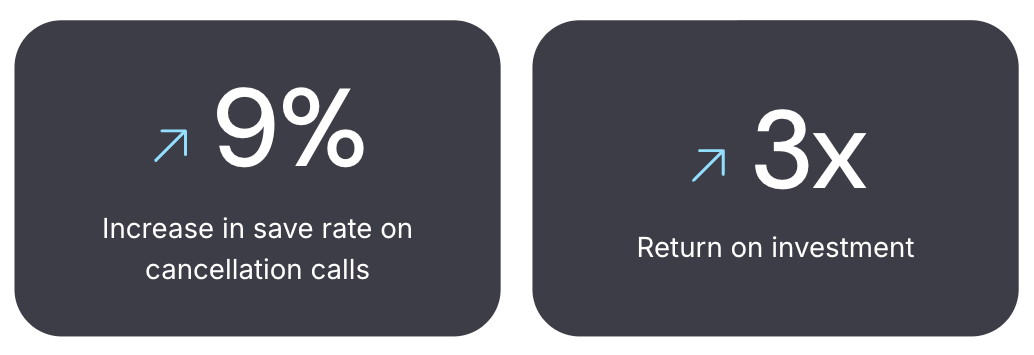
- Has several case studies with powerful business metrics. For example, Aptive, a pest control company, added $2.37M with Cresta
Why choose Cresta over Verint
You want every conversation analyzed and turned into live guidance and coaching, not sampled and reviewed weeks later. Cresta layers onto your existing CCaaS and workforce management tools, so you can keep Verint for scheduling while Cresta Agent Assist augments your agents.
See how Cresta can transform your CX operations by scheduling a demo.
2. NICE CXone
NICE CXone is a vertically integrated CCaaS platform that bundles routing, workforce management, and analytics.
Highlights
- Vertically-integrated platform unifying CCaaS, workforce management, and analytics, so you manage one vendor instead of several
- Cloud-native architecture supporting voice, chat, email, social media, and SMS
- LLM technology for context, sentiment, and intent analysis with automatic interaction scoring, ensuring QA doesn’t depend on manual scoring
- Named a Leader in the 2025 Gartner® Magic Quadrant™ for Contact Center as a Service
Why choose NICE CXone over Verint
You want to replace Verint and your CCaaS with a single suite from one vendor, especially in regulated industries.
Related: The best alternatives to NICE CXone
3. Genesys Cloud CX
Genesys built its cloud platform for organizations requiring flexible customization and journey orchestration.
Highlights
- Vertically-integrated CCaaS and analytics capabilities, so interaction data and reporting sit in one platform
- Journey orchestration tracking customers across channels, which matters when one customer issue spans voice, chat, and digital
- AI-powered automation and predictive analytics, which help teams automate routine work and plan ahead
- Also a Leader in the 2025 Gartner® Magic Quadrant™ for Contact Center as a Service
Why choose Genesys Cloud CX over Verint
You need deep customization and journey orchestration across many channels, and you have skilled admins to run it.
Related: The top Genesys alternatives
4. Talkdesk
Talkdesk provides cloud-based software delivering CCaaS and workforce management from a single vendor to eliminate integration complexity between contact center infrastructure and workforce optimization tools.
Highlights
- Integrated CCaaS and WEM with shared data model, so schedules and interaction data stay in sync
- Simplified vendor management eliminating multi-vendor troubleshooting
- Named a Leader in the 2025 Gartner® Magic Quadrant™ for Contact Center as a Service after placing as a Visionary the year before
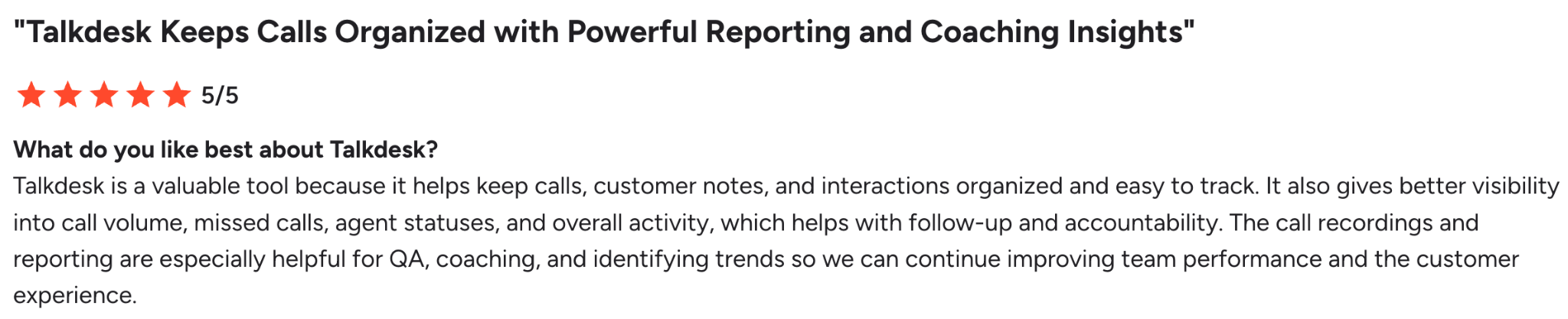
- Users (like the G2 reviewer below) often praise the platform’s efficiency and reporting functionality
Why choose Talkdesk over Verint
You want CCaaS and WEM from one vendor with a simpler admin experience than a legacy suite.
Related: Which Talkdesk alternatives fit enterprise CX teams
5. Observe.AI
Observe.AI built its platform specifically for organizations with complex existing manual QA programs that require them to analyze every interaction to identify performance patterns and coaching opportunities.
Highlights
- Support for manual QA scoring workflows that integrate with existing processes, enabling your team to keep the scorecards it already uses
- AI copilots provide real-time guidance for human agents during live conversations, so help arrives before the call ends
- Conversation intelligence analyzes interactions across channels. This means trends surface across voice and digital
- Named a Cool Vendor in the 2025 Gartner® Cool Vendors™ in Customer Service and Support Technology report
Why choose Observe.AI over Verint
You run a complex manual QA program you need to keep while adding AI scoring and agent assist.
Related: A guide to Observe.AI alternatives
6. Balto
Balto specializes in real-time agent guidance during live calls with particular strength in sales environments. The system listens to both sides of calls and provides immediate correction during interactions rather than waiting for post-call coaching.
Highlights
- Real-time guidance during live sales calls with immediate correction, so reps can fix a miss before the call ends
- AI call scoring with automatic call summarization synced to CRM. This means call notes reach the CRM without manual entry
- Sales playbook enforcement helps reps hit key points during conversations
- Users often cite the platform’s ease of use as a key benefit. The review from G2 below is a good example

Why choose Balto over Verint
You run sales or collections teams that need live call guidance more than scheduling or suite breadth.
Related: The top Balto competitors
7. CallMiner
CallMiner is a conversation intelligence platform for contact centers, built for deep speech and interaction analytics.
Highlights
- CallMiner says it analyzes 100% of omnichannel interactions, so analysis isn't limited to a sample
- Topic and behavior classification plus insights exploration help analysts find what's driving contact trends
- Automated QA scoring and coaching workflows turn analysis into agent feedback
- Leader in The Forrester Wave™: Conversation Intelligence Solutions for Contact Centers, Q2 2025, which says it "best fits enterprises with sophisticated operations"
Why choose CallMiner over Verint
You're replacing Verint Speech Analytics and want a dedicated analytics specialist with a mature toolkit.
Related: Explore the top CallMiner alternatives
Final thoughts
Verint remains a solid fit if forecasting and scheduling are your top priority. But the friction sits underneath: a difficult-to-use interface, reporting that's hard to extract, and QA that often stops at a sample.
That last gap, visibility into only a fraction of interactions, is where Cresta takes a different approach. AI Agent, Agent Assist, and Conversation Intelligence analyze every conversation, turn findings into live guidance and coaching, and automate the routine contacts, all on one platform.