
The top 5 Fin AI alternatives in 2026
.avif)

- The five Fin AI alternatives worth shortlisting are Cresta, Sierra, PolyAI, Cognigy, and Decagon
- Pick Cresta for full-lifecycle enterprise CX, Sierra for brand-controlled consumer CX, PolyAI for high-volume voice/IVR replacement, Cognigy for multilingual, global operations, and Decagon for digital-native, lower-complexity support
- Fin AI remains a strong pick for digital-first teams that want fast chat resolution
Fin AI is one of the strongest AI agents in customer support. It's especially compelling for digital-first teams that want automated resolution at speed.
But it isn't the right fit for every CX program.
Fin AI charges per outcome, so the bill can climb as deflection improves and it resolves more volume. Its chat-first origins also leave gaps in enterprise voice, conversation intelligence, and human-AI handoff. And its Salesforce acquisition makes CRM independence a serious consideration.
To help you decide whether Fin AI is the best fit for your business, we've compared it to its top alternatives below.
Note: This guide was updated in September 2026. The information on this page can change in the future.
How we evaluated the Fin AI alternatives
Our assessments draw on third-party review sites like G2, Capterra, and Gartner® Peer Insights, analyst reports from Forrester and Gartner, and Cresta's own conversations with prospects and customers.
Here’s the criteria we used:
- Voice coverage at enterprise scale: does it handle voice at real scale? Given that nearly 70% of Americans reported using phone support, this is a significant consideration
- Enterprise readiness for regulated industries: guardrails, adversarial testing, behavioral quality management, audit trails, and versioning
- Conversation intelligence and outcome linkage: analyzes 100% of conversations and ties behaviors to outcomes like sales, retention, resolution, CSAT, and AHT
- Human-AI handoff quality: what the human agent receives when automation escalates, including real-time guidance
Here are the top Fin AI alternatives measured against the criteria above.
Top alternatives to Fin AI
Here's how each alternative stacks up against Fin AI, starting with Cresta.
1. Cresta
Cresta is the leading AI for CX platform. It unifies AI agent automation, real-time human agent augmentation, and conversation intelligence on one shared layer. And it's trained on each customer's own conversation data.
Highlights
- Cresta AI Agent, Agent Assist, and Conversation Intelligence run on one shared intelligence layer, so automation, live guidance, and analysis reinforce each other
- Conversation Intelligence analyzes 100% of conversations and links behavior to outcomes like resolution, handle time, and revenue
- Named a Leader in The Forrester Wave™: Conversation Intelligence Solutions for Contact Centers, Q2 2025
- Works with the leading brands across healthcare, travel and hospitality, insurance, and more
Why choose Cresta over Fin AI
You want to connect conversation intelligence, behavioral guidance, and AI agents on one layer to improve human and AI agent performance.
See how Cresta can transform your CX operations by scheduling a demo.
2. Sierra
Sierra is an AI-agent vendor for customer service.
It’s positioned as a point solution focused on autonomous resolution, rather than a unified platform connecting AI-agent automation with human-agent performance.
Highlights
- AI agents across voice, chat, email, and WhatsApp, so one deployment can meet customers on their channel of choice
- Support for 59 languages, so one deployment can serve many markets
- System-of-record integrations for tasks like returns, claims, and mortgage origination, enabling agents to complete real work
- Users often claim it's easy to use and set up. The G2 review below is a good example

Why choose Sierra over Fin AI
You need an autonomous agent built for complex, outcome-oriented work, not just support deflection.
Related: Deep dive on how Fin AI compares to Sierra
3. PolyAI
PolyAI is an enterprise conversational-AI platform focused primarily on voice-first dialog agents. It’s designed for complex customer conversations that require maintaining context, handling ambiguity, and completing real tasks.
Highlights
- Voice-first AI agents for phone-based service across authentication, call routing, billing, bookings, and troubleshooting
- Agent Studio lets users build and iterate on dialog agents, allowing teams to improve performance over time
- Enterprise guardrails for compliance, brand, and experience, so voice automation stays on-brand
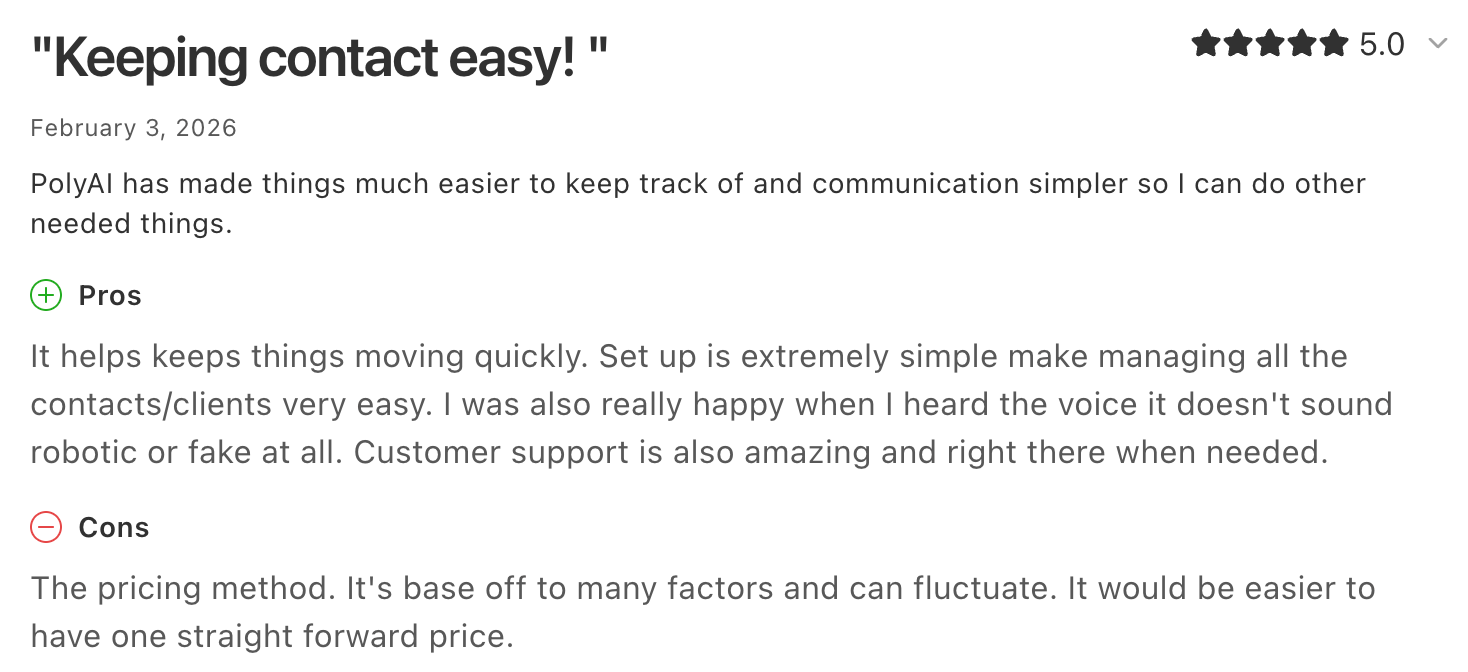
- Users often praise its natural, low-latency voice. For example, the reviewer from Capterra below said it sounded very human-like
Why choose PolyAI over Fin AI
Your primary requirement is reliable, enterprise-grade voice automation for nuanced customer interactions.
4. NICE Cognigy
NiCE Cognigy is an AI layer within NICE’s CXone ecosystem, supporting conversational AI, workflow orchestration, and automated customer-service interactions.
Highlights
- AI agents for phone, voice, chat, and messaging, available 24/7, so global customers get consistent service
- Offers an AI Agent Studio, Knowledge AI, Voice Gateway, and Agent Copilot for building and running agents
- Named a Leader in The Forrester Wave™: Conversational AI Platforms for Customer Service, Q2 2026
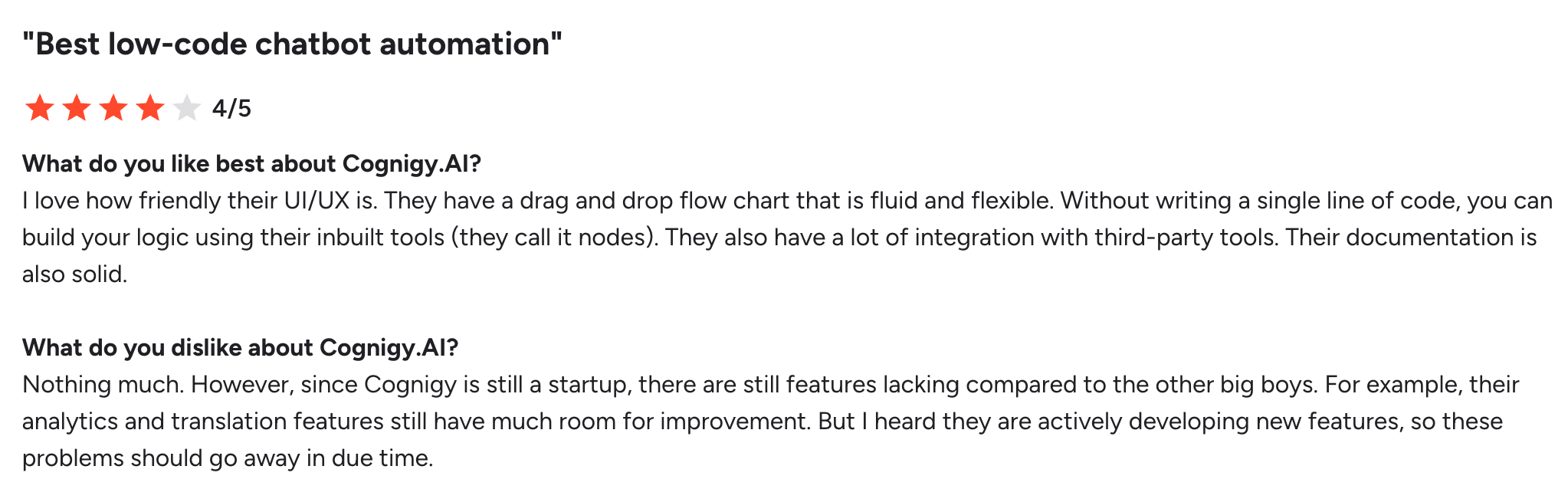
- Users (like the G2 reviewer below) value its no-code ease of use
Why choose NICE Cognigy over Fin AI
You need enterprise-grade workflow orchestration and technical control, rather than primarily knowledge- and FAQ-driven automation.
5. Decagon
Decagon is an AI customer-service platform for building, deploying, testing, and optimizing autonomous agents. Its core approach converts knowledge documents and SOPs into Agent Operating Procedures (AOPs) that define how the agent behaves.
Highlights
- AI agents for chat, voice, and email, so digital-first teams can automate across their core channels
- Agent Operating Procedures for natural-language workflow definition and fast iteration
- Its testing, QA, “Watchtower”, insights, and reporting let teams observe and improve the AI agents
- Users, like the G2 reviewer below, consistently cite its ease of implementation and responsive support

Why choose Decagon over Fin AI
You need fast, branded automation with structured control over agent behavior and iteration.
Related: The best Decagon competitors
Final thoughts
Fin AI is a strong chat-first AI agent, and for many digital-first teams it resolves a large share of support volume quickly.
But the right question isn't which AI agent has the highest containment rate. Containment measures throughput, not whether you understand why customers called, what broke during automated sessions, or how well human agents perform on escalations.
Enterprise CX needs three things working together on one layer: automation for the conversations neither party wants, augmentation for the moments that need a human, and intelligence that analyzes every conversation. When those run as three disconnected tools, insight doesn't reach the agent and AI agents don’t learn.
There's also a structural shift to weigh. With Fin AI now part of Salesforce, it's tied to Salesforce’s CRM, and its roadmap now follows Salesforce's priorities, which may not align with yours.