Fin AI vs Sierra: How to compare them

- Choose Fin if you run a chat-led, small, or mid-market support team and want a self-serve agent that works with your current helpdesk
- Choose Sierra if you're a large enterprise that needs deep action-taking across back-end systems and production-grade voice, and you can take on a custom deal and complex setup
- Both bill by outcome, so budget predictability depends on how well you can forecast resolution volume and how clearly "resolution" is defined
- Choose Cresta, our AI operating system for CX, if you want AI agents built from your real conversations plus human-agent augmentation and analysis of every conversation on one platform
If you want an AI agent to resolve customer conversations end to end instead of deflecting them, you'll likely consider Fin AI (or Fin) and Sierra.
Fin is quick to launch, reaches a wide range of channels, and likely works with the helpdesk you already use. However, its per-outcome billing grows with volume and is hard to forecast. And with Salesforce's acquisition now closed, there’s uncertainty on its roadmap over the coming months.
Sierra is built for large enterprises that need an agent to take real actions, like processing returns or updating plans, across voice and digital channels. Some of its top drawbacks include a complex setup and little independent review evidence to check its claims against.
To help you compare the platforms, we'll go deep on their pros and cons. But first, let's break down how we analyzed both platforms.
How we compared Fin and Sierra
Our comparisons draw on analyst reports from Forrester and Gartner, user reviews from third-party sites like G2 and TrustRadius, and conversations with hundreds of prospects and customers.
We scored both platforms against six criteria:
- Depth of action-taking: an agent that only answers questions deflects contacts, while one that can process a return or authenticate a caller resolves them, which decides how much volume you can automate
- Voice readiness: if phone is your largest or most expensive channel, latency, interruption handling, and noise tolerance decide whether automation works there at all
- Deployment model and stack fit: a self-serve or vendor-built setup decides who owns the agent and how fast it changes, while integration depth with your CCaaS, CRM, and back-end systems decides whether you'll need to migrate off tools you already run
- Pricing model and cost predictability: outcome-based pricing ties cost to value, but you can only budget for it if "resolution" is clearly defined and your volume is forecastable
- Testing, governance, and oversight: at enterprise scale, your trust in an agent depends on pre-release testing, guardrails, versioning, and live monitoring more than demo quality
- Coverage of human agents and analytics: most of your contact volume still involves people, so a platform that also augments agents and analyzes every conversation saves you from adding tools
Learn how Cresta's AI approach differs from both.
Fin overview
Fin is an AI customer service agent that resolves queries across live chat, email, WhatsApp, SMS, phone, Slack, and more. It allows teams to train, test, deploy, and analyze the agent in one workspace, using Procedures for multi-step workflows and Copilot as a separate inbox assistant for human agents.
Pros
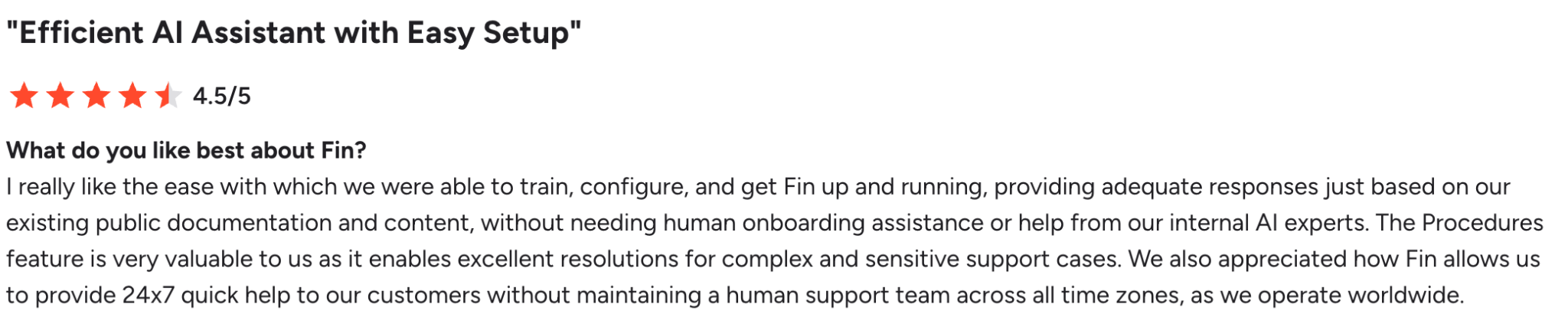
- Users (like the G2 reviewer below) often cite the agent’s deployment flexibility as a key benefit

- You don't have to migrate. Fin can run on Intercom's helpdesk or standalone with Zendesk, Salesforce, HubSpot, and Freshdesk
- Pricing is public. Fin publishes $0.99 per outcome with a 50-outcome monthly minimum, and Copilot costs $29 per agent per month billed annually
- Its Procedures feature can handle harder cases. The G2 reviewer below goes further and claims that that the feature can also handle “sensitive” cases
Cons
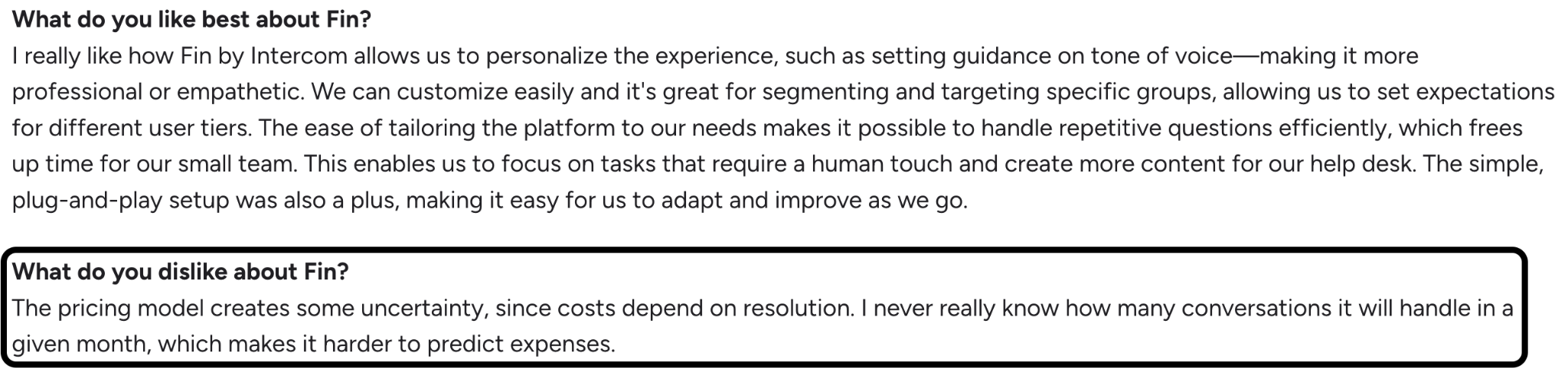
- Many users (like the G2 reviewer below) says that costs can be hard to forecast, making it difficult to set a budget for the tool
- Fin is built around digital support, so enterprise voice and human-agent coaching aren't its core focus
- Standalone deployments give up some depth. The G2 reviewer below, for example, explains that reporting and customization capabilities depend on the level of adoption of the Intercom suite
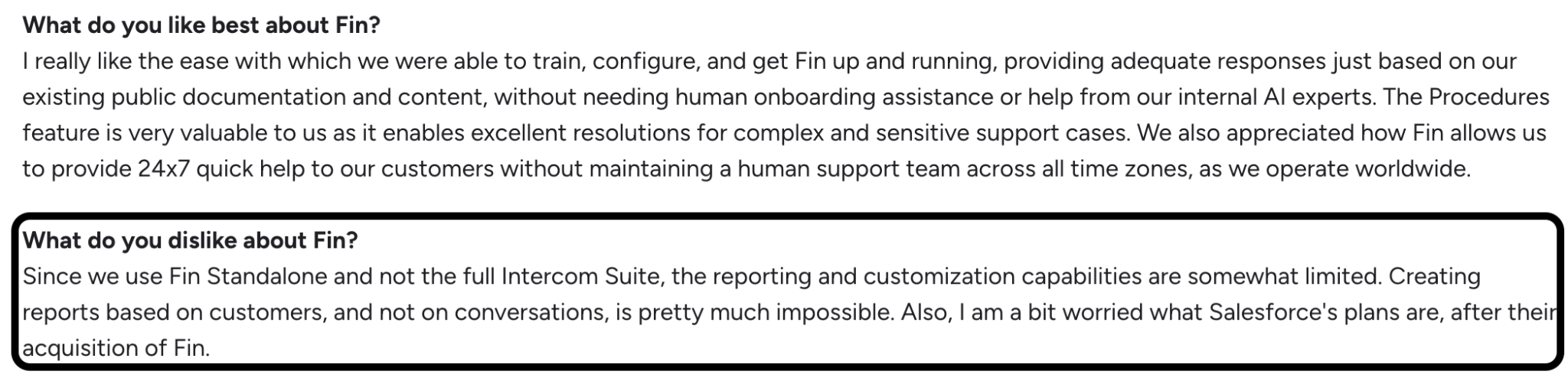
- The roadmap is in flux. Salesforce just closed its acquisition and positions Fin alongside Agentforce rather than as a replacement. Whether that positioning holds and what it means for Fin long term is still an open question
Related: The top alternatives to Fin AI
Sierra overview
Sierra is an enterprise AI agent platform that handles customer interactions end to end. Its products include Agent OS, Agent Studio, Ghostwriter (an agent that builds agents), Insights, Explorer, and Horizon.
Sierra covers voice, chat across web, app, WhatsApp, Apple Business Chat, and SMS, plus email and Live Assist.
Pros
- Voice AI is a core strength. Its AI agent’s low-latency voice handles interruptions, background noise, and accents, alongside broad chat and email coverage
- Strong business traction. Sierra raised a $950M Series E, which gives it a long runway and the resources to continue building its platform
- Forrester named Sierra a Strong Performer in The Forrester Wave™: Conversational AI Platforms For Customer Service, Q2 2026
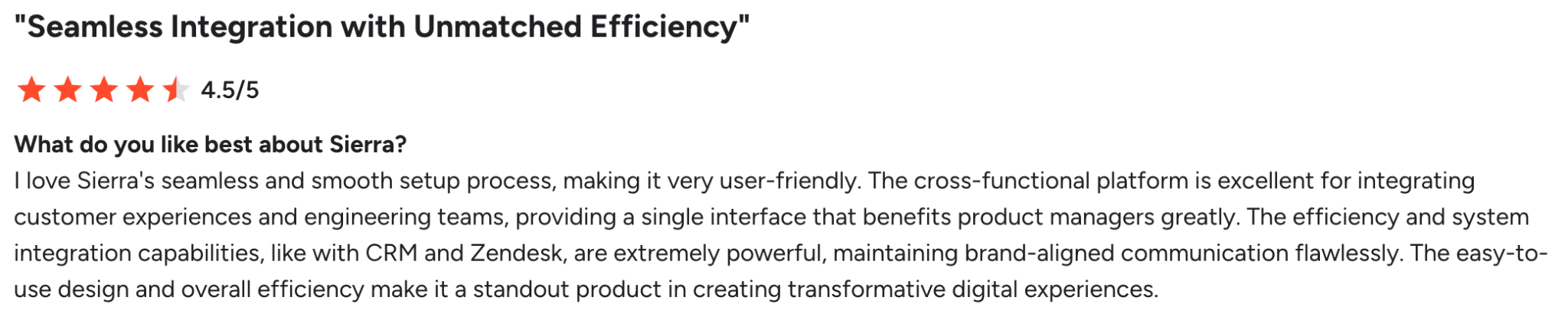
- Users (like the G2 reviewer below) often cite the platform’s ease of use, fast implementation, efficiency, and integrations as key benefits
Related: How Sierra compares to Parloa
Cons
- There's no public pricing, and every deal has to be custom negotiated
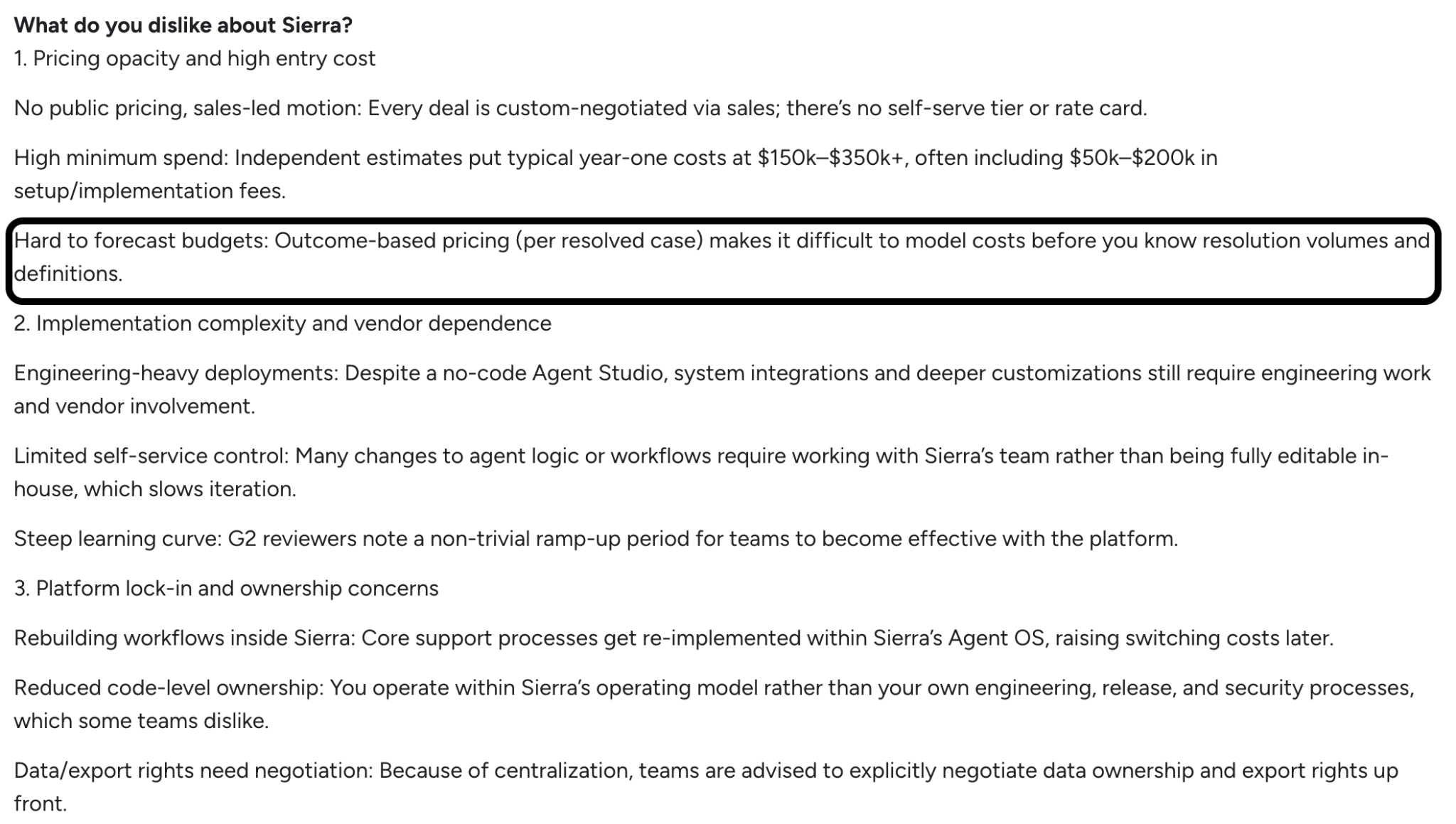
- Budgets are hard to model through their per-resolution pricing. The G2 reviewer below explicitly calls this out
- Their agent assist product (Live Assist) was recently bolted onto the platform, so it might not have the features and functionality your human agents want
- Sierra is built for large enterprises, so it may not be the right fit if you run a smaller team
Given all the pros and cons of each platform, it can be hard to decide between the two. We'll help you navigate the decision more directly in the next section.
Related: The top Sierra AI competitors to consider
Sierra vs Fin AI: Which should you choose?
Choose Fin if you're a small or mid-market team with chat-led, digital-first support. It fits when you want to own the agent yourself, launch fast, and keep Intercom, Zendesk, Salesforce, HubSpot, or Freshdesk as your helpdesk.
Choose Sierra if you're a large enterprise where the phone carries heavy volume and the agent needs to act inside CRM, billing, and order systems.
Both bill by outcome, so forecast your resolution volume and pin down how each vendor defines a resolution before you sign.
Don't settle for Fin or Sierra
Cresta is the AI operating system for CX. It enables both AI agents and human agents to run on the same conversation data.
Here's just a few areas where Cresta differs from Fin and Sierra:
- We build AI Agent from your real conversations so it sounds like your best agents and handles edge cases from day one. Fin has you train its agent and build Procedures by hand, and Sierra's Ghostwriter builds agents from SOPs and scripts, not your actual conversations
- Our AI Agent, Agent Assist, and Conversation Intelligence share one platform that analyzes 100% of your conversations. Fin pairs its agent with Copilot, a separate inbox assistant, and Sierra is heavily focused on AI agents
- We work on top of your existing CCaaS and CRM, so you don't migrate. Fin is oriented around helpdesks and now sits in Salesforce's portfolio, while Sierra's vendor-managed deployment can take months to wire into those same systems and their team is required for most changes