
The top 10 AI call center companies in 2027


- AI call center software automates routine contacts, augments human agents in real time, and analyzes every conversation. Most vendors are strongest at one of those jobs
- Use Cresta to unify human and AI agents, NICE CXone for workforce depth, Genesys for omnichannel orchestration, Five9 for cloud migration, Talkdesk for speed, Observe.AI for QA, and Retell AI for developer-built voice
- Evaluating the software successfully testing its transcriptions, guardrails, integrations, and AI agent-to-human handoff during the pilot
AI is fundamentally changing the work inside your contact center.
In our 2026 CX Workforce Report, over 9 in 10 of the 300 CX leaders surveyed say human-led interactions are getting more complex, and 97% say AI has freed people for higher-value work.
To help your human agents handle increasingly complex conversations and to make the most of AI agents across your operations, you’ll need to leverage AI call center software.
But not all AI call center companies are built equal.
Some are strongest at routing, workforce management, and cloud infrastructure, while others lead on autonomous voice automation, real-time agent guidance, or quality analysis.
To help you pick the best AI call center company for your business, we'll evaluate 10 top platforms. But first, let's align on how AI call center companies typically work.
Note: This article was updated on 10/29/2026. The information below can change in the future.
What is an AI call center company?
It's a provider whose software uses artificial intelligence to handle, assist, and/or analyze customer calls and digital conversations.
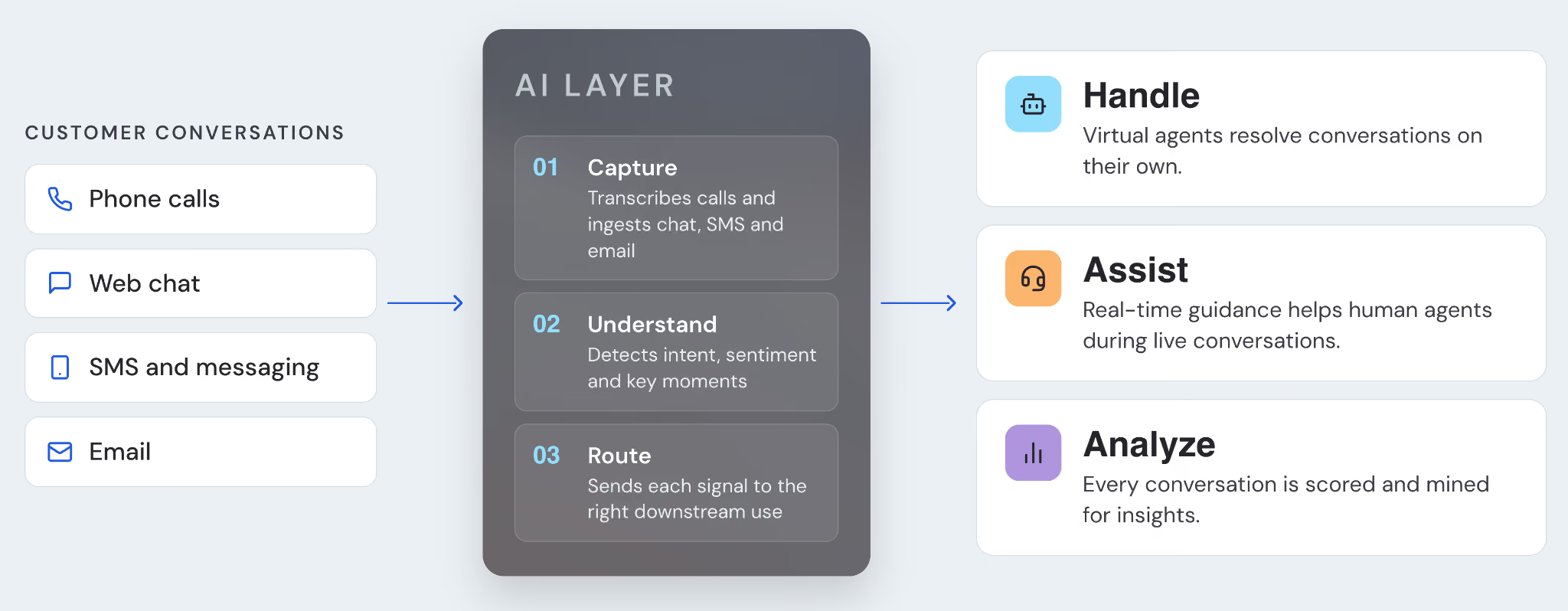
A few terms show up again and again. Here's what they mean in plain language:
- AI voice agent: software that talks with a customer over the phone and completes a task on its own, like verifying an account
- Agent assist: real-time AI that listens during a live call and gives the human agent answers, prompts, and next steps
- Conversation intelligence: AI that reviews conversations to score quality, surface trends, and guide coaching
- CCaaS (contact center as a service): cloud software that runs the core contact center, including call routing, queues, and reporting
It’s worth noting that the AI call center company category has shifted. Early tools were scripted chatbots and keyword spotters. Today's agentic AI understands intent and takes action across a full conversation.
How we evaluated the top AI call center companies
We evaluated each platform using third-party reviews on G2, analyst reports, product documentation, and our conversations with customers and prospects.
Using these inputs, we evaluated each vendor across the following criteria:
- Where it fits in the call center: routing and infrastructure, autonomous resolution, real-time guidance, or analysis and QA
- Trained on your conversations: whether the AI learns from your real interactions or runs on a generic model
- Human handoff: how well calls escalate to a person with full context
- Safety and oversight: testing, monitoring, and controls for anything customer-facing
- Stack compatibility: fit with your existing CRM and CCaaS platforms
- One connected loop: whether analysis, automation, and augmentation work from a single shared record
Here's how the companies performed across this criteria:
The top AI call center companies
Let’s take a closer look at your options.
1. Cresta
Cresta is the AI operating system for CX.
It analyzes, automates, and augments customer conversations on one platform. Its models are also trained on each customer's own conversations, not generic off-the-shelf models.
It's best for enterprises that want automation and real-time human augmentation on one platform.
Key AI call center features
- AI Agent for autonomous voice and digital resolution, with guardrails, testing, and live oversight
- Agentic Assist for real-time guidance, knowledge, and summaries that augment human agents
- Conversation Intelligence that analyzes 100% of conversations for quality management and coaching
- Behavioral recognition that reads intent through context and comprehension, not keyword matching
- Cresta Opera, the no-code engine for building, testing, and deploying AI workflows
What reviewers say
G2 reviewers say real-time coaching substantially lifts agent productivity and makes every call reviewable.

Watch Cresta analyze, automate, and augment your calls in a live demo.
2. NICE CXone
NICE CXone is a mature CCaaS platform that solves the enterprise backbone: routing, workforce management, and compliance, with AI layered across it.
It's a strong incumbent for large operations that need depth in workforce optimization, though that breadth can mean added complexity and a longer rollout.
It's best for large, regulated operations that need proven scheduling, forecasting, and compliance depth.
Key AI call center features
- CXone Mpower Autopilot, an intelligent virtual agent for voice and digital self-service
- CXone Mpower Agents, built from natural-language prompts and deployed across Copilot and Autopilot
- CXone Mpower AutoSummary for generative interaction summaries
- Interaction Analytics with Enlighten AI for CSAT
- Analytics-driven quality management that targets the most impactful interactions
What reviewers say
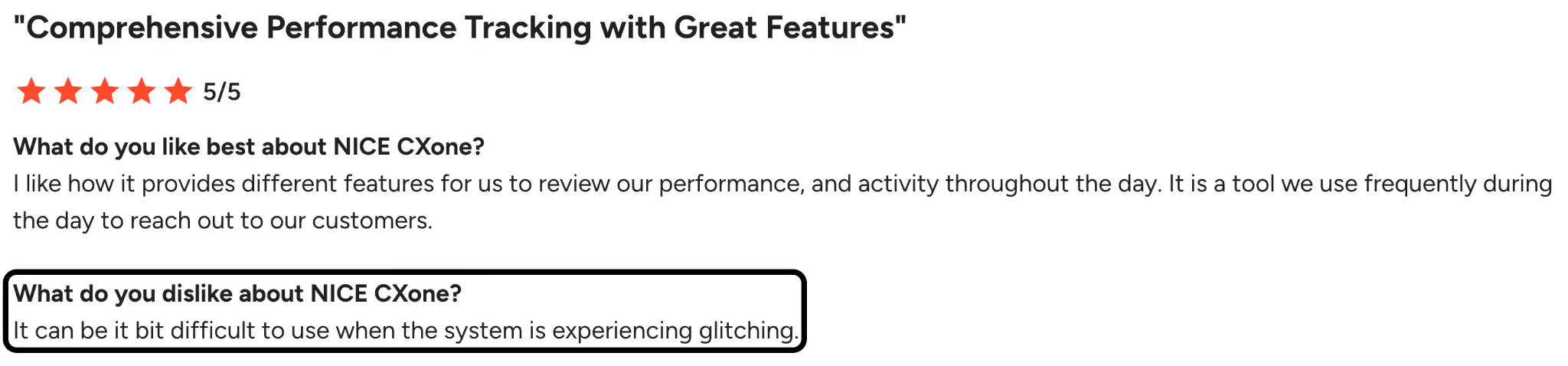
G2 reviewers find the platform easy to navigate and like having calls, scheduling, and performance tracking in one place.

That said, a recurring complaint is occasional lag, glitches, and dropped calls that interrupt agents' work.
Related: The top NICE CXone alternatives
3. Genesys Cloud CX
Genesys Cloud CX is orchestration-first. It solves omnichannel journey orchestration, tying voice and digital channels together with AI-assisted routing so a customer's path stays connected across touchpoints. That depth takes configuration investment to get right.
It's best for complex, multi-channel enterprises coordinating many contact types.
Key AI call center features
- Agentic Virtual Agent that plans and runs multi-step workflows within guardrails
- AI Studio, a no-code space for building virtual agents, including AI Guides
- Agent Copilot and supervisor copilot for real-time knowledge, next-best actions, and auto-summaries
- A virtual agent performance dashboard with intent tracking and audit trails
What reviewers say
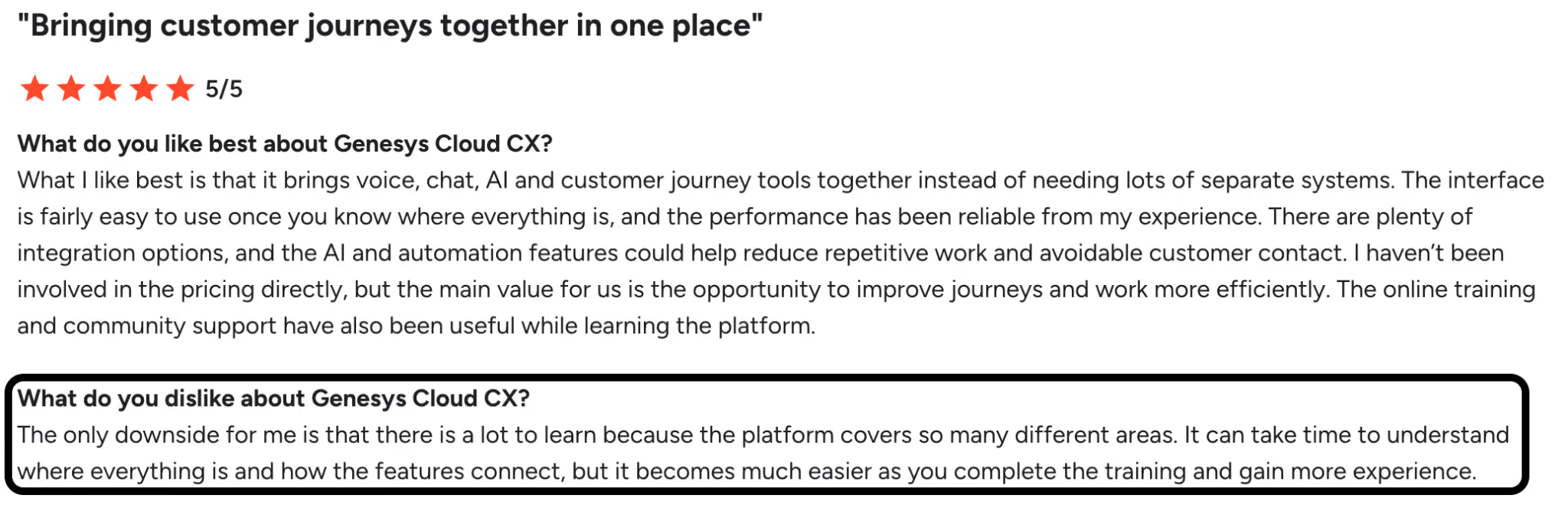
G2 reviewers value the flexibility to build complex routing, IVR, and AI-driven automation on one omnichannel platform.
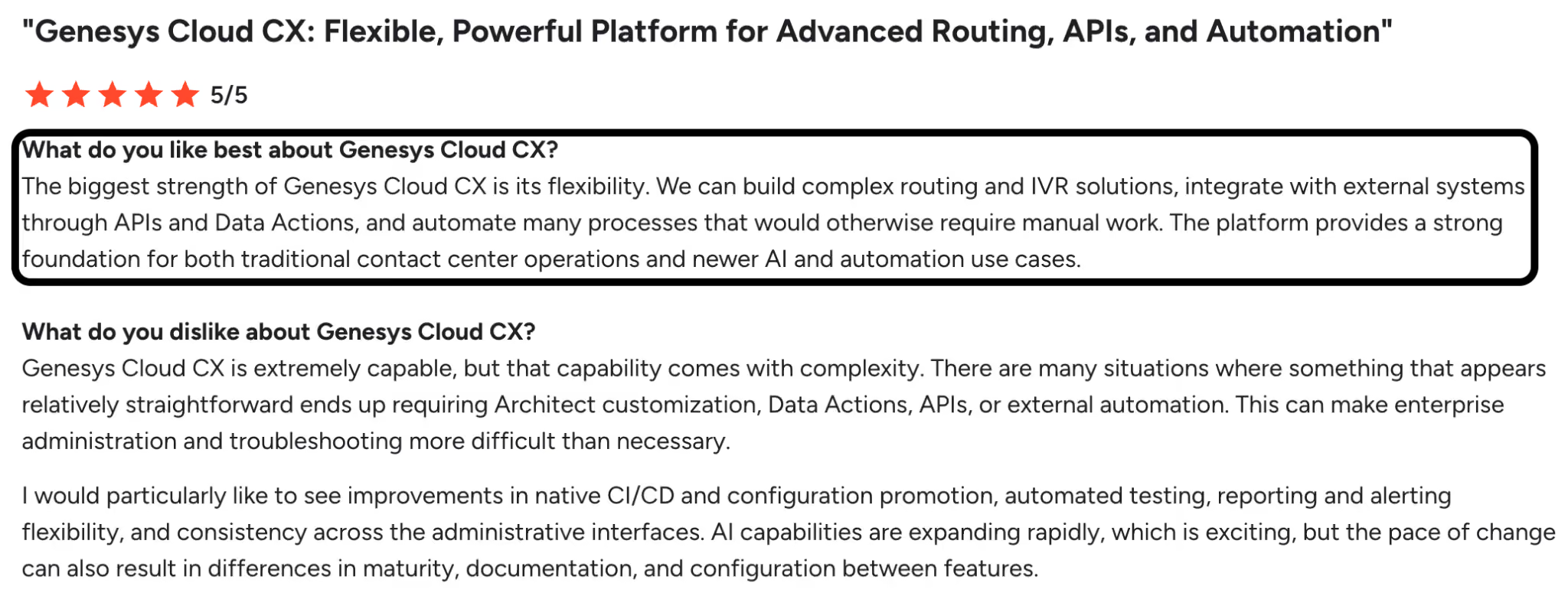
However, its depth brings complexity and a long learning curve.
Related: The top Genesys alternatives
Five9
Five9 is a cloud CCaaS platform that solves core contact center operations. It uses intelligent virtual agents (IVAs) and workflow automation to handle routine, high-volume contacts.
It's best for high-volume operations modernizing legacy infrastructure.
Key AI call center features
- Genius AI suite across the platform
- Voice AI Agents and IVAs that resolve multi-step requests and escalate with context
- AI Agent Assist with real-time transcription and guidance cards
- AI Summaries customizable in GenAI Studio
- Agentic Quality Management that can evaluate up to 100% of interactions
What reviewers say
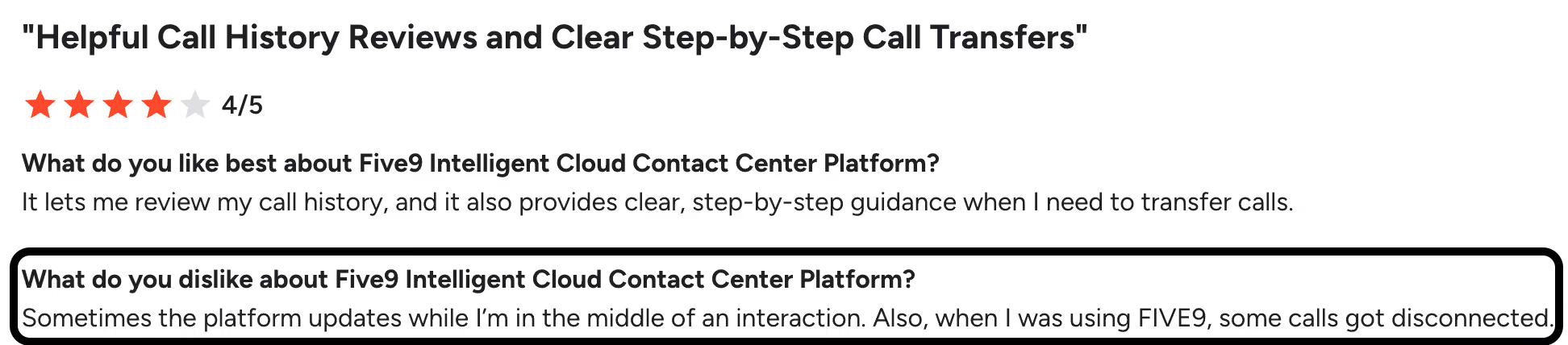
G2 reviewers say the platform is easy to learn, with strong support and integrations.

That said, recurring complaints are dropped calls, lag, and connectivity problems.
Talkdesk
Talkdesk offers flexible AI and easy integrations, which appeals to teams that lean on analytics-driven engagement. That breadth can favor coverage over specialized depth.
It's best for teams that value speed and quick analytics-driven deployment.
Key AI call center features
- Customer Experience Automation (CXA), an agentic AI platform that works with Talkdesk or third-party contact centers
- Copilot (formerly Agent Assist) for live transcription, answers, and next-best actions
- AI Trainer for human-in-the-loop tuning and guardrails
- Interaction and Quality Analytics
What reviewers say
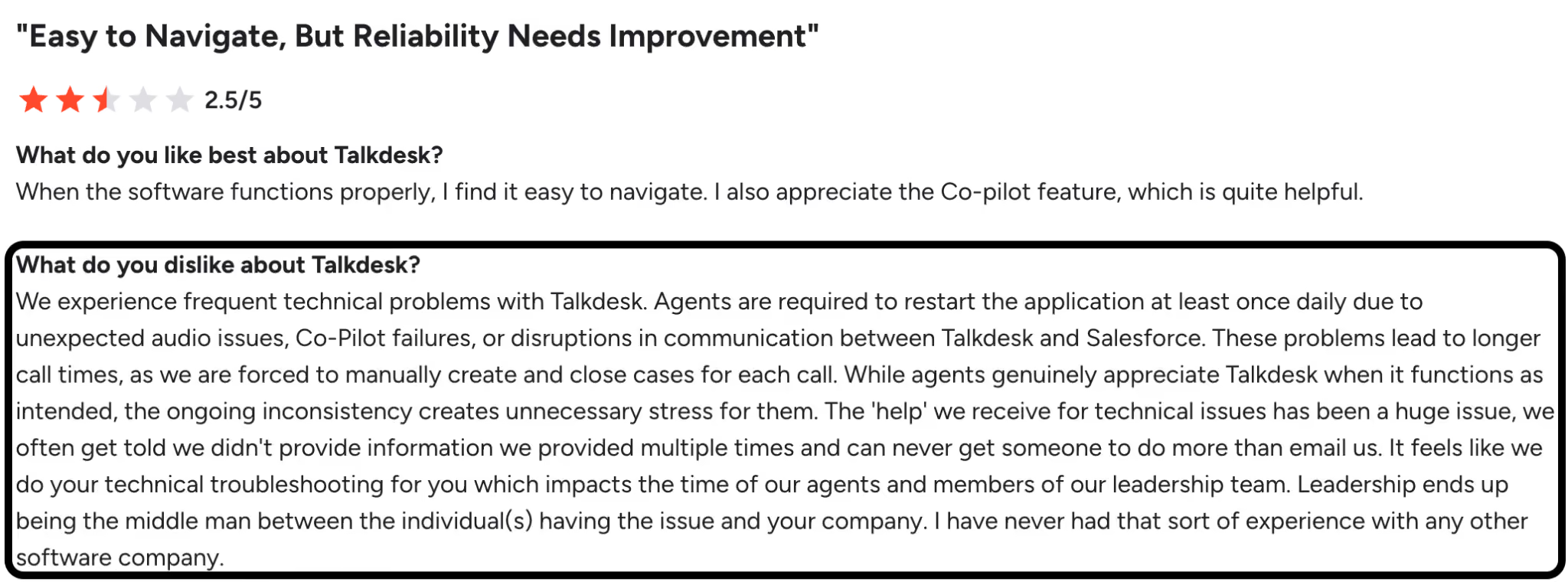
G2 reviewers find the platform easy to learn and say its AI guidance and transcripts make agents more confident.
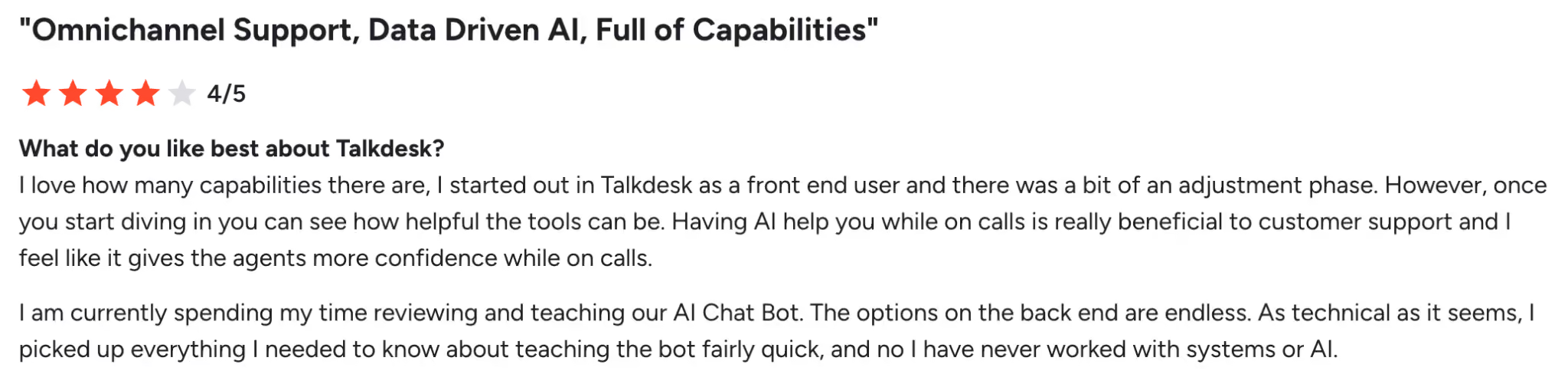
However, recurring complaints are calls that don't connect and issues with support.
Related: The top Talkdesk alternatives
Observe.AI
Observe.AI focuses on the analysis and QA job. It solves conversation intelligence and quality management by scoring conversations, surfacing insights, and feeding coaching. But its center of gravity is analysis rather than autonomous resolution.
It's best for teams prioritizing quality assurance at scale.
Key AI call center features
- VoiceAI Agents built to replace legacy IVRs
- Real-time agent assist with smart scripts, alerts, and compliance reminders
- Auto QA that assesses 100% of interactions
- Conversation intelligence with automatic PII detection and masking
What reviewers say
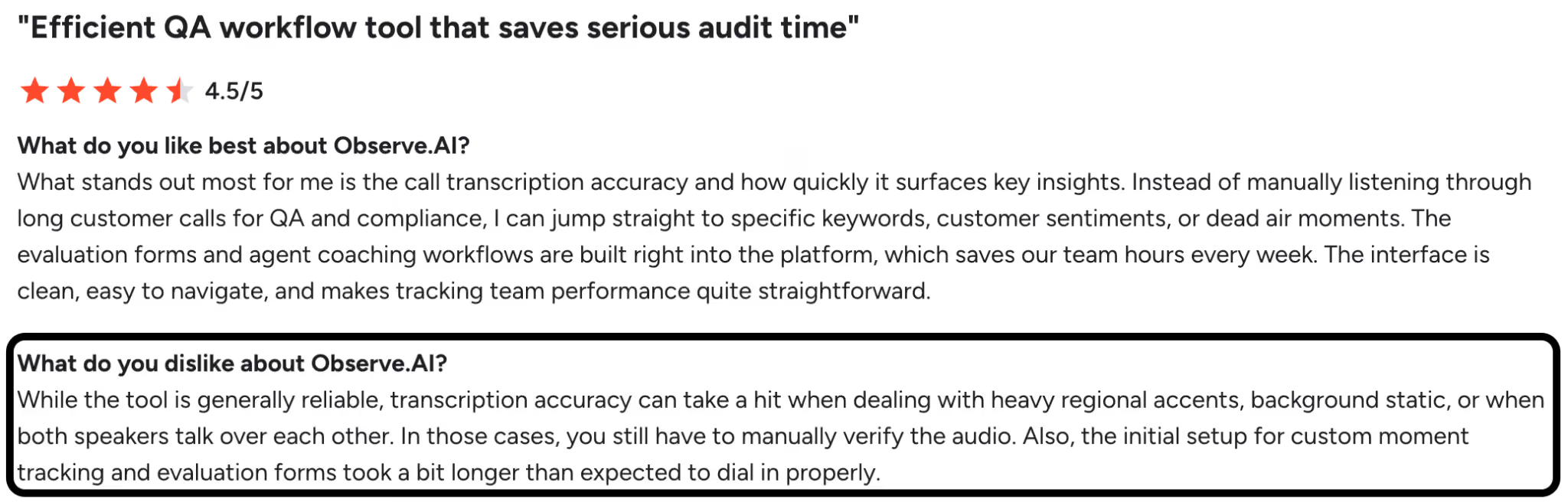
G2 reviewers say automated QA and conversation analytics let them review far more interactions with less manual effort.
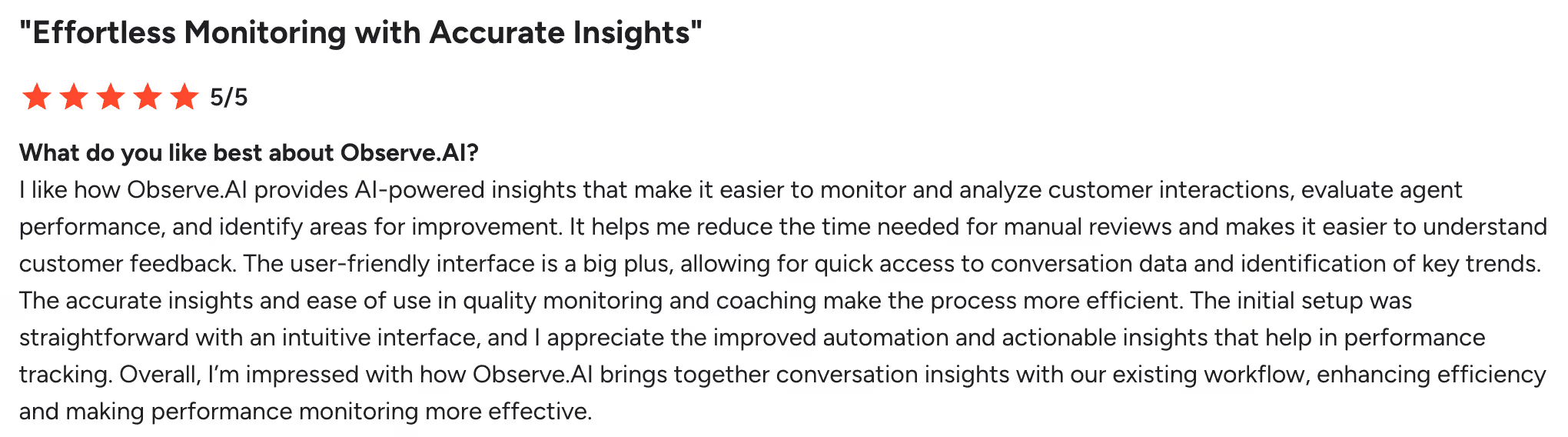
But many reviewers complain that transcription and automated scoring lose accuracy with accents, noisy audio, or complex conversations.
Related: The top Observe.AI alternatives
Retell AI
Retell AI is built for developers. It solves autonomous voice automation for teams that want to build and run their own phone agents. The tradeoff is ownership: you build and maintain the agent, and enterprise governance becomes your responsibility.
It's best for technical teams that want hands-on control over their voice AI.
Key AI call center features
- Voice agents built as prompts or conversation-flow graphs
- Cold, warm, and agentic warm call transfer to humans
- A knowledge base retrieved mid-call
- Post-call analysis and pre- and post-call functions
- Batch outbound calls and custom telephony over SIP
What reviewers say
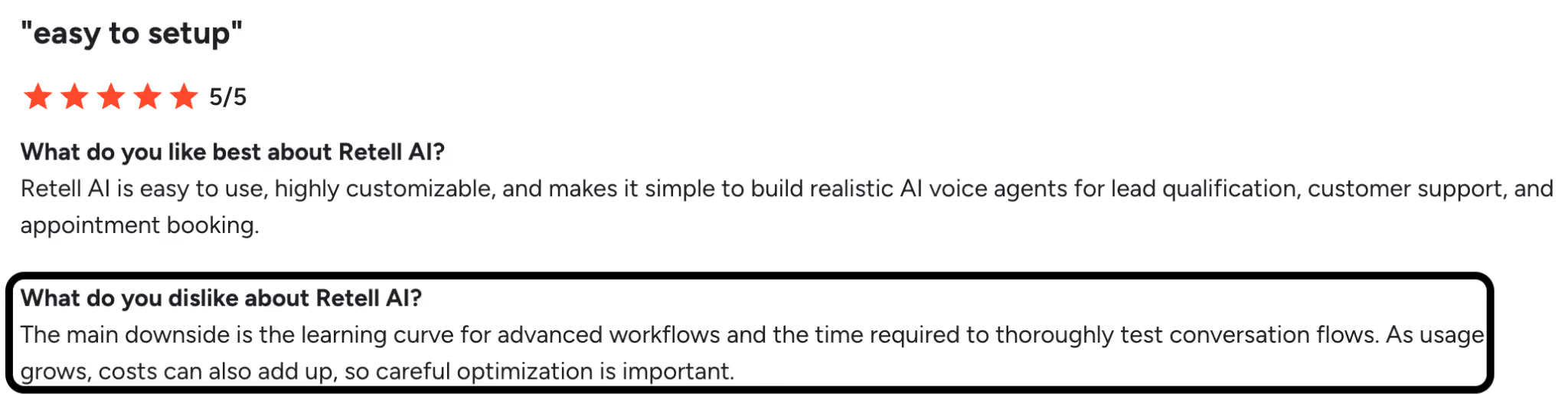
G2 reviewers say its voice agents are fast to build, with natural, low-latency conversations and easy integrations.
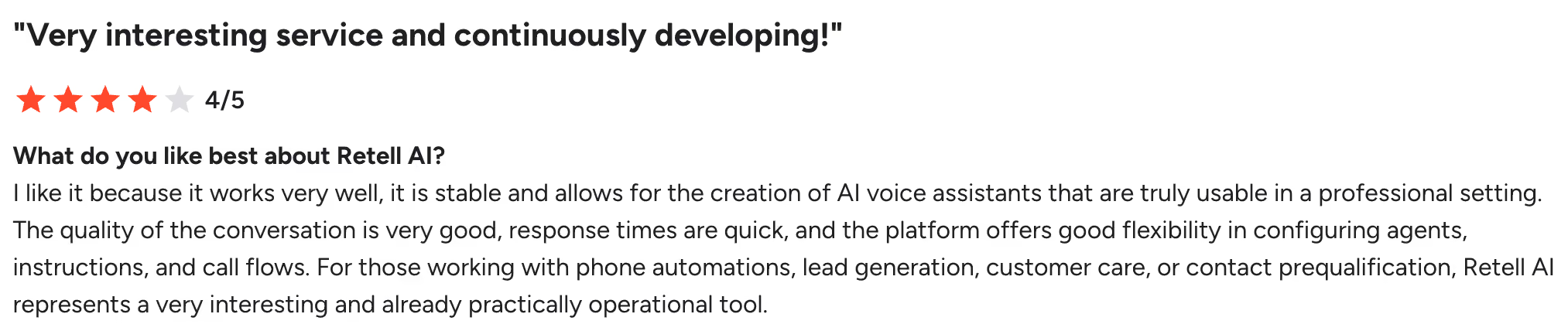
A recurring complaint is the learning curve for advanced flows and prompt tuning.
Salesforce Agentforce
Salesforce Agentforce solves the CRM-connected action layer. It lets AI agents act directly on customer records inside the Salesforce ecosystem, which is powerful when your system of record is already Salesforce. Its strength is also its boundary: it's strongest inside the Salesforce ecosystem.
It's best for Salesforce-centric organizations.
Key AI call center features
- Agentforce Contact Center, unifying voice, digital, CRM data, and AI agents
- Agentforce Service Agent for 24/7 self-service with escalation
- Agentforce Voice for real-time voice conversations on the same topics and actions
- Service Cloud Voice integration with third-party telephony
What reviewers say
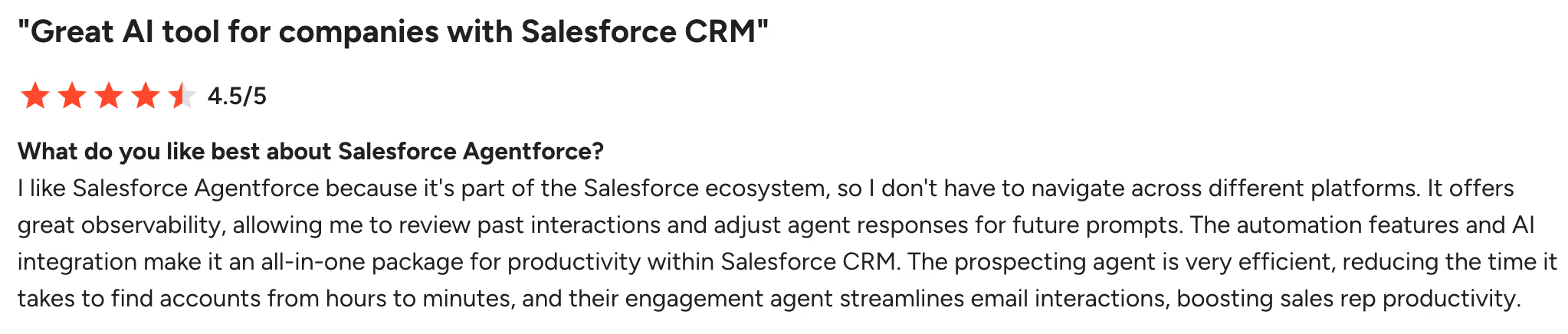
G2 reviewers value the fact that it lives within the Salesforce ecosystem so they don’t have to leave the apps they already use and that the AI agents can resolve routine questions and hand off complex cases.
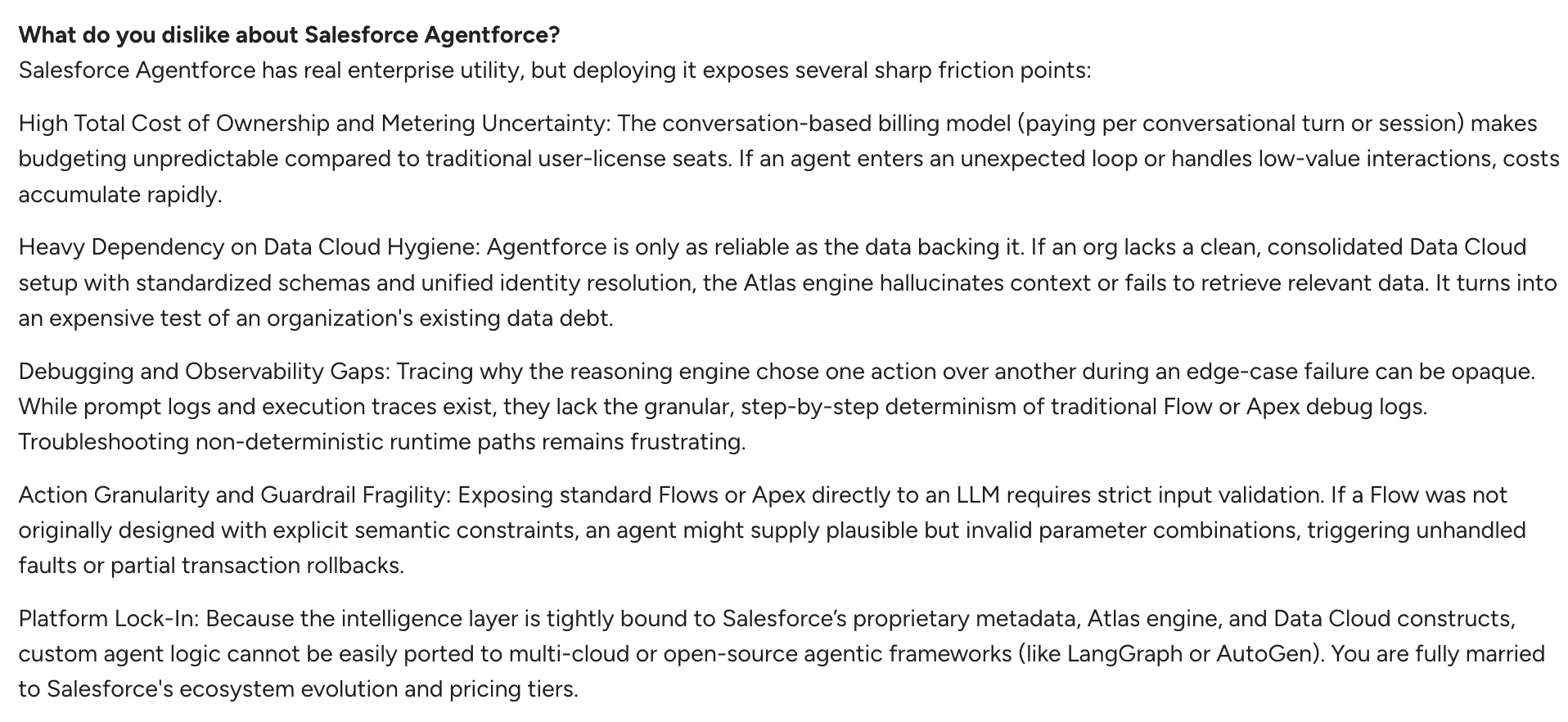
The tradeoff they report most is pricing complexity, observability gaps, and a strong reliance on Salesforce.
Amazon Connect
Amazon Connect solves the underlying layer with cloud telephony and infrastructure, plus modular AI services for speech, chat, and analytics.
It gives cloud-first teams the building blocks to assemble their own contact center. But getting from building blocks to a finished experience takes real engineering effort.
It's best for cloud-first teams that want to assemble their own stack.
Key AI call center features
- AI agent designer for first-party and custom AI agents
- Agentic self-service across voice and chat
- Amazon Q in Connect for real-time agent recommendations
- Contact Lens conversational analytics with redaction and summaries
- Performance evaluations for human and self-service interactions
What reviewers say
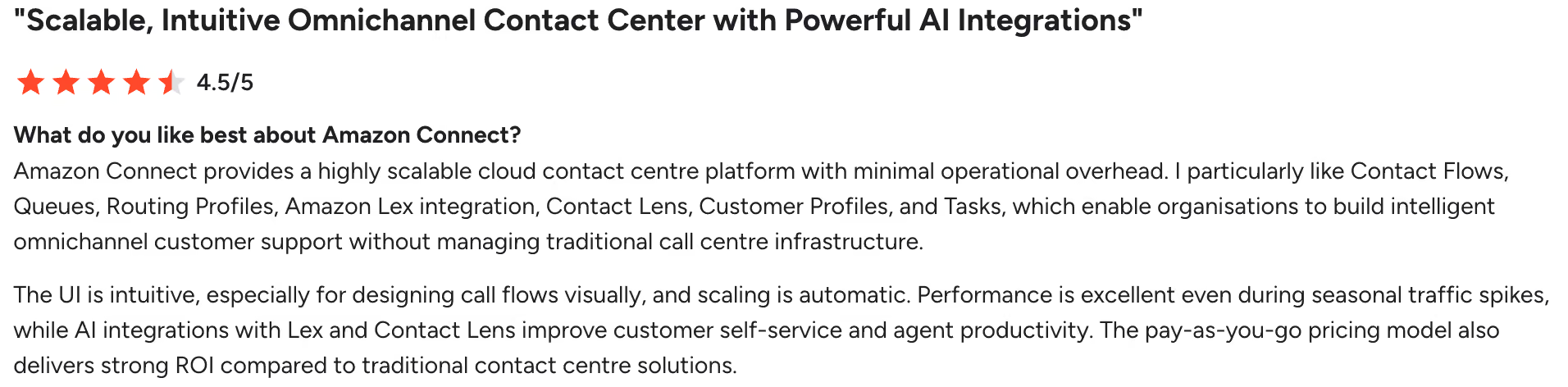
G2 reviewers like the automatic scaling, visual contact-flow builder, and native AI services.
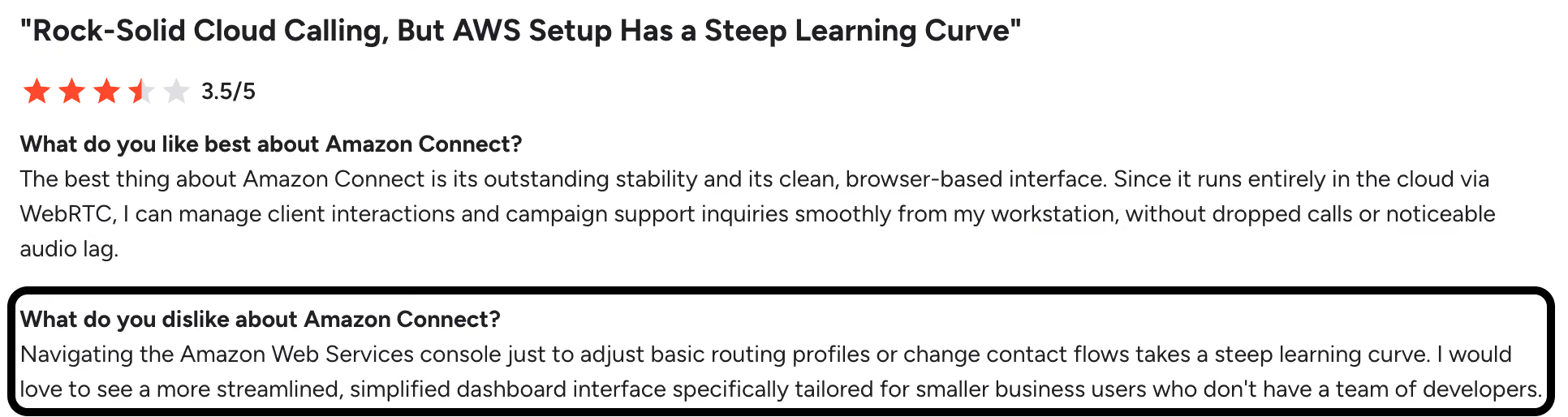
But non-technical teams without find setup and advanced configuration complex.
Dialpad
Dialpad is an AI-native communications platform. It solves unified communications with built-in real-time transcription and assist, packaged with the phone system itself, which fits mid-market teams well. But its bundled assist tends to offer less enterprise governance and model customization.
It's best for mid-market teams that want AI included with their phone system.
Key AI call center features
- AI Agent for 24/7 digital front-line support
- AI CSAT that predicts satisfaction from transcripts
- AI Live Coach Cards for real-time agent guidance
- AI Recaps for shareable call summaries
What reviewers say
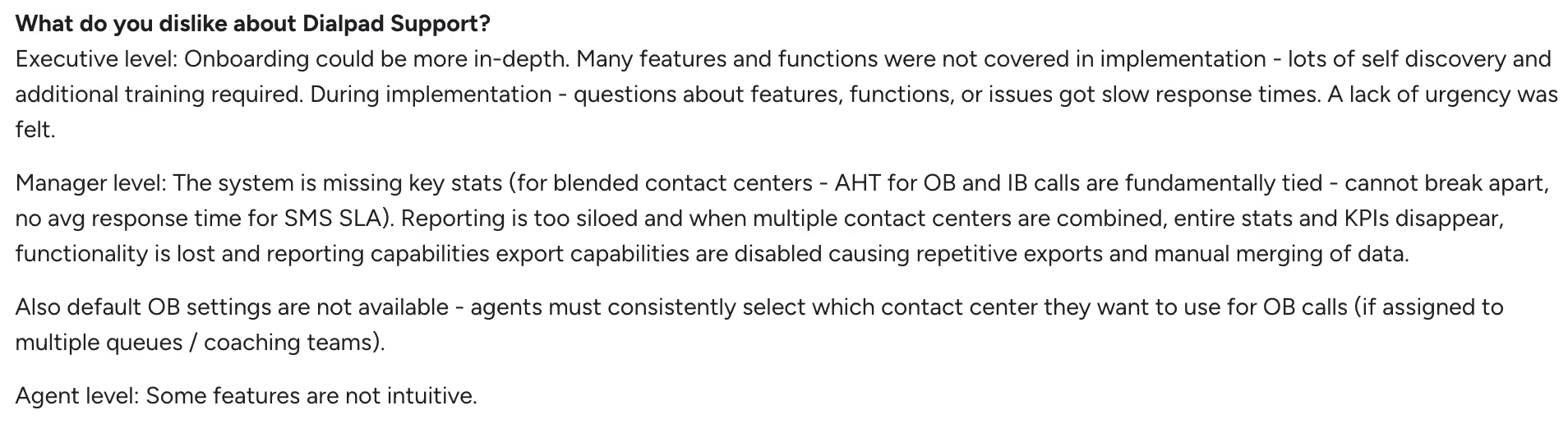
G2 reviewers find the platform easy to set up and say AI call summaries and transcripts save time on notes.
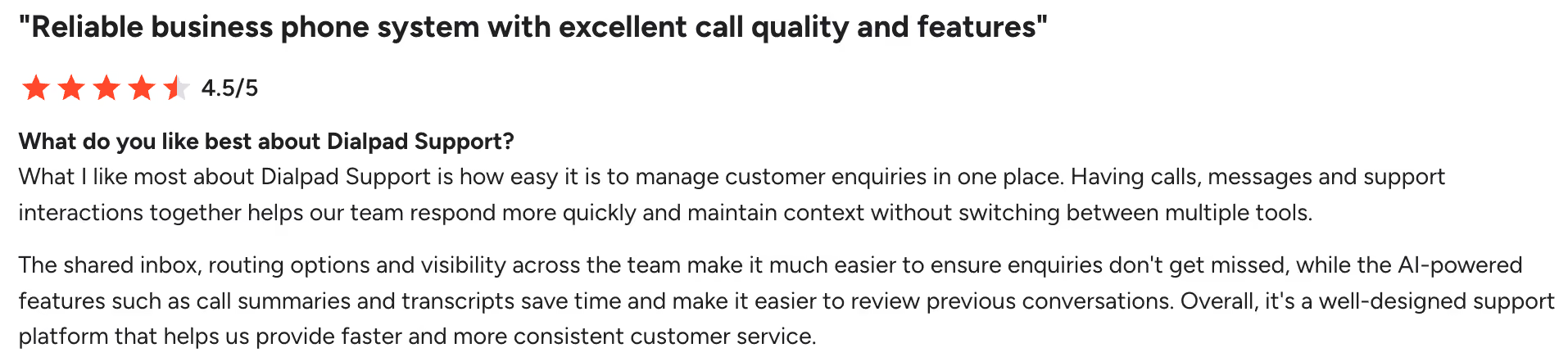
A recurring complaint is slow vendor support responses.
Evaluation checklist for AI call center companies
Once you've narrowed your shortlist, you can evaluate any AI contact center software using the criteria below..
Image idea: a one-page scorecard grid with the five criteria below as rows and shortlisted vendors as columns
Models trained on your conversations
Generic models break when customers go off-script, so you’ll need models fine-tuned on your own interactions that recognize behaviors and intent, not keywords.
When talking to vendors, ask whether they fine-tune on your data or only prompts a shared model, and how long customization takes. Also, confirm your data stays yours. Foundation model providers should be contractually barred from training on it, and each customer's models should be isolated from every other customer's.
Human control and escalation
High-emotion, judgment-heavy calls need people. To that end, you’ll need clean handoffs that carry full context to prevent customers from repeating themselves.
Check which transfer types the platform supports: cold (a direct handoff), warm (the AI introduces the human before dropping off), and conference (the AI stays on to brief the human, then exits).
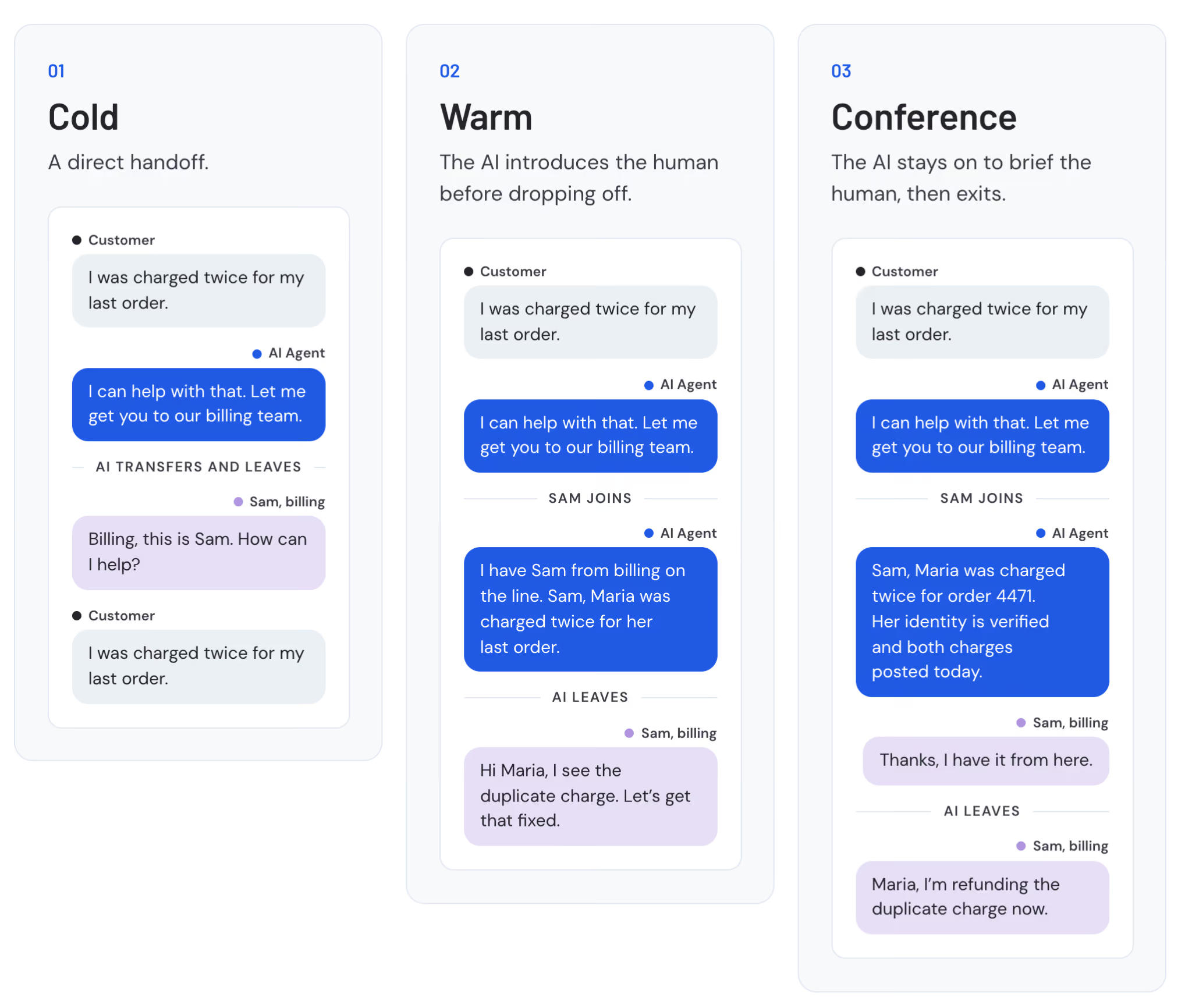
Then check what the human sees on arrival, such as a conversation summary, customer context, and recommended next actions, and whether guidance continues until the issue is resolved.
Guardrails, testing, and oversight
Look for two layers: rules written into the agent’s instructions, and separate guardrails that run alongside it and stop any response that breaks policy, such as prompt injection or medical and financial advice.
You should also ask to see testing in practice. This can take the form of simulated customers built from real conversation data, regression tests before every release, and a dry-run mode that logs violations on live traffic without interrupting calls.
Integration with your CRM and CCaaS
Look for native connectors that layer AI onto your current stack instead of a walled garden.
To help suss this out, ask vendors how audio and data reach the platform: A direct stream (such as Genesys AudioHook), a SIP trunk, or a PSTN bridge, depending on what your CCaaS exposes. Then confirm that summaries and dispositions flow back into your CRM and CCaaS, through an API or a push into downstream systems, and that the vendor works with your current telephony instead of replacing it.
A connected loop
Look for a solution that offers one conversation record powering QA, coaching, and live guidance.
The test is whether a finding in one place changes behavior in another, so ask the vendor to show how a quality issue found in QM scoring reaches the AI agent's guardrail configuration or training pipeline. And ask whether outcomes from escalated conversations flow back to improve automation.
Final thoughts
There's no single best pick among AI call center companies.
For example, you should choose a CCaaS platform like NICE CXone, Genesys, Five9, or Talkdesk when you want to replace core infrastructure. And you should pick Cresta when you want to add AI agents, real-time guidance, and quality analysis on top of the CCaaS and CRM you already run.
Whichever you choose, grade it on the checklist above and prove outcomes in a pilot before you commit.