


Why: Turn the Customer Journey Into a Compounding Automation Opportunity with AI Agents
Cresta has worked with financial-services customers including Propel Holdings, Snap Finance, and Aqua Finance, as well as Fortune 500 companies across lending, collections, debt resolution, and customer service workflows. Cresta’s AI Agent service enables automation on routine account management, payment inquiries, and application support across customer service, loan origination and servicing, and collections, helping improve containment, reduce handle time, expand self-service, and increase customer satisfaction.
Most teams frame "AI agent in the customer journey" as a single launch. It isn't; it’s a full maturity curve.
Most AI agent deployments are multi-phased, replacing existing phone trees, similar to the “front desk” in a hotel of your customer’s journey. Then you commonly build out more self-service use cases in following iterations: the AI agent becomes the concierge while also taking over your human agents’ repetitive operations. Not only does this improve customer experience and the everyday life of your human agents, it also opens time and resources for agents to tackle the harder customer inquiries.
Traditional phone trees, IVRs (Interactive Voice Response) systems, across most of our customers get about 20% to 30% containment. The Replacement of these systems agentic AI agent deployments commonly go like this:
First, in our experience replacing the IVR you already have, gets you to about 40% containment. Commonly this bump in containment comes from the personalization, conversational nature and the ability to reason through complexity. Post launch, you can evaluate your new human agent traffic and this is where the value begins to compound. From there, teams often go back and build workflows for the highest-volume, more complex and easily automated call topics, commonly elevating containment to 60% to 85% in subsequent phases.
The phases look similar from the outside, but produce compounding outcomes, like a snow ball rolling down a hill.
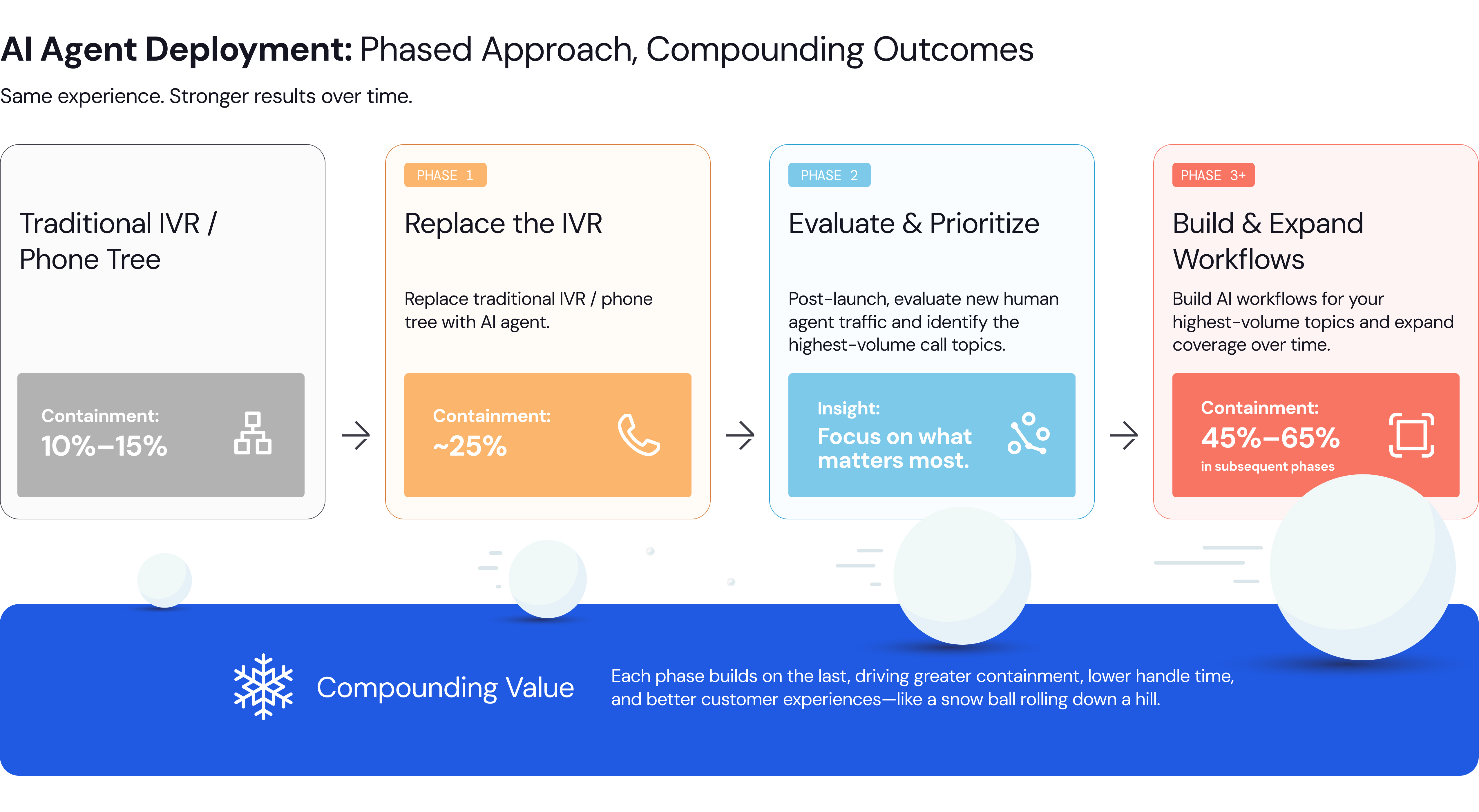
Across this two-part series, we'll lay out the pattern and what we've commonly seen in each phase: the IVR replacement here, and the phases where the value actually compounds in Part 2.
First, a caveat on the numbers themselves. Nearly every figure in this series is a containment or service-level metric, and containment is the easiest number in the contact center to accidentally inflate, so it's worth agreeing on what counts before we get to what changed.
Simply put, containment in AI agents is the percentage of customer interactions that the AI agent resolves without transferring to a human. It is the truest measure of self-service effectiveness, and the primary lever for reducing contact centre operational costs at scale.
Measure it Honestly-Or the Win Evaporates Under Scrutiny
Three lessons we had to learn repeatedly, offered so you don't have to:
- Exclude weekends and after-hours. When human queues are closed, nothing can transfer, so containment reads 90–100% by default. Those aren't wins, they're artifacts. Compare weekday to weekday, and strip any "transfer blocked after hours" bucket before you quote a rate.
- Containment is not resolution. An unlabeled or "no value" outcome usually hides abandonment (people who hung up). Counting a hang-up as containment inflates the agent and eventually gets caught. Track resolved and self-service separately as your defensible number.
- Watch the composition, not just the headline. When a metric jumps, decompose it. If containment rose 11 points but resolution rose 4, say so. Stakeholders trust the smaller, honest number far more than the big one that doesn't survive a follow-up question.
Why Phase It At All: Smaller Blast Radius, Faster Cadence
Before the phases themselves, let’s explore the case for phasing AI agent releases. Sequencing isn't only about stacking value, it's about lowering risk.
Every release into a live contact center can break something customers feel within minutes, so the goal is to change as little as possible per step. Along with regression testing, Cresta Synthetic Customer testing, and User acceptance testing (UAT), a phased rollout shrinks the blast radius: each release touches one well-understood slice of the call flow, which means you can hyper-care it.
You can watch that single flow intently for the first few hours, catch a regression or edge cases while they are small, and roll back one feature instead of an entire system. 20 things going live at once means 20 suspects when something moves the wrong way; one flow at a time means you always know what changed.
It also builds the thing that matters more than any single launch: a release cadence. Once you've scoped, shadow-tested, launched, watched, and widened one flow, the next follows the identical path.
That rhythm turns "the AI project" from a high-stakes bet into routine delivery, and it's the difference between a team that ships one impressive demo and one that compounds improvements every few weeks.
The batch-by-batch cutover leaves a visible fingerprint in the data, too: containment shifts as each new flow goes live, which is exactly what a controlled, one-piece-at-a-time rollout should look like.
Stay tuned for Part II next week!
Frequently asked questions





.avif)