
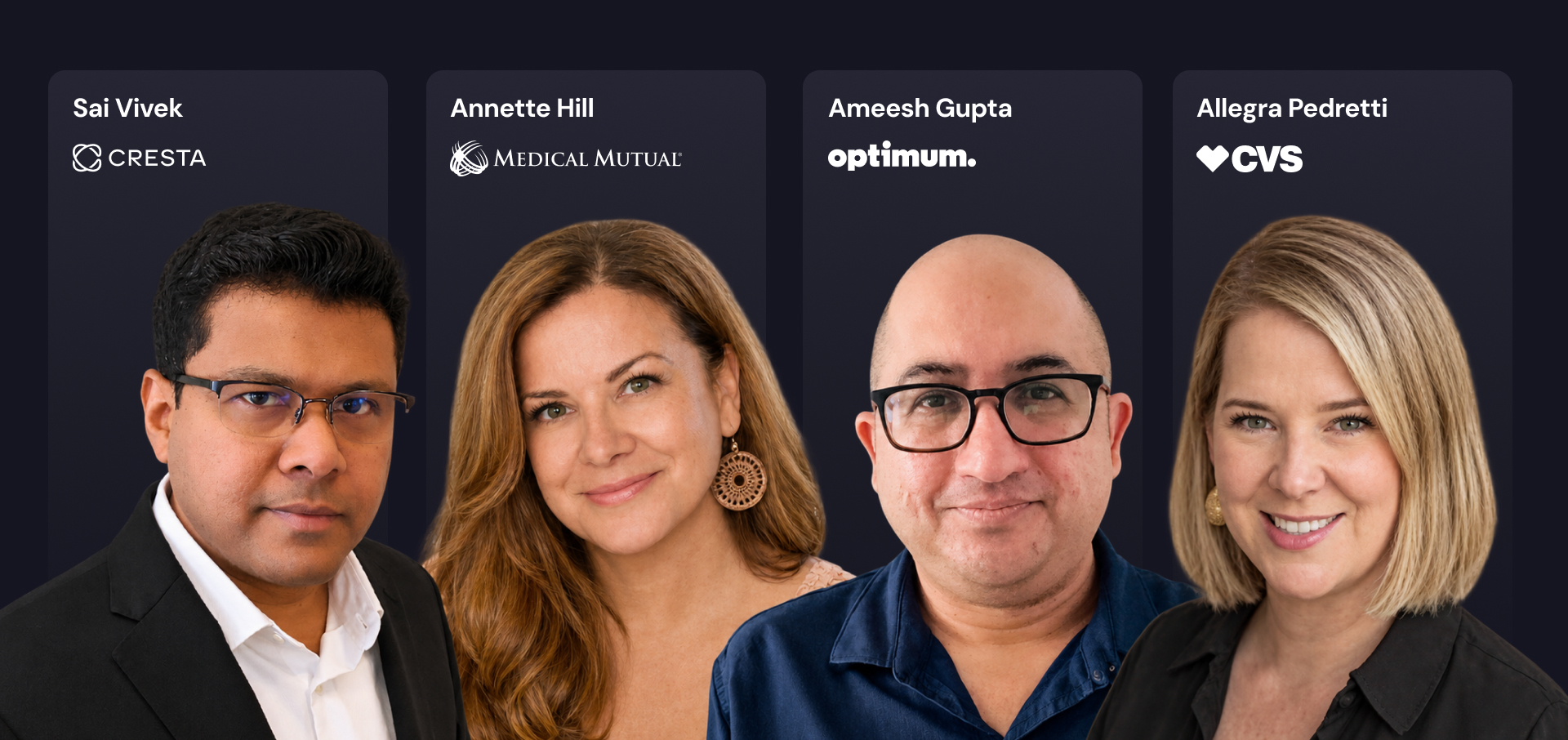
At CCW Nashville, our Chief Customer Officer, Sai Vivek, sat down with CX leaders from Medical Mutual, CVS Health, and Optimum to talk about how they’ve rolled out AI successfully across their contact centers.
Each speaker has found that success with AI depends on getting the fundamentals right, whether that’s identifying the right business problems, accessing reliable data, or creating a thoughtful role for the human agent.
We’ll take a closer look at what they shared to help you use AI when the stakes are highest.
Understand the Calls, Then Automate, Augment, or Both
Sai outlined Cresta’s high-level approach to automating CX with customers: Teams need to first understand their customer conversations to see what’s working and what isn’t across their agents and use cases. From there, they choose a path for improvement, which can include automation, human augmentation, or both.
The panelists shared their learnings from following this approach:
- Find tooling that scales. CVS Health’s centralized CX team supports 18 contact centers, and each often needs the same tooling. For example, they found that they needed a conversation intelligence solution that could analyze calls across contact centers to uncover common and preventable friction points.
- Automate the simple, repetitive calls. Most of Medical Mutual’s call volume came from providers asking straightforward transactional questions, like an effective date or office copay. The existing intelligent virtual assistant (IVA) had low containment because it made callers sit through options they didn’t need. Once the team discovered that, they decided they needed a conversational AI agent.
- Empower human agents for the most important calls. Losing a customer is the costliest outcome for Optimum. As a result, they started surfacing customer history and context during retention calls so agents could avoid looking for information and focus on preserving the relationship.
Get Your Data Ready Months Before Launching AI Agents
Annette Hill, the RNI COO at Medical Mutual, said the toughest part of their AI transformation was their data.
Medical Mutual had old APIs that fed their IVA, but these endpoints had issues that would make them a bad fit for an AI agent. This meant Annette and her team had to put API work on IT’s roadmap.
They ended up buying Cresta AI Agent in August and were piloting by November, but getting to market that quickly meant using the old APIs.
That speed came at a cost.
Medical Mutual’s data is still moving to new systems, and each change to a data source means redoing the AI agent’s integration. Because of that, the team has held off on building the richer dataset they want to train the agent.
If they did it again, Annette said, they would spend about six more months on data prep. Settling where the data came from and how reliable it’d need to be before launch would have meant fewer surprises for the AI agent, and fewer reintegrations later.
Measure 100% of Calls to Spot Key Trends
Allegra Pedretti, an insights and CX executive at CVS Health, described going from scoring about 5% of calls to 100% for prior authorizations of a popular class of weight loss medications.
At 5% sampling, CSAT and resolution looked good. But at 100%, the team saw that customers were calling back after “resolved” calls because they hadn’t received the full prior auth information. The process is confusing, especially when customers switch medications, since each may need its own prior authorization and customers aren’t sure what carries over.
Measuring 100% of calls ultimately surfaced a problem in weeks that could have taken months to find, or might never have been found.
Know When to Hand Off to a Human
Ameesh Gupta, a CX leader at Optimum, came to the quick realization that customers who pay a premium not only want human agents, but also ones who can consistently solve their problems with empathy.
To help deliver on this, Ameesh and his team provide human agents with robust and timely insights via Agentic Assist.
The agents can see a customer’s history when talking to them, including past contacts and app activities. That context, along with information in their knowledge base, grounds the conversation and powers real-time guidance. But the real value is in enabling agents to allocate more of their time and attention toward building the relationship, using their judgment on nuanced decisions, and ultimately making the customer feel valued.
In Ameesh’s words, “we don’t get that many opportunities to build relationships with the customer.”
Annette and her team at Medical Mutual also treated empathy as a key factor when deciding how to roll out AI Agent.
According to Annette, health insurance combines two things people feel most strongly about: their finances and their health. Knowing this, her team decided that if the AI agent picks up on emotional cues, it should route a caller to a human quickly, even when the question sounds transactional.
What Set Cresta Apart for Medical Mutual, CVS Health, and Optimum
In a lightning round, each panelist shared what drove their decision to partner with Cresta:
- Annette interviewed 15 to 20 vendors. Anyone who promised to automate all calls was off the table, because it showed they didn’t understand why a human belongs in the middle. She also looked for multichannel coverage, strong security for PII and PHI, and a team that wanted to meet her business objectives instead of just selling tools.
- Allegra wanted a partner proven with other large, complex enterprises, and—like Annette—could support PHI and PII. She also looked for vendors that treated Agentic Assist as a core capability, not an offshoot.
- Ameesh valued a partner that started with their business problem and North Star. Over about a year and a half of conversations with Cresta, they’ve never got a “we need to close this now” call. The discussions always centered on Optimum’s evolving CX needs and how Cresta could help solve them.
See how Cresta can supercharge your CX operations by scheduling a demo with our team.