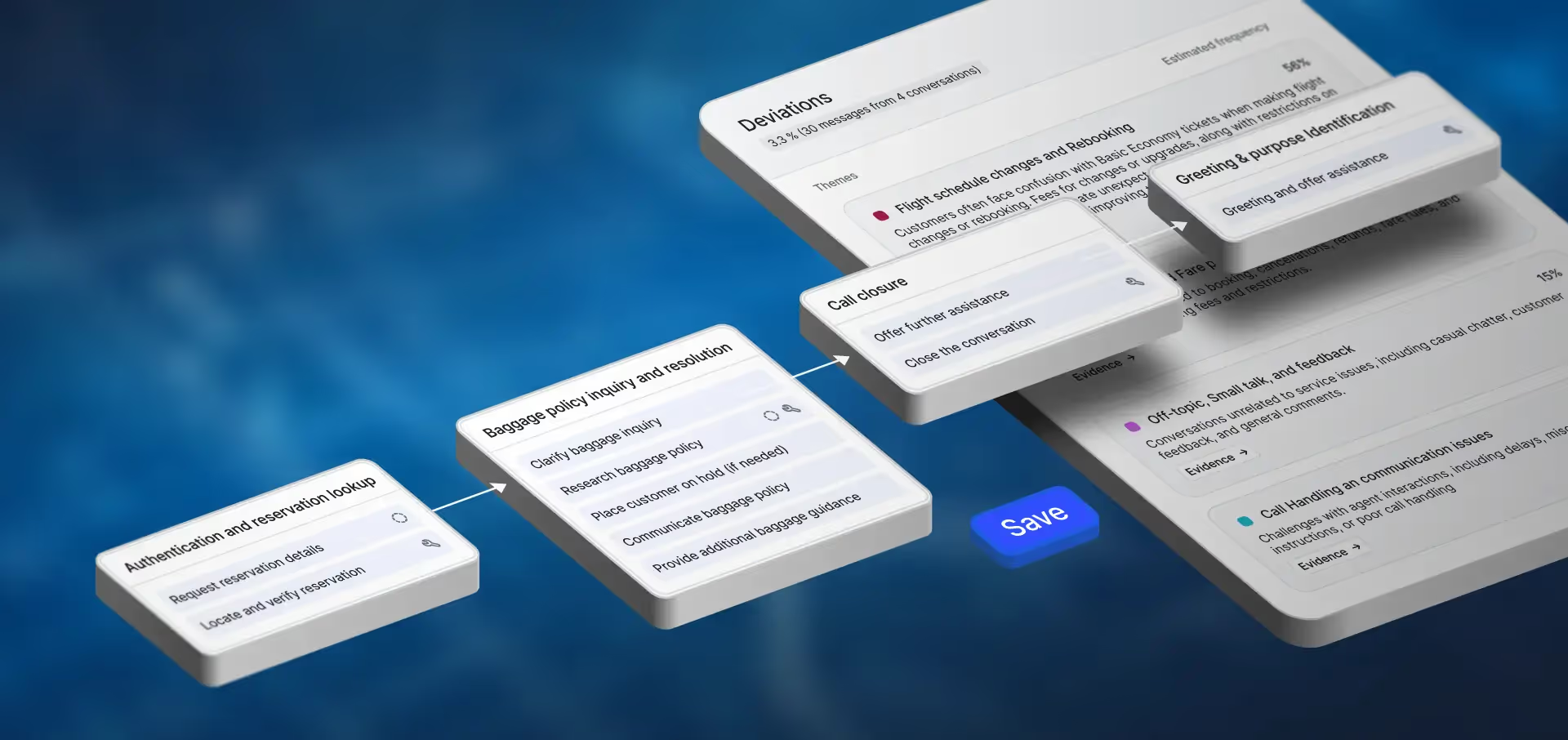


A customer rarely experiences your business one interaction at a time. Instead, they experience it as an ongoing relationship: the delayed delivery, the chat that didn’t end up resolving their problem, the call where they had to explain everything again, and the final conversation that either restores their confidence…or loses it for good.
CX organizations are not blind to the customer journey; many can connect customer touchpoints, track repeat contacts, and measure key metrics like first contact resolution (FCR). But these signals often show what happened, without explaining why it unfolded the way it did, or how the business should evolve in response. A single call may appear successfully resolved, when in reality the agent has forgotten to give the customer one critical piece of information that causes the customer to call back the following day.
And when that subsequent contact happens, the customer may have another bad experience: repeating information they’ve already provided before, being transferred from AI agents that can’t see their interaction history to human agents who don’t have context on who they are or why they’re calling.
The gap between connecting the substance of these individual conversations to the broader journey is where some of the most important customer experience questions live: Was the customer’s issue truly resolved? What happened in the interaction that turned the experience from negative to positive, or vice versa? Which policies and processes keep customers coming back, or seem to scare them away? And what is this customer most likely to need next?
Today, we are introducing Cresta Journey Intelligence to give CX teams the power to answer these questions and turn customer relationships into one continuous conversation. Journey Intelligence connects calls, chats, and other CX touchpoints into a unified view of the customer journey. It reveals the patterns no single conversation can show, then carries that understanding into the next interaction so human and AI agents have deep context from the moment they start the conversation: who is calling, how their prior interactions went, and what this conversation is likely to be about.
From Conversation Intelligence to Journey Intelligence
Conversation Intelligence allows organizations to understand the individual conversations they’re having with their customers in unparalleled depth, from key moments, behaviors and their impact, sentiment, to CSAT, outcomes and more. By connecting all of these individual interactions, Journey Intelligence enables an entirely different class of insight. Leaders can see whether an issue was truly resolved, how one contact reason led to another, and why a customer decided to stay or go.

WIth these insights in hand, teams can improve CX by fixing policies that create avoidable demand, cut costs by reworking clunky processes, and improve human and AI agent performance using patterns that unfold across multiple conversations.
Journey Intelligence is embedded into Cresta’s operating system, allowing these insights to become context for the next conversations. Human and AI agents have a deep understanding of a customer’s history, what it means, and what they may need next in their customer journey.
Understand Patterns with Journey Insights
Journey Insights brings three new capabilities to Cresta Insights, giving CX leaders both a population-level view of repeat contacts, as well as a detailed view of each individual customer’s experience:
- Repeat contact analysis. Understand how many customers contacted the business again, why, and whether an initial conversation about one issue led to a later conversation about something else. This makes it easier to identify broken self-service flows, policy-driven friction, and operational problems that would otherwise be invisible in a conversation-by-conversation report.
- Customer journey maps. Follow the complete sequence of a customer’s past conversations and touchpoints with your brand, with deep insight into each interaction, including conversation reasons, outcomes, and predictive CSAT. Leaders can easily deconstruct how a journey unfolded, and identify not only the moment it improved or began to break down, but why.
- Next contact predictions. See each customer’s likelihood of contacting the business again and the most likely reason for that contact, based on what you already know about their journey thus far. Cresta Journey Intelligence is the first solution in the market to predict a customer’s next contact, helping teams identify potential issues and act before the next inbound conversation.
Together, these capabilities shift the unit of analysis from the interaction to the outcome. Instead of asking whether one singular call met its quality criteria, leaders can ask whether the customer actually got where they needed to go, then use next-contact predictions to resolve likely issues before the customer even reaches out.
Consider financial services companies, where a loan application or transaction dispute often unfolds over several contacts. Journey Intelligence helps leaders to understand why customers keep coming back, whether unclear requirements are creating confusion, inconsistent policy interpretation is producing conflicting answers, or lost context is forcing customers to start over after every handoff. It also reveals which agent behaviors can turn a deteriorating journey around. Next contact predictions help teams to identify customers who may need proactive intervention before another issue becomes another inbound call. can reveal where customers are struggling to find solutions, which handoffs create dead ends, and which agent behaviors help recover the relationship. Next contact predictions help teams identify customers who may need proactive attention.
Enrich Every Conversation With Journey Context
The value of Journey Intelligence compounds across Cresta’s operating system. Customer Snapshot in Agentic Assist gives human agents a rich overview of who is contacting the business and why they’ve previously reached out, before the conversation even begins.
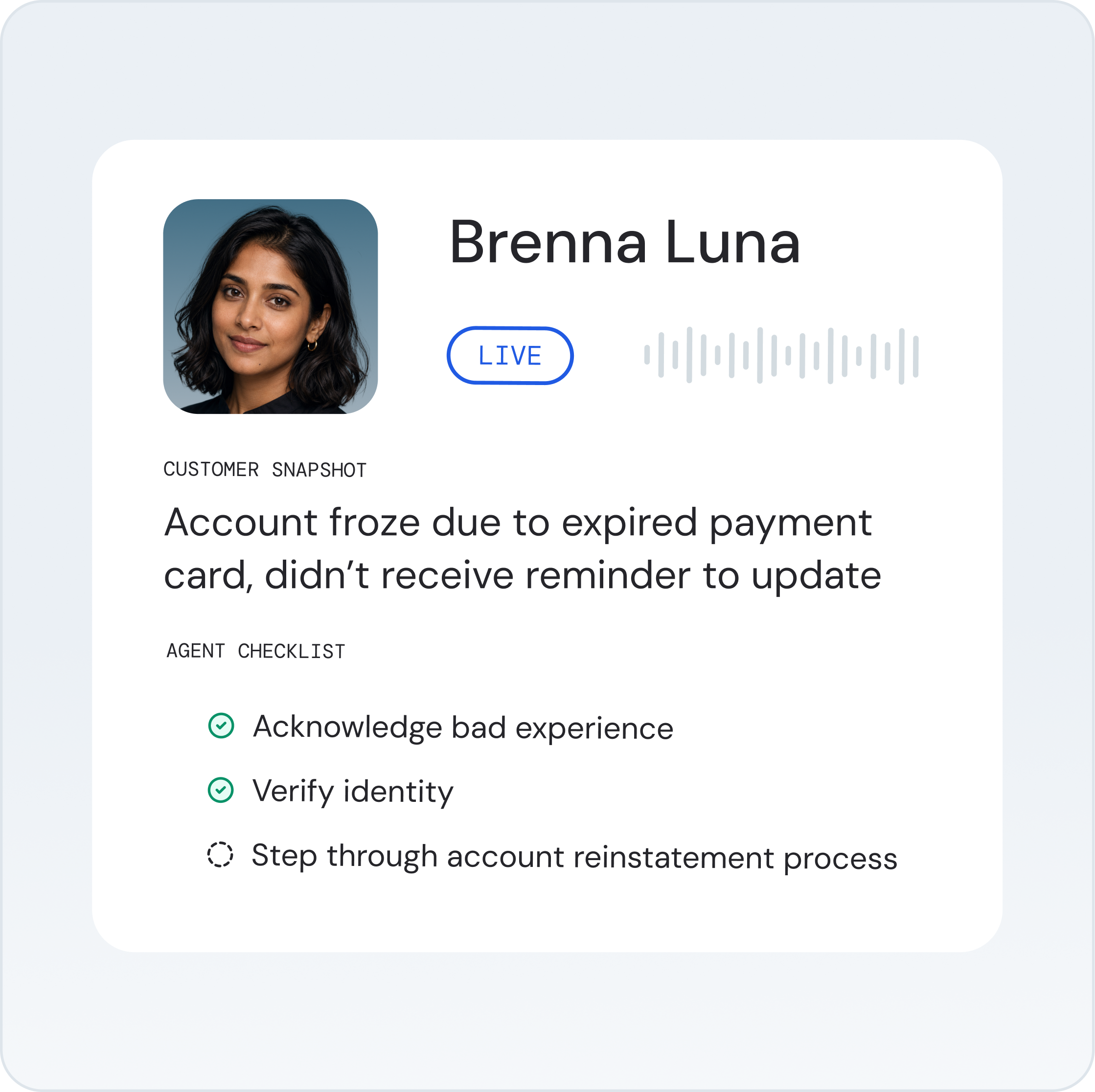
Journey Intelligence enhances AI Agent memory with derived journey insight, so customers can expect the same level of personalization and predictive service no matter who they’re speaking to. Instead of starting every interaction cold, agents go in with existing context, able to personalize the experience, whether that’s recognizing the preference a customer shared several conversations ago, or taking extra care with someone coming off a string of difficult experiences. The customer spends less time repeating themselves, while the agent can move more quickly towards the best next step, improving CX and average handle time (AHT), while also creating more natural moments for retention or upsell motions.
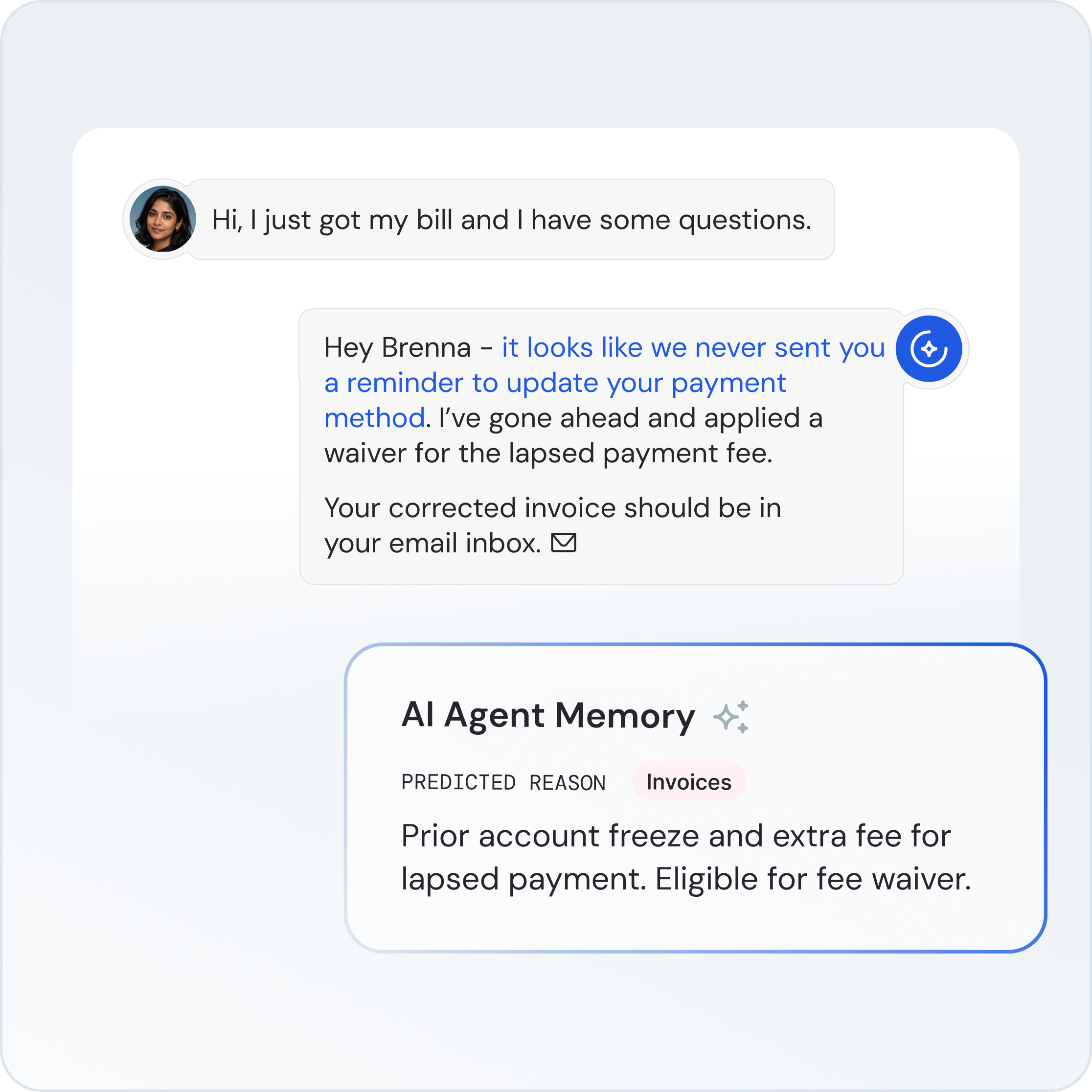
For example, if a telecom customer’s CSAT has declined across three consecutive conversations about the same WiFi issue, the AI Agent can recognize both the unresolved problem and the deteriorating experience. Rather than restarting the standard troubleshooting process, the agent can acknowledge the frustration, explain that it will skip the steps that have already failed, and arrange for a technician to fix the issue.
For an airline company, a canceled flight can trigger a chat about rebooking, a call about a missed connection, and an email about reimbursement. Journey Insights can reveal what drives repeat contacts, like agents not volunteering info about rebooking unless customers ask themselves, or app notifications that direct customers to a broken reimbursement claim form. A similar pattern can emerge after a customer is rebooked: the app confirms the new flight but does not explain that their seat assignment, checked-bag routing, or special service requests did not carry over, generating another series of avoidable contacts.
Rather than simply showing that the customer has contacted the airline multiple times in a given time period, Journey Intelligence identifies the breakdowns that have shaped the journey and the customer’s experience. Leaders can repair the reimbursement flow, update disruption messaging to set clearer expectations, and guide agents to proactively address the questions most likely to drive another contact. Customer Snapshot then carries that context into the next conversation, helping the agent see what the traveler has already experienced, what has been promised, and which issues still need to be resolved.
The amount of context available to the agent scales with how certain the customer’s identity is. For example, consider a customer calling a car dealership. The agent sees context from prior interactions based on just their phone number: this person visited the dealership in person last week, test drove a 2026 Camry, but wanted one in blue which the dealership did not have on hand. The agent can use these details to guide the discussion so that the customer doesn’t have to re-explain any of it.
When the discussion subsequently turns to financial negotiations, the agent asks the customer for the reference number from the quote they had previously received from the dealership. That info authenticates the customer, allowing the agent to see some more financial information, such as pre-approved loan terms and results from the customer's credit report and use that info to guide the conversation in a deeply personalized way.
Every business sets those thresholds itself, per channel, so warmer conversations don't come at the cost of a wider security breach.
Find the Root Cause and Improve What Happens Next, Every Time
For years, customer experience organizations have optimized what they could see: one call, one chat, one CSAT score, one outcome.
The problem with this? Customers remember the whole journey, and experience an ongoing relationship, and like in any relationship, they expect it to evolve with their feedback. They remember how many times they had to ask the same question, how often they had to start over with the same exact details, and whether the business adapted in any way after their last conversation. When every conversation starts from scratch, the relationship feels fragmented. However, when each interaction builds on the ones that came before it, customers feel prioritized, recognized, and understood.
Cresta Journey Intelligence gives CX leaders that same rich continuity, effortlessly. It connects the dots across interactions so teams can identify the real causes of repeat contact, fix policies and processes at their source, cut the cost of avoidable demand, and improve human and AI agent performance using pattern recognition across conversations. Then it brings that understanding back into the moment of service, helping every agent make the next conversation more informed, personal, and effective.
The customer journey is already happening. Journey Intelligence makes it visible, understandable, and actionable, so businesses can anticipate what a customer will need and solve issues before the next call even comes.
Learn more about Cresta Journey Intelligence and see how connected journey context can transform how you deliver customer experience.