
AI Agent Pilots: How Enterprise Leaders Turn Small Tests Into Scaled Wins


- A pilot is a small, low-commitment test: it proves an AI agent on a real workflow before any wide rollout.
- Real conversations beat scripted demos: agents built from idealized scripts break the moment a real customer strays from the flow.
- Write success criteria first: without an agreed definition of good enough, a pilot ends in debate, not a decision.
- Governance belongs on day one: Cresta surrounds agents with guardrails, testing, and live oversight through the Agent Operations Center.
- Choose the right conversations: automate routine contacts, and keep high-emotion moments with people by design.
- Frontline adoption is the signal: when agents reach for the tool on their own, you know what should scale.
You feel the pressure to adopt AI agents. You also do not want to bet your whole contact center on a rollout that has never touched a real customer.
So you ask the questions every CX leader is asking. What is an AI agent pilot? Where should it start? How do you run one that reaches production instead of dying as a demo?
This guide answers those questions for enterprise CX and contact center leaders. It draws on how Cresta runs AI agent pilots and on operators who have graduated agents from test to live production.
What Is an AI Agent Pilot?
An AI agent pilot is a small, time-boxed test of an AI agent on a real workflow before any wide rollout. An AI agent is software that can handle a multi-step task on its own, such as verifying a caller, looking up an account, and taking the resolving action. A pilot proves the agent works on live conversations, not just in a scripted demo.
Cresta AI Agent is one example of the kind of agent a pilot tests. It resolves complete workflows across voice and digital channels, then hands off cleanly to a human when a moment needs one.
The goal of a pilot is learning, not spectacle. You limit exposure, watch the agent meet real customers, and decide with evidence whether it deserves to scale.
Why a Pilot Is the Right Way to Start With AI Agents
A pilot lets you learn before you commit. You do not have to choose between doing nothing and rewiring the whole floor.
Cresta frames Customer Experience AI as a spectrum: Analyze, Automate, Augment. You can start anywhere on it, so a pilot can begin with analysis or augmentation, not only full automation.
Lower Risk, Faster Learning
A pilot limits your exposure to a single workflow and a small group of agents. You learn what works before you spend budget or ask the whole floor to change how it works.
- Key point: a narrow scope makes results easy to read and mistakes cheap to fix.
- Key point: starting with augmentation lets Cresta Agent Assist help human agents while you build trust in automation.
Proof Grounded in Your Own Operation
A demo runs on clean, happy-path examples. A pilot runs on your real conversations, with all the messy edge cases that break agents built from idealized scripts.
Cresta builds agents from a customer's own conversation data, so the pilot reflects how your business really runs. That grounding is why brands like Brinks Home and Propel Holdings trust Cresta AI Agent on real service flows.
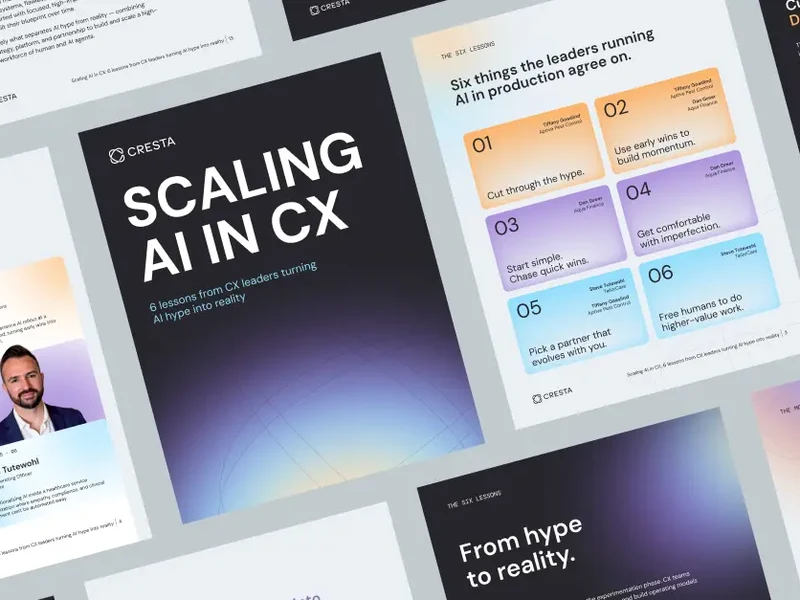
Six lessons from CX leaders who've implemented AI
Why Most AI Agent Pilots Stall (and What the Exceptions Do)
Most AI agent pilots do not fail because the technology cannot work. They stall for reasons that are organizational, and every one of them is avoidable. Research from Deloitte's State of AI in the Enterprise report points to governance and readiness, not raw capability, as what separates the pilots that scale from the ones that stall.
The Pilot Was a Demo in Disguise
Curated data and happy-path scenarios look great in a room. They never test whether the agent holds up under real volume and real edge cases.
A pilot that only rehearses the easy path proves nothing about production. When live customers arrive, the gaps show up all at once.
No Definition of Good Enough
Without success criteria agreed before launch, the pilot ends in debate instead of a decision. Everyone reads the same results differently, and the project drifts.
The exceptions decide what good looks like up front. They know before kickoff which outcome the agent must hit and which exceptions the team can absorb.
Governance Arrives Too Late
When risk and compliance meet the agent only after it works, every control becomes a costly retrofit. Trust is hard to earn and easy to lose.
- Key point: Cresta surrounds agents with layered, real-time guardrails from the start.
- Key point: adversarial testing and versioning catch problems before customers do.
- Key point: the Agent Operations Center gives teams live oversight of agents in production.
No Owner and No Kill Rule
A pilot with no named owner and no willingness to stop weak experiments turns into a zombie. It never graduates, and it never quite dies.
The exceptions name an owner and agree a kill rule in advance. They are willing to stop what is not working so they can double down on what is.
How to Choose the Right First Use Case
The workflow you pick decides most of the outcome. Choose well, and the pilot almost runs itself.
Start With the Conversations That Fit
Cresta sorts conversations into distinct groups, and each one calls for a different approach.
- Automate: routine, clear-goal interactions that neither the customer nor the agent wants to linger on.
- Keep human: high-emotion, high-value moments that need a person, with AI helping behind the scenes.
- Fix the root cause: contacts that should not have happened, where the answer is to remove the reason, not automate it.
- Open proactively: touchpoints that are not feasible at human scale, such as reminders and outreach.
Your best first pilot lives in the automate group. Cresta is honest about the tradeoff: some conversations should be routed to people by design, and a pilot should not try to automate everything.
Let the Data Point to the Opportunity
You do not have to guess which workflow is ready. Analysis of your real conversations shows you the high-volume, well-understood flows that are ripe to automate.
Cresta Conversation Intelligence analyzes every conversation, not a small sample. Automation Discovery scores which topics are ready and can export a candidate straight into an AI agent prototype, so the pilot starts from evidence.
What Leaders Need to Get Right Before Launch
The technology is rarely the hard part. As one contact center leader at an airline puts it, the gap is usually the organization's readiness to give the technology what it needs.
Readiness Behind the Agent
An AI agent is only as good as what sits behind it. That means a clean knowledge base, procedures written for a system to read rather than assumed by a person, and integrations that pass the right context at the right moment.
Cresta carries context across channels and across AI-to-human handoffs, so the customer never has to repeat themselves. Get this groundwork right, and the agent has what it needs to succeed.
Write Down What Success Looks Like
Before kickoff, put the definition of success in writing. Vague goals are how pilots end in argument.
- Outcome: the result the pilot must hit to earn a wider rollout.
- Exceptions: the edge cases the team can absorb while the agent learns.
- Owner: the person accountable for the agent once it reaches production.
Let Frontline Adoption Decide What Scales
The clearest signal a pilot is working is that agents reach for the tool on their own. An airline customer service leader who runs small, low-commitment pilots lets that frontline adoption decide what scales.
Cresta augments human agents and keeps people as the decision-makers. Expand what agents adopt, and rework what they avoid, because their behavior is the real proof.
Pre-Launch Checklist for an AI Agent Pilot
Run through this readiness checklist before you launch. If you cannot check every box, you are not ready yet.
- Use case chosen from real conversation data, not a hunch
- Success criteria written and agreed before kickoff
- A named owner accountable for the agent in production
- Knowledge base cleaned and written for a system to read
- Integrations passing the right context at the right moment
- Guardrails, testing, and live oversight in place
- A kill rule agreed, so weak experiments can stop
How to Know Your Pilot Is Ready to Scale
Graduation is not a feeling. A pilot is ready when it meets the criteria you wrote, holds up on real volume and edge cases, earns frontline adoption without prompting, and already has governance in place.
The table below shows the difference between a demo that impresses and a pilot that is ready for production.
Conclusion
A pilot is the smartest way to start with AI agents, but only when it is designed for production from day one. Start narrow, ground it in your own conversations, and write down what success looks like before you launch.
Choose the conversations that fit, get the readiness behind the agent right, and let frontline adoption tell you what should scale. On the Analyze, Automate, Augment spectrum, you can start anywhere, then let real results decide the next step.
Book a Demo
See how Cresta AI Agent, Cresta Agent Assist, and Cresta Conversation Intelligence turn a small pilot into a scaled win. Book a demo to walk through choosing your first use case, setting success criteria, and deploying with guardrails from day one.