
11 Best AI Agent Platforms for Customer Experience in 2026
.avif)

- The best AI agent platforms for customer experience handle complex tasks end to end, carry full context into human handoffs, enforce guardrails in real time, and measure resolution and CSAT, not just headline containment.
- The market splits into three shapes: unified platforms (automation, human assist, and Conversation Intelligence on shared data), automation-first agent platforms (end-to-end resolution across digital and sometimes voice), and voice-first agent platforms (built mainly for the phone).
- As of this time, Cresta is the only platform here that unifies automation, Agent Assist, and Conversation Intelligence on one foundation, so the experience does not fall apart at the handoff.
- The strongest evaluation questions focus on three things: how agents were designed, whether from real conversation data or templates; what oversight tools exist during live AI conversations; and whether performance data connects across both AI and human interactions on a shared foundation.
How do you choose between the best AI agent platforms for customer experience when every vendor now claims to have one?
Gartner predicts that by 2029, agentic AI will autonomously resolve 80% of common customer service issues without human intervention, leading to a 30% reduction in operational costs. That shift is already changing how CX teams buy. Today's AI agents are far more than the chatbot in the corner of a website: they reason across systems, complete multi-step tasks, and decide when to bring in a human.
That capability also makes them much harder to evaluate than the tools that came before, where a demo told you most of what you needed to know. This guide to the best AI agent platforms for customer experience helps CX leaders cut through the noise. It explains what separates a real agent from a relabeled chatbot, and how to choose a platform that delivers the outcomes that matter most.
What are AI agents?
AI agents are semi-autonomous systems that handle customer conversations end to end, escalating complex or high-risk cases to humans when needed. They use generative AI to understand requests, take action, and determine when a conversation needs human judgment.
In contact centers, AI agents address a persistent capacity problem. Call volumes keep growing while teams stay the same size. AI agents handle predictable conversations around the clock across phone and chat, freeing human agents for issues that require judgment.
The key distinction from legacy chatbots is flexibility. Chatbots follow rigid scripts and break when customers deviate. AI agents understand context and adapt when conversations shift direction.
The architecture has evolved. Early chatbots used decision trees, and single-agent LLM deployments offered more flexibility but struggled with complex multi-step workflows.
The current trend among leading enterprise platforms is toward multi-agent architectures, where a routing agent coordinates specialized sub-agents, each optimized for tasks like authentication, billing, or troubleshooting. Deterministic state management tracks each customer's progress step by step, so the AI triggers the right actions at the right moments. Market approaches still vary, so buyers should treat this as an evaluation area rather than a universal standard.
Score each one with this workbook
What AI agents can do in customer experience
AI agents manage routine conversations independently across voice and digital channels. They authenticate customers, look up account information, process transactions, and resolve common issues without human involvement.
What happens after escalation matters as much as the handoff itself. The best platforms pass full conversation history, extracted entities, actions already attempted, and suggested next steps to the human agent. Some continue augmenting the human agent after handoff with real-time guidance and automated summaries, creating continuity across the entire conversation.
A newer category of agentic assistants complements autonomous AI agents by working alongside human reps during live conversations. Cresta's Knowledge Agent is an example. It combines what's being said with on-screen context to deliver source-backed answers through a persistent browser sidebar.
AI agents also handle multiple languages through real-time translation, letting teams help international customers without needing native speakers for every language.
Comparison of best AI agent platforms for customer experience
1. Cresta
Cresta built AI agents as part of a unified platform where automation and human performance reinforce each other. The same conversation data that trains AI agents also powers real-time guidance for human agents. The same analytics that measure containment rates also track resolution quality and customer satisfaction across your entire operation.
Cresta's platform includes Conversation Intelligence that analyzes interactions across both automated and human conversations. Forrester recognized this capability when naming Cresta a Leader in The Forrester Wave for Conversation Intelligence Solutions for Contact Centers, Q2 2025. In production, Cresta AI Agent reaches 58% containment across AI Agents at Propel Holdings, 74% containment at Xanterra, and 70% chat containment at Windstar Cruises.
Key capabilities
- Conversation-grounded AI agents. AI Agent design starts from real conversations. Automation Discovery identifies which interactions suit automation based on complexity, frequency, and resolution patterns (Early Access).
- Sub-agent architecture. Specialized sub-agents coordinated by a routing agent handle complex multi-intent conversations. Deterministic state management balances LLM flexibility with predictable behavior.
- Voice performance. Low-latency response times backed by SLAs. Human-aware turn-taking distinguishes true interruptions from background noise.
- Post-handoff continuity. Cresta AI Agent tracks and carries customer context across the whole conversation, so when it escalates, the human agent gets full handoff context and accurate summaries sync into the CRM. Cresta Agent Assist then continues augmenting that agent with real-time guidance.
- Knowledge Agent for proactive, real-time answers. A persistent browser sidebar that travels with the agent across tabs, using ambient listening and on-screen Context Fields (such as loyalty tier or account status) to deliver precise, cited answers during live conversations without requiring the agent to search.
- Agent Operations Center. Human-in-the-loop supervision for monitoring hundreds of simultaneous AI conversations (Early Access).
- Unified analytics. Conversation Intelligence analyzes all interactions across AI and human agents with predictive CSAT scoring.
- Enterprise guardrails. Four layers of defense: system-level, supervisory, adversarial testing, and automated behavioral QM. Certifications include SOC 2 Type II, HIPAA, PCI DSS, ISO 27001, and ISO 42001.
What to watch for. Cresta operates through a forward-deployed partnership model rather than self-service. That means faster time to value for enterprises but less independence for teams that prefer to build on their own. Some features are in Early Access.
Who it's for.
- Contact centers and customer experience leaders unwilling to sacrifice visibility into what happens after escalation
- Teams stitching together data from multiple point solutions
- Organizations where agents lose time toggling between CRMs, knowledge bases, and internal tools during live conversations
- Regulated industries where compliance monitoring needs to span both automated and human interactions
For more detail, review the AI Agent, Agent Assist, and Conversation Intelligence pages, or request a demo.
2. Sierra
Sierra centers its offer on fully automated customer conversations delivered through a managed service model. The architecture is oriented around automation first, which means buyers should investigate what remains visible and actionable when a conversation leaves the automated flow.
Key capabilities
- Agent OS. Manages AI agents across voice, chat, and messaging with workflow configuration, tone controls, and policy enforcement.
- Fully managed service. Handles implementation complexity, integrations, and ongoing maintenance.
- Live Assist. Human agent guidance functionality, though newer to an automation-first platform rather than built on years of coaching expertise.
What to watch for. The managed service model trades internal control for deployment speed. Buyers should ask what context moves to the human agent, whether human agent guidance is part of the same operating environment, and whether supervisors can measure AI and human performance side by side after escalation.
Who it's for. Consumer brands prioritizing speed to deployment over internal control, comfortable with vendor-managed implementations for transactional customer interactions.
Related: A guide to Sierra alternatives
3. Decagon
Decagon gives business teams direct control over AI behavior. The harder evaluation question is what oversight and quality infrastructure sits behind that flexibility once generative systems are in production.
Key capabilities
- Agent Operating Procedures. Combine natural language instructions with structured logic, letting CX operators build and modify AI agent logic without engineering support.
- Self-service customization. Allows teams to adjust escalation triggers, refine conversation flows, and modify agent behavior directly.
What to watch for. Buyers should ask how the platform evaluates agent behavior at scale, what auditability exists for automated decisions, and what support remains after escalation to a human rep.
Who it's for. Tech-savvy CX teams, particularly in fintech and SaaS, that want direct control over AI agent behavior without engineering dependencies. Examine whether the platform supports human-side workflows, QM, and coaching with the same depth it brings to automation design.
4. Google Contact Center AI
Google CCAI brings conversational tooling to organizations already invested in Google Cloud. The main tradeoff is that buyers are evaluating a collection of cloud components rather than a packaged contact center operating layer.
Key capabilities
- Dialogflow CX. Conversational AI with Google's natural language understanding, intent recognition, and visual flow builder.
- Agent Assist. Real-time suggestions to human agents during live conversations based on conversation context.
What to watch for. Companies with strong internal technical teams may be comfortable assembling these components themselves. Others should ask how much implementation and long-term optimization they will own after launch. Budget for significant internal technical resources compared to turnkey alternatives.
Who it's for. Organizations already on Google Cloud with internal technical capacity. Evaluate whether you want cloud-native building blocks or a packaged system that already connects automation, live guidance, and analytics.
5. Kore.ai
Kore.ai emphasizes enterprise conversational AI with no-code tools and prebuilt templates. Templates reduce initial setup effort but do not remove the need to handle conversation variability and the long tail of real contact center behavior.
Key capabilities
- Experience Optimization Platform. No-code conversational AI development with visual builders and pre-configured templates.
- Industry-specific solutions. Pre-configured workflows for banking, healthcare, and retail with compliance features built in.
- Multi-channel deployment. Spans voice, chat, messaging, and email with unified conversation management.
What to watch for. Buyers should ask how far templates take you once real conversations vary, what customization is needed for complex workflows, and how much visibility you have into automation candidates before building.
Who it's for. Organizations wanting pre-built industry solutions rather than building from scratch, where templated starting points matter more than unified automation, human assistance, and analytics.
6. Cognigy
Cognigy provides enterprise conversational AI using a hybrid architecture combining rule-based automation with LLM capabilities, with particular strength in global deployments. Cognigy is now part of NICE, which may affect product direction and ecosystem integration. Buyers should confirm current packaging and roadmap directly.
Key capabilities
- Agentic AI. Combines LLM reasoning with real-time context, memory, and enterprise governance.
- Low-code and no-code AI Agent Studio. Visual tools for business users and developers to co-create AI agents.
- Multilingual and full-spectrum automation. Broad language support with conversational IVR, self-service, agent assist, and RPA.
What to watch for. The structured approach provides predictability but may constrain flexibility when interactions deviate from expected paths. Evaluate how the NICE acquisition affects the long-term roadmap.
Who it's for. Global enterprises needing multilingual support and flexible deployment options.
7. Forethought AI
Forethought AI emphasizes issue resolution and triage rather than simple deflection. Its product family spans Solve, Triage, Assist, and Discover. The tradeoff is that support-centric breadth does not automatically translate into equal depth for live voice and handoff-heavy environments.
Key capabilities
- Agentic AI approach. Resolution verification checks that responses actually address customer needs before delivery.
- Forethought Voice. Extends AI capabilities to phone-based customer interactions.
What to watch for. Contact center buyers should examine how well the platform handles multi-turn voice interactions and whether analytics connect automation outcomes with human performance after transfer.
Who it's for. Support teams prioritizing resolution rates over containment metrics. Voice-heavy enterprises should validate channel depth carefully.
8. Retell AI
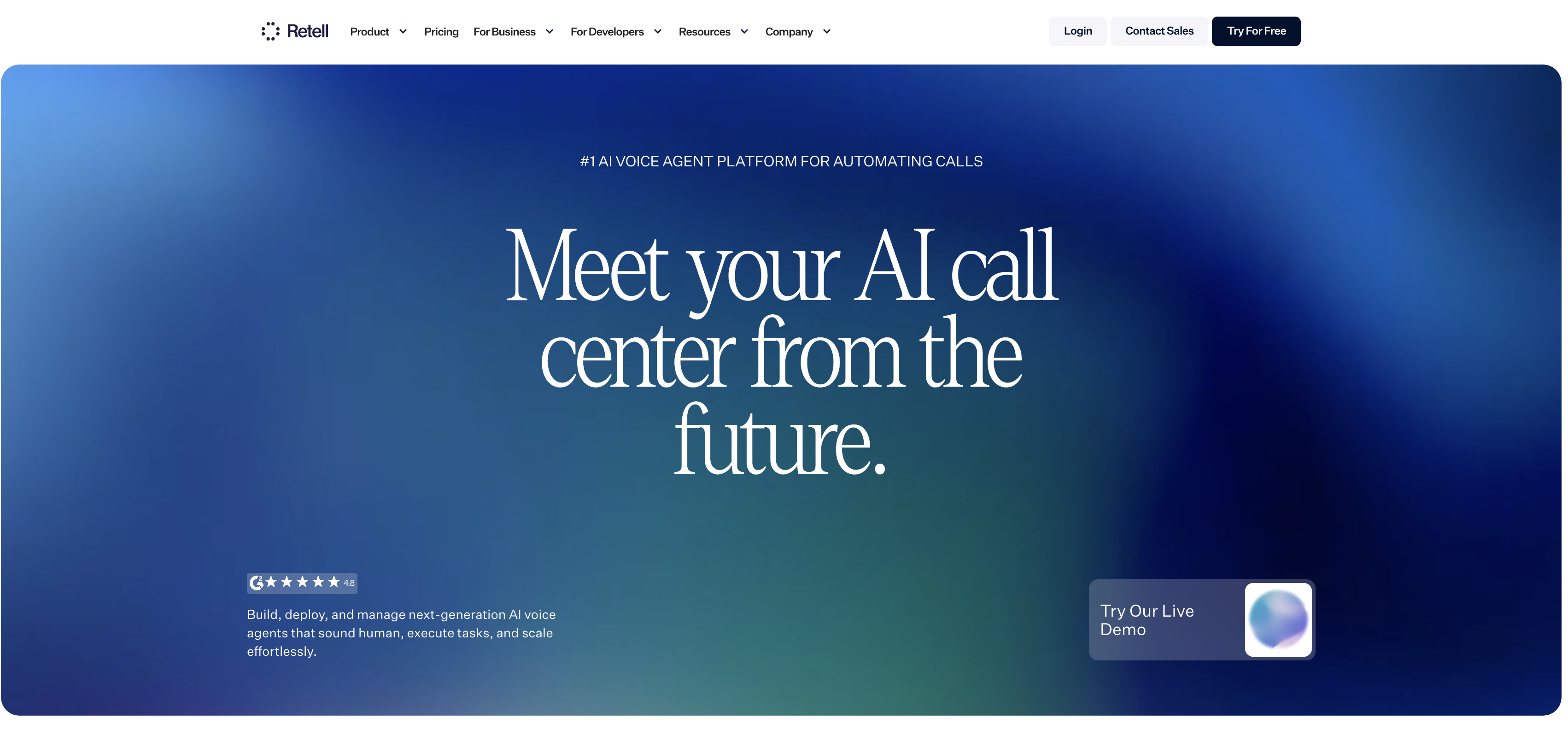
Retell AI is voice AI infrastructure for technical teams, emphasizing low latency, natural conversation flow, and developer control through APIs and SDKs. This places it in a different buying category from packaged contact center products.
Key capabilities
- Voice AI infrastructure. Optimized for sub-second latency across the speech-to-response pipeline.
- Developer control. APIs and SDKs for custom voice experiences with granular control over conversation logic.
What to watch for. Teams should assume responsibility for analytics, QM, escalation workflows, supervisor tooling, and ongoing optimization. The development investment and ongoing maintenance fall entirely on internal teams.
Who it's for. Engineering-led teams building custom voice experiences with existing internal infrastructure for everything else.
9. Salesforce Agentforce
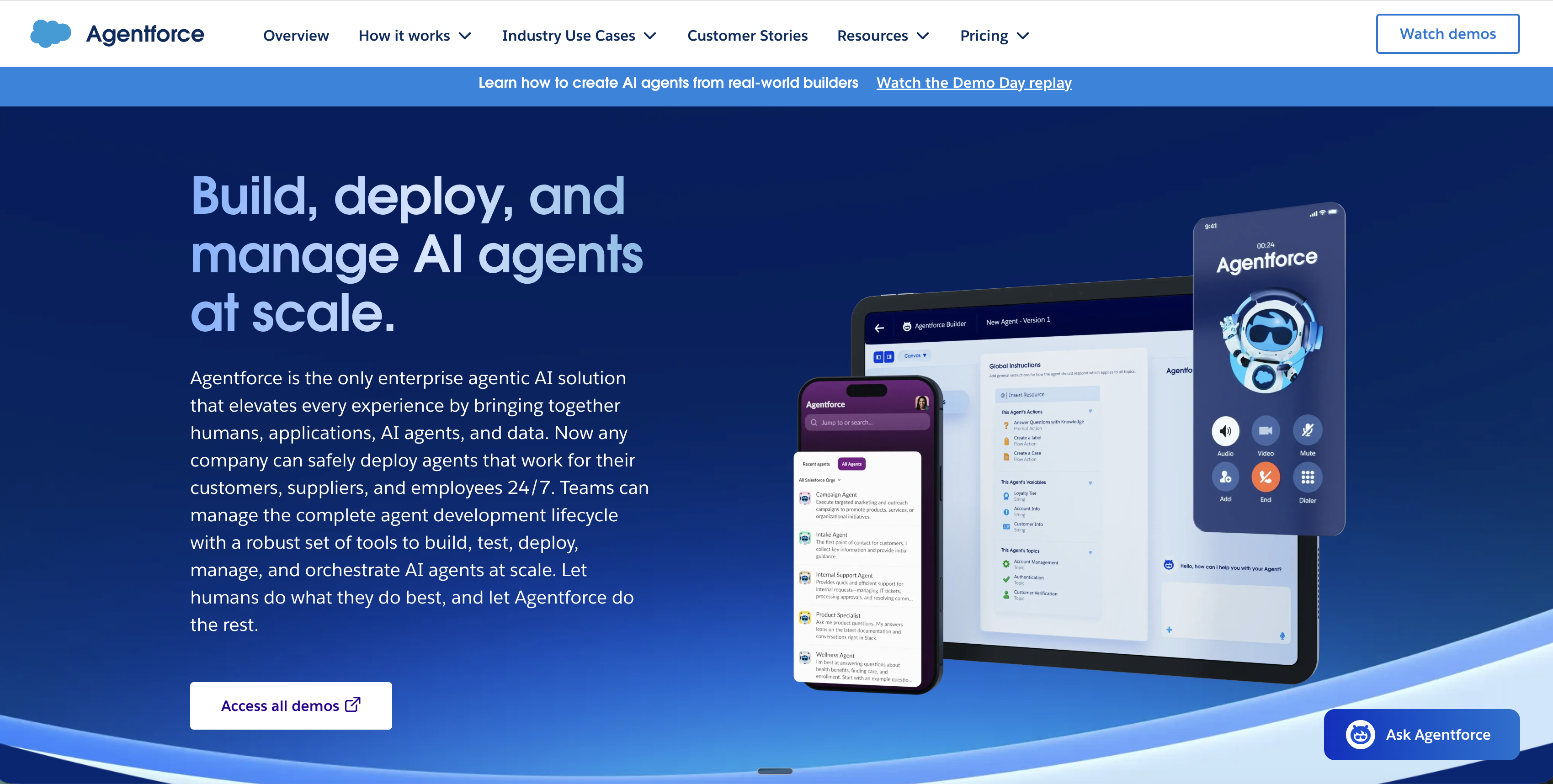
Salesforce Agentforce brings AI agents into the Salesforce environment. CRM proximity simplifies access to account data and case history, but the question is whether the evaluation begins with CRM convenience instead of the full contact center operating model.
Key capabilities
- CRM-native AI agents. Handle customer service interactions using Salesforce CRM data, reducing integration burden.
- Enterprise ecosystem. Benefits from Salesforce's broad enterprise footprint and existing trust relationships.
What to watch for. Ask how well the architecture supports live voice handling, whether post-transfer context remains useful, and how real-time human guidance fits when the contact center stack spans multiple vendors.
Who it's for. Organizations already invested in Salesforce that want native AI agent expansion. Buyers with mixed environments should pay special attention to workflow fragmentation.
10. Fin AI

Fin AI is a natural option for companies already on Intercom for digital customer support. The main tradeoff is that native fit inside one support stack may not cover enterprise contact center needs.
Key capabilities
- Performance-based pricing. Pay per resolved conversation, aligning costs with outcomes.
- Native Intercom integration. Integrates directly with Intercom's inbox, routing, and reporting.
What to watch for. Examine how far the product extends beyond digital support and whether analytics remain strong when telephony or external CRM systems enter the picture.
Who it's for. Companies already on Intercom seeking native AI integration for digital support. Less likely the right choice for enterprise contact centers needing broader channel coverage across digital and voice.
Related: Fin AI's biggest competitors in 2026
11. Zendesk AI
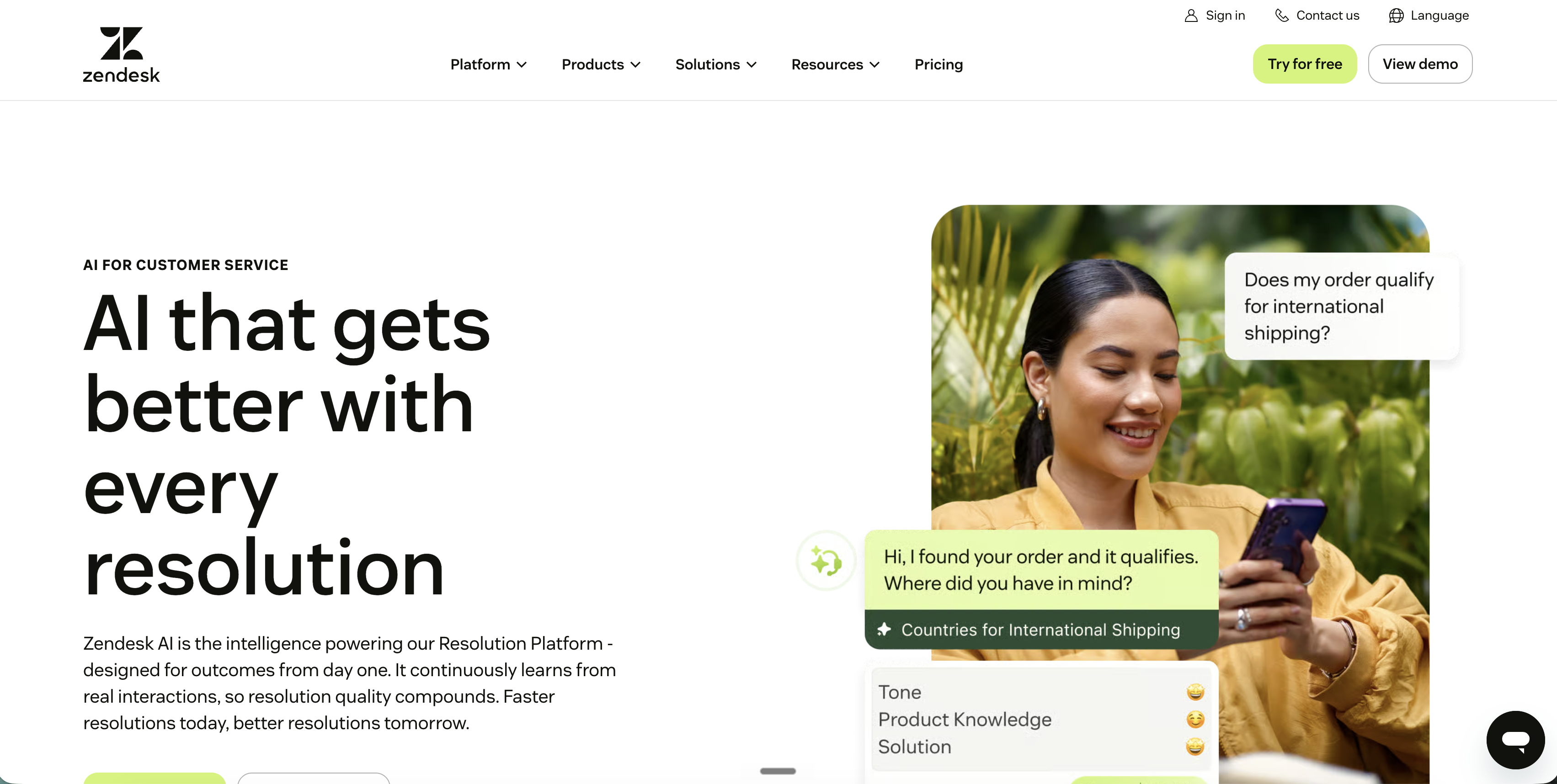
Zendesk AI extends automation inside the Zendesk ecosystem using the knowledge base, ticketing environment, and workflow structure already in place. Strong local fit comes with more questions once the operation expands beyond Zendesk.
Key capabilities
- Pre-trained intent models. Covers common customer service scenarios, reducing setup time.
- Native ecosystem integration. Works alongside Zendesk's existing routing, ticketing, and reporting infrastructure.
What to watch for. Evaluate whether the product meets enterprise voice needs, how much context survives transfer to a human, and whether cross-journey analytics are deep enough. Post-handoff support is more limited than what dedicated platforms provide.
Who it's for. Existing Zendesk customers adding AI automation without changing platforms. Buyers with larger voice operations should compare carefully with specialized contact center AI offerings.
Other platforms buyers may encounter
Several additional platforms may appear during evaluations, depending on your technology ecosystem.
Microsoft Copilot Studio lets organizations within the Microsoft 365 ecosystem build AI agents using low-code tools. It integrates with Microsoft's broader AI infrastructure but requires customization for contact center workflows.
UiPath Agentic Automation combines RPA with AI agent capabilities for multi-step workflow automation. It is useful for back-office processes that feed into customer interactions, though not purpose-built for live conversational AI.
IBM watsonx.ai provides enterprise AI with emphasis on governance and compliance controls. Organizations in heavily regulated industries may consider IBM's approach, though significant technical resources are required for contact center use cases.
These options are better understood as adjacent tools or strategic platforms than direct substitutes for dedicated AI agent vendors.
How to evaluate and choose an AI agent platform
When comparing the best AI agent platforms for customer experience, the strongest evaluations focus on architecture and operating fit rather than surface features. Buyers should understand how a vendor manages context through a conversation and how it tests for failures before those failures reach customers. These areas have more impact on enterprise performance than a long feature list.
Key evaluation criteria
These are the areas that separate enterprise-ready platforms from polished demos. Each should be tested during evaluation rather than taken at face value from vendor materials.
Agent architecture. Multi-agent architectures with routing agents coordinating specialized sub-agents handle complex conversations more reliably than single-agent approaches. Deterministic state management should track customer progress and trigger the right actions at the right moments.
Guardrails and governance. Enterprise AI agents need layered defenses. System-level guardrails enforce non-negotiable rules, supervisory guardrails monitor behavior in real time, and adversarial testing stress-tests against edge cases and malicious inputs.
Testing and evaluation. Look for platforms that generate test cases from historical conversations, use LLM-powered evaluators for flow adherence, and provide regression protection.
Latency and conversation flow. Voice interactions expose latency problems immediately. Look for sub-second response times backed by SLAs and human-aware turn-taking.
Human-agent collaboration and handoff. Effective platforms transfer full conversation context during handoffs and maintain visibility after escalation. If agents lose time searching for answers during live calls, evaluate whether the vendor offers context-aware knowledge assistance directly in the workflow. Cresta addresses this with Knowledge Agent, which proactively surfaces cited answers through a persistent browser sidebar.
Real-time knowledge augmentation. Evaluate whether the platform provides real-time agent assistance during live calls, delivering proactive knowledge to human agents mid-conversation. Look for in-workflow experiences that incorporate on-screen context like account status or loyalty tier, and surface cited answers grounded in source material. This matters because knowledge gaps are common: in a Gartner survey, 61% of customer service leaders reported a backlog of knowledge articles to edit, and more than a third had no formal process for revising outdated ones.
Continuous improvement. Performance analytics should connect AI behavior to business outcomes. Root-cause analysis, A/B testing, and versioning with rollback help teams expand automation safely.
Platform and security. Unified platforms combining AI agents with agent assist and conversation intelligence offer compounding value over siloed tools. Expect SOC 2 Type II, ISO 27001, and ISO 42001 across enterprise vendors. Verify HIPAA, GDPR, and PCI-DSS where relevant.
Questions to ask during evaluation
Direct operating questions move the conversation away from polished demos and toward production behavior. These are organized by the three areas that matter most.
- Architecture questions. How does the platform manage state and context across multi-step conversations? What safeguards prevent hallucinations or skipped workflow steps? How does the system decide when to escalate?
- Human-side questions. What exact context transfers to the human rep? Does the platform continue helping the human agent after transfer? Can supervisors compare AI and human performance side by side?
- Improvement questions. Can the vendor generate test cases from real conversations? Does QM cover 100% of AI interactions? Can your team trace why an output happened and tune the system without losing governance?
Choosing the right fit
The evaluation criteria above give you the framework. The remaining question is which criteria matter most for your specific operation.
Post-handoff visibility matters first. If your AI agents will escalate a meaningful percentage of conversations, what happens after handoff affects your overall customer experience. Platforms that lose sight of conversations at escalation create blind spots.
Your technical resources determine fit. Managed services get you to production faster but put you on the vendor's timeline. Developer-focused platforms offer more control but require engineering investment. Ecosystem-specific options reduce integration complexity within their platforms but limit flexibility outside them.
Human-agent productivity is often overlooked. Many contact centers focus entirely on AI agents while missing the productivity drain human agents face, toggling between browser tabs, CRM screens, and knowledge bases. Cresta calls this the "toggle-tax," and addressing it alongside automation improves both sides of the operation. According to Deloitte Digital's 2024 Global Contact Center Survey, companies deploying generative AI are 35% less likely to report agents overwhelmed by information during calls.
Metrics should align with goals. If containment rate is your primary metric, pure automation platforms optimize for that. If you care about resolution quality, customer satisfaction, or revenue impact across both automated and human interactions, you need unified analytics that span both.
How to measure AI agent platform performance
Before evaluating specific platforms, contact center teams should align on which metrics actually matter for their operation. The right measurement framework prevents teams from optimizing for a single metric like containment rate while ignoring downstream effects on customer satisfaction or resolution quality.
- Containment rate measures conversations resolved without human intervention. Commonly cited but misleading in isolation. A high rate means little if issues are not actually resolved.
- Resolution rate tracks whether the customer's issue was actually solved, not just whether the conversation stayed with the AI.
- First call resolution (FCR) measures whether the issue was resolved in a single interaction without callbacks. It applies across both AI and human conversations.
- Average handle time (AHT) tracks total conversation time. For human agents picking up escalations, AHT is affected by how much context transfers with the handoff.
- Customer satisfaction (CSAT) measures the customer's perception. Some platforms infer CSAT from conversation content rather than relying on post-interaction surveys.
- AI vs. human breakdown. The strongest platforms report AI-handled outcomes such as containment, resolution, CSAT, and time saved separately from human-handled ones, on one platform, so leaders can compare the two rather than read a blended number.
- Post-handoff continuity tracks whether escalated conversations require customers to repeat information and whether the platform continues providing guidance after handoff.
- Governance and compliance adherence tracks guardrail activation rates, policy compliance scores, and audit trail completeness.
Stop choosing between automation and agent performance
The question that matters most is whether your platform improves the entire contact center operation or only the automated slice. Most platforms force a tradeoff between automating conversations and augmenting human agents, or between measuring containment and tracking resolution quality. That tradeoff is unnecessary.
Cresta is built to eliminate it. The platform supports AI Agent conversations, continued augmentation through Agentic Assist after escalation, proactive answers through Knowledge Agent, and cross-operation analytics through Conversation Intelligence. Human agents picking up escalations get full context and continued real-time augmentation.
Knowledge Agent works proactively alongside human agents in their browser, connecting what's being said with what's on screen to deliver precise, cited answers. Leaders see performance across their entire operation in one place, and the platform layers onto your existing CCaaS infrastructure without a rip-and-replace.
Visit the Platform overview or request a demo to see how it works with your operation. Teams preparing a final vendor shortlist should still validate feature maturity, channel requirements, and ownership assumptions against their own workflows before making a commitment.