Cresta vs Sierra: how to compare them in 2027
.avif)

- Cresta and Sierra both deploy AI agents across voice and digital channels, so they can look alike in a demo
- Choose Cresta if AI agents and human agents share your workload and you need real-time guidance, quality management, and coaching on one platform
- Sierra might still fit if your plan is agent-first automation and you already run separate tools for human agent QM and coaching
- Sierra announced Live Assist for human reps in late 2025, but it doesn't offer a dedicated QM or coaching product for human agents
Enterprise CX leaders consider both Cresta and Sierra when they want AI agents that resolve conversations, and want the human agent to get full context and continued guidance after a handoff.
Sierra builds autonomous AI agents for chat, messaging, email, and voice, and it's grown fast. For example, they now serve more than 40% of the Fortune 50. That said, Sierra doesn't offer a dedicated QM or coaching product for human agents, and their agent assist product recently launched, so it likely still needs to be battle tested.
Cresta started with real-time guidance for human agents when the company was founded, added AI Agent several years ago, and now runs both on one platform with conversation intelligence. Cresta also recently surpassed $100 million in annual recurring revenue, and supports leading brands across industries, like United Airlines, Cox Communications, and Marriott.
To help you cut through the noise and evaluate each platform more easily, we'll go deep on both companies and compare them directly.
Note: This guide was updated on 10/21/2026 and is subject to change in the future.
How we compared Cresta and Sierra
We drew on analyst reports from firms like Gartner and Forrester, user reviews from sites like G2, and our own conversations with customers and prospects.
We evaluated both platforms against six criteria:
- AI agent automation: How each platform builds, tests, and governs AI agents across voice and digital channels
- Human agent augmentation: What real-time guidance human agents get during live conversations and after an AI-to-human handoff
- Quality management: Whether QM covers both AI and human conversations
- Coaching: How insight from conversations turns into targeted behavior change
- Conversation intelligence: How deeply the platform analyzes conversations and ties them to business outcomes
- Enterprise governance: Guardrails, live oversight, integrations with existing systems, and certifications
Cresta overview
Cresta is the AI operating system for CX. It was founded in 2017 at Stanford's AI Lab, and it runs its four core products (Agentic Assist, AI Agent, Deputy Agent, and Conversation Intelligence) on one unified CX platform.
Top features
- Real-time guidance: Agentic Assist augments human agents with behavioral hints, checklists, and guided workflows during live conversations. In addition, Knowledge Agent adds proactive, source-backed answers from the live conversation and on-screen context
- Automated quality management and coaching: Conversation Intelligence scores conversations across human and AI agents and turns the results into targeted coaching opportunities
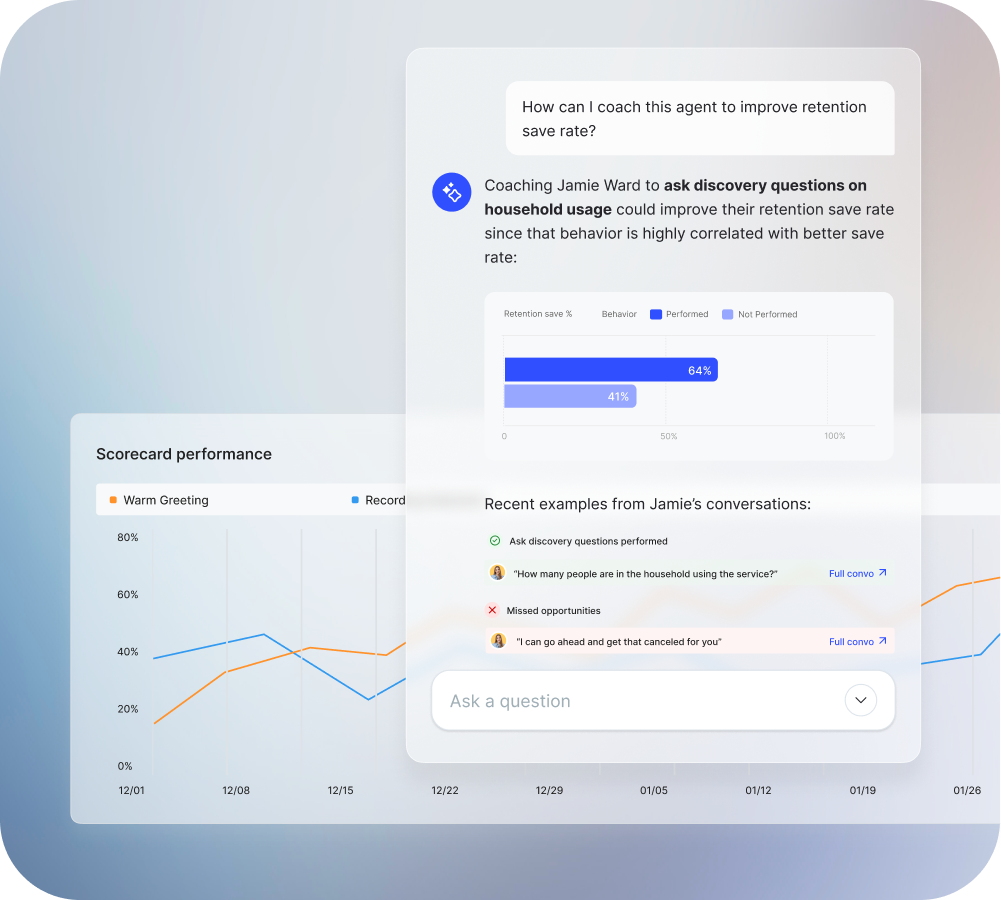
- Automation Discovery: Combines data on flow complexity, conversation volume, and resolution rates into a single readiness score per topic, so teams know which conversations to automate first
- Deputy Agent: The long-running agent launched in October 2026. It keeps working behind the conversation on billing disputes, delayed orders, insurance claims, and other workflows with people approving key steps
Pros
- Quality management covers every conversation: Cresta scores every conversation across human and AI agents automatically to surface all of the most important issues or opportunities
Case in point: when CVS Health used Conversation Intelligence to start evaluating 100% of their conversations, they uncovered and resolved a significant friction point for prior authorizations of a popular class of weight loss medications.
- Automation built from your own conversations: AI Agent learns from real customer interactions, including how people phrase questions and how conversations actually unfold. That lets it handle the twists and variations that scripted flows miss, and, in turn, resolve more chats without a handoff
For example, Propel Holdings, a financial technology company with multiple lending brands, reached a 58% chat containment rate with AI Agent.
- Strong analyst validation: Cresta is a Leader in The Forrester Wave™: Conversation Intelligence Solutions For Contact Centers, Q2 2025. Cresta also received the highest possible scores across 16 criteria, including Real-Time Guidance
- Real-time coaching enables every agent to be a high performer: Real-time insights and coaching are among the most common pieces of positive feedback from users. The G2 review below is a good example

Cons
- Business-specific setup takes upfront work: If you need an AI agent that performs well out of the box and you don't have time to map real conversations, test edge cases, and refine its behavior, Cresta may not be the best fit
- Built for the enterprise: A small, digital-only support team with few human agents, for example, may not use the guidance, QM, and coaching layers
- AI Agent optimization is an ongoing initiative: If you need an AI agent you can leave untouched, Cresta may not be a good match. Cresta’s approach includes monitoring live performance and refining the agent as new issues and edge cases emerge
See how Cresta can support your AI and human agents on one platform
Sierra overview
Sierra builds autonomous AI agents that handle customer conversations across chat, SMS, WhatsApp, email, voice, and ChatGPT.
Top features
- Agent Studio: The no-code workspace lets you build and manage agents, so CX teams can make changes without engineering
- Voice agents: Sierra agents handle inbound and outbound calls alongside digital channels, so phone automation runs on the same platform as chat and messaging
- Insights: Analytics and custom reports show how the AI agent performs, and always-on review flags conversations that need attention, so teams can spot where the agent needs work
- Live Assist: Brings the AI agent's real-time suggestions and actions to human reps' screens, allowing reps who take over a conversation to get help in the moment
- Ghostwriter: It's an agent designed to build other agents, so teams can describe a new agent in plain language instead of configuring it by hand
Pros
- One agent across many channels: A single Sierra agent can run across chat, SMS, WhatsApp, email, voice, and ChatGPT, so customers get one consistent automated experience wherever they start
- Recognized agentic framework: Sierra is a Strong Performer in The Forrester Wave™: Conversational AI Platforms For Customer Service, Q2 2026. It earns top marks for its agentic framework, vision, and roadmap
- Enterprise-scale customer base: Their customers include Santander, Blue Cross Blue Shield, and Rocket Mortgage, which shows that the platform can run in large, regulated environments
- Fast to deploy: Many users (like the G2 reviewer below) launch AI agents with Sierra in a matter of weeks, which is critical when speed to first automation is your top goal

Cons
- Poor integration support with legacy systems: According to CX Foundation's analysis of The Forrester Wave™: Conversational AI Platforms For Customer Service, Q2 2026 report, Sierra scored just one out of five for legacy system integrations. In other words, Sierra may not be able to connect to your contact center’s older CCaaS, CRM, or billing systems
- No dedicated QM or coaching for human agents: Sierra doesn't offer a dedicated quality management or coaching product for human agents. Teams that still rely on human agents need separate tools to score and coach them
- Newer human-agent tooling: Sierra announced Live Assist in November 2025, so its real-time guidance has a shorter production track record than Sierra's AI agent
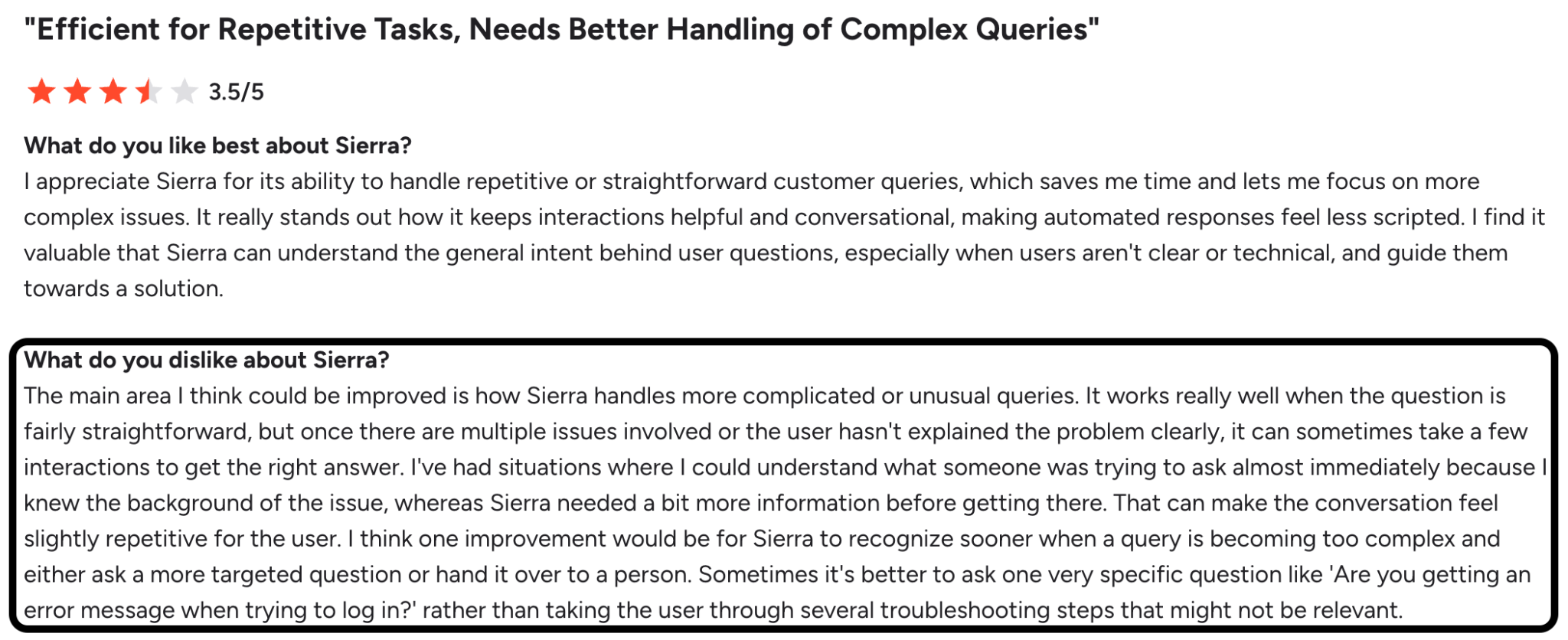
- AI agents fall short for more complex and unique conversations: Users often describe Sierra’s AI agents as being unable to answer more nuanced, one-off questions in one or two turns as well as failing to offer support from a human agent when necessary. The G2 review below is a good example
Related: The top Sierra alternatives
Cresta vs Sierra decision guidance
Given all of the context above, it can be hard to decide between the two platforms. Here’s some general guidance to make the decision easier: