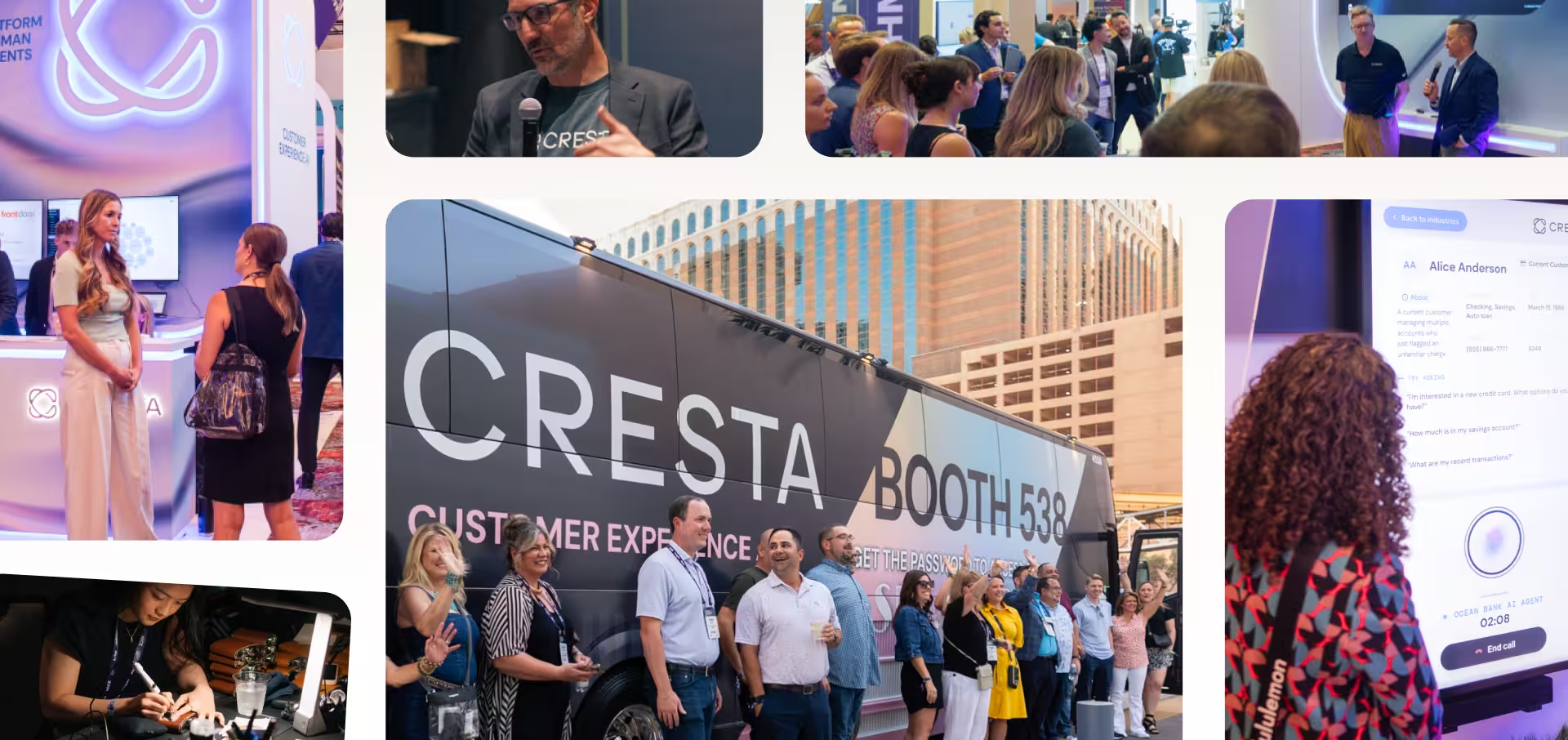


Cresta Connect26 Australia brought together customers, partners, and CX leaders across industries for a day focused less on AI theory and more on what it takes to actually put AI to work in the real world.
The agenda moved from the changing enterprise AI landscape to the role of customer conversations, the realities of implementation, the importance of partnerships and a live demonstration of how human and AI agents can work together.
Speakers from Cresta, Accenture Song, Firstsource and the broader Australian business community brought different perspectives, but a consistent theme emerged: meaningful CX transformation will require technology, people, and partners to move together.
The Wrong Question About AI and Jobs
For the past several years, much of the conversation around AI has focused on whether it will replace human workers – and how soon.
It’s an understandable concern, particularly in customer service, where high-volume and repeatable interactions appear well suited to automation. But it is also an increasingly incomplete way to understand the transformation underway.
As routine work moves to AI, the conversations reaching human agents are becoming more demanding. Cresta’s recent CX workforce research found that 93% of CX leaders believe human-handled calls are growing more complex. The skills that consequently matter most—empathy, judgment, critical thinking, emotional intelligence, and problem-solving—are distinctly human.
That shift was reflected throughout Cresta Connect26 Australia.
Rather than debating whether enterprises should invest in human agents or AI agents, speakers examined how the two can operate as one unified workforce: using the same customer context, organizational knowledge, playbooks, quality standards, and feedback loops.
Cresta’s vision is straightforward: one platform, supporting two kinds of agents.
Customer Conversations Are Where the Brand Becomes Real
The human implications of that vision became particularly clear during a discussion between Cresta Chief Marketing Officer Russell Banzon and Brent Smart, former Chief Marketing Officer of Telstra and one of Australia’s most recognized brand leaders.
Smart’s perspective cuts through a common misconception about brand building: a brand is not simply what a company says in its advertising. It is what customers experience when they interact with the business.
Every service call, claim enquiry, billing dispute, product question, or moment of frustration is a brand interaction. In those moments, operational execution and brand promise become inseparable, which is why customer conversations matter far beyond the contact center. They contain evidence about what customers want, where processes are failing, which promises are being broken, and where an organization is creating, or destroying, trust.
Historically, most enterprises could examine only a small sample of those conversations. The rest remained effectively invisible. AI changes that equation by enabling organizations to analyse conversations at scale, identify root causes, and turn frontline interactions into a continuously improving source of business intelligence.
Moving From Presentation to Production
The difference between an impressive AI demonstration and a successful enterprise deployment is significant.
Enterprise environments contain legacy systems, incomplete data, operational dependencies, regulatory requirements, and unpredictable customer behaviour. AI must work within those constraints while maintaining accuracy, brand standards, compliance, and appropriate human oversight.
This is where many programs stall. Cresta’s workforce research found that 81% of leaders cite integration complexity as their biggest barrier to AI adoption. Only 7% said they can easily access their own conversation data.
At Connect26, Cresta General Manager Andrew Cannington and Cindy Huang demonstrated a more grounded approach by building an AI agent live on stage.
The use case was deliberately familiar: an insurance customer calling to ask about the status of a claim.
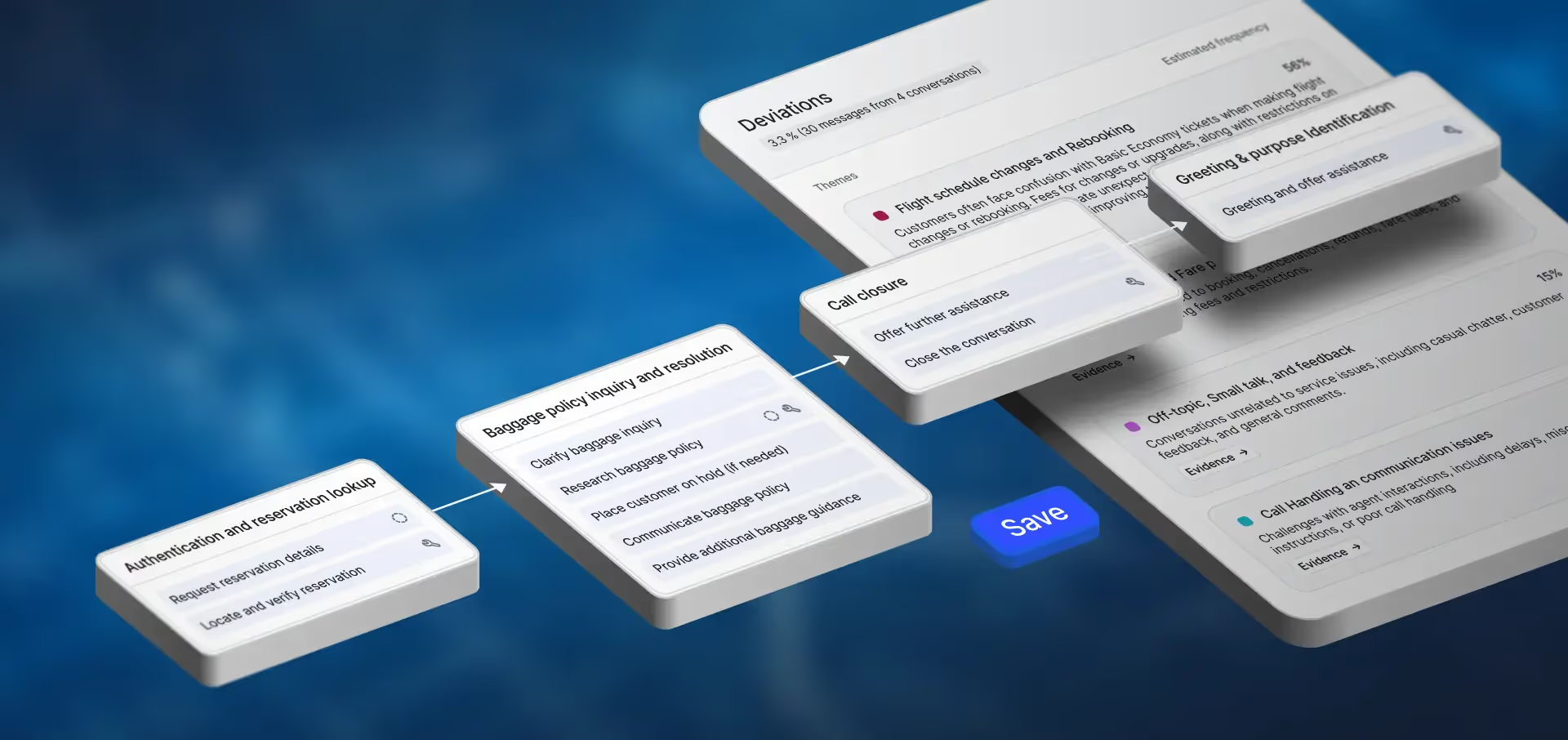
The team did not begin with a generic model or a hypothetical workflow. They began with real customer conversations. Using conversation intelligence, they identified the reasons customers were making contact, examined where the process tended to break down, and mapped the actual workflow required to resolve the enquiry.
They then built and tested an AI agent capable of verifying the customer, retrieving the relevant claim information, and responding to the request. When the conversation required human involvement, the interaction transferred to a human agent with its context intact.
The demonstration illustrated a broader operating model:
- Analyze real conversations to understand customer demand
- Identify the interactions that can be automated safely
- Augment human agents during complex or emotionally sensitive work
- Preserve context when a conversation moves between AI and people
- Use the outcomes of both human and AI interactions to improve the system continuously
In other words, automation and augmentation are not separate strategies. They are parts of the same system.
Transformation Requires More Than One Company
Connect26 was also designed around another enterprise reality: meaningful AI transformation cannot be delivered by a software provider alone.
The event brought together organizations from across the CX ecosystem, including advisory firms, systems integrators, business-process providers, technology companies, and customer-experience specialists. The participating ecosystem reflected the range of capabilities required to move an AI program from strategy to implementation and ongoing operations.
During a discussion led by Cresta CEO Ping Wu, Gagan Vohra, SVP and Country Head at Firstsource, and Chloe Cifelli, Senior Manager at Accenture Song, addressed the practical challenges enterprises face as they attempt to put AI into production.
The discussion moved beyond abstract enthusiasm. Successful adoption requires organizations to redesign workflows, integrate systems, establish governance, prepare their workforce, and measure whether the technology is actually improving customer and business outcomes.
Partners play a critical role in that work. They bring industry knowledge, transformation expertise, implementation capacity, change-management experience, and long-term operational support.
This was also the rationale behind Cresta’s expanded partner strategy. The company’s objective is not simply to create a channel for software distribution, but to support an ecosystem capable of helping enterprises discover opportunities, build AI agents, integrate them into existing environments, manage deployment, and continually optimize performance.
From Scarcity of Intelligence to Abundance
Ping closed the day by outlining Cresta’s vision for the AI-native customer experience.
For decades, high-quality customer intelligence has been scarce. Companies could listen to only a fraction of their conversations. Coaching was limited by managerial capacity. Expert knowledge was difficult to capture. Personalized service was expensive to deliver consistently.
AI has the potential to change those constraints.
When enterprises can understand every conversation, make organizational knowledge available at the point of need, automate suitable interactions, and provide human agents with real-time assistance, good customer experience no longer has to be reserved for a small number of customers or exceptional circumstances.
But abundance does not mean removing people from the system.
It means using AI to eliminate avoidable effort, resolve appropriate interactions more quickly, create conversations that could not economically happen before, and allow human employees to concentrate on moments requiring judgment, empathy, creativity, and trust.
That is the emerging hybrid CX organization described in Cresta’s Workforce Report: AI taking on more routine work while human roles become more specialized and consequential. Eighty-nine percent of surveyed leaders already report improvements in productivity and decision-making from AI adoption.
The Future is Human and AI
The most important lesson from Cresta Connect26 Australia was not that AI has solved every enterprise CX challenge.
It was that the industry is moving beyond simplistic arguments about replacement.
The real work is now about orchestration: deciding which conversations AI should handle, which require people, how the two should collaborate, and how every interaction can make the entire organization more intelligent.
That requires technology built for real operational conditions. It requires workforce planning and organizational change. It requires customer data, governance, integrations, industry expertise, and an ecosystem of partners capable of bringing all of those pieces together.
The future of customer experience will be human and AI: operating on one platform, learning from the same conversations, and working together to deliver better outcomes at a scale neither could achieve alone.