
With all the technologies available to improve customer experience (CX), enterprise IT/CX leaders often ask where to invest their limited budgets. Hands down for me, it’s conversation analytics – the data and insights derived from customer interactions.
Companies can invest in agent assist or AI self-service agents, for example, but how do they know if what they’re doing is working? How do they know what to automate? How do they know what changes to make for continuous improvement?
When AI analyzes every customer interaction, companies can answer all those questions and more. Analytics are the cornerstone for improvements in both CX and the technology that supports it. Today, 49.8% of companies use conversation analytics, but the value of the data can’t be understated: More than 90% say the data derived from conversation analytics is either the most valuable or among the most valuable data available in the company, according to Metrigy’s AI for Business Success 2025-26 global study of 1,104 companies.
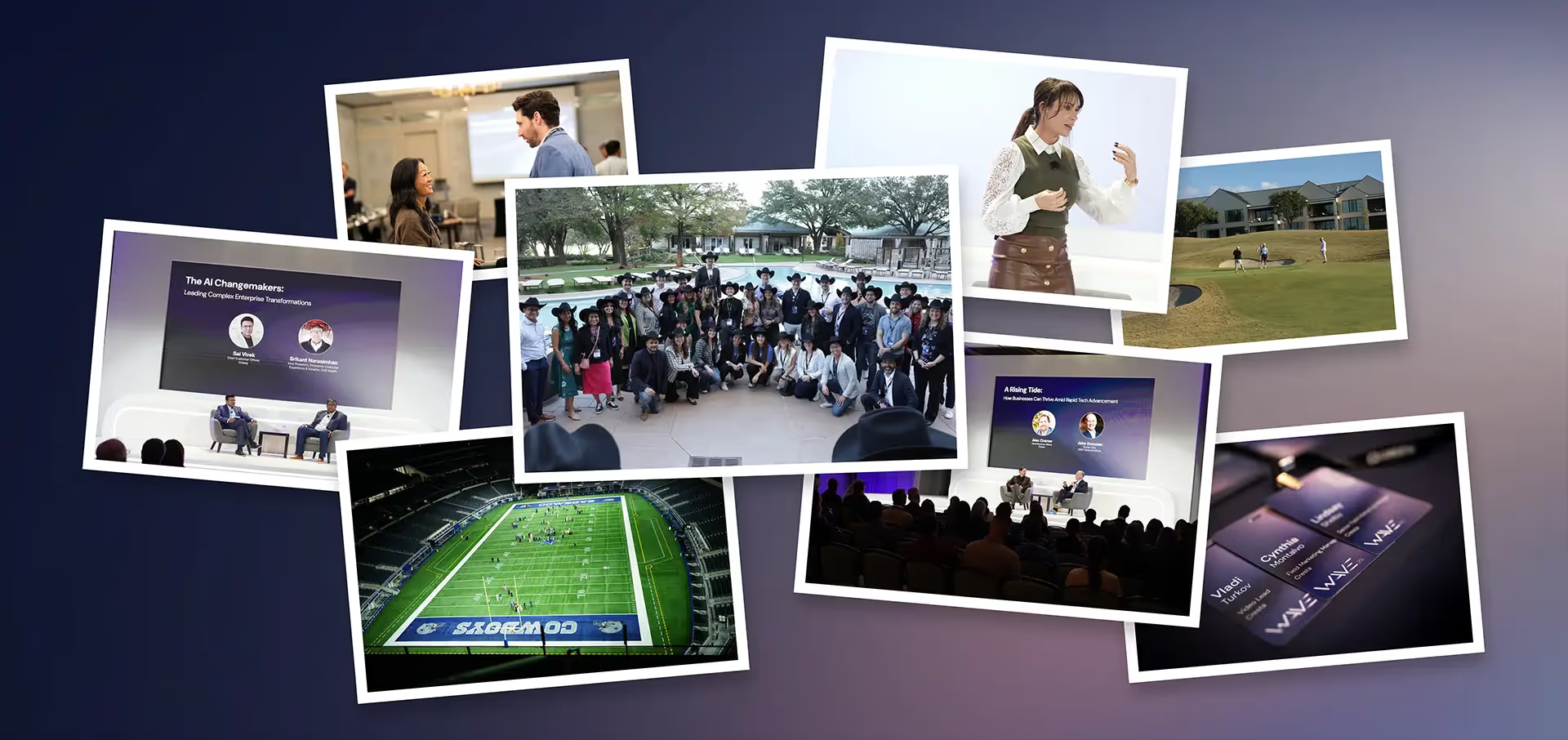
As this technology continues to rise in value, I’m reminded of an incredible session I recently attended at the Cresta Wave conference. Barry Chester, Cresta’s Head of Airlines, interviewed Rachel Walker, Managing Director of Customer Support and Advocacy, and Brandy Maxwell, Senior Manager of Customer Insights Policy Execution, both with United Airlines.
United Airlines’ Path to Success
United Airlines is well into its deployment of Cresta’s Conversation Intelligence products, including Insights and AI Analyst, along with other Cresta offerings. United has even stood up an “Insights to Action” team that leverages the findings. (This, by the way, is a stellar move. I see far too many companies gathering insights and customer feedback and failing to act upon them.)
Getting to the point they’re at now was a progression, starting from paper tallies showing what they thought were their top drivers when customers called into the contact centers, progressing to surveys asking customers for the reasons for their calls. United then added more automation by looking at keywords and breaking down categories, but the tool in use at the time was inflexible, non-real-time, and lacked a good interface.
Once they started using Cresta, all of that changed. Easy-to-use interface? Check. Changes in the moment? No problem. Real-time analysis of what was happening in the moment? Done. The changes were so significant, Maxwell refers to Cresta as United’s “game changer.” The Insights to Action team started operationalizing the information and developing processes to leverage it.
The team worked with digital partners, communications teams, bot and automation teams, and others to make changes based on this data. Insights to Action would suggest changes (or brainstorm together with other departments to develop solutions), show the return-on-investment (ROI) for making the change, and document the results after the changes took place. “We put an ROI against it,” Walker says. “We can go back and say, ‘You making this change did drive the cost savings.’ It motivated the teams. Real data, real volumes, real cost savings.”
For example, customers may have been calling for clarification on communications United sent to them. By changing the communications moving forward to clarify the content, fewer customers would have to call. The data guided them to identify an issue that could be resolved fairly easily.
“It’s an opportunity to establish the contact center as an insights value driver for the business,” Chester says. “We can actually inform our cross-functional departments. Your contact center is the front door to the business; being able to provide the intelligence back to the organization to help drive change, to improve the overall customer experience is a massive opportunity.”
Metrigy’s research backs this up, with 83.7% of IT/CX leaders saying that insights data should be included in dashboards for companywide decision-making.
Maxwell highlights three core examples of where United uses the insights gleaned from Cresta’s products and turns them into action:
- Call deflection – United has a fare type that doesn’t allow customers to make changes to their travel plans unless they upgrade to a different fare, and they must pay to upgrade. Even though they could upgrade to the new fare type and make their travel changes in self-service, they still were calling into the contact center to talk to someone.
Cresta Insights uncovered why: United was asking customers to pay to upgrade before they knew if they could make the travel change they wanted. So, United redesigned the self-service experience, enabling customers to see if they could get the change that they wanted first, and then pay for the upgraded fare at the end of the interaction.
The results? An immediate 50% reduction in live interactions for that contact type, saving the company millions of dollars a year, along with improved customer satisfaction.
- Customer feedback – United’s customers could see the upgrade waitlist about 72 hours in advance of their flight, but they would call prior to that to see how the list was looking. The agents had, and would freely give, the information to customers. But customers simply wanted to see the information digitally. In response to the feedback, the company recently introduced an enhancement to show the upgrade waitlist 30 days prior to a flight, freeing agents to handle more complex issues
- In-the-moment scenario – Maxwell pointed to an incident last year with an air travel disruption. United wanted to validate that safety was the main issue of concern with its own customers. But analytics showed them that customers were more concerned about rebooking. Data from Insights and AI Analyst provided the information to know what customers were talking about, which helped both customers and agents.
“With AI Analyst...it’s not just anecdotal, it’s real data. We can ask questions back and forth. Why it’s happening and what customers are contacting us about. Also, we can see how our front line is doing,” Walker says. “Our agents are so happy that we’re getting better information out to them much faster.”
Moving forward, United wants to use the products to help with day-to-day work because they must do more with the same size team. Cresta’s Automation Discovery, for example, can help them understand how to automate more functions.
CVS Finds Value in AI + Human to Improve Healthcare
In another session at the event, Srikant Narasimhan, VP of enterprise customer experience and insights, CVS Health (which includes Aetna, Caremark, CVS Pharmacy, Minute Clinic, and more brands), described how AI has found a home in the company’s CX strategy. Though many think AI is coming for their jobs, Narasimham says CVS views AI as complementary with humans.
“Human plus AI is better than human without AI,” he says. “AI takes the stupid out of work. So, it’s more of a capability to free up the productivity and the mind space for teams to deliver a better experience.”
The front-line employees want to help patients and impact their healthcare, and when they realize how AI will make it easier to deliver a better outcome for the patient or their family member, the adoption flows from that. In fact, Metrigy’s study shows 71.9% of companies see a 31.1% improvement in CSAT/PSAT when they use agent assist.
One of the first applications of AI for CVS was summarization, which resulted in a fast return through reducing after-call work time. Illustrating those wins to their leadership enabled CVS to obtain buy-in for other capabilities, including predictive CSAT.
CVS leverages Cresta’s predictive CSAT on every call, giving the company a more complete picture of the true customer sentiment. Previously, CVS relied on customer surveys, where they received a 5% response rate.
“Now, we’ve scored 100% of our calls. So, at an agent level, we understand performance, not just from their perspective but from the consumers’ perspective,” Narasimhan says.
Predictive CSAT models are running at an 85% to 95% accuracy rate, according to Metrigy’s research.
By tracking CSAT in this way, CVS’ time to insight is accelerated. CX leaders can see when sentiment is declining and get in front of it quickly, being more proactive with communication and explaining alternatives to customers. In the world of customer surveys, it would take a few weeks to get enough information to analyze—and even then, it was only from a fraction of interactions.
Moving forward, CVS plans to work with Cresta on a scoring model to rate all calls on customer experience and agent quality. One benefit from that is to improve coaching. What’s more, they will use analytics to understand why customers are not using self-service options for certain functions, such as changing mailing addresses.
.avif)