Parloa vs Decagon: how to compare them


- Choose Parloa if you're a voice-first enterprise with high inbound call volume and a stack built on SAP, Genesys, Salesforce, or ServiceNow
- Choose Decagon if you're a digital-first company that wants chat and email automation live quickly, with CX teams editing agent logic in plain language
- Both platforms center on AI agents, though Decagon's Watchtower also monitors human-agent interactions
- Choose Cresta if you want one platform that automates, augments, and analyzes every conversation your human and AI agents handle
If you want AI agents to automate a large share of your customer conversations, you'll likely consider Parloa and Decagon.
Parloa is voice-first with deep SAP ties, but setup can be complex. On the other side of the coin, Decagon is digital-first and quick to implement. But unusual customer problems still need humans, and there's little independent validation of its agent assist platform.
We'll help you compare Parloa and Decagon by profiling each platform's pros and cons and walking through when to choose which. But first, here's how we analyzed both.
How we compared Parloa and Decagon
We drew on analyst reports from firms like Gartner and Forrester and user reviews from sites like G2 and Gartner® Peer Insights. We also leveraged our conversations with hundreds of prospects and customers who’ve used and/or evaluated Parloa or Decagon.
We evaluated both platforms against seven criteria:
- Channel focus: whether the platform started in voice or in chat and email, since that shapes where it's strongest
- How agents are built and changed: who can change agent behavior, and how quickly
- Enterprise fit and integrations: whether the AI layers onto your telephony, CCaaS, CRM, and help desk stack or sits in front of it
- Implementation effort and time to value: how long it takes to go live and how much technical lift setup demands
- Pricing transparency and model: whether pricing is published and how you're charged as volume grows
- Analyst validation and review depth: how much independent evidence exists beyond the vendor's own claims
- Human and AI operations: whether QA, coaching, and analytics cover AI agents and human agents on one platform
Learn how Cresta can transform your CX operations
Parloa overview
Parloa sells the AI Agent Management Platform (AMP) for voice and chat. It covers conversation design, simulation and evaluation, NLU, telephony and CRM integrations, and analytics.
Pros
- Built for voice. Parloa started in telephony, and users can tell that that’s a core strength of the platform. For example, here’s what one G2 reviewer said:

- Wide language coverage. Parloa supports 140+ languages, which means global businesses can serve customers in their preferred language
- Deep enterprise ecosystem. It holds SAP's endorsed app premium certification and partners with Microsoft, OpenAI, Five9, and Epic. As a result, Parloa can plug into the systems large enterprises already run with relatively little custom integration work
Cons
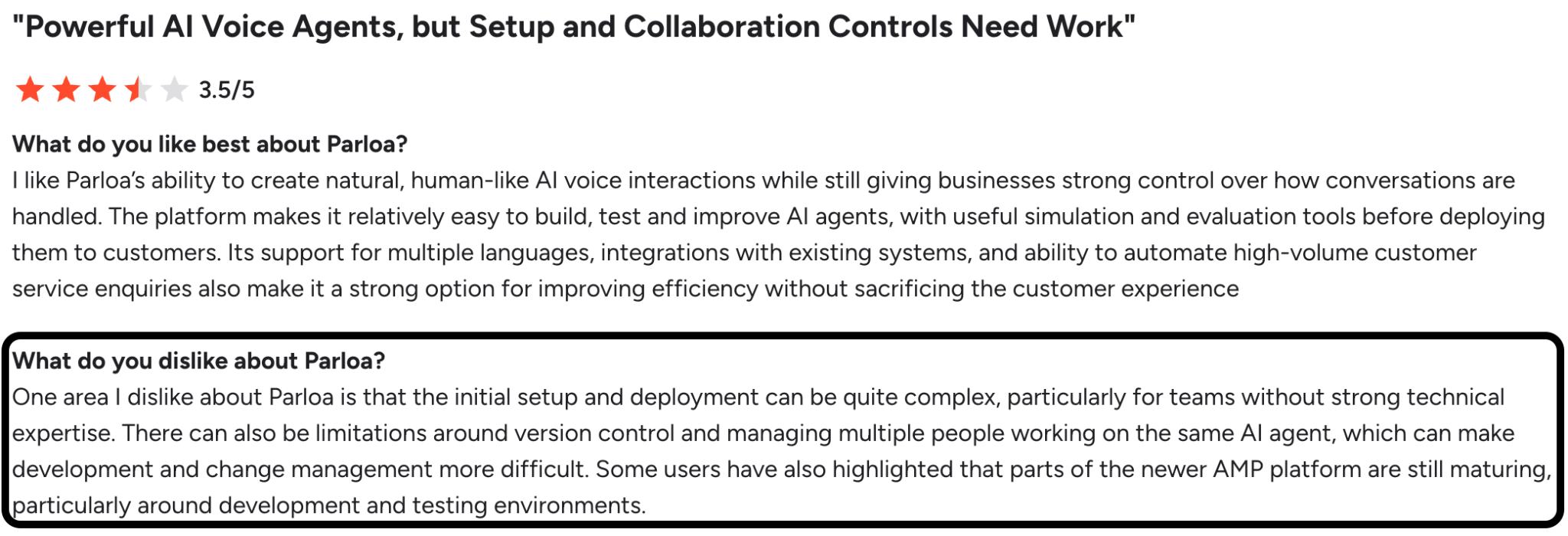
- Complex setup for nontechnical teams. Users say that they need technical resources to stand up the platform, which can delay its implementation and time to value. The G2 reviewer highlighted earlier shared this sentiment:
- No public pricing. Parloa quotes on request, so you have to schedule time with their team to learn about their pricing model, and get a custom quote
- No confirmed Gartner or Forrester Leader placement. It's a Gartner Cool Vendor in CRM, but beyond that, it holds no major leadership placements
- Automation-focused. Parloa’s QA tooling scores its AI agents, not human agents, so it offers no unified coaching and QA layer across both
Related: The top alternatives to Parloa
Decagon overview
Decagon positions itself as "The AI concierge for every customer." It runs voice, chat, and email agents on one intelligence layer, with workflows defined in natural-language Agent Operating Procedures (AOPs).
It started with digital-first, high-growth tech companies and is increasingly selling to Fortune 100 enterprises in airlines, banking, telecom, and retail.
Pros
- Well funded and growing fast. Decagon also has significant financial backing. Case in point: The company raised a $250M Series D at a $4.5B valuation in January 2026
- Fast to implement. G2 shows a 2-month average implementation and many reviews validate the fast implementation timeline

- CX teams can change agent logic in plain language. This enables CX teams to define and update agent workflows in natural language, so routine changes like a new policy or escalation rule don’t wait on an engineering sprint or a vendor’s queue
- CX teams can change agent logic in plain language. Decagon’s Agent Operating Procedures (AOPs) define workflows in natural language, so routine changes like a new policy or escalation rule don’t wait on an engineering sprint or a vendor’s queue
- Recognizable and fast-growing customers. Its customers include brands like Chime, Notion, Duolingo, and Rippling, which validates the platform’s strength and credibility
Cons
- Limited agent assist functionality. Decagon Assist, launched in August 2026, can only provide guidance that follows known AI-agent workflows rather than live conversation behavior, and its usage data isn’t connected to coaching or quality workflows
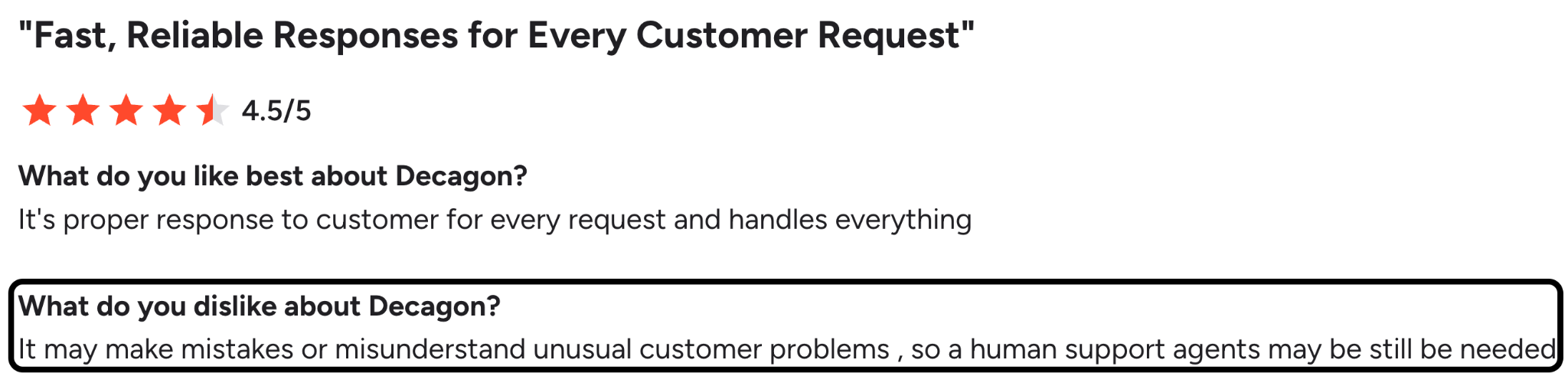
- Unusual problems still need humans. Users (like the G2 reviewer below) say that the AI agents can make mistakes. When they do, you’ll need a human agent to get involved (which, as our previous bullet pointed out, forces you to use their less mature agent assist product)
- Little independent validation. Like Parloa, Decagon doesn't appear in major evaluations, like the 2026 Gartner® Magic Quadrant™ for Conversational AI Platforms. The platform also has zero reviews on several software review sites, including Capterra and Trustpilot
- No public pricing. Decagon forces you to book a demo to get any information on its pricing
Given all the pros and cons of each platform, it can be hard to decide between the two. We'll help you navigate the decision more directly in the next section.
Related: The best Decagon competitors and alternatives
Decagon vs Parloa: which should you choose?
Choose Parloa if you're a large enterprise with high inbound call volume in insurance, financial services, telecom, or travel. It’s a particularly great fit for voice-first operations that run on SAP, Genesys, Salesforce, or ServiceNow.
On the other hand, pick Decagon if you're a digital-first, high-growth company where chat and email carry most of your volume. It’s especially a strong fit for mid-market and enterprise teams on Zendesk or Salesforce that want CX staff editing agent logic.
Don't settle for Parloa or Decagon
Cresta, the AI operating system for CX, addresses Parloa's and Decagon's gaps by offering:
- Live guidance based on behaviors. Decagon Assist matches known AI-agent workflows and offers next steps, and Parloa’s quality tooling stops at its own AI agent. Cresta Agentic Assist detects what’s happening in the conversation and prompts the behaviors that drive outcomes, so a rep gets the right help at the right moment
- One standard across QA, coaching, and live guidance. Decagon’s Watchtower and Parloa’s Lens and Navigator score conversations, but neither connects scoring to coaching and live guidance. In Cresta, a gap found in QA becomes a coaching plan, the same behavior is reinforced in the live conversation, and reports show whether it changed
- Human and AI agents on one platform. Parloa centers on its AI agent, and Decagon Assist runs inside helpdesks like Zendesk, Salesforce, and Front with no CCaaS integration. Cresta covers both kinds of agent on one behavior model, layers onto your existing CCaaS, and analyzes 100% of conversations across human and AI agents
- AI agents built from real conversations. Decagon’s Duet drafts AOPs from a sample of past conversations, and Parloa’s tooling centers on tuning prompts, workflows, and tools. Cresta’s Automation Discovery scores which workflows are ready to automate using production conversations, and Synthetic Customers test the agent against personas traced back to real calls
- Independent validation. Forrester named Cresta a Leader in The Forrester Wave™: Conversation Intelligence Solutions for Contact Centers, Q2 2025, and Cresta reports the highest score in the Current Offering category
See how Cresta works on your own conversations by scheduling a demo.