
The 7 best AI agents for customer care contact centers in 2027


- AI agents for customer care contact centers resolve voice and digital conversations, take actions in your systems, and hand off to humans with context
- Pick Cresta for human and AI agents on one platform; Cognigy and Genesys for suites; Sierra andDecagon for agent builders; and PolyAI or Parloa for voice-heavy operations
- Evaluate AI agents by testing them on your own conversations first, then check guardrails, human and AI compatibility, stack fit, and outcomes beyond containment
Customer care leaders are being asked to show results from AI, quickly.
Case in point: A Gartner® survey of service leaders found that 91% are under executive pressure to implement AI.
Yet later Gartner® research shows only 4% have achieved the AI return they expected.
One of the most useful applications of AI in customer care contact centers are AI agents that can resolve routine requests end to end, such as billing questions, order status, password resets, and hand off to a human with a summary and history when the issue needs judgment.
We’ll help you adopt AI agents successfully by breaking down the best AI agents for customer care operations, along with best practices for evaluating each.
But first, let's align on how AI agents for customer care typically work.
Note: This article was updated on 11/12/2026. The information below can change in the future.
What are AI agents for customer care contact centers?
They're AI systems that understand what a customer wants, work out how to resolve it, and take action, within guardrails you set.
They also lwork across voice and digital channels and hand off to a human agent—when a request needs one or the customer asks—with a summary and the conversation history.
Under the hood, they pair large language models (LLMs), which are AI trained on vast amounts of text, with tools, memory, and rules, plus fixed controls for steps that need to happen the same way every time.
That mix lets them do things, like update an address or change a booking, instead of only answering questions.
Most AI agents work through the same basic loop:
- Understand: Figure out the customer's intent, even when they explain it in a messy or roundabout way
- Reason: Plan the steps needed to resolve the request, using the policies and knowledge you provide
- Act: Verify who the customer is, then take action in back-end systems, such as checking an order, changing a booking, or taking a payment
- Hand off: Pass the conversation to a human, along with a summary and history, when the request needs judgment, the customer asks, or the agent isn't confident
How an agent is built also matters as much as the model behind it.
Agents designed only from scripts and help articles tend to break when real customers go off-script, while Agents designed from real conversations reflect how your customers talk and what your best human agents do.
How we evaluated the best AI agents for customer care contact centers
We assessed the platforms using reviews from G2, analyst research, and product documentation. We also drew on our conversations with customers and prospects.
Using these inputs, we scored every platform on these criteria:
- Conversation quality on voice and digital: How naturally the agent handles interruptions, topic changes, and the requests on each channel it covers
- Grounding in real conversation data: Whether the agent is designed from your real transcripts and procedures or only from scripts and help articles
- Testing and guardrails: How the vendor tests before launch and keeps the agent accurate, safe, and on-policy afterward
- Human and AI collaboration: How humans and AI agents work together
- Integrations with your existing stack: Whether it connects to your contact center platform (CCaaS) and customer records system (CRM) without a rip-and-replace project
- Builder experience and ownership: Who can build and change the agent, and how much depends on the vendor's services team
Here’s how the platforms performed across this criteria:
Top AI agents for customer care contact centers
Let’s take a closer look at each platform.
Cresta
Cresta is the AI operating system for CX.
It powers Cresta AI Agent, which resolves multi-step workflows on voice and digital channels, like verifying a caller, checking an account, and taking action. And it shares one conversation layer with Agentic Assist and Conversation Intelligence, so insight from every conversation shapes how the agent is built and improved.
Key AI agent features
- Built from real conversations: AI Agent is designed from your own transcripts and top performers instead of idealized scripts
- Testing with synthetic customers: Simulated customers that act like yours stress-test the agent before launch and after each change
- Agent Operations Center: A unified command center for overseeing human and AI agents, backed by guardrails, testing, and versioning
- Multi-intent, omnichannel conversations: One agent handles a billing question and an address change in the same session, across voice, chat, and messaging
- Conductor and Cresta CLI: Technical teams can build, test, and deploy their own agents, alongside Cresta's guided delivery
- Handoff into Agentic Assist: When a person takes over, full context carries over and Agentic Assist guides them in real time
What customers say
Dozens of enterprise brands cite significant ROI metrics from using AI Agent and the Cresta platform more broadly.
For example, Propel Holdings, a Canadian fintech lender, reached a 58% chat containment rate with Cresta AI Agent and expects to absorb 30 to 40% contact growth with minimal added headcount.
Get a personalized demo of human and AI agents working on one platform.
NICE Cognigy
Cognigy, now part of NICE, is a conversational AI platform built for large contact centers that want AI flexibility with firm control.
It mixes generative AI with rule-based steps in one conversation. That way, teams decide where the agent can improvise and where it must follow a fixed path.
Key AI agent features
- Hybrid AI: Blends agentic AI with deterministic steps, meaning rules that run the same way every time, in one conversation
- AI Agent Studio: A low-code builder with prebuilt tools and integrations, plus two-way Model Context Protocol (MCP) connections to outside systems
- Knowledge AI: Grounds answers in your own content, shows the source behind each response, and keeps short- and long-term memory
- AI Agent Evaluation: Runs simulated conversations before launch and after each change to catch new problems early
- Channel and language reach: Covers voice and a wide range of messaging channels and languages, plus a copilot for human agents
What reviewers say
G2 reviewers say Cognigy is easy to use, with built-in tools that make building bots simple.
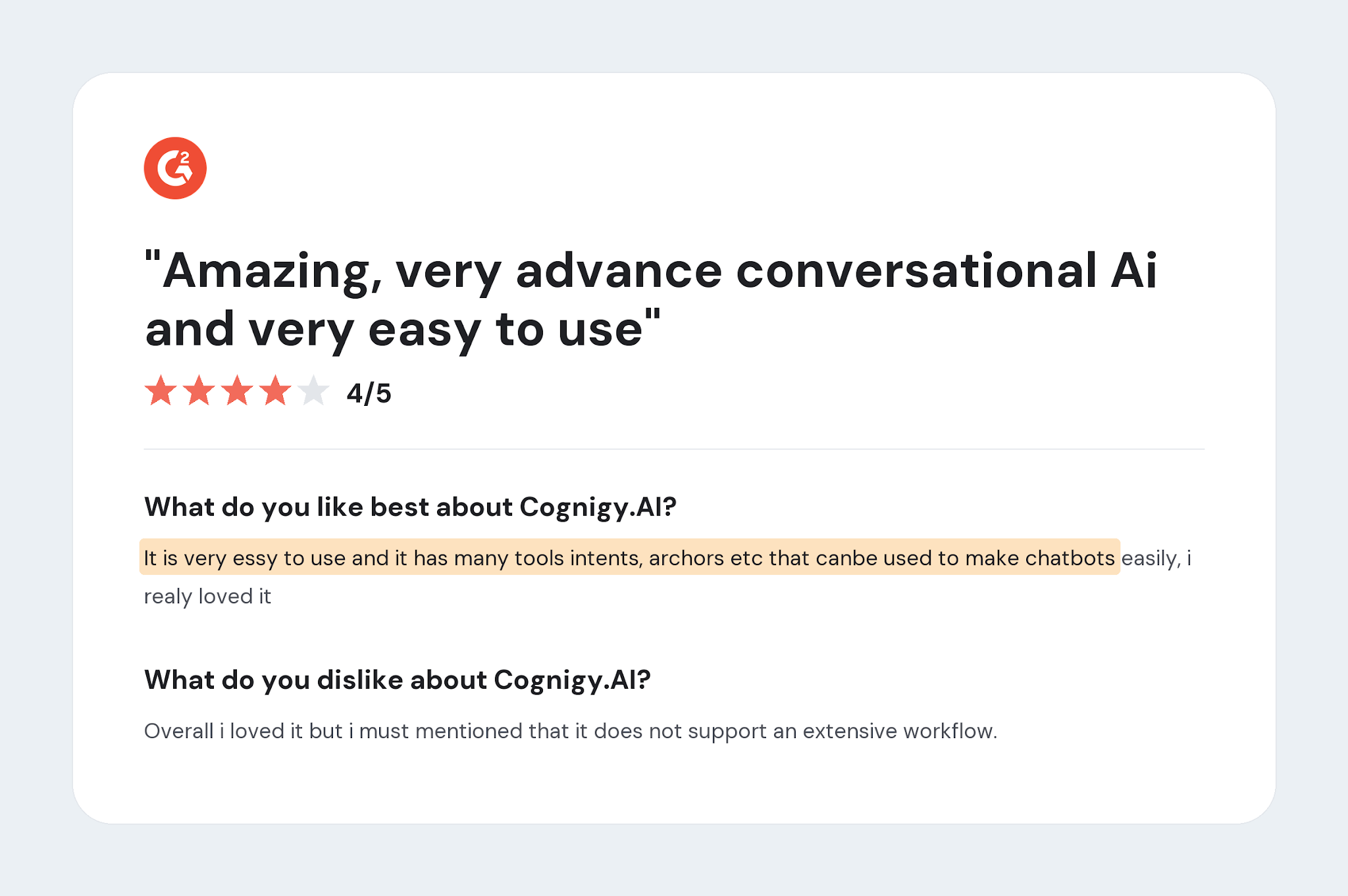
But some reviewers note it doesn't handle very extensive workflows well, and some mention limited analytics.
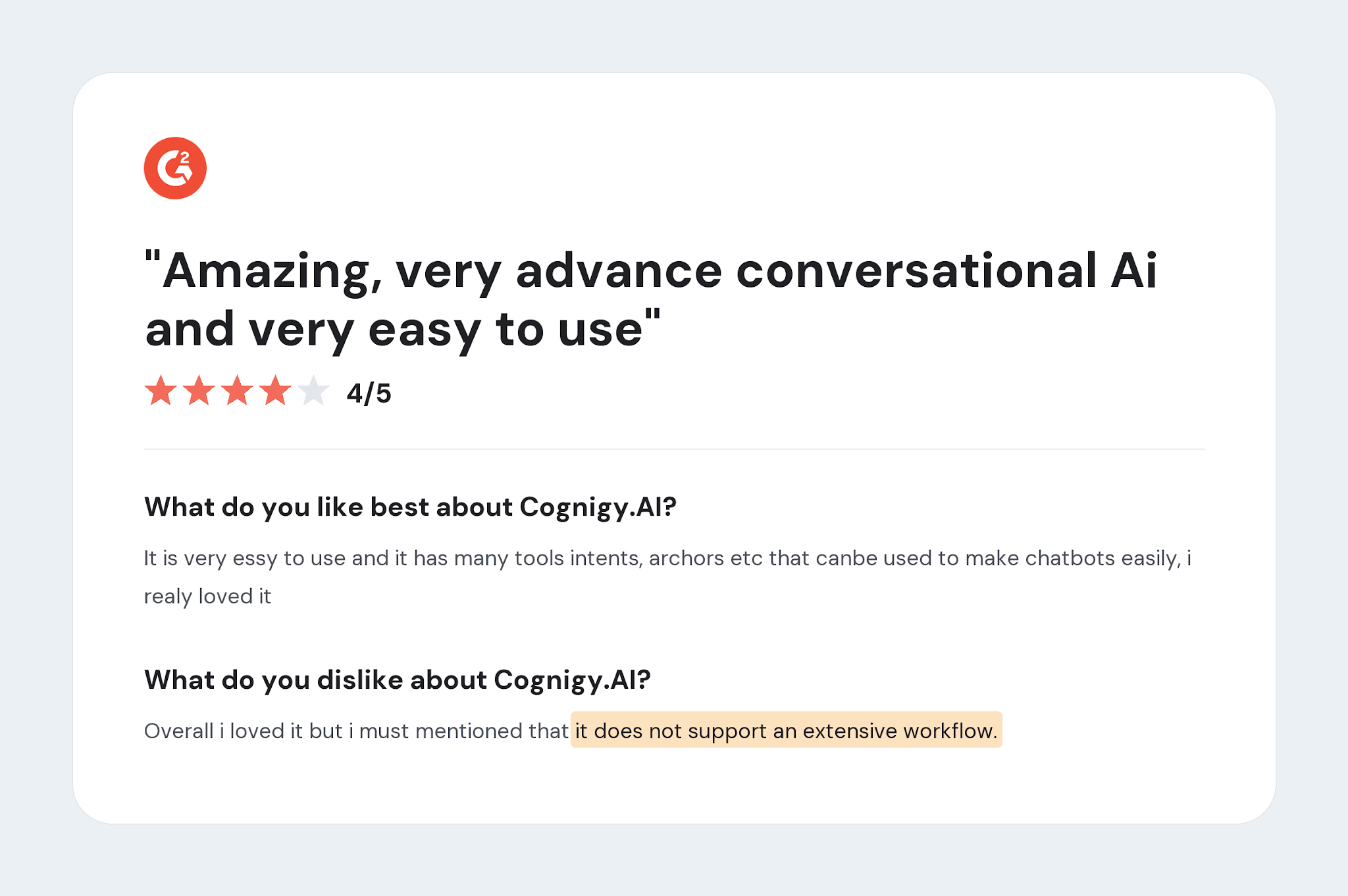
That matters for AI agents because resolving one request often takes several linked steps across different systems.
Related: The top Cognigy alternatives
Sierra
Sierra supports AI agents for customer-facing brands across chat and voice, with its own team typically handling the initial build.
Key AI agent features
- Agent Studio journeys: Step-by-step agent instructions that can be generated from your existing standard operating procedures (SOPs)
- Agent Traces: A real-time record of every decision and tool call, so teams can see why the agent acted
- Knowledge-gap detection: Flags questions your knowledge base can't answer, so content teams know what to fix next
- Simulations: AI-driven testing runs large sets of practice conversations to evaluate the agent before and after changes
- Integrations and routing: Prebuilt connectors to knowledge bases, systems of record, and contact centers, with routing to humans with context
What reviewers say
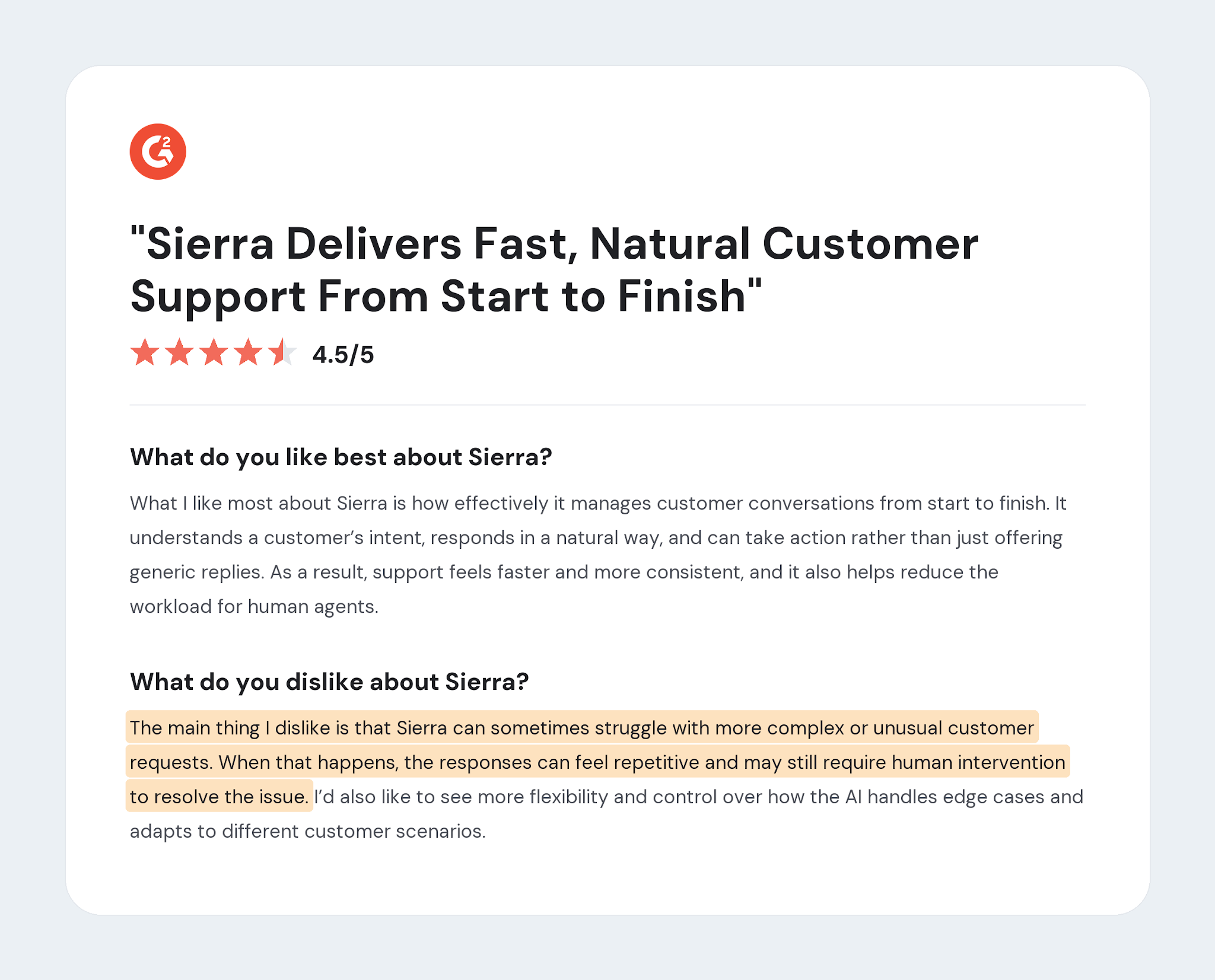
G2 reviewers highlight how Sierra’s AI agents can understand intent, sound natural, and take action to resolve requests.
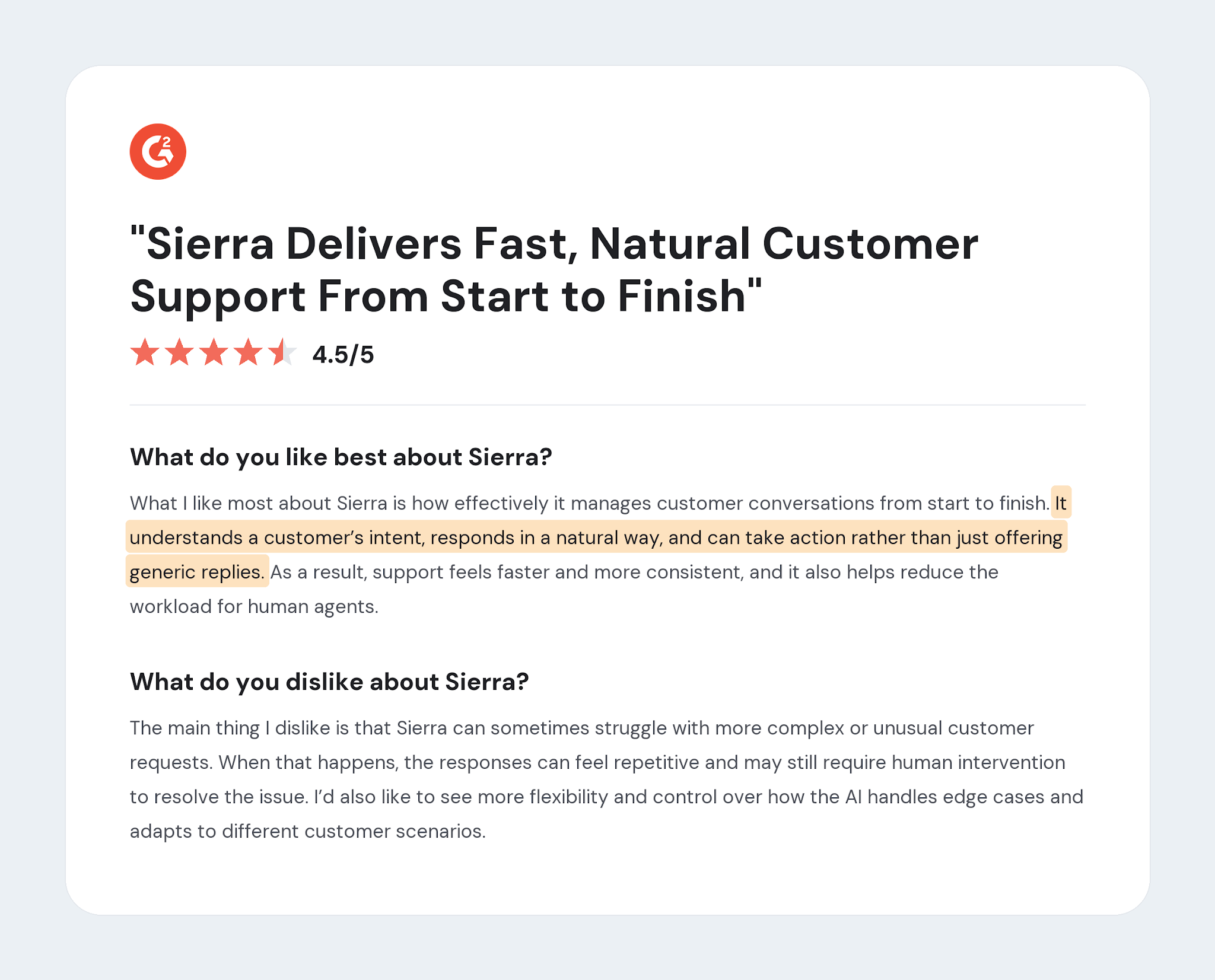
But other reviewers say Sierra can struggle with complex or unusual requests that still need human help.
Related: A guide to Sierra alternatives
Decagon
Decagon builds AI agents that CX teams write in plain language, with engineers owning the guardrails and integrations.
One agent can cover chat, voice, and email and carries context across sessions.
Key AI agent features
- Agent Operating Procedures (AOPs): Natural-language instructions that compile into code, with engineers controlling guardrails, integrations, and versioning
- AOP Copilot: Also called Duet, it analyzes past conversations, then drafts, tests, and refines new AOPs
- Unified chat, voice, and email: One agent across channels with user memory, plus Proactive Agents for outbound voice calls
- Watchtower QA: Always-on quality assurance (QA) review, alongside simulations and live A/B experiments that compare agent versions with real customers
- Personal AI agent detection: Recognizes when a customer's own AI assistant, instead of a person, contacts your business
What reviewers say
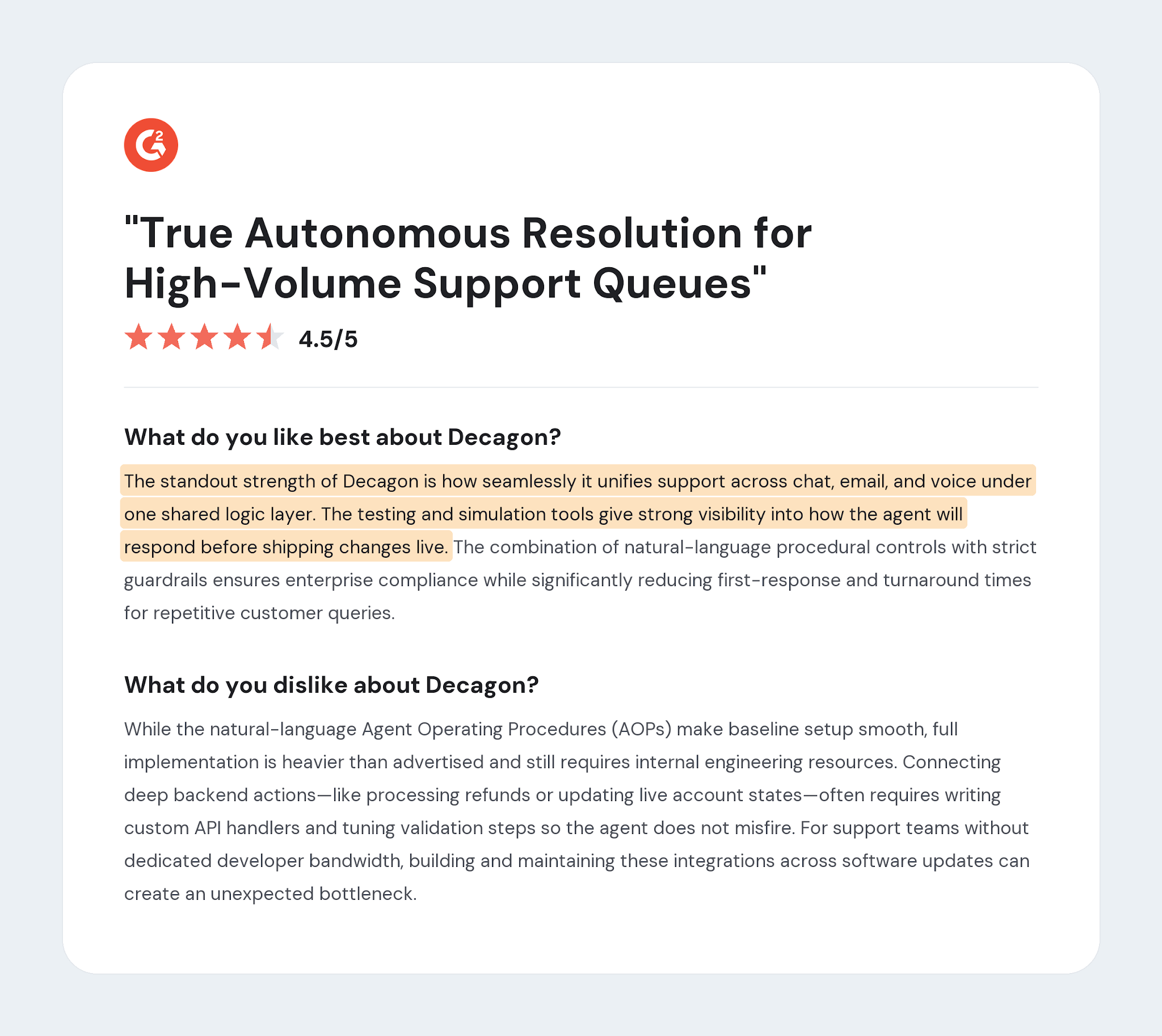
G2 reviewers value Decagon's unified logic across chat, email, and voice, plus its testing and simulation tools.
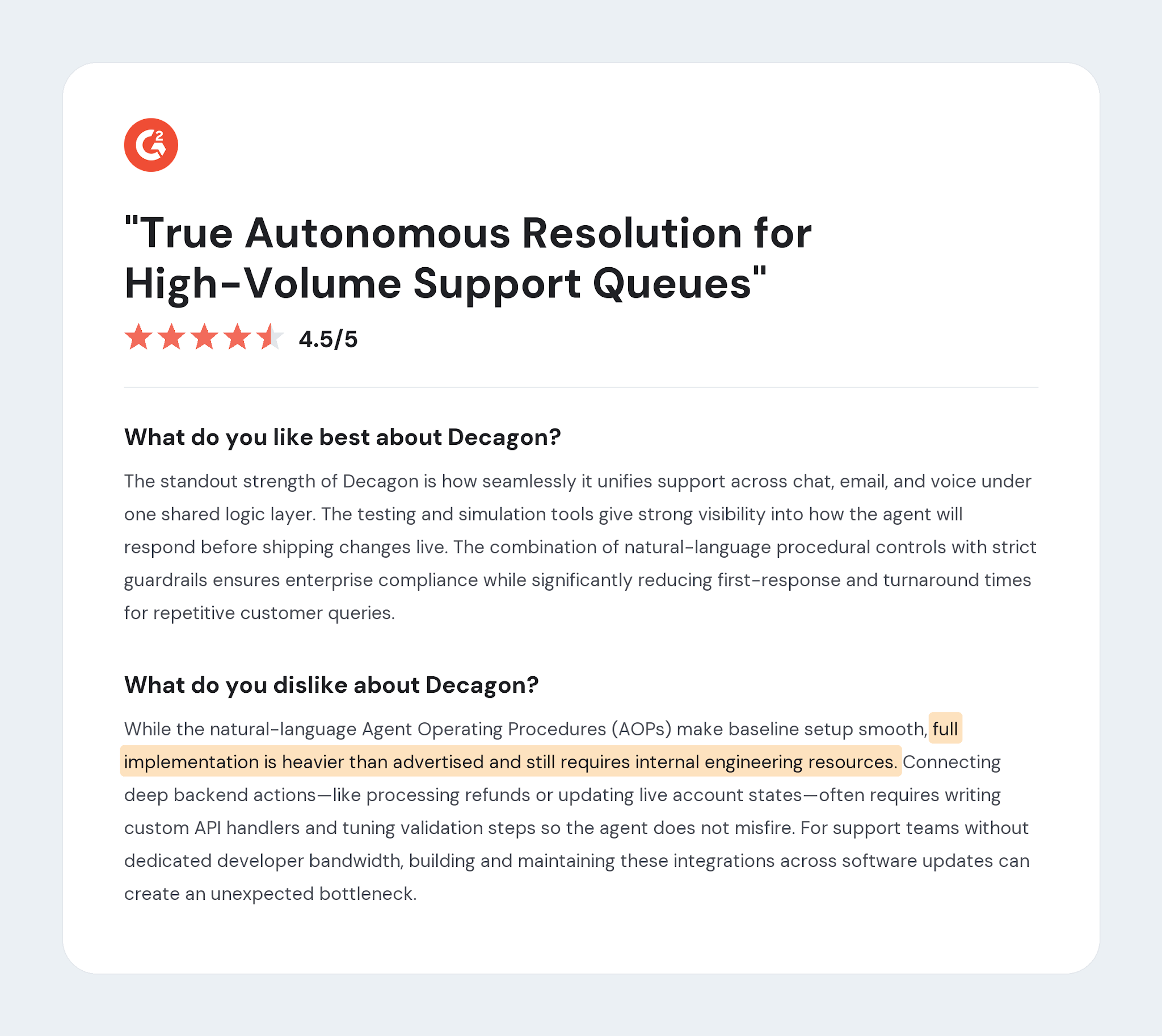
But reviewers also say implementation is heavier than advertised and needs engineering time.
Related: The best Decagon alternatives
PolyAI
PolyAI is a voice-first AI agent company built for phone calls that need to sound natural. It runs on its own voice and language models and also offers a no-code builder for chat.
Key AI agent features
- Agent Studio: A visual no-code builder for voice and chat agents, covering knowledge, flows, tools, voices, and integrations
- Proprietary models: The Raven LLM and an audio-native speech model, with support for other LLMs
- Wren Studio Assistant: Builds, tests, and debugs agents from plain-language requests, with edits made on separate branches
- Simulation testing and PolyScores: Tests agents across channels, then tracks performance through analytics, PolyScores, and dashboards
- Agent Development Kit (ADK): Python extensibility, open APIs, and a Connect Portal for custom integrations
What reviewers say
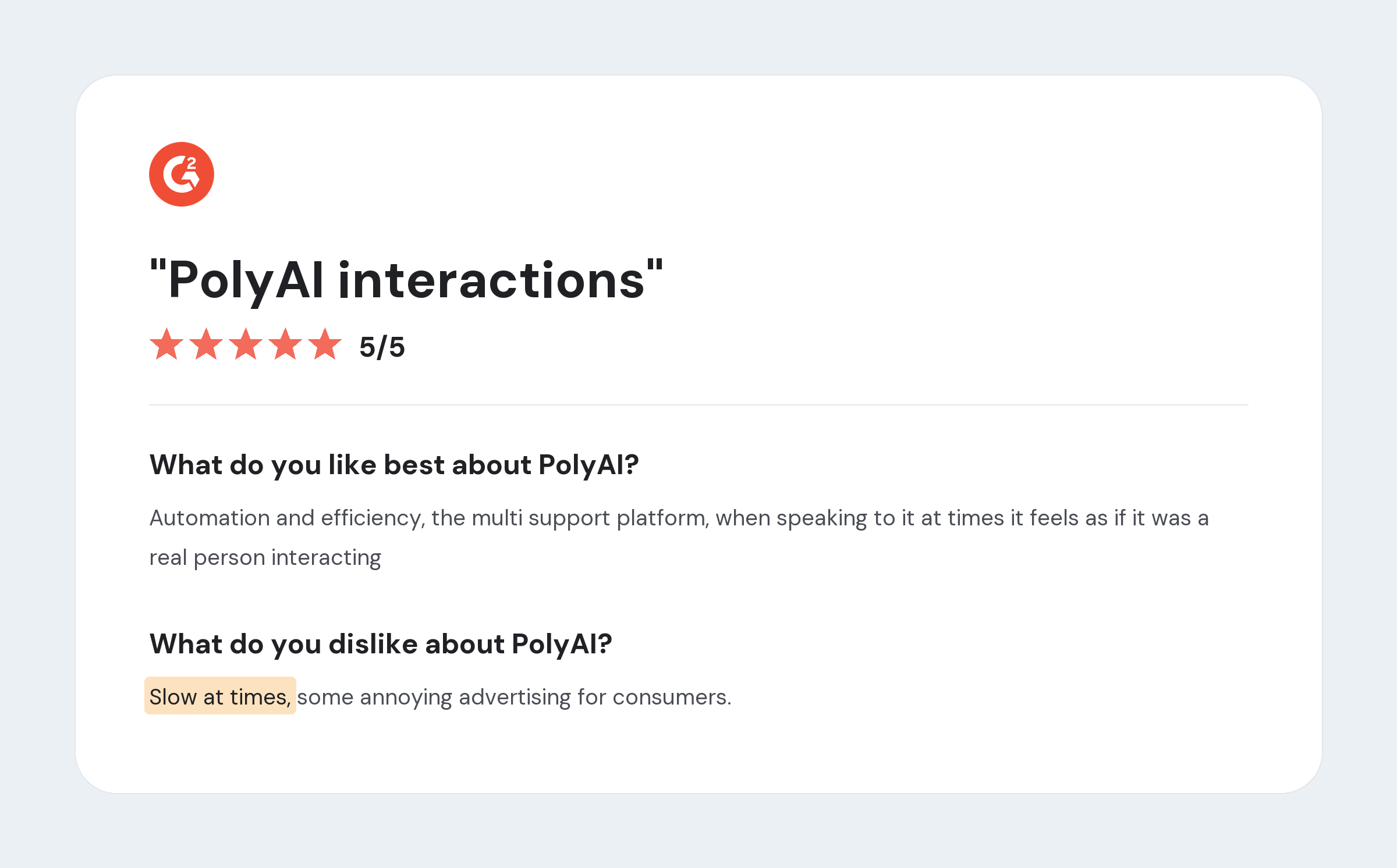
G2 reviewers praise PolyAI's automation and a voice that can feel like talking to a real person.
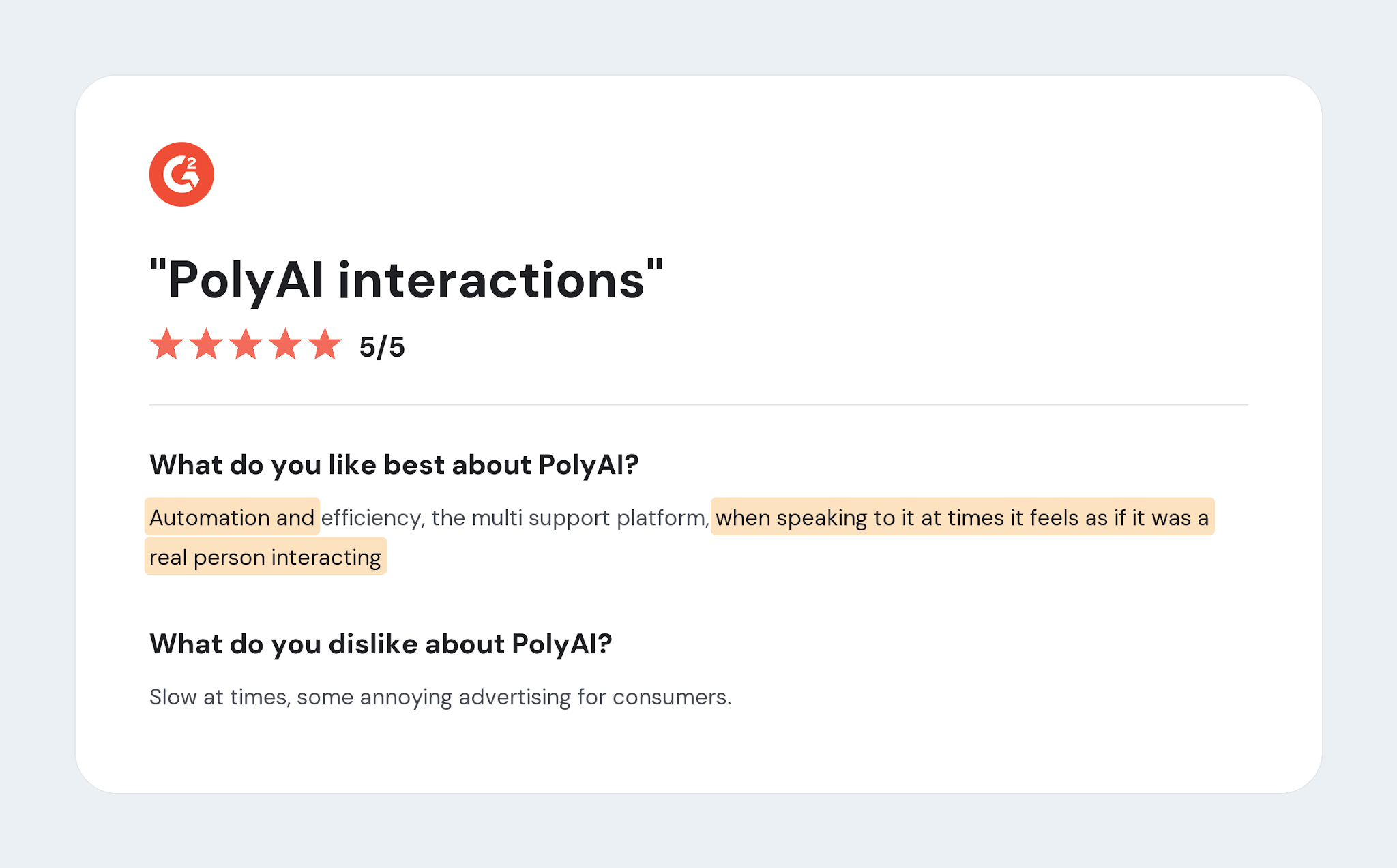
But some reviewers say it can be slow at times.
Related: The top PolyAI alternatives
Genesys Cloud AI agents
Genesys Cloud AI agents are built into the Genesys Cloud CX platform.
For teams already on Genesys, AI agents share routing, Agent Copilot, and governance with the rest of the suite.
Key AI agent features
- Agentic Virtual Agent: Runs on large action models, which are AI built to complete goals and take actions, not just answer questions
- Genesys Cloud AI Studio: No-code setup of goals, guardrails, and actions, with enterprise governance and audit trails
- AI Guides: AI-executable instruction sets, generated from prompts, that power both virtual agents and Agent Copilot
- Channel breadth: Voice, text, web, social, and WhatsApp, inbound and outbound, around the clock in any language
- Native routing and Copilot handoff: Contextual handoffs into Genesys routing, where Agent Copilot keeps guiding the human agent
What reviewers say
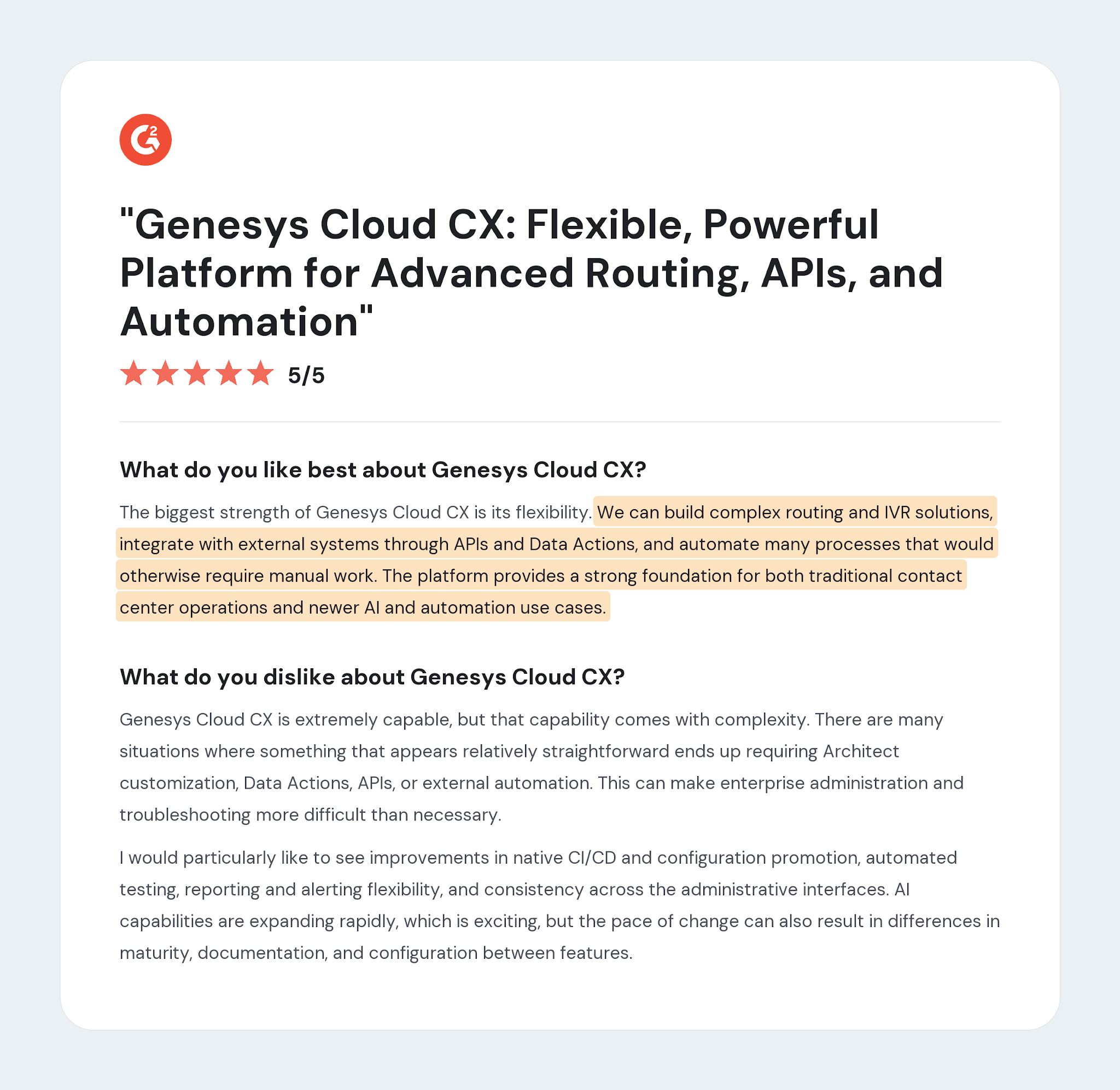
G2 reviewers praise Genesys Cloud CX's flexibility, advanced routing, APIs, and automation for AI use cases.
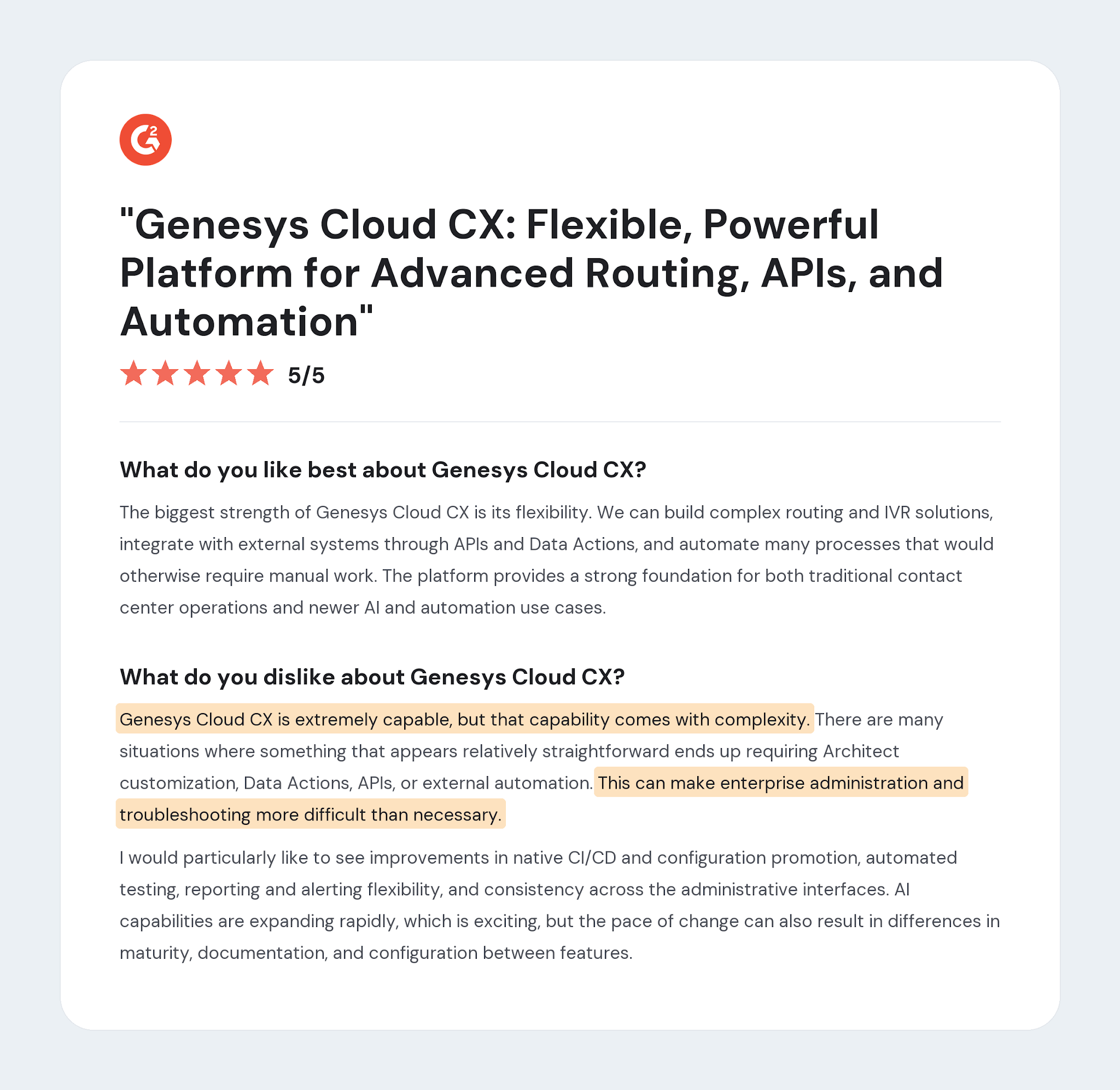
Reviewers also say that capability comes with complexity, which makes administration and troubleshooting harder.
Related: The top Genesys alternatives
Parloa
Parloa is an AI agent management platform focused on enterprise voice and chat. Teams brief agents in natural language, then test, deploy, and monitor them across one defined lifecycle.
Key AI agent features
- AI Agent Management Platform (AMP): Covers design, integration, testing, deployment, scaling, monitoring, and improvement in one lifecycle
- Natural-language briefing: Agents are instructed in plain language, with prebuilt skills for FAQs, routing, and authentication, plus custom skills
- Simulations, evaluations, and versioning: Agents are tested, scored, and versioned before they go live
- Bring your own models: Model orchestration with your choice of speech-to-text, text-to-speech, and LLM providers
- CCaaS and CRM integrations: Connects to Genesys, Avaya, Twilio, Salesforce, ServiceNow, and Zendesk, with real-time translation for human agents
What reviewers say
G2 reviewers describe Parloa's automated calls as natural, with low latency and smooth handoffs to agents.
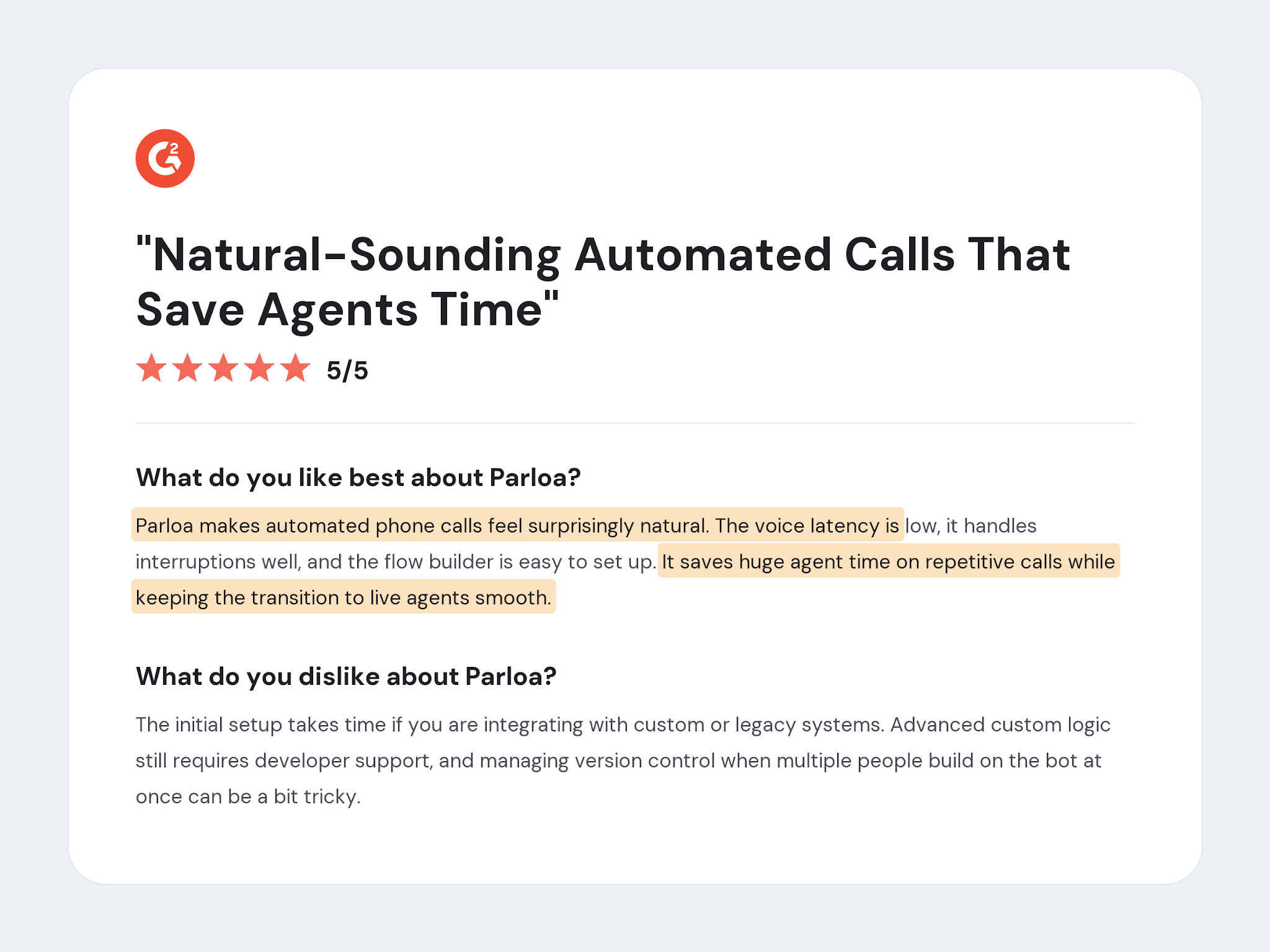
But reviewers also say setup takes time with custom or legacy systems, and version control can be tricky.
Related: The best Parloa alternatives
How to evaluate AI agents for your customer care contact center
Once you've narrowed your shortlist of AI agents for customer care contact centers, test each vendor on the criteria below.
Test on your own conversations
Real customers ramble, change topics, and ask for more than one thing at once. An agent designed only from scripts and help articles tends to break on those turns, even if it shines in a demo.
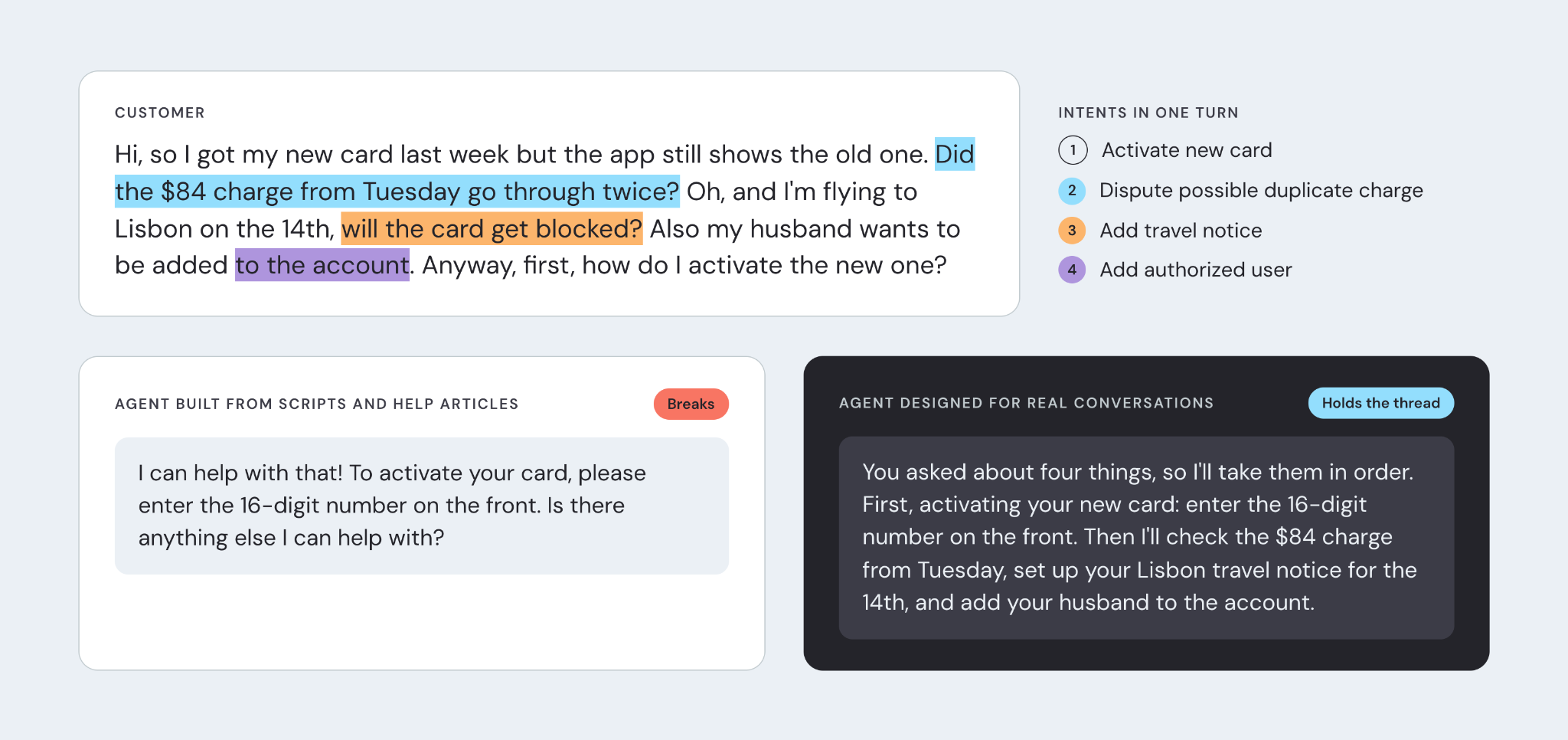
Look for an AI agent platform that can be designed from your call transcripts, including how your top human agents handle tricky moments. To that end, the vendor should let you run the AI agent against your historical conversations during testing.
Enable humans and AI agents to work together
AI agents should handle routine, well-defined requests, and people should still handle the conversations that need judgment or empathy, so the two work best as one operation on shared data.
To that end, look for platforms that offer one view across human and AI conversations, with the same quality scoring and reporting for both.
That way, what your best human agents do can shape how the AI agent is designed, and supervisors can oversee both in one place.
Evaluate guardrails before and after launch
An AI agent that's right most of the time can still damage trust with one bad answer. So guardrails, the rules that keep AI accurate, on-topic, and safe, need to be tested as hard as the agent itself.
Prioritize platforms that offer simulation at scale, with synthetic customers that behave like yours, plus adversarial testing that tries to break the agent on purpose.
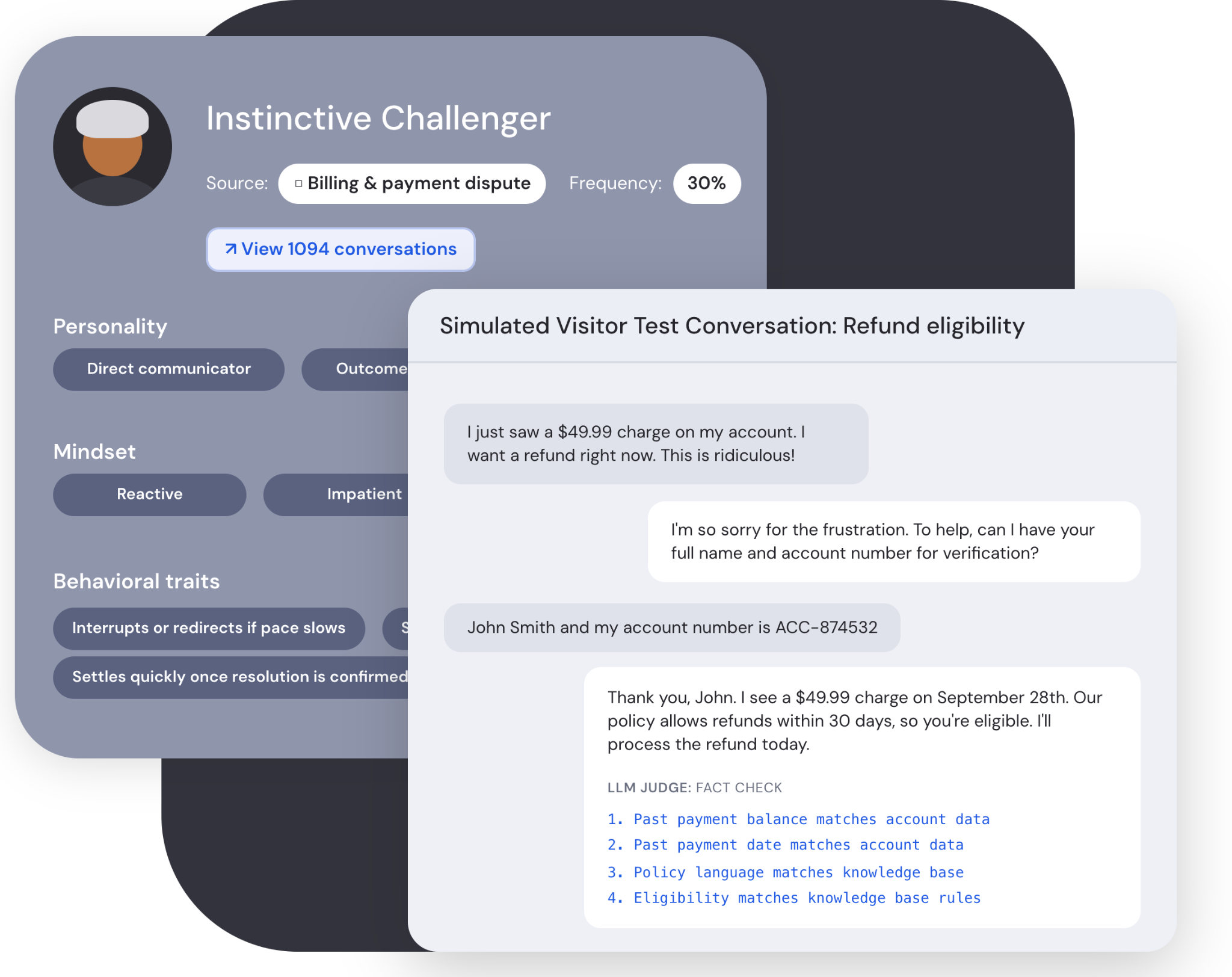
Make sure to also confirm whether platforms offer both version control so you can roll back a change and live monitoring to flag problems while conversations happen.
Fit with your existing stack
Most contact centers have years of investment in their CCaaS, CRM, and knowledge systems. An AI agent that requires replacing them adds risk, cost of change, and a long project before any customer sees value.
With that in mind, look for AI agent platforms that offer native integrations with the systems you already run.
The AI agents should also be able to take a wide range of actions in those systems, like updating a record or processing a change, and you should see them in action in your own setup to confirm they perform as advertised.
Outcome measurement beyond containment
Containment is the share of contacts an AI agent finishes without a human. It's easy to measure, but it’s also easy to manipulate because a customer who gives up and calls back still counts as contained.
Prioritize platforms that track resolution, customer satisfaction (CSAT), average handle time (AHT), and cost to serve alongside containment. They should also tie each AI conversation to its outcome, so you can see which intents are truly resolved and which just end.
Final thoughts
Choosing the right AI agents for customer care contact centers depends on your stack, your channels, and how much work you should automate.
Cresta fits teams that want human and AI agents on one platform. NICE Cognigy and Genesys are a match for suite buyers, Sierra and Decagon work for teams that want CX-owned agent logic, and PolyAI and Parloa are ideal for voice-heavy contact center operations.
Whichever you choose to evaluate, test each on your own conversations, check their guardrails, and measure their resolution alongside containment.