
The best AI voice agents for enterprise businesses in 2027

- The best AI voice agent for the enterprise picks the right calls, keeps context, and hands off cleanly
- Pick Cresta if you want AI agents and human agents working from one platform
- Evaluate enterprise AI voice agents by resolution first, then check context, real-conversation design, guardrails and testing, human handoff, and stack fit
An AI voice agent that shines in a demo can stall on real calls.
Callers can interrupt, phone in from noisy places, or have a poor connection, leading the AI agent to talk over callers, give late replies, and mishear details.
To help you overcome these challenges, you’ll need to adopt a best-in-class AI voice agent.
We’ll help your enterprise business navigate this exercise by evaluating eight leading platforms. But first, let's align on how enterprise AI voice agents typically work.
Note: This article was updated on 11/19/2026. The information below can change in the future.
What is an enterprise AI voice agent?
It's software that handles phone calls on its own, in real time. It understands callers in their own words, takes actions in back-end systems, and hands off to a person with full context when needed.
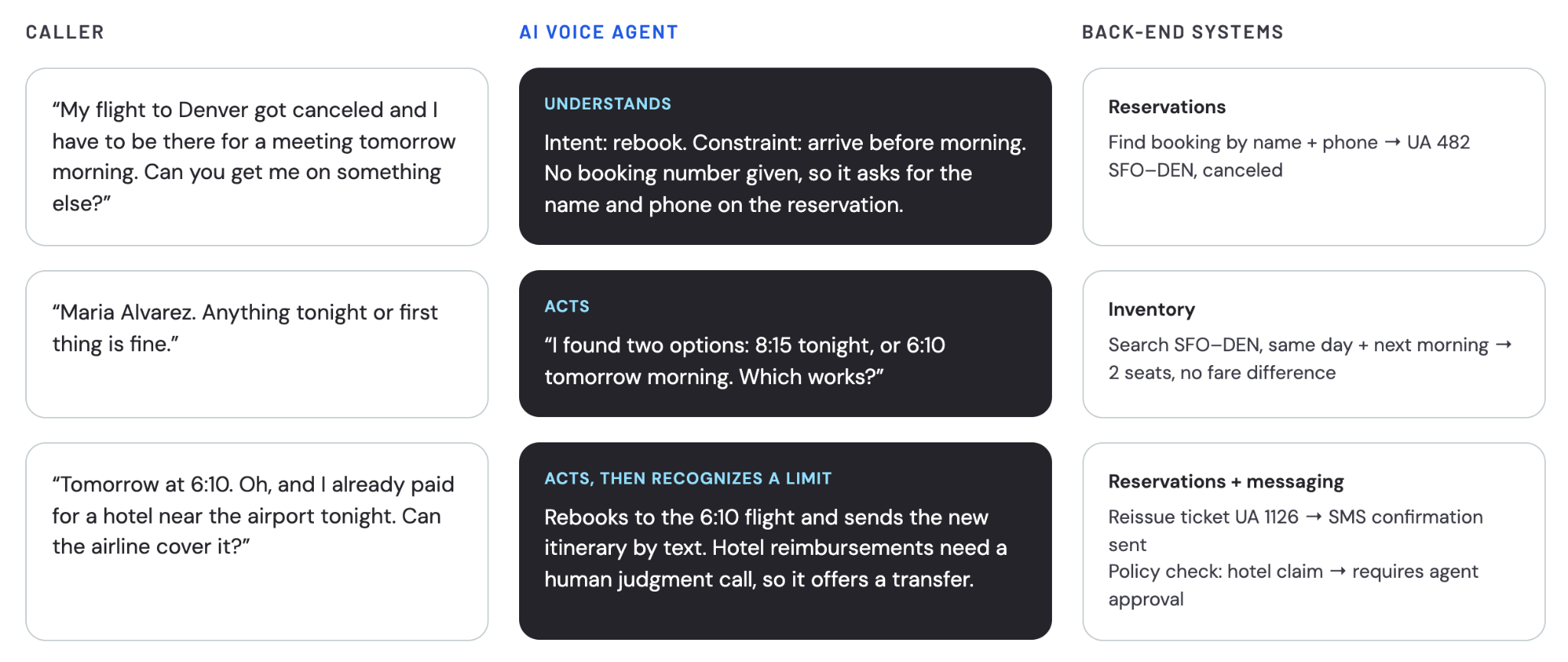
What makes it "enterprise" is the setting it runs in.
It has to handle heavy call volume, meet strict security rules, connect to your contact center platform (CCaaS) CRM, billing system—among other tools—and stay under clear governance.
How we evaluated the best AI voice agents for enterprise
We chose vendors with a clear focus on enterprise contact centers and voice.
We reviewed third-party reviews on G2, analyst coverage, product documentation, and our own conversations with customers and prospects.
Most AI agents fail in production for the same reasons; real calls are messy, context goes missing, and trust breaks at scale. Our criteria test for each one:
- End-to-end resolution: Whether the agent finishes multi-step tasks, such as verifying a caller and updating an account
- Context and memory: Whether the agent remembers the caller across calls, channels, and handoffs
- Built from real conversations: Whether design starts from your own call history and top-performer behaviors
- Guardrails and testing: Whether you can test before launch, control behavior live, and roll back changes
- Human handoff and augmentation: Whether calls pass to people with context, and whether those people get AI help too
- Omnichannel: Whether one agent works across voice, chat, and messaging with a shared view of the customer
- Integrations: Whether the agent runs on your existing telephony, CCaaS, and CRM
- Compliance and security: Whether the platform meets the rules your industry and outbound calling require
Here's how the platforms performed across this criteria:
Top AI voice agents for enterprise
Let’s take a closer look at each option.
1. Cresta
Cresta, the AI operating system for CX, powers Cresta AI Agent to resolve voice and digital conversations end to end.
AI Agent shares a conversation layer with Agentic Assist and Conversation Intelligence. That lets enterprises carry customer context across AI and human handoffs, and apply what they learn from every conversation to improve automation and agent guidance
Key AI voice agent features
- Multi-step resolution: AI Agent authenticates callers, looks up accounts, and takes the resolving action, so routine calls close without a transfer
- Built from your conversations: Agents are designed from your real calls and top-performer behaviors, so they hold up when callers go off script
- Journey Intelligence: The agent remembers each customer's history across calls and chats, enabling callers to avoid starting over
- Agent Operations Center: Supervisors watch live AI conversations and can guide the agent or step in, so risk gets caught before it spreads
- Soundcheck: Simulated callers with different voices, background noise, and line quality test how the agent listens and responds, so teams catch voice issues before customers hear them
- Conductor and Cresta CLI: Technical teams build, test, and deploy their own agents, alongside Cresta's guided delivery
What customers say
Cresta AI Agent is used by enterprise brands across industries.
For example, Brinks Home, a leading home security company, deployed Cresta AI Agent for voice to guide customers through multi-step troubleshooting and hand off smoothly when needed.
Veronica Moturi, SVP of Customer Experience at Brinks Home, described the experience in a Cresta blog post:
"Our voice AI Agent guides customers through complex, multi-step troubleshooting scenarios, and the positive feedback from these customers has been eye-opening."
Callers noticed too. One of the first customers to use the AI agent said:
"That was the best virtual assistant I've ever experienced…normally they are worse than any alternative, but this was actually great."
See how AI Agent resolves routine calls and hands off the rest with full context.
2. PolyAI
PolyAI builds voice-first AI agents for large contact centers in sectors like hospitality, banking, and utilities.
Delivery has typically been vendor-led, though Agent Studio and a developer kit now give teams more direct control.
Key AI voice agent features
- Raven model: A proprietary model trained for customer service dialog, so agents handle interruptions and topic changes on the phone
- Agent Studio: A no-code workspace where CX teams design, test, and monitor voice agents with built-in safety filters
- Agent Development Kit: A code-first toolkit with version control and a CLI, so engineers can build agents in their own workflow
- Multilingual voice: One agent can serve callers in many languages, which helps global service lines
- Voice-first omnichannel: The same agent logic extends to chat and SMS, while voice stays the strongest channel
What reviewers say
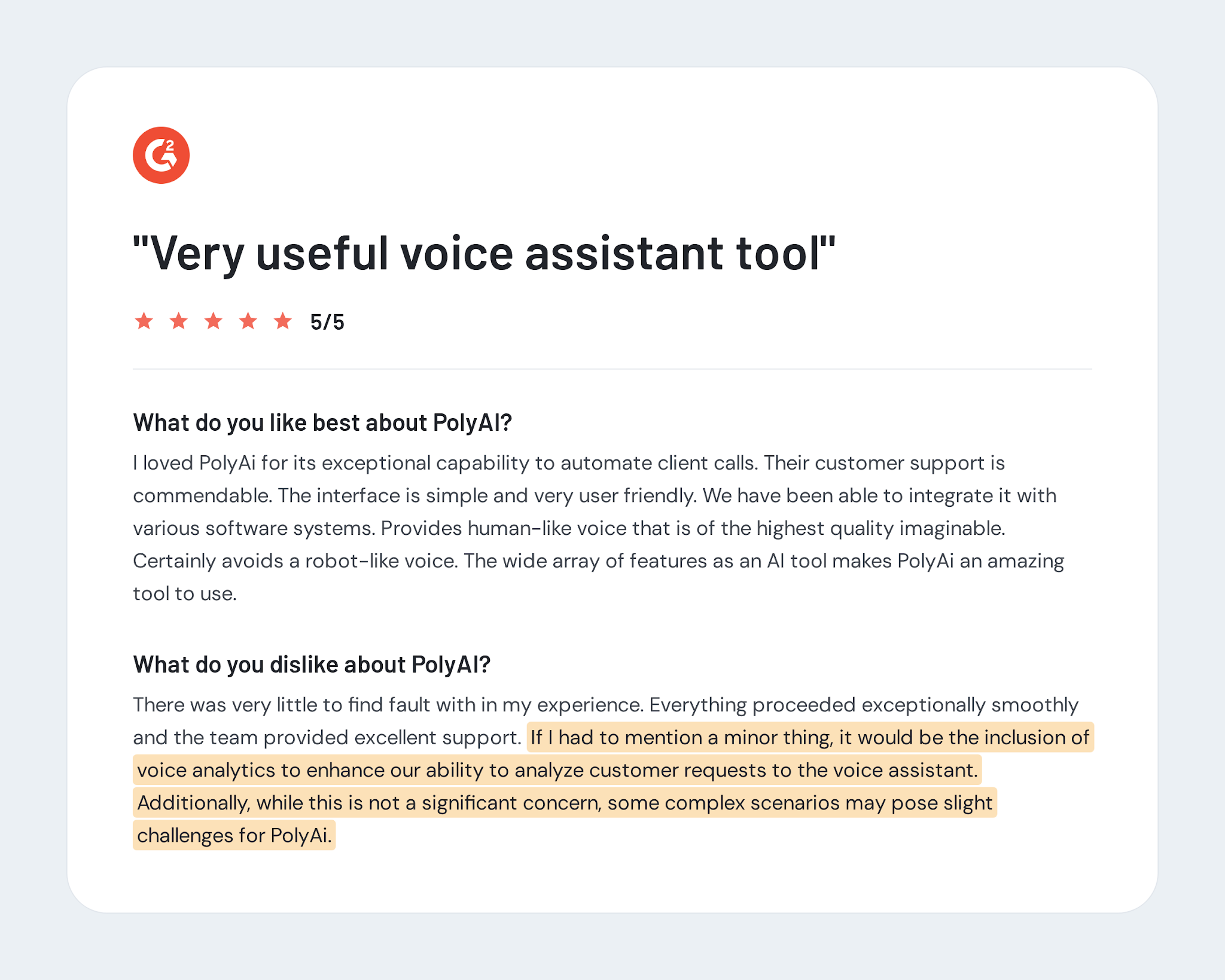
G2 reviewers highlight PolyAI's human-like voice and how well it automates customer calls.
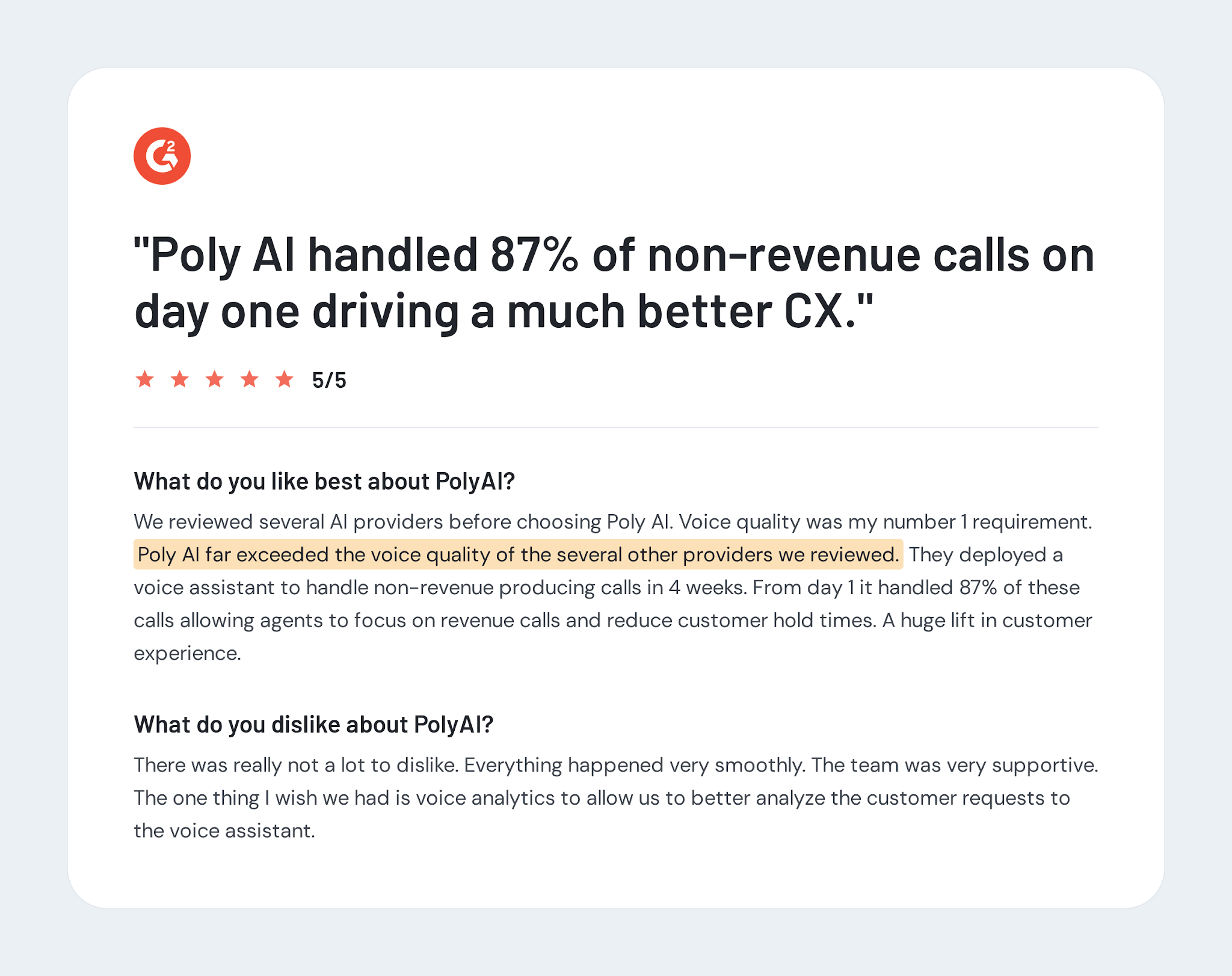
That said, a couple of reviewers want voice analytics on caller requests, and one developer mentioned slight challenges with some complex scenarios.
Related: A guide to PolyAI alternatives
3. NiCE Cognigy
NiCE Cognigy is an enterprise AI agent platform for voice and digital service.
It pairs autonomous agents with structured flows, so teams decide where the AI acts freely and where fixed steps apply.
Key AI voice agent features
- Agentic Experience Studio: A low-code workspace where teams build agents from reusable skills, tools, and personas
- AI Assist: A built-in helper that guides setup, runs simulations, and helps debug agents across their lifecycle
- Decision tracing: A record of each step an agent takes, so teams can see why it made a choice
- Voice-to-voice processing: Native speech-to-speech models handle audio end to end for faster, more natural calls
- Native NiCE CXone handover: Calls move from AI to human agents inside the NiCE stack
What reviewers say
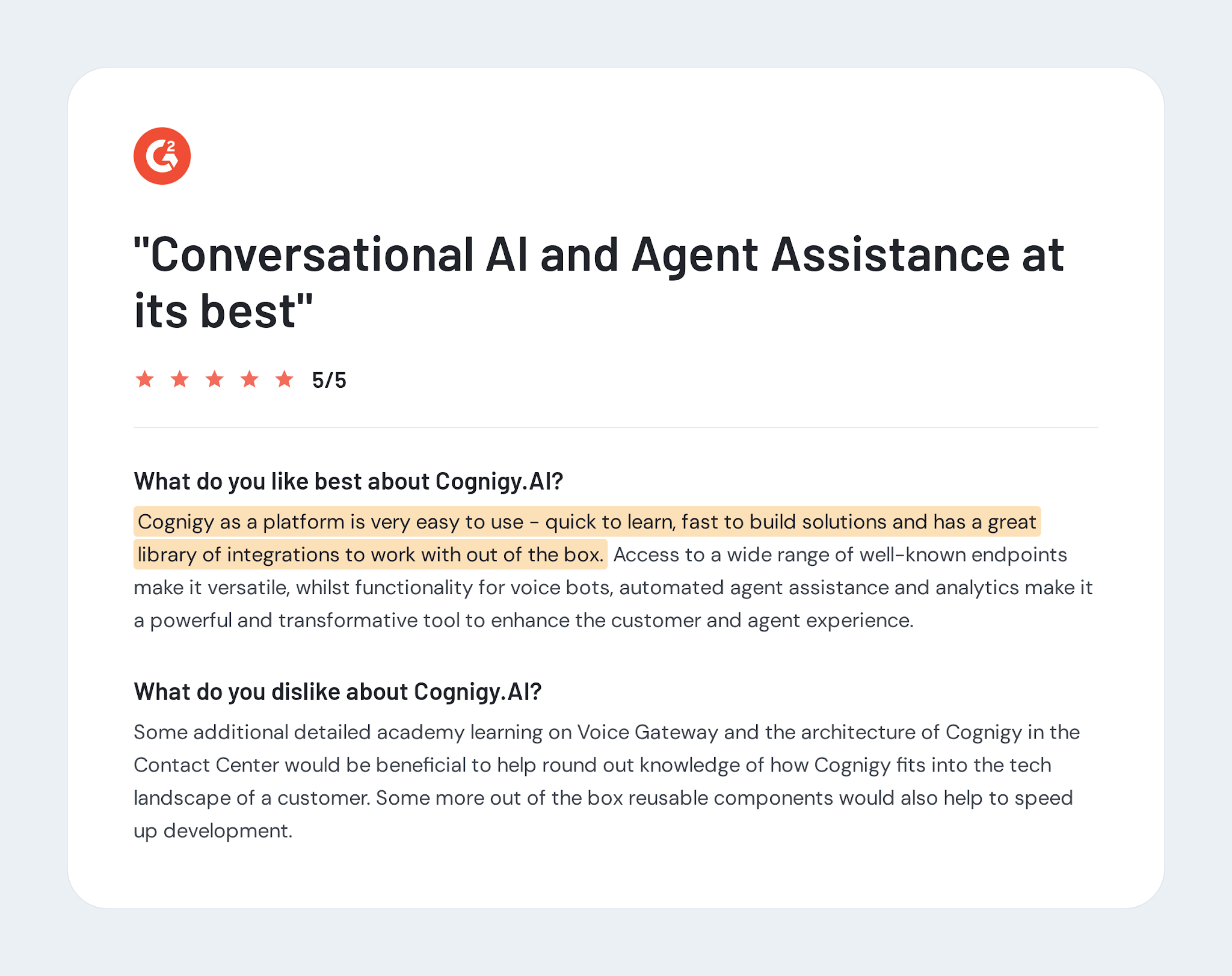
G2 reviewers value how easy Cognigy is to learn and build agents with, often without code. They also point to a large library of ready-made integrations.
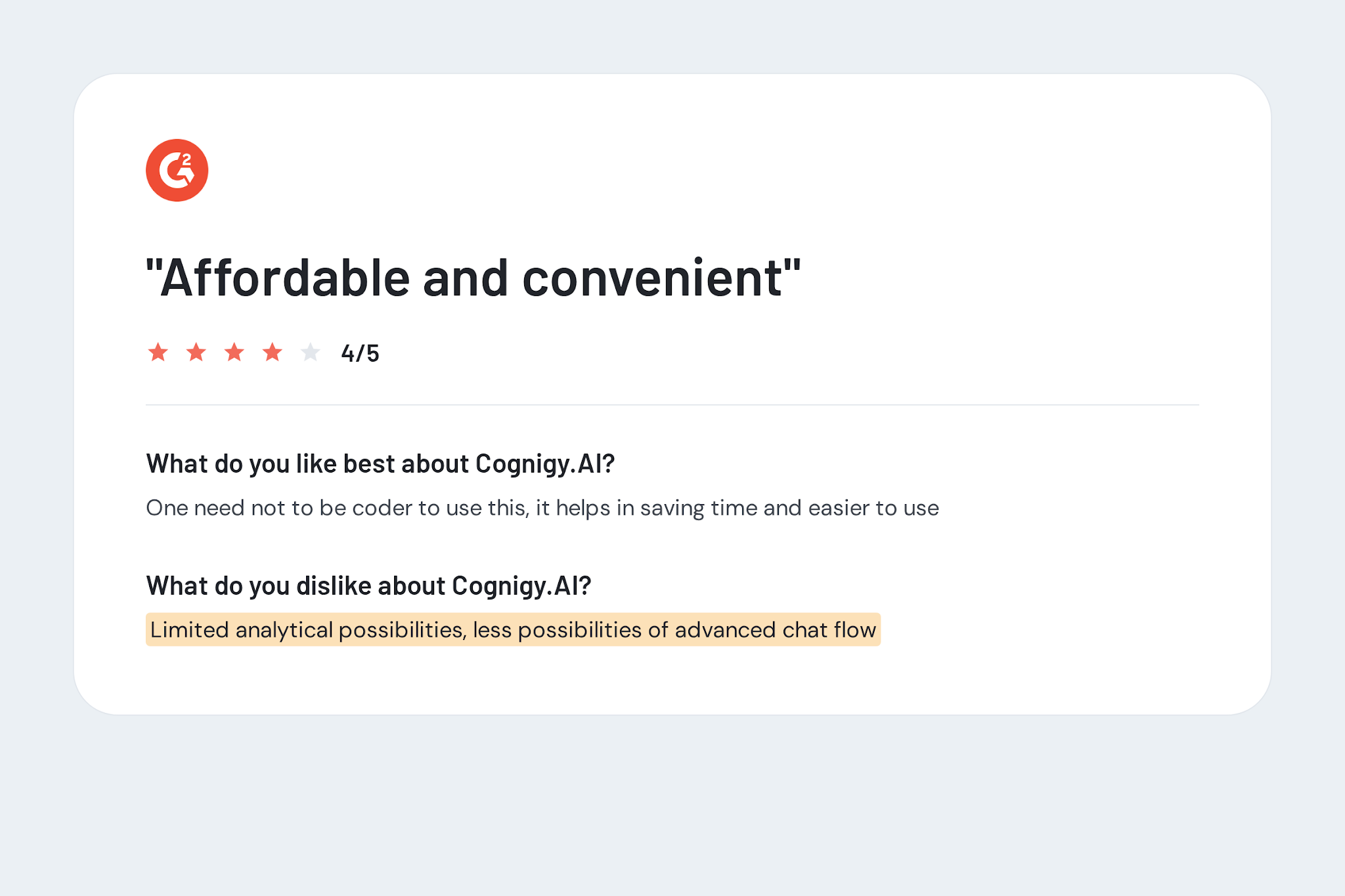
However, reviewers flag limited analytics and fewer options for advanced chat flows.
Related: The best alternatives to NiCE Cognigy
4. Sierra
Sierra offers an agent platform, called Agent OS, for consumer brands across chat, voice, and messaging.
It's strong at shaping an agent's tone to match a brand, and its roots are digital-first, but it's newer to voice at contact center scale.
Key AI voice agent features
- Agent OS: One agent setup that runs across voice, chat, SMS, WhatsApp, and email with shared context
- Ghostwriter: A builder that drafts agents from plain-language instructions, SOPs, or transcripts
- Voice Sims: A testing tool that simulates real calls so teams can check a voice agent before launch
- In-call payments: PCI-compliant payment capture lets callers pay without a transfer
- Contact center handoff: Calls pass to human agents with an AI summary and routing hints
What reviewers say
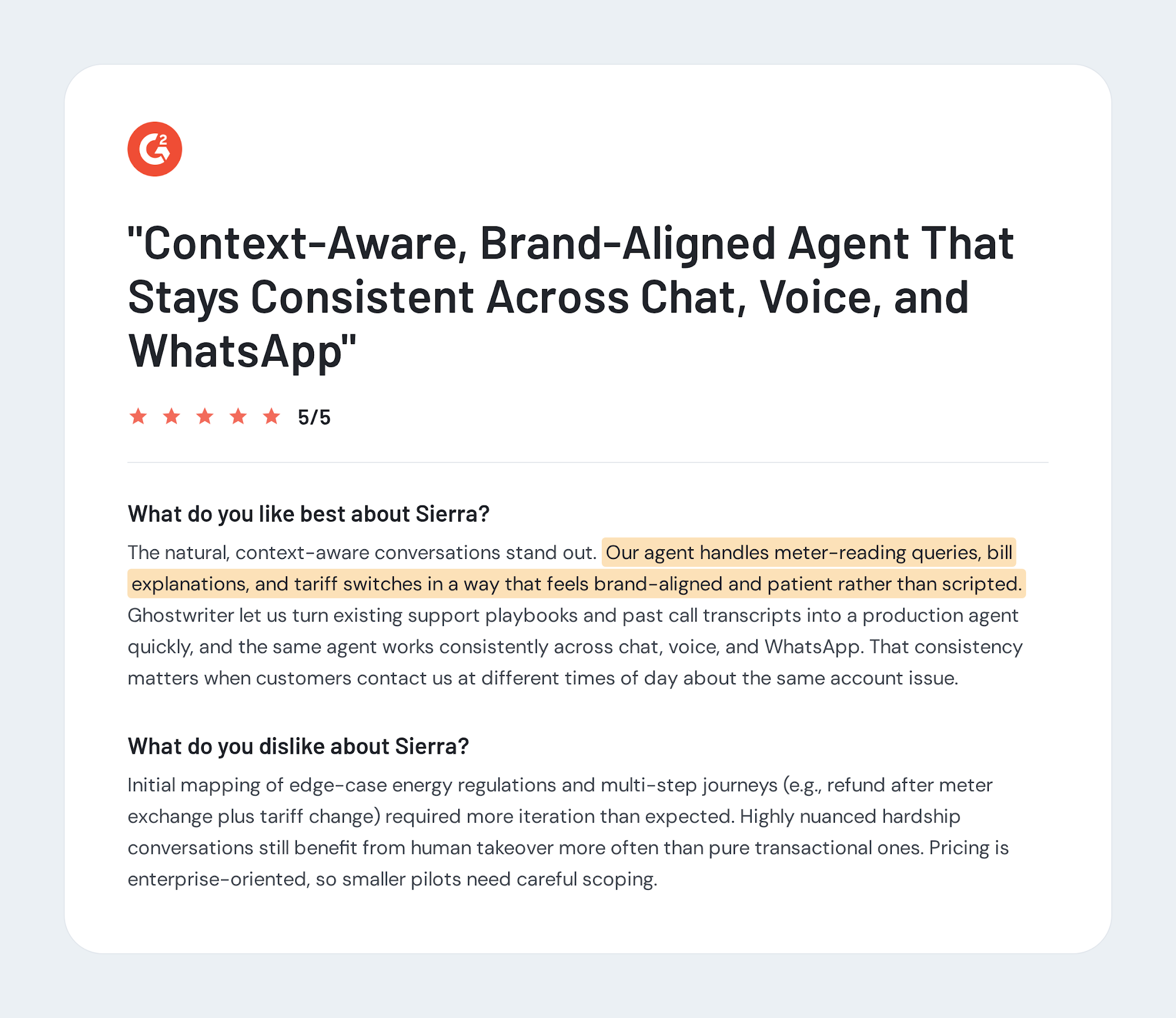
G2 reviewers like Sierra's natural, context-aware conversations and the fact that agents can stay on brand. Many also note that the same agent works across chat, voice, and WhatsApp.
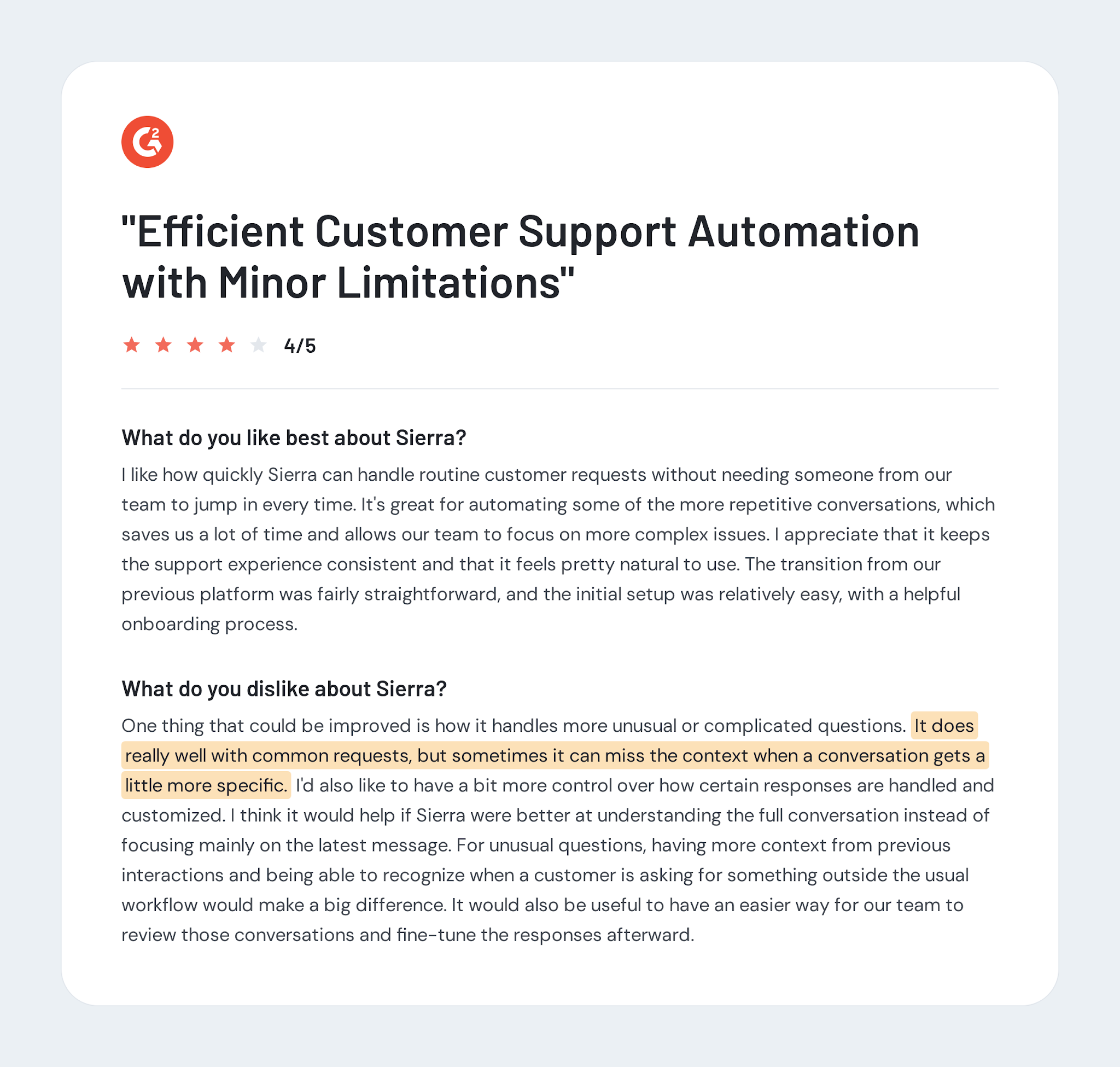
However, a recurring theme is that the agent can miss context when a conversation gets more specific.
Related: Common alternatives to Sierra
5. Kore.ai
Kore.ai is a broad enterprise agent platform that covers customer service, employee support, and back-office work.
Its AI for Service line includes voice and digital agents, agent assist, and quality management. But that breadth can mean a longer setup.
Key AI voice agent features
- Agent Platform: One build environment for voice, chat, and messaging agents, with orchestration across multiple agents
- Voice gateway: Connects voice agents to telephony and CCaaS platforms like Genesys, NICE CXone, and Amazon Connect
- Context-rich handoff: Passes the transcript, intent, and collected data to the live agent when a call escalates
- Knowledge grounding: Agents answer from large internal knowledge bases with governance controls
- Flexible deployment: Runs as SaaS, in a private cloud, or on premises for strict data needs
What reviewers say
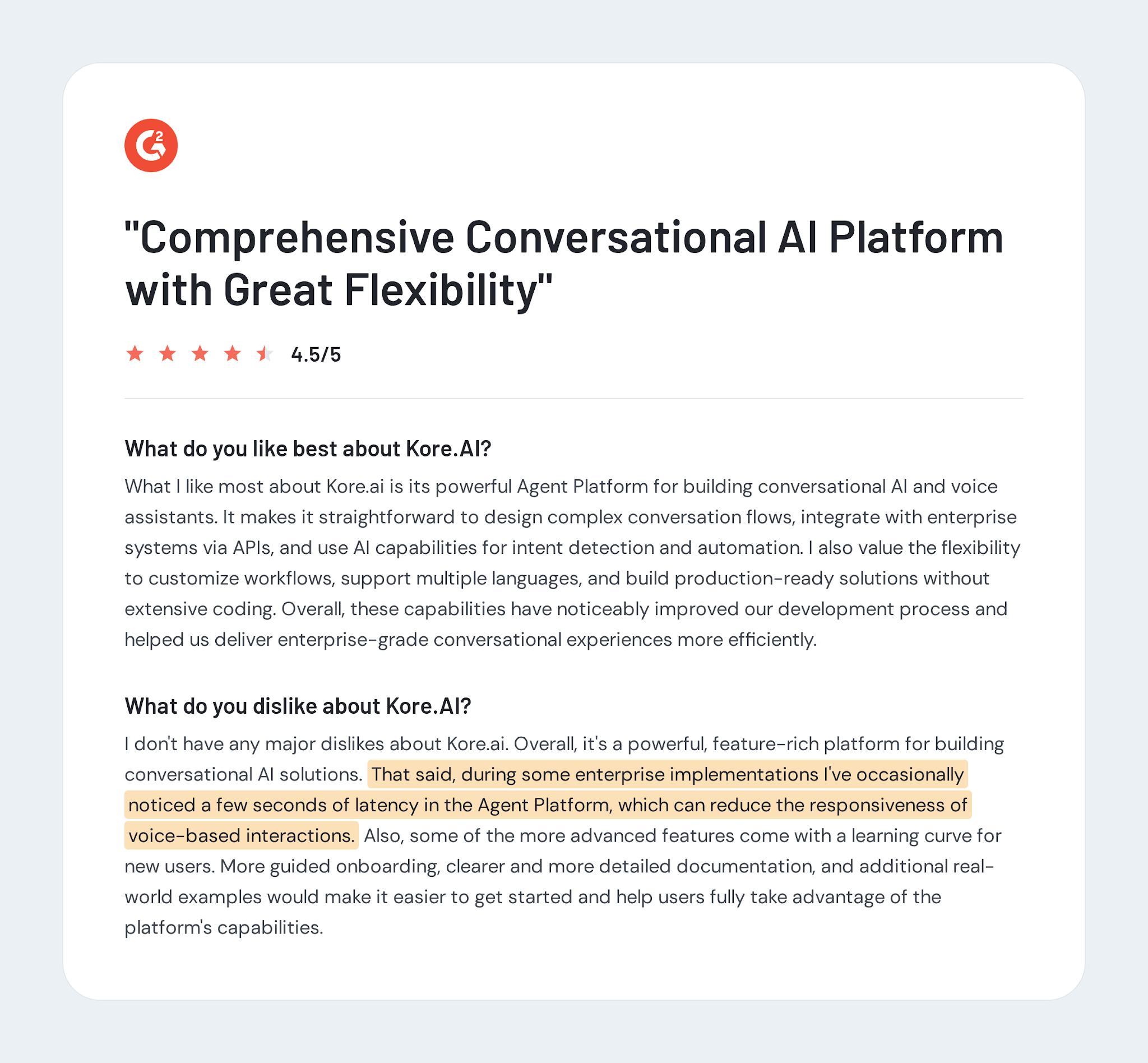
G2 reviewers point to Kore.ai's ease of use and ability to handle different kinds of conversations.
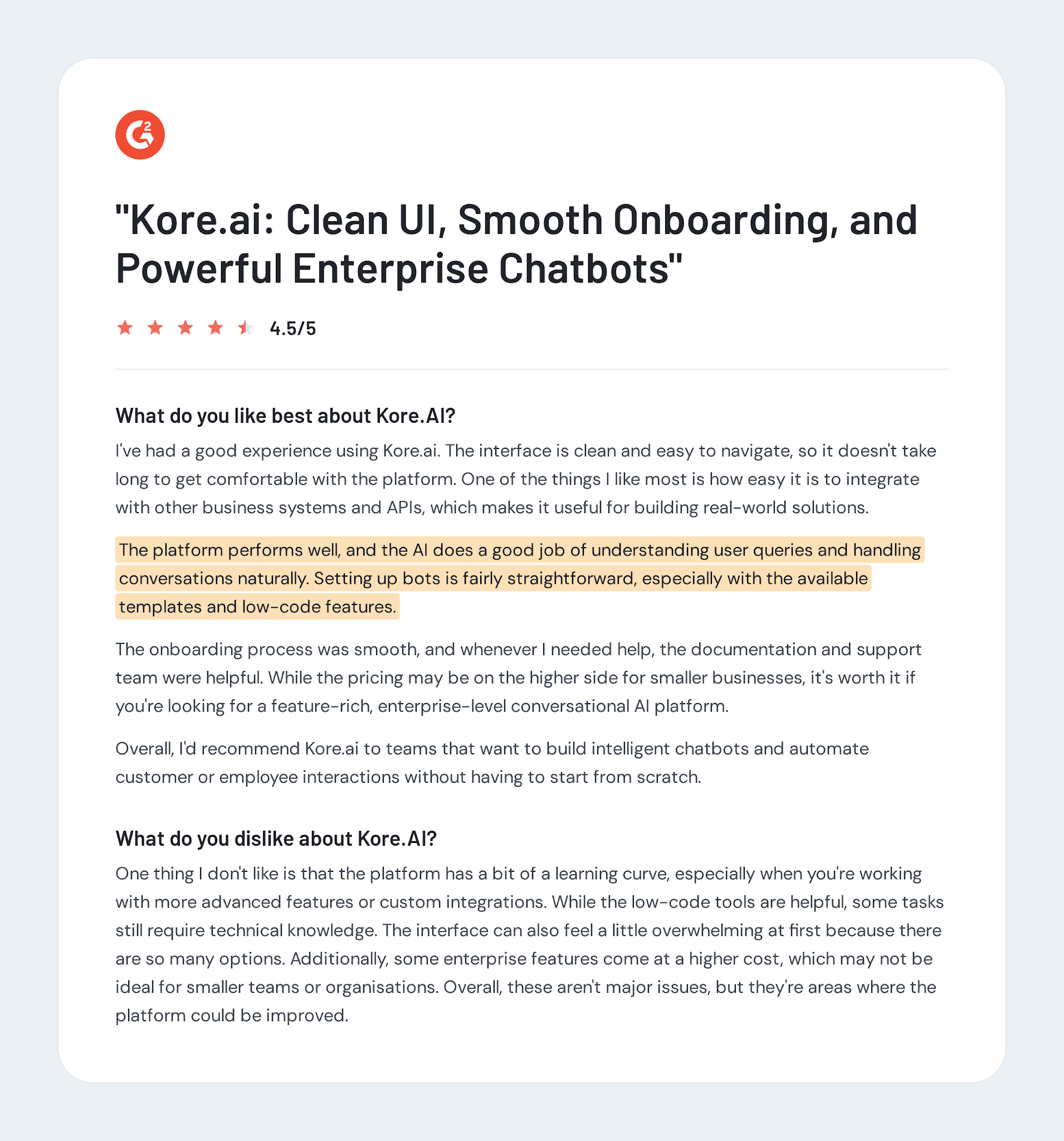
On the downside, reviewers often cite slow performance. One engineer noticed occasional latency in the Agent Platform during some enterprise implementations, which can reduce the responsiveness of voice interactions.
Related: Kore.ai’s best competitors
6. Parloa
Parloa runs an AI Agent Management Platform with enterprise customers in Europe and the US.
It's strong on voice and on simulation testing before and after launch, but it's narrower outside voice than full CX platforms.
Key AI voice agent features
- Natural-language briefs: Business teams define an agent's role, rules, and systems in plain language, without code
- Performance Lab: Simulates customer calls for every update or model change, then scores them with rules and AI judges
- Parloa Lens: Monitors live agents in production to reduce risk after launch
- Subtask Agents: Splits one agent into specialist agents, each with its own instructions
- Parloa Zones: Helps teams meet data sovereignty rules when they operate across regions
What reviewers say
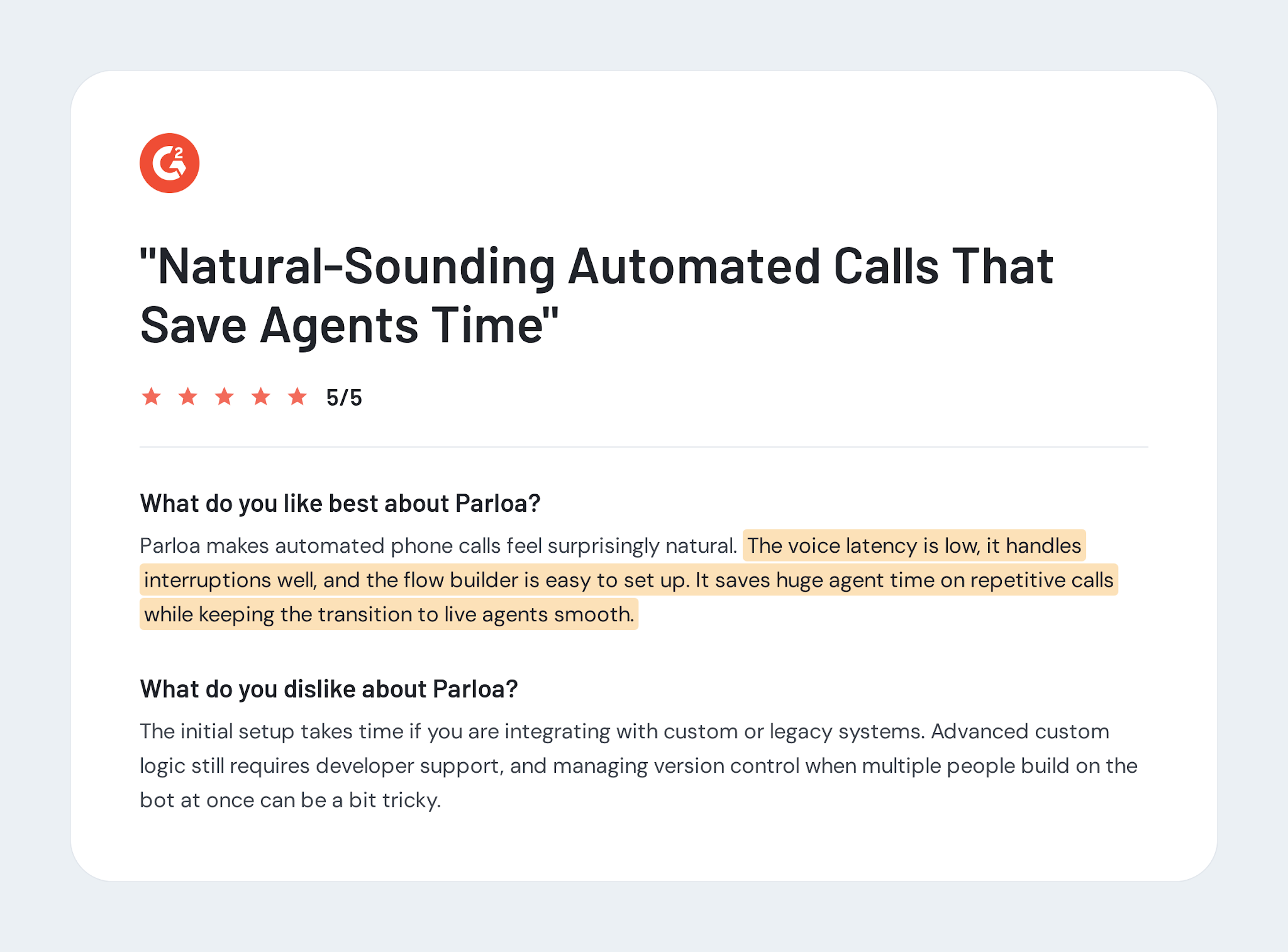
G2 reviewers love Parloa's natural-sounding voice agents and ease of use. They also highlight low latency, good handling of interruptions, and smooth handoffs to live agents.
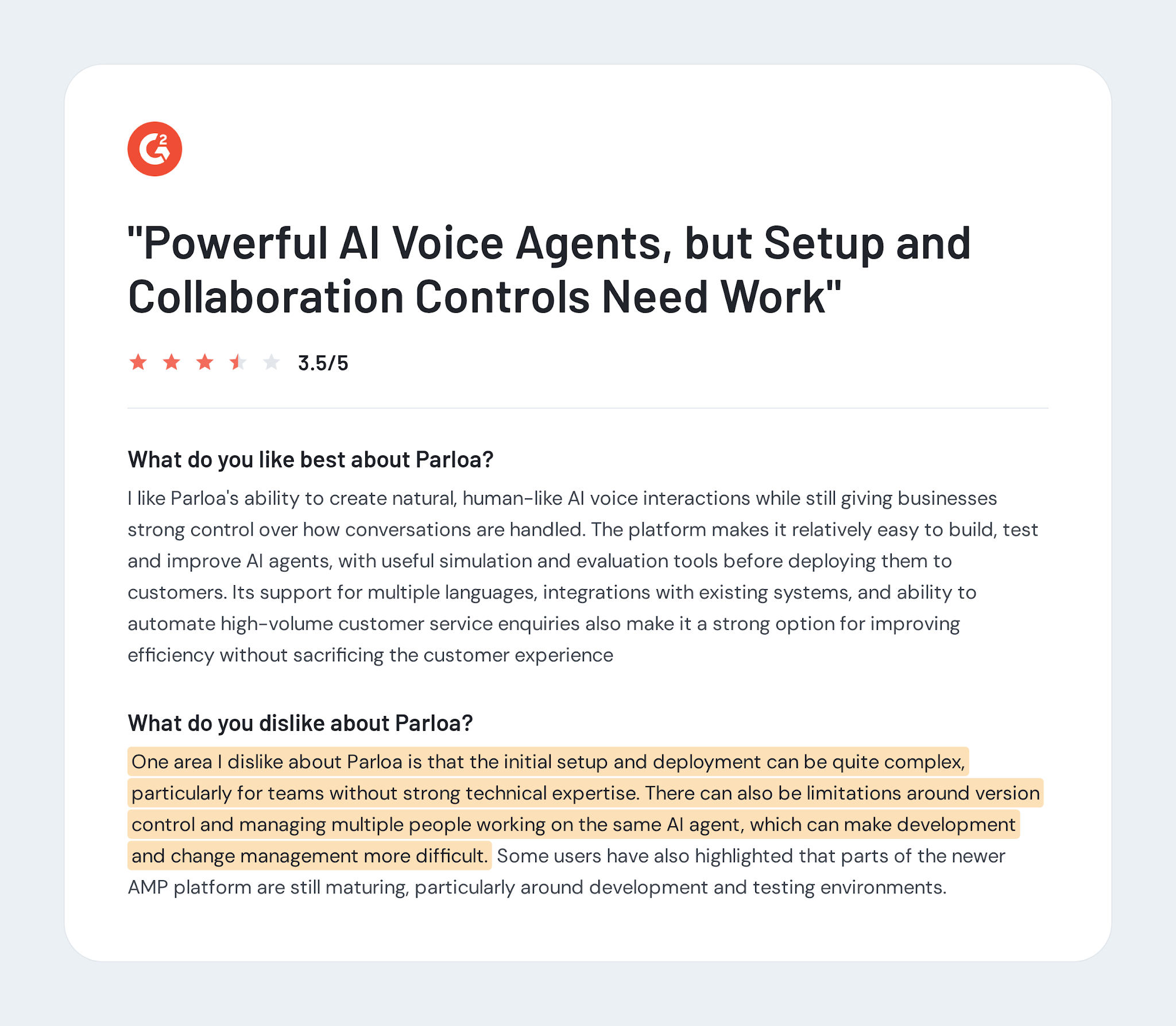
But several reviewers say initial deployment can be complex, and an IT director noted version control limits when many people build one agent.
7. Replicant
Replicant automates routine contact center conversations across voice, chat, and SMS.
It builds agents from real contact center conversations and pairs software with a full-service delivery team. But its scope is narrower than platforms that also cover human agent tools.
Key AI voice agent features
- Conversation-based design: Agents are modeled on real service calls, so behavior reflects how customers talk
- AI Studio: A workspace for configuring, testing, and updating agents
- Replicare delivery: A full-service team helps design, launch, and tune agents for you
- Call QA and analytics: Automated quality checks across calls show where agents need work
- CCaaS connectors: Sits in front of platforms like Genesys, Five9, Talkdesk, and NICE
What reviewers say
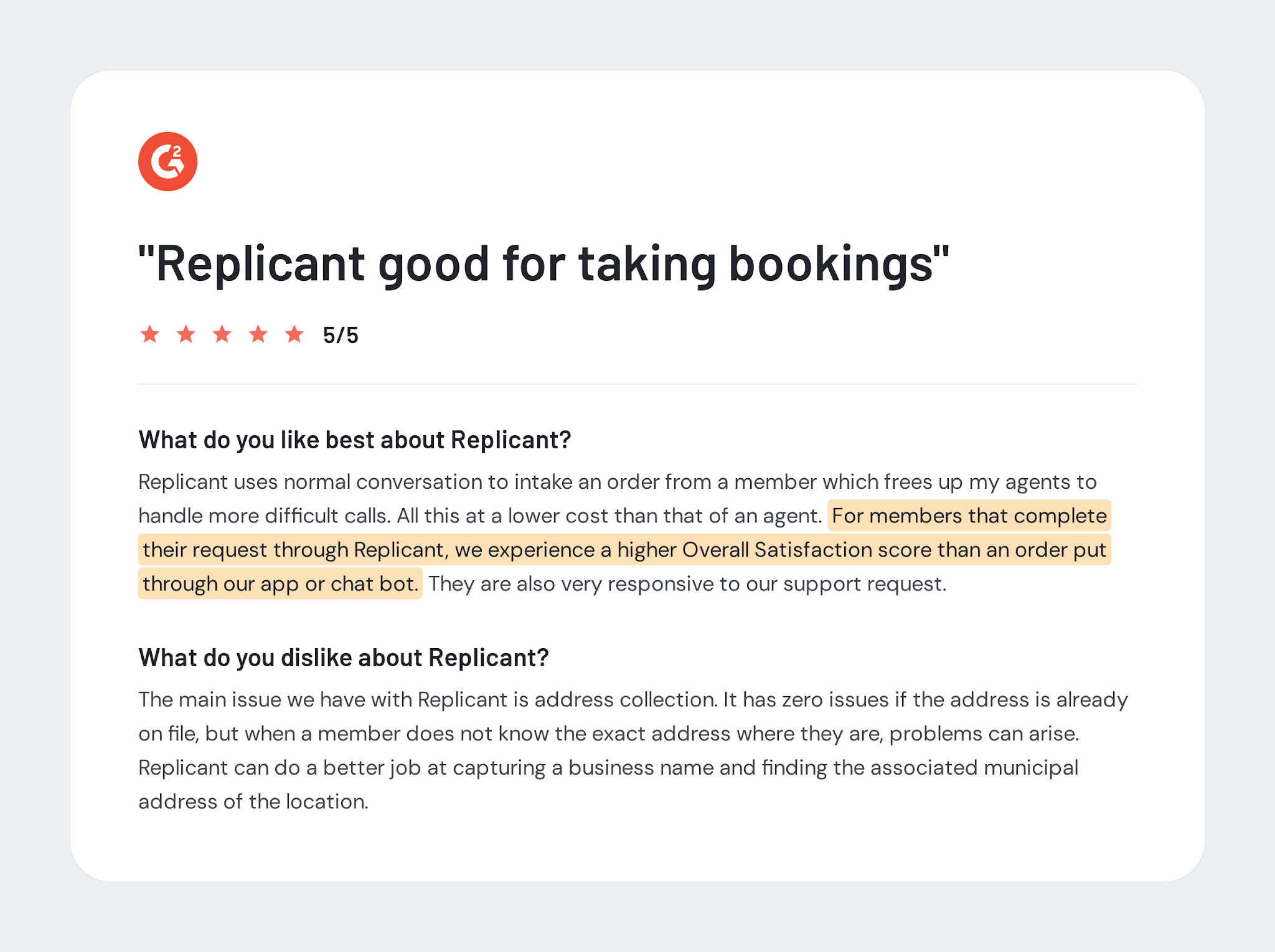
G2 reviewers praise the AI agent’s ability to delight customers at scale. One reviewer even said that customers who interact with it have a higher satisfaction score than those using their chatbot.
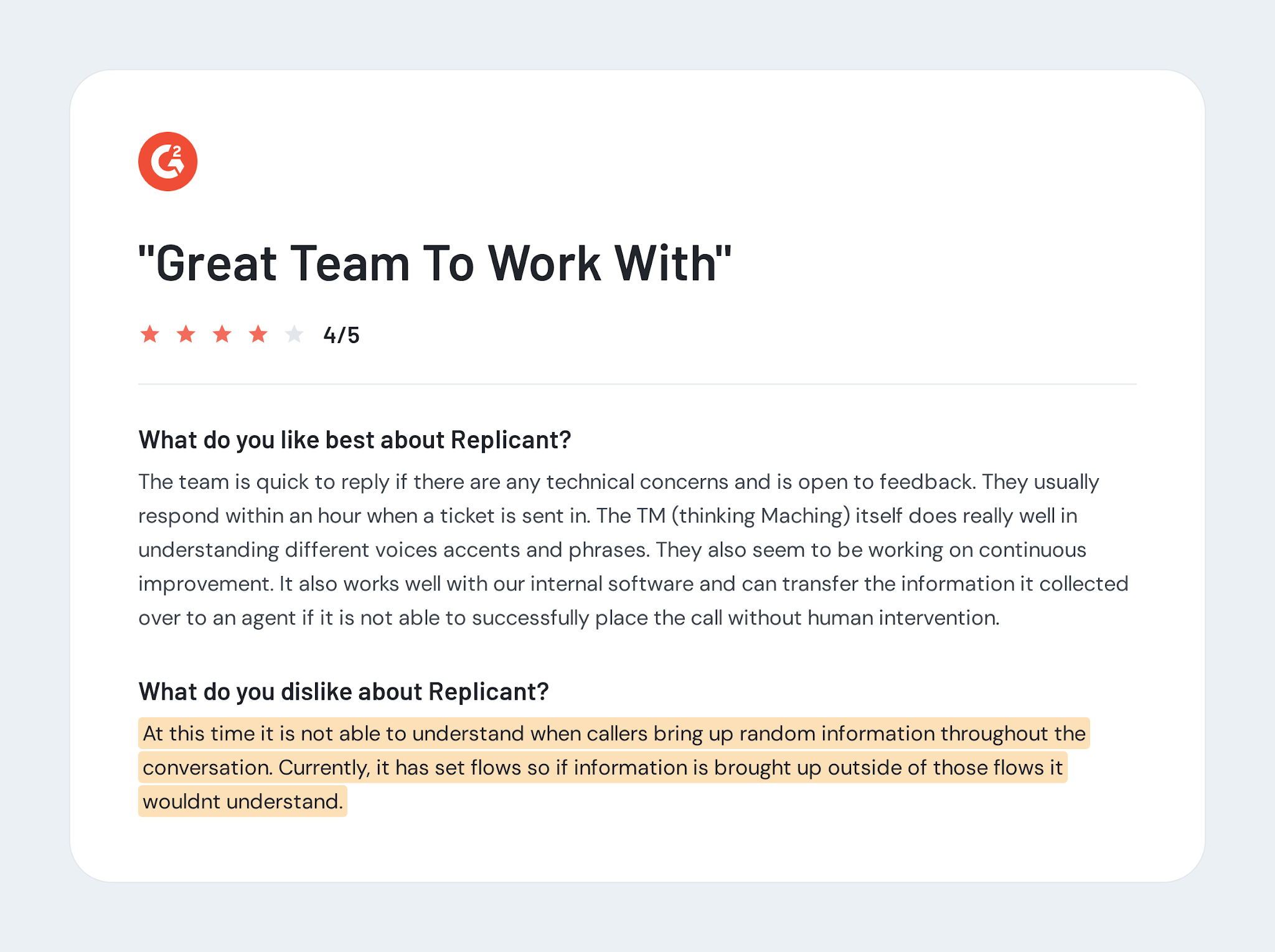
However, reviewers note limits when callers go off script, with one enterprise reviewer saying the agent's set flows can't follow information outside them.
8. Google Gemini Enterprise for CX
Google now sells its Customer Engagement Suite under the Gemini Enterprise for Customer Experience brand.
It's a fit for teams already invested in Google Cloud, with strong speech and model infrastructure. But you should expect more build work and integration effort than packaged CX platforms.
Key AI voice agent features
- CX Agent Studio: A low-code builder, formerly Conversational Agents, for creating voice and chat agents on Gemini models
- Flows and playbooks: Teams mix fixed flows with generative playbooks to control how agents behave
- Speech infrastructure: Google's speech models handle accents and noisy phone lines
- Customer Experience Insights: Analytics, formerly Conversational Insights, that surface trends across contact center calls
- Agent assist tools: Real-time help for human agents within the same Google Cloud suite
What reviewers say
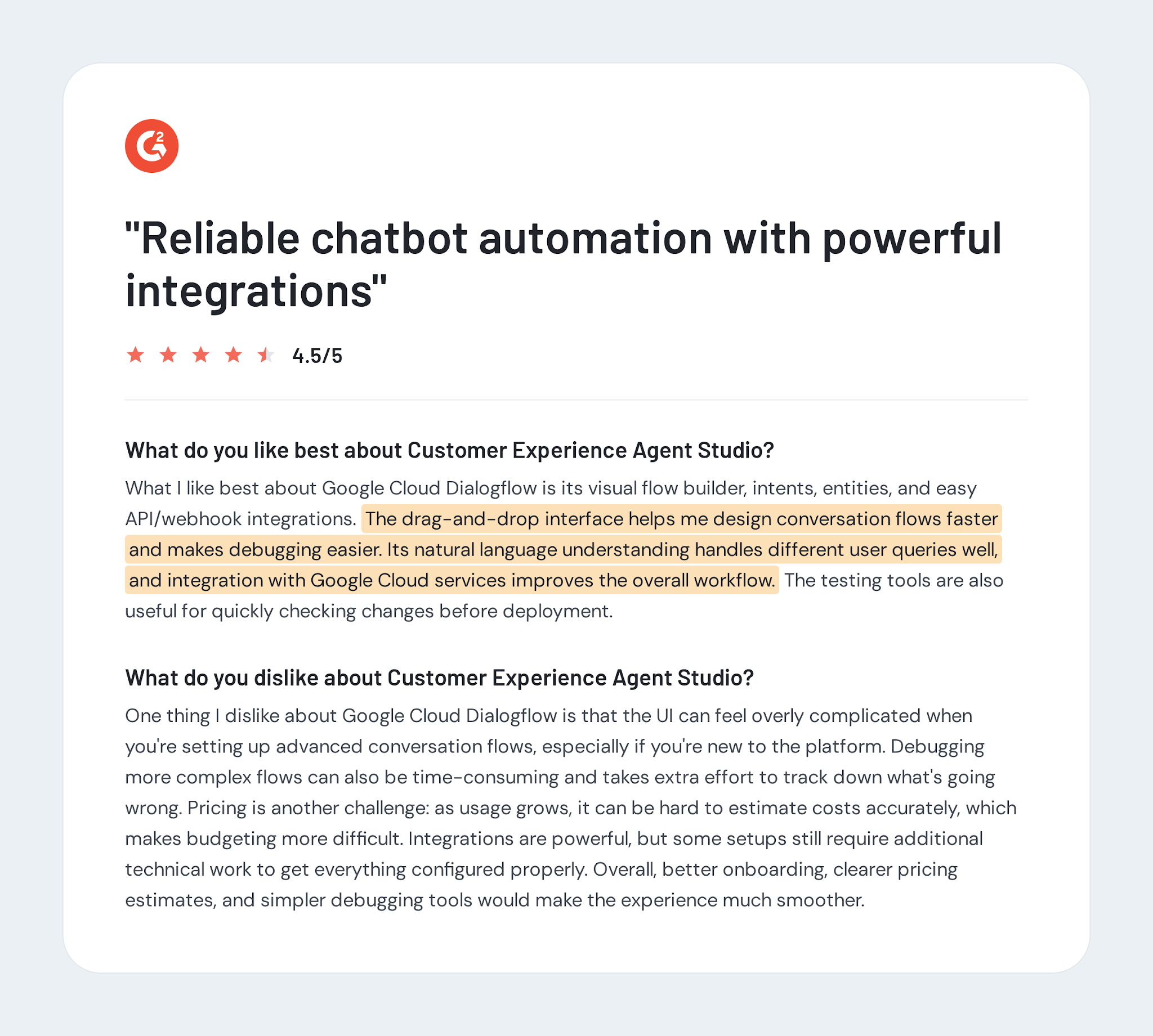
G2 reviewers like the drag-and-drop builder, strong language understanding, and Google Cloud integrations in Customer Experience Agent Studio.
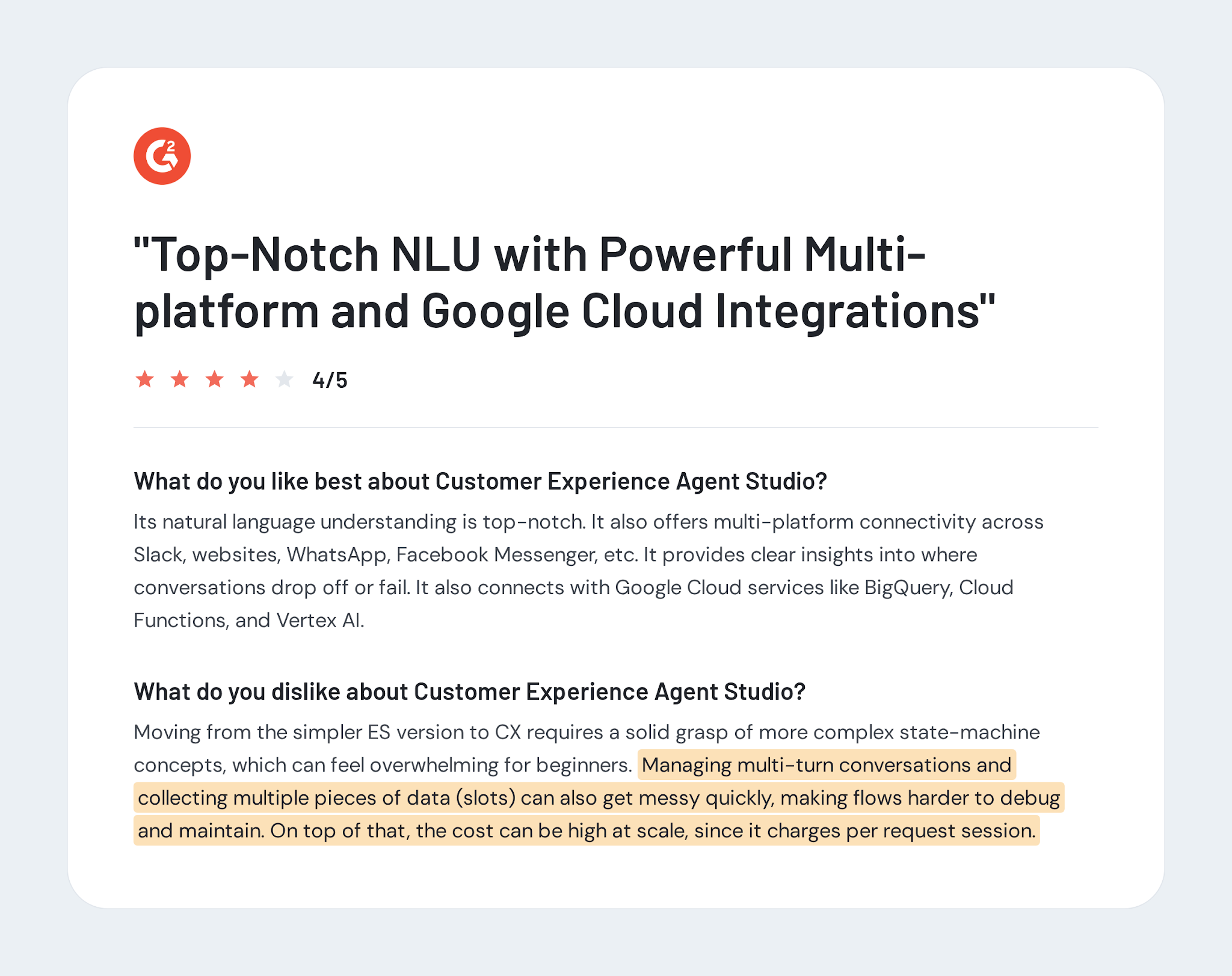
Still, reviewers often mention feature complexity. For example, one cloud developer said multi-turn and slot handling can make flows hard to debug and maintain.
Evaluation checklist for enterprise AI voice agents
Once you've narrowed your shortlist, test each vendor on the criteria below.
Measure resolution per conversation
Containment and deflection only show where a call went, not whether the problem was solved.
To see if problems were actually solved, you’ll need to track resolution per conversation and repeat contacts against the AI voice agent.
In a demo or pilot, check for these three things:
- Outcome tracking: The vendor reports resolved, transferred, and abandoned calls for each use case
- Repeat contacts: Callbacks on the same issue count against the AI agent’s results
- Real call samples: You can listen to resolved calls and confirm the task was actually completed
Gather context across calls and channels
Customers often call after a chat, an email, or an earlier call. When the agent forgets that history, callers repeat themselves and get frustrated.
To that end, prioritize AI voice vendors that can keep memory of past contacts across voice and digital channels. They should also be able to pass the full story to the next person on a handoff.
In a pilot, check these points:
- Prior contacts: The agent recognizes a repeat caller and the reason for their last contact
- Channel switch: A customer who starts in chat can call and pick up where they left off
- Handoff notes: The human agent sees a summary and collected details the moment the call connects
Built from your real conversations
Agents built from idealized scripts and help articles tend to break when real callers go off track.
Real callers mix topics, use slang, and give details out of order.
An AI voice agent should keep up and respond consistently with your other top-performing AI and human agents.
Pressure test this for every vendor in the following areas:
- Source data: The vendor explains which of your conversations it used to design the agent
- Top-performer behaviors: The agent follows the steps your best human agents use to resolve the same issue
- Off-script tests: The agent stays on task when you interrupt, change topics, or give partial answers
Guardrails, testing, and live oversight
Image idea: A loop diagram that moves from simulation to launch to live monitoring to versioned updates.
In an enterprise contact center, one wrong answer on a billing or compliance topic can repeat across many calls fast.
A strong AI voice vendor prevents this from happening by combining several layers:
- Pre-launch simulation: Test agents against realistic calls before customers hear them
- Versioning: Track every change and roll back fast if results drop
- Real-time guardrails: Block off-policy answers while the call is live
- Live operations view: Let supervisors watch AI calls and step in when needed
Human handoff and augmentation
Some calls need a person, and customers expect a clear path to one.
When you need to make a handoff, the AI voice agent solution should also offer the human agent real-time AI support once they take the call.
This includes:
- Context on arrival: The human agent sees what the caller said and what the AI already did
- Live guidance: The human agent gets real-time prompts and answers on the calls the AI shouldn't take
- Automatic summaries: Each call ends with a summary of the issue and outcome, so no one has to write notes or ask the caller to repeat themselves
- Follow-up reminders: Promised callbacks and next steps are captured and flagged, so commitments made on the call don’t get lost
Fit with your existing stack
Stack fit means the AI voice agent works with the tech stack you already run. This lets you avoid replacing software, which not only costs significant money but takes a long time.
A strong AI voice agent vendor will offer the following native connectors:
- Contact center and telephony (CCaaS): connects the agent to the call itself, so it can answer, route, and transfer without a custom build, and hand off to humans with context intact
- CRM: lets the agent look up the customer and log what happened, so it can personalize the call and leave a record for the next contact
- Ticketing and case management: enables the agent to open, update, and close cases during the call, so issues don’t fall through the cracks and repeat contacts tie back to the original case
- Billing and payments: allows the agent to check balances, take payments, and apply credits securely, which is where many high-volume calls get resolved and compliance matters most
- Order, scheduling, and account systems: allows the agent to take resolving actions, like changing an address or rebooking an appointment, so it can solve problems instead of only answering questions
- Identity and authentication: verifies the caller before the agent shares or changes account details
- Knowledge bases: gives the agent approved, current answers instead of guesses, and keep it consistent with what human agents say
Final thoughts
There’s no one-size-fits-all enterprise AI voice solution.
Use Cresta if you want to run AI and human agents together. Pick a voice-first specialist like PolyAI or Parloa if natural dialog and simulation lead your list. And choose NiCE Cognigy, Kore.ai, or Google for a broad build platform on your current stack.
Whichever you shortlist, test resolution first. Then check context, real-conversation design, guardrails, handoff, and stack fit.