
8 Best Kore.ai Alternatives for Contact Centers in 2026
.avif)

- Kore.ai's no-code development tools and pre-built industry templates can accelerate bot deployment, but self-service platforms put the design burden on the buyer. Without conversation intelligence showing what top performers actually do, organizations risk building AI agents that behave like untrained employees
- Kore.ai is a horizontal enterprise platform where the contact center is one use case among many. That breadth is an advantage for organizations that need virtual agents across multiple business functions, but a limitation for contact centers that need analytics, coaching, and automation connected on a shared foundation
- The alternatives span genuinely different approaches, from open-source frameworks like Rasa that give engineering teams full control, to unified platforms that combine AI agents with human agent guidance and conversation intelligence in one system
- The right choice comes down to whether your operation needs standalone bot-building or a platform where AI agent performance, human agent coaching, and quality management reinforce each other rather than running in separate workflows
Kore.ai is a platform for deploying AI agents across verticals like banking, healthcare, and retail. Its Experience Optimization (XO) Platform provides pre-built AI agent templates that business users can configure without engineering support, with pre-configured industry workflows that can accelerate deployment for common use cases. For organizations focused primarily on virtual assistant development, these strengths are important.
Per Fortune Business Insights, the global call center AI market was USD 2.41 billion in 2025 and is projected to reach USD 13.52 billion by 2034, a 20.80% CAGR.
But self-service platforms carry risk. To design and build performant agents yourself, you must already understand what your conversations look like and what top performers do differently. Most organizations don't have that visibility.
Without it, you end up building AI agents that behave like average performers rather than your best agents, that escalate rather than resolve real conversations when they deviate from scripted paths.
This article examines why contact centers look beyond Kore.ai, compares the leading alternatives across AI agent platforms, open-source frameworks, and platforms that combine AI agents with conversation intelligence, and provides guidance for choosing the right platform for your organization.
Why Contact Centers Evaluate Kore.ai Alternatives
Kore.ai is designed for building AI agents. But contact center leaders evaluating AI platforms often discover that bot-building is only part of the problem they need to solve. Organizations seek alternatives for five key reasons:
- They need more than bot-building: Enterprise contact centers need platforms that handle AI agents, human agent assistance, and analytics together rather than focusing on virtual assistant development alone
- They need conversation intelligence to guide AI agent design: Building effective AI agents requires understanding what your conversations actually look like and what top performers do differently. Platforms with built-in conversation intelligence provide that foundation before automation begins
- They want real-time guidance, not just automation: In-conversation guidance during live interactions prevents mistakes and surfaces relevant knowledge when agents need it
- They're seeking a single platform approach: Organizations want single platforms that handle AI agents alongside human agent assistance and analytics together, rather than stitching together separate tools. Unified platforms share data, models, and integrations across capabilities without fragmentation
- They have different deployment preferences: Organizations vary in technical resources, control preferences, and data residency requirements
The table below summarizes how the leading alternatives compare across these dimensions.
Best Kore.ai alternatives at a glance
1. Cresta
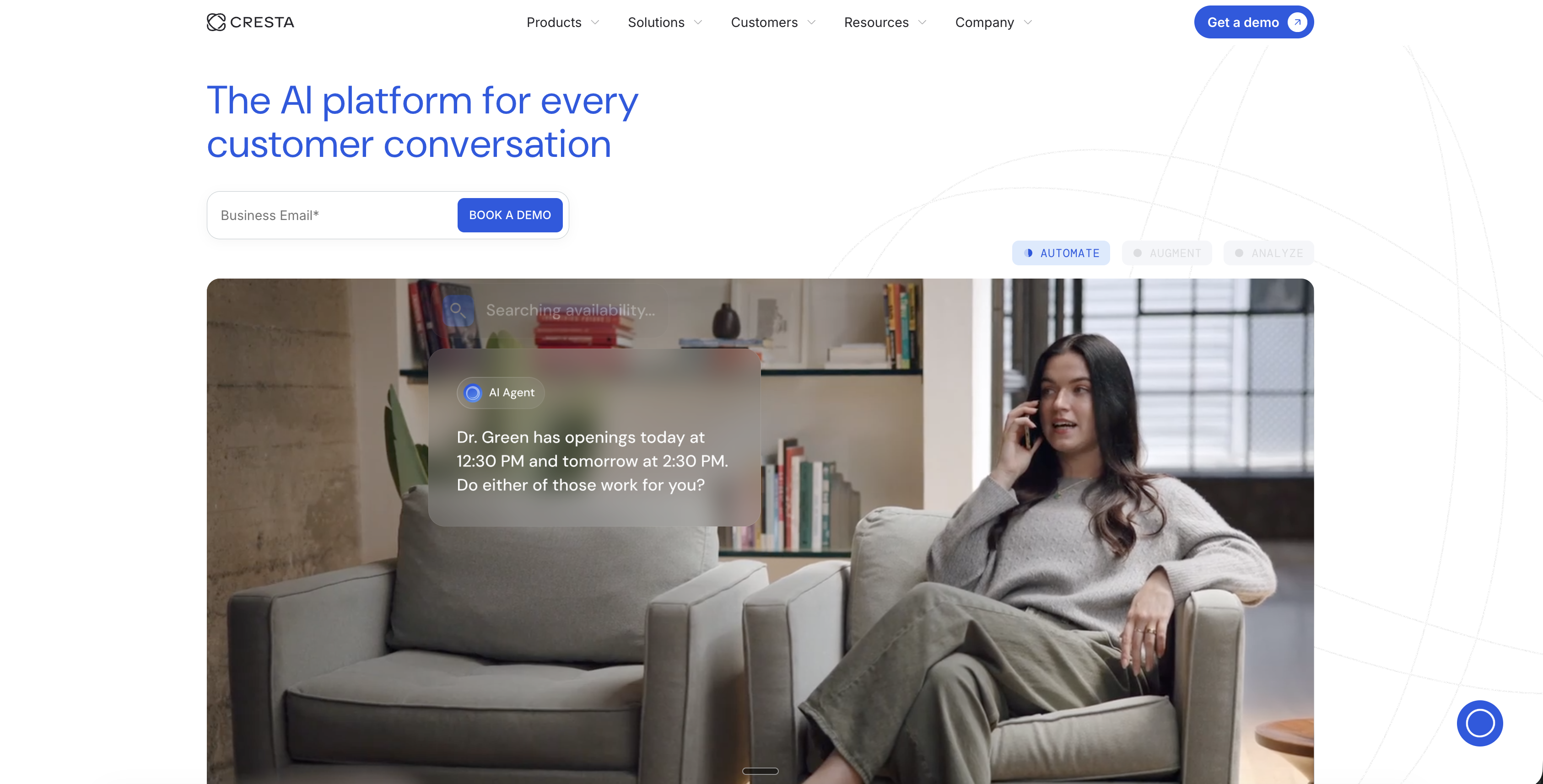
Organizations moving beyond bot-building platforms often land on Cresta because it addresses the gaps that pure automation tools leave behind. Where Kore.ai focuses on virtual assistant development, Cresta treats automation and human agent performance as connected problems that require a unified solution.
The platform brings together AI agents, real-time agent guidance, and conversation intelligence on a shared foundation. These aren't separate tools stitched together after the fact. They share data, models, and integrations, so insights from conversation analytics inform both AI agent optimization and human agent coaching.
When an AI agent escalates to a human, context transfers and support continue rather than dropping into a blind spot.
Forrester validated this approach in The Forrester Wave for Conversation Intelligence Solutions for Contact Centers, Q2 2025, where Cresta achieved the highest Current Offering score among all evaluated vendors.
Here's how each capability addresses the gaps that bring teams to evaluate Kore.ai alternatives:
- Cresta AI Agent automates conversations across voice and digital channels using a multi-model architecture with 20+ task-optimized models. A routing agent identifies intent and selects specialized sub-agents for different tasks, handling complex multi-intent conversations that would break simpler bot frameworks
- Cresta Agent Assist provides real-time guidance during live human conversations, surfacing knowledge, behavioral hints, and compliance reminders as agents work. When AI agents escalate to human representatives, Agent Assist keeps augmenting the human rep with full handoff context, so the customer doesn't start over and the agent isn't flying blind
- Agent Operations Center gives supervisors visibility into hundreds of simultaneous AI conversations with the ability to intervene when needed. This human-in-the-loop oversight addresses a common concern with autonomous platforms: what happens when the AI gets it wrong?
- Enterprise-grade guardrails provide four layers of defense: system-level constraints embedded in prompts, supervisory models monitoring in real time, LLM-driven adversarial testing, and automated behavioral quality management
- Cresta Conversation Intelligence analyzes 100% of interactions across both AI and human agents. Unlike analytics tied only to bot performance, this connects conversation patterns to business outcomes like revenue, retention, and satisfaction across your entire operation
This is how Brinks Home, one of North America's largest home security companies, achieved a 30-point NPS increase after implementing Cresta. With in-house agents plus BPOs across multiple locations on various platforms, they lacked visibility across their organization and struggled with inconsistent customer experiences.
Cresta gave them unified visibility across both AI and human agent conversations, and the results showed up across all their core metrics.
Propel Holdings, a fintech lender, reached 58% containment across its AI Agents with Cresta.
Cresta's built for enterprise contact centers with real conversation volume. It's more platform than a small team running a simple FAQ bot needs. Deployment is a guided enterprise engagement, not a self-serve sign-up.
Who it's for: Contact centers that need more than chatbots. Organizations in financial services, healthcare, telecommunications, and travel that need compliance visibility, where human agents handle high-value conversations, and that need a seamless handoff between AI and humans.
Pick Cresta if you need AI automation and human agent performance managed on one platform, with visibility that survives the escalation.
Ready to see how Cresta works in practice? Visit the resource library to learn more or request a Cresta demo.
See how Cresta can transform your CX operations by scheduling a demo.
2. Sierra
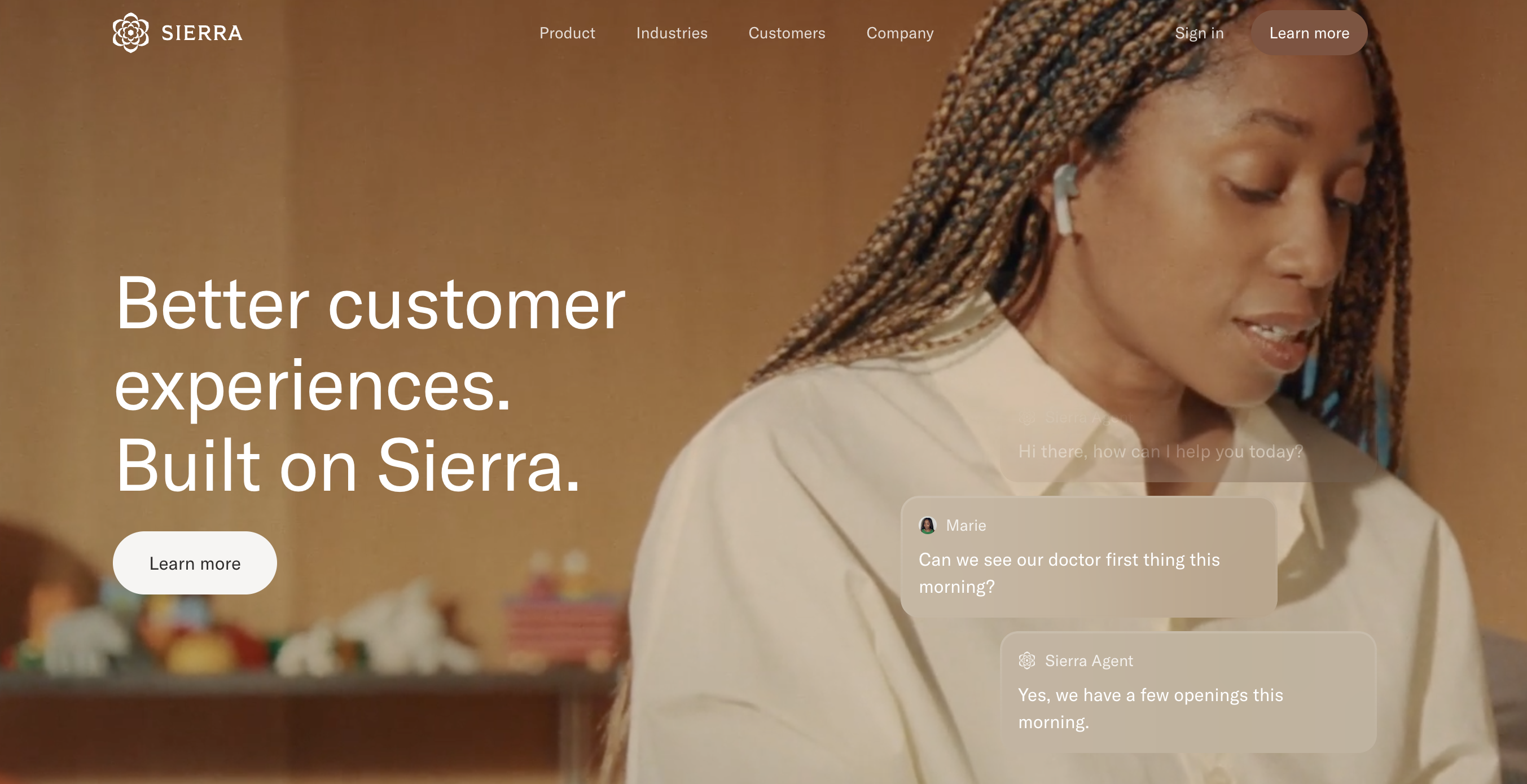
Sierra offers a managed service model where they handle implementation, setup, and ongoing optimization. This approach produces AI agents without requiring internal AI expertise, but it also means less direct control over how agents are configured and how they evolve over time.
Sierra’s roots are in AI agent resolution, but it now also supports Live Assist, where the same AI agent powers real-time guidance and drafted responses for human reps.
Who it's for: Brands comfortable with vendor-managed implementations who prioritize speed to deployment over internal control.
3. Decagon
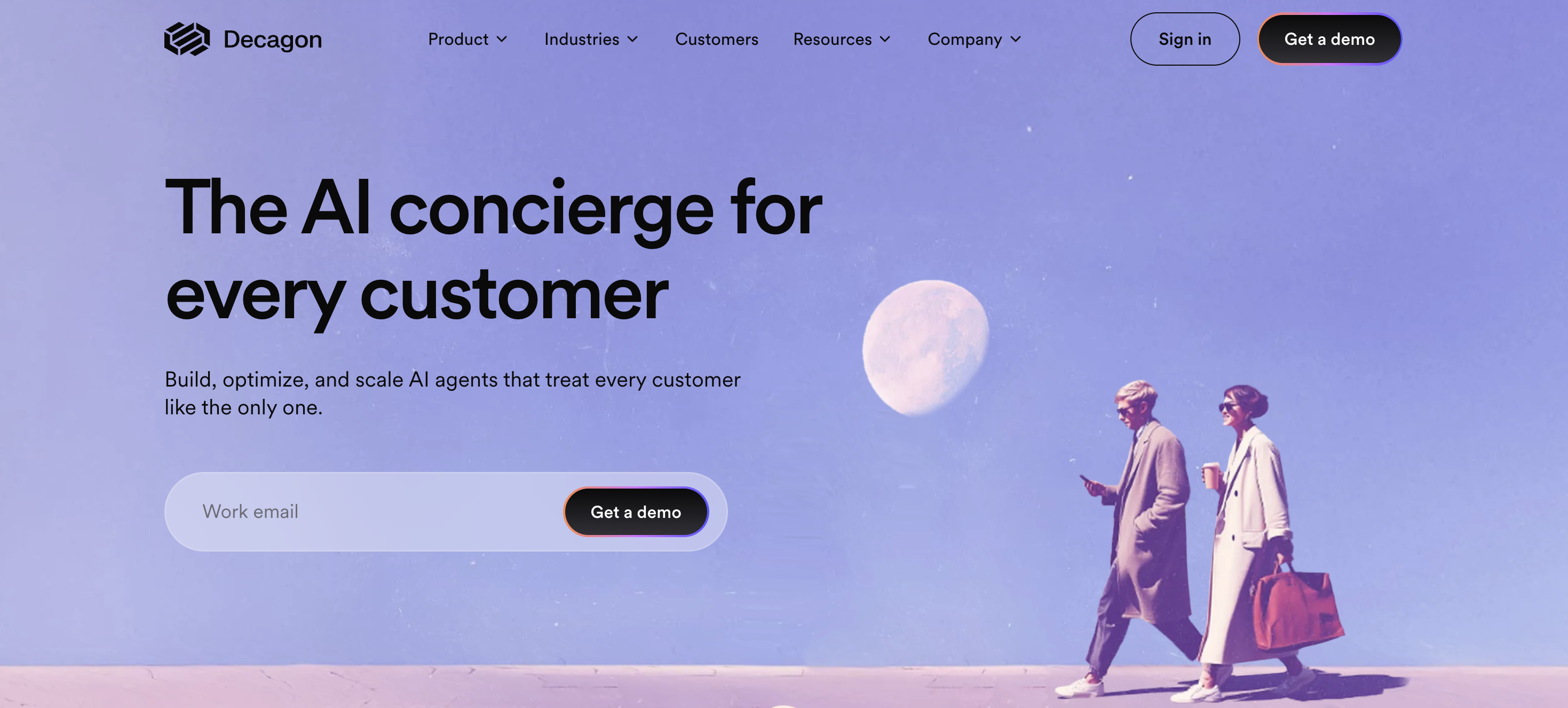
Decagon's Agent Operating Procedures (AOPs) use natural language prompts to encode agent logic, positioning the platform around operational agility. This allows CX teams to launch and experiment quickly without waiting on engineering queues, while the underlying logic remains flexible.
That agility comes with tradeoffs. Configuring and optimizing agents still requires technical investment, and organizations whose SOPs don't translate cleanly into AI agent workflows may find the learning curve steeper than expected. The platform provides API extensibility for integrations, but realizing that flexibility demands ongoing technical involvement.
Who it's for: Organizations with engineering resources who want to iterate quickly on AI agent behavior. Works for teams that view technical investment as a worthwhile tradeoff for control.
4. Cognigy
Cognigy was recently acquired by NICE, making it the AI agent component of the NICE platform. For organizations already in the NICE ecosystem or evaluating it, Cognigy is now the native option for AI agents.
The platform uses a hybrid architecture that layers LLM capabilities on top of rule-based workflows. This on-rails approach provides predictability for structured conversations but may constrain flexibility when interactions deviate from expected paths (whcih is why we recommend comparing Cognigy to its top alternatives).
Who it's for: Global enterprises requiring multilingual support at scale and conversational AI capabilities with flexibility across AI providers.
5. Google Contact Center AI
Google's Customer Engagement Suite with Google AI provides building blocks for contact center automation: Conversational Agents (via Dialogflow CX) for self-service, Agent Assist for live rep support, Conversational Insights for analytics, and CCAI Platform for infrastructure.
The keyword is "building blocks." Google provides the components, but your team must have the technical resources to spec, design, and implement a solution that fits your needs. Organizations without dedicated engineering capacity may find the assembly required more demanding than turnkey alternatives.
Who it's for: Organizations on Google Cloud with internal technical resources to design and build their own implementation. Works for teams comfortable assembling components or paying service integrators rather than deploying a pre-integrated platform.
6. Rasa
Rasa provides an open-source conversational AI framework with on-premises deployment options for organizations with strict data sovereignty requirements. The platform's CALM architecture layers LLM capabilities on top of deterministic business logic.
"Open-source" and "self-hosted" sound appealing, but they come with a significant technical burden. Building, maintaining, and optimizing a Rasa deployment requires dedicated developer resources and infrastructure management. Organizations should weigh the control benefits against the ongoing investment required.
Who it's for: Enterprises with developer resources and infrastructure to build and maintain a self-hosted solution. Works for organizations where data sovereignty requirements rule out cloud-hosted alternatives.
7. Replicant
Replicant provides autonomous AI agents designed specifically for voice. The platform supports voice, SMS, and chat channels.
Replicant also offers a conversation intelligence product, though it's focused narrowly on QA and compliance rather than broader performance analytics. Organizations wanting conversation intelligence that spans AI and human interactions, connects to business outcomes, or informs coaching and optimization may find the scope limiting.
Who it's for: Contact centers prioritizing voice automation with some digital channel coverage. Organizations wanting deeper conversation intelligence beyond QA may find the analytics scope limiting.
8. Ada
Ada uses Playbooks to define AI agent behavior through structured, pre-built workflows. This approach enables fast deployment, but the quality of AI agent performance depends on how well the underlying SOPs reflect best practices. Playbooks built from prompts may not perform as well as those built from documented workflows, and the approach assumes your existing SOPs represent the optimal way to handle each conversation type.
The platform supports over 50 languages and covers chat, voice, email, and social channels. Compliance certifications include HIPAA, SOC2, and GDPR. Ada holds a 4.6 out of 5 rating across 173 reviews on G2.
Who it's for: Organizations wanting fast deployment through pre-defined workflows that can accept less flexibility for complex or dynamic conversations. Works for teams that prioritize speed over customization.
Pick Ada if you want fast, workflow-driven deployment and can accept less flexibility on complex conversations.
Choosing the right alternative for your organization
The right choice depends on which Kore.ai gaps matter most to your organization and what tradeoffs you're willing to accept.
Decagon and Ada offer operational agility through structured workflows, though performance depends on how well those workflows reflect best practices. Rasa provides on-premises deployment for data sovereignty requirements, but building and maintaining a self-hosted solution demands significant developer resources.
Contact centers prioritizing voice automation might evaluate Replicant, though its conversation intelligence is limited to QA and compliance. Cognigy, now part of NICE, serves enterprises needing structured workflows within that ecosystem. Google CCAI provides building blocks for organizations on Google Cloud, but requires internal technical resources to assemble them.
These platforms solve different pieces of the puzzle. But if the underlying problem is that you need automation and human agent performance working together, Cresta addresses both.
The platform continues supporting human agents with real-time assistance after AI escalations, analyzes 100% of interactions across both AI and humans, and connects performance data to business outcomes rather than just containment metrics. That visibility across the full operation is what CX leaders need.
Request a demo to see how Cresta works with your specific environment.
Cresta is dedicated to helping businesses of all sizes make informed decisions. We adhere to strict editorial guidelines to ensure that our content meets and maintains our high standards.