5 Top Cognigy Alternatives for Contact Centers
Information accurate as of February 2026. Competitor products and capabilities change frequently.
TL;DR: Cognigy earned recognition for structured, rule-based conversational AI, but its acquisition by NICE ties the platform to a single vendor ecosystem and raises questions for organizations that want flexibility. Contact center leaders evaluating alternatives need to assess whether a platform can handle multi-intent conversations, provide visibility after AI-to-human handoffs, and connect automation performance to business outcomes.
Cognigy is an enterprise conversational AI platform specializing in structured, workflow-driven automation for contact centers. NICE recently acquired the company, integrating it into a large CCaaS organization. While Cognigy continues to support integrations with major platforms, the acquisition raises questions about the product's pace of innovation.
As a standalone company, Cognigy was already more deterministic and rule-based in its approach to conversational AI. Under the NICE umbrella, the platform is competing for development priority against a broad portfolio rather than evolving with the singular focus of purpose-built AI agent companies that are building their businesses around this market.
Beyond the acquisition, some organizations find that Cognigy's rule-based foundation constrains flexibility when conversations deviate from predefined paths, particularly in financial services, healthcare, and technical support where multi-intent interactions are common. This guide evaluates five alternatives across architecture, quality management (QM), and whether each platform supports human agents after AI escalation.
A breakdown of Cognigy alternatives
1. Cresta: Unified conversation intelligence and AI agents
Cresta treats automation and human performance as connected parts of the same system. The platform is built around three pillars that share data, models, integrations, analytics, and governance: Conversation Intelligence (Analyze), Agent Assist (Augment), and AI Agent (Automate). Forrester named Cresta a Leader in Conversation Intelligence Solutions for Contact Centers in Q2 2025, awarding the highest Current Offering score and highest possible scores across criteria including Insight Discovery, Real-Time Guidance, Outcome Analysis, and GenAI Safety and Controls.
How Cresta differs from Cognigy
Where Cognigy focuses on structured conversational AI workflows within the NICE ecosystem, Cresta provides a unified platform where conversation intelligence directly informs both AI agent design and human agent coaching. Visibility continues through AI-to-human handoffs because Cresta Agent Assist supports human agents with real-time guidance after escalation, and Cresta Conversation Intelligence captures the full interaction for analysis.
Cresta's outcome inference models can identify which specific agent behaviors actually drive customer satisfaction (CSAT), resolution, and revenue from conversation transcripts. This goes beyond keyword matching or sentiment analysis. The platform's Automation Discovery feature analyzes existing conversations to identify which topics are good automation candidates and which are not, so organizations build AI agents based on data rather than assumptions.
Key considerations for buyers
Cresta's multi-model architecture deploys 20+ task-optimized models per implementation, purpose-built for contact center conversations. The platform provides four-layer enterprise guardrails and an Agent Operations Center for real-time AI agent supervision. With 7-8 years of heritage building QM and coaching tools for human agents, Cresta applies proven oversight infrastructure to AI conversations, an advantage newer automation-focused platforms have not had time to build.
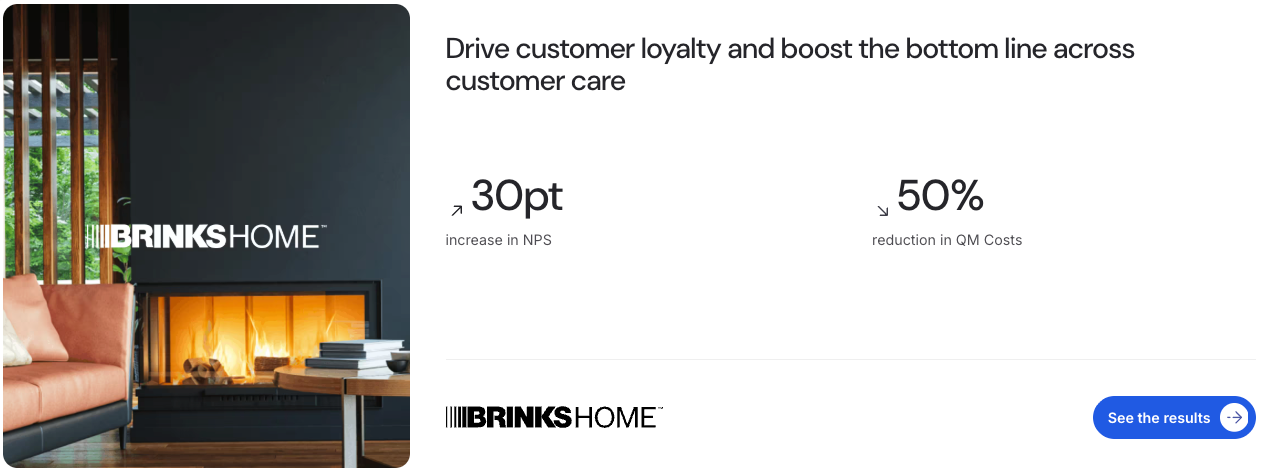
Brinks Home, one of North America's largest home security companies, needed that kind of unified visibility across in-house agents and BPOs running on different platforms. After deploying Cresta, they achieved a 30-point Net Promoter Score (NPS) increase, a 73% reduction in transfer rates, and 50% reduction in QM costs.
Who Cresta is best for
Organizations where both AI automation and human agent performance matter. Financial services, healthcare, telecommunications, travel, and retail operations with high-volume, complex interactions benefit most from a platform that connects conversation intelligence to both automation and coaching. The platform supports 25+ languages across voice and digital channels.
2. Sierra: Autonomous AI agents for customer self-service
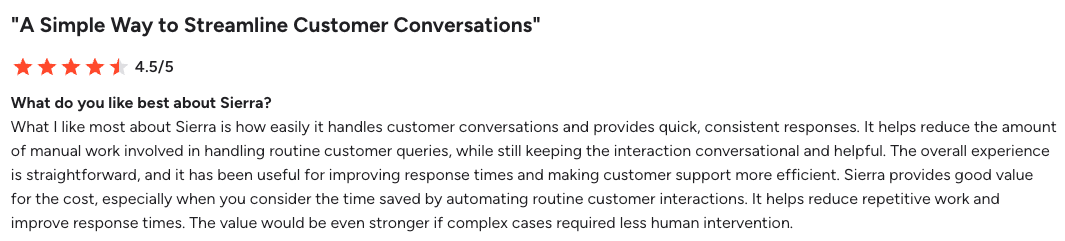
Sierra builds autonomous AI agents for customer self-service, offering white-glove support for initial deployment and configuration. The platform also provides tools like Agent Studio, Agent OS, and an SDK for organizations that want to take more ownership of agent building and optimization over time.
How Sierra differs from Cognigy
Where Cognigy takes a structured, rule-based approach to conversational AI within the NICE ecosystem, Sierra focuses on autonomous AI agents that handle customer interactions end-to-end. Sierra recently introduced Live Assist to bring AI guidance into human-handled conversations, but this is new functionality built on an automation-first platform rather than a capability developed over years of building agent coaching and quality management tools.
Key considerations for buyers
Sierra provides tools for insights, experimentation, and conversation design alongside its Agent Studio and SDK for ongoing configuration. However, the platform's foundation is in automation, and its recently added Live Assist capabilities for human agents don't carry the depth of platforms that have spent years building quality management and coaching tools. Live Assist is a new functionality built on an automation-first platform, so organizations evaluating Sierra for human agent coaching should consider whether recently added assist capabilities match the depth of platforms with years of coaching and QM heritage. While Sierra can track metrics like CSAT, the platform lacks outcome inference capabilities that connect specific conversation behaviors to those outcomes.
Who Sierra is best for
Organizations prioritizing AI automation over human agent performance, with flexible options for white-glove or self-service deployment.
3. Kore.ai: Self-service conversational AI with industry templates
Kore.ai provides a self-service platform with pre-built industry templates for banking, healthcare, and retail.
How Kore.ai differs from Cognigy
Both take structured, workflow-driven approaches to conversational AI, but Cognigy now operates within the NICE ecosystem while Kore.ai positions itself as a standalone self-service platform. Organizations build and manage their own AI agents using templates and pre-built workflows across customer relationship management (CRM), enterprise resource planning (ERP), and IT service management (ITSM) systems. Kore.ai also emphasizes agentic AI for autonomous multi-step task completion across business systems.
Key considerations for buyers
The self-service model means you build agents yourself. Templates provide starting points, but they only help if you already know what conversations look like in your operation, what deviations occur frequently, and what top performers do differently. Without that visibility, organizations risk building AI agents that handle scripted scenarios well but struggle with real-world complexity. Kore.ai does not have proven experience in quality management or conversation intelligence, so organizations needing to coach human agents alongside AI automation will need separate tools, creating fragmented data and siloed visibility.
Who Kore.ai is best for
Enterprises that have already invested in understanding their conversation patterns and want a self-service platform to build and deploy AI agents against that knowledge.
4. Decagon: Autonomous AI agents with code-level configuration
Decagon builds autonomous AI agents for organizations with technical and business resources to invest in detailed configuration. The platform's Agent Operating Procedures use natural language prompts to encode agent logic.
How Decagon differs from Cognigy
Cognigy's structured, workflow-driven approach targets enterprises wanting predictable, predefined conversation flows through visual tools. Decagon uses natural language prompts and templates to let teams configure how AI agents handle conversations.
Key considerations for buyers
Operational agility depends on having engineering resources available to make changes. Decagon does not have heritage in quality management or coaching tools for human agents. Because generative AI agents behave non-deterministically, they require the same QM oversight as human agents, and platforms that have not built that infrastructure are starting from scratch. The platform also lacks conversation intelligence capabilities that inform AI agent design, meaning you are building agents based on assumptions rather than data about what your conversations actually look like.
Who Decagon is best for
Organizations willing to invest significant internal resources in configuration and optimization, with realistic expectations about the effort required to meaningfully improve agent behavior.
5. Google Contact Center AI: Cloud-native conversational AI building blocks
Google Contact Center AI (CCAI) provides conversational AI components within the Google Cloud ecosystem, including virtual agents through Dialogflow, agent assist, and conversation analytics.
How Google CCAI differs from Cognigy
Cognigy offers a more packaged, workflow-driven approach. Google CCAI provides component services that organizations connect and configure. The components draw on Google's strengths in natural language processing (NLP) and machine learning, but they are pieces of a puzzle rather than a finished picture.
Key considerations for buyers
Google CCAI requires internal teams or professional services vendors to spec, design, implement, and maintain the overall solution. The total cost of ownership extends beyond licensing to include the internal resources required for implementation and ongoing optimization. Organizations outside the Google Cloud ecosystem face additional integration work. The components also lack the tight integration of purpose-built unified platforms, so conversation analytics, agent assist, and virtual agents operate as related but distinct services rather than sharing a unified data foundation.
Who Google CCAI is best for
Organizations already invested in Google Cloud infrastructure with internal technical resources to design and build a custom conversational AI solution.
How to choose the right Cognigy alternative
The right choice depends on what you need beyond structured conversational AI workflows and how you want automation and human agent performance to work together. Here are the key tradeoffs to weigh.
Unified platform vs. point solution
Platforms that connect conversation intelligence, agent coaching, and AI automation on a shared foundation reduce data fragmentation and give you visibility across the entire customer journey. Point solutions focused solely on automation create gaps where human agent performance, post-handoff quality, and full journey analytics fall through the cracks.
Conversation intelligence first vs. automation first
Organizations that understand their conversations before automating them build better AI agents. Platforms with conversation intelligence foundations can identify which topics to automate, what complexity patterns to expect, and what top performers do differently. Automation-first platforms skip this step, which means you are building on assumptions.
Quality management vs. starting fresh
Generative AI agents need the same oversight as human agents. Vendors with years of experience building QM, coaching, and scoring tools for human agents can apply that infrastructure to AI agent oversight and human agents. This can lend insights into the comparison of how AI and humans perform. Newer vendors focused on automation are still building those capabilities.
Internal control vs. vendor management
Self-service platforms and code-level configuration tools give you control but require internal resources. Vendor-managed models offer speed but limit your ability to iterate and adapt. Building-block approaches offer flexibility but demand significant assembly effort.
A platform evaluation should test real conversations from your operation, not just demo scenarios, and should assess how the vendor handles the interactions that do not follow standard paths. According to the 2023-24 ContactBabel US Customer Experience Decision-Makers' Guide, 74% of customers still prefer speaking with a human agent even when outcomes and time would be identical with automation, and that preference intensifies with complexity. The conversations reaching your agents are harder than ever because simple queries resolve through self-service, leaving AI and human agents to handle exceptions, escalations, and nuance.
Cresta brings conversation intelligence, agent coaching, and AI agents together
Cresta analyzes every customer interaction across voice and digital channels using AI purpose-built for contact center conversations. Because the platform shares data, models, and integrations across Conversation Intelligence, Agent Assist, and AI Agent, insights flow into frontline action without fragmentation.
Cresta Conversation Intelligence gives you full visibility into what drives customer satisfaction and operational outcomes. Automation Discovery identifies strong automation candidates so you build AI agents from data. Cresta Agent Assist supports human agents with real-time guidance during live conversations, including after AI-to-human handoffs. And Cresta AI Agent handles automated interactions with enterprise-grade guardrails and the same QM oversight that applies to human agents.
Visit our resource library to explore more conversational AI evaluation approaches, or request a demo to see how Cresta's unified platform works with your existing contact center infrastructure.
Frequently asked questions about Cognigy alternatives
Why are organizations looking for Cognigy alternatives in 2026?
The biggest driver is Cognigy's acquisition by NICE, which ties the platform to a specific CCaaS ecosystem. Organizations using non-NICE infrastructure may face integration friction or ecosystem lock-in concerns. Some organizations also find that Cognigy's structured, rule-based approach constrains flexibility when conversations deviate from predefined paths. Teams looking for deeper conversation intelligence, real-time agent coaching, or unified automation and human performance management often evaluate alternatives that take different architectural approaches.
What is the difference between AI agent platforms and CCaaS infrastructure?
AI agent platforms focus specifically on AI-powered customer interactions. Cresta combines AI agents with conversation intelligence and human agent coaching on a unified platform, while others like Sierra, Decagon, Kore.ai, and Cognigy focus primarily on automation. CCaaS platforms like Genesys, NICE CXone, Amazon Connect, and Five9 provide underlying contact center infrastructure, including telephony, routing, and workforce management. The two categories solve different problems. Some CCaaS platforms embed conversational AI features, and some AI agent platforms layer onto existing CCaaS infrastructure, but the core competencies are different.
How important is conversation intelligence when deploying AI agents?
Conversation intelligence is foundational. Without understanding what your conversations look like, what topics carry the most complexity, and what top performers do differently, you are building AI agents based on assumptions. According to Cresta's State of the Agent 2024 report, 79% of agents say good software makes or breaks whether they can do their job well, and 65% actively want real-time AI hints during customer interactions. Conversation intelligence tells you what agents need and where automation can help most.
What should I look for in AI agent quality management?
Generative AI agents behave non-deterministically, producing different responses to similar inputs and making judgment calls that need oversight. Look for platforms that apply the same QM rigor to AI conversations as to human conversations, including automated scoring across 100% of interactions, outcome-based scorecards, and real-time alerting when AI agents deviate from expected performance.
Can AI agent platforms work alongside existing contact center infrastructure?
Yes. Purpose-built AI agent platforms are designed to layer onto existing CCaaS and telephony infrastructure rather than replacing it. Organizations with investments in their current stack can add conversational AI, agent coaching, and conversation intelligence without ripping out working systems. The key question is whether the platform integrates cleanly with your infrastructure or requires significant middleware and custom development.
How do I measure ROI from an AI agent platform?
Look beyond containment rate and deflection metrics. A complete ROI assessment should include impact on average handle time (AHT) for both AI and human agents, changes in CSAT and NPS across the full customer journey, reduction in QM and coaching costs, improvement in agent ramp time and retention, and revenue impact from better sales and retention conversations. Platforms that connect AI agent performance to actual business outcomes provide the data you need for meaningful ROI measurement.