
A guide to conversational AI for call centers
.avif)

- Conversational AI in a call center covers three jobs: automating customer conversations, augmenting live agents, and analyzing far more interactions than manual review can reach
- The strongest starting use cases tie directly to an operational pain point, such as routine volume, slow ramp, or thin QA coverage
- Autonomous resolution pays off only when AI can finish complete journeys and hand off with full context when it can't
- Implementation works best as a workflow change program with baseline metrics and prepared agents and supervisors
Call centers have moved from touch-tone IVR menus to conversational AI that understands natural speech, and budgets are following.
Conversational AI technology generally works, but picking the wrong architecture or first use case can turn that spending into a pilot that never scales.
To help you invest in the use cases that pay off, we'll explain how call center conversational AI works, where it delivers ROI, and how to evaluate and implement it sucessfully.
What is conversational AI for call centers?
It’s a technology that uses natural language processing (NLP) and machine learning (ML) to understand, automate, and augment customer conversations across voice and digital channels.
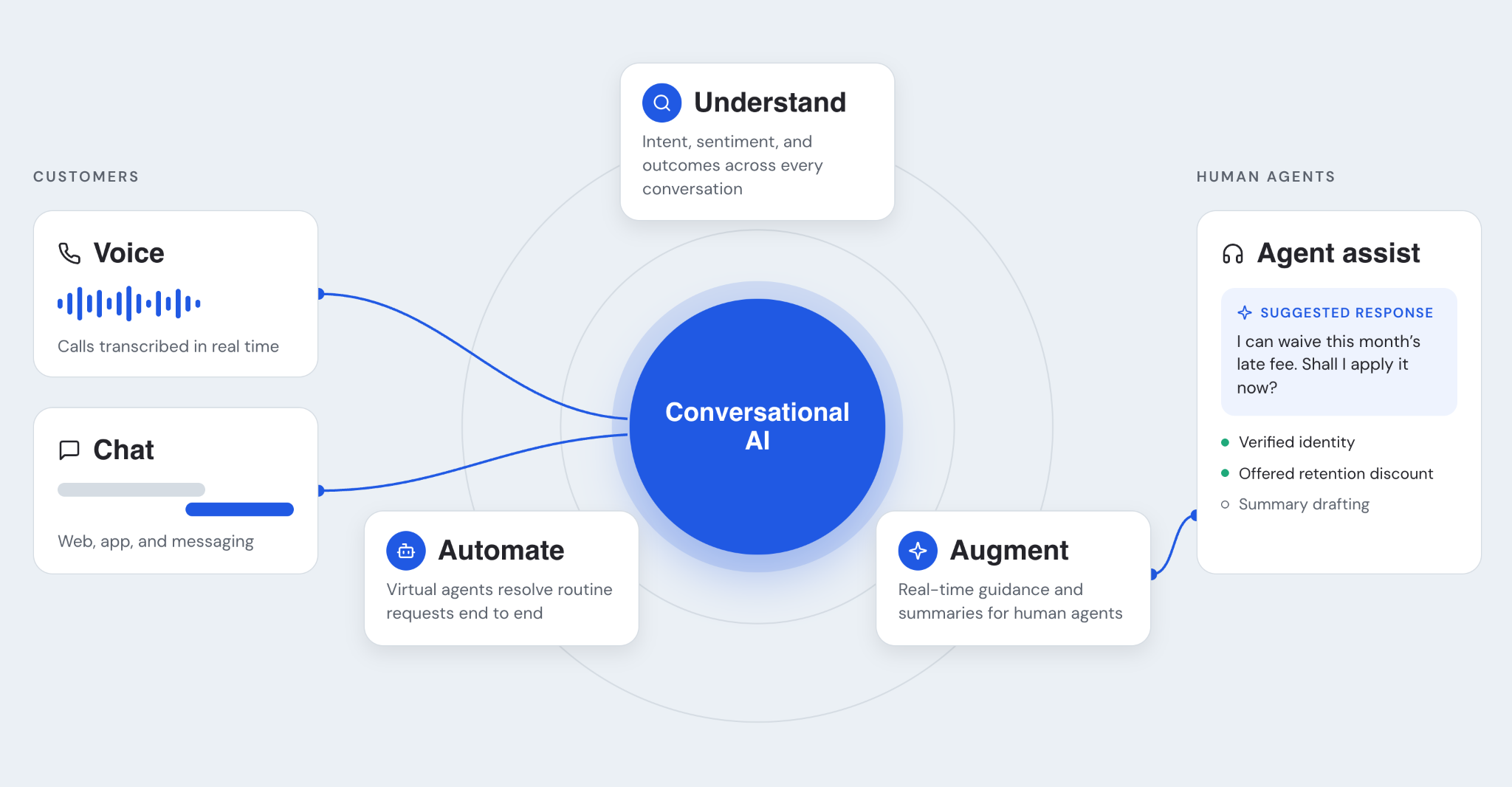
Unlike keyword-based systems, conversational AI can interpret context, handle multi-intent requests, and improve as it learns from more interactions. It can also help resolve many issues without requiring a human agent, while also augmenting agents when human judgment is still necessary via agent assist tooling.
How conversational AI works in a call center
Conversational AI processes customer interactions through a connected sequence of steps, and those steps shape real-world call center performance.
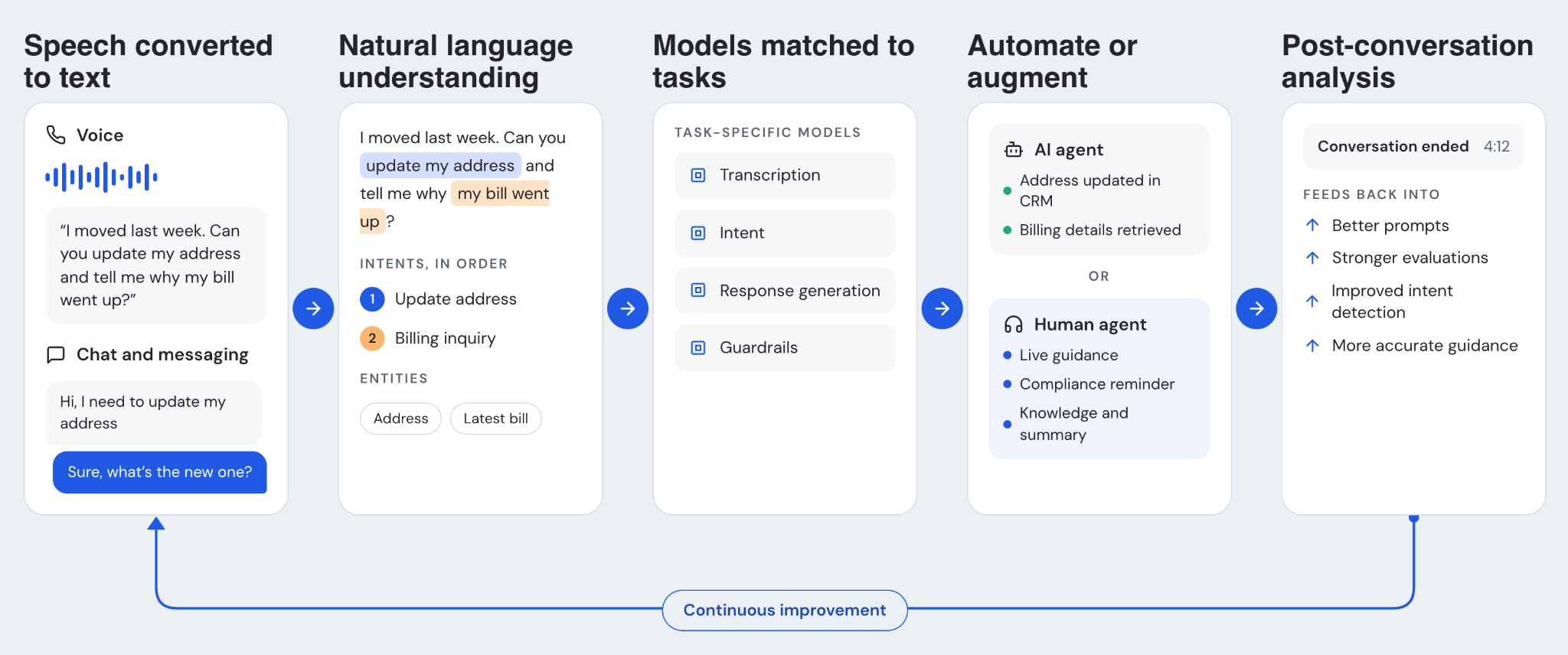
The process starts with input processing. In voice channels, automatic speech recognition (ASR) converts spoken language into text.
Once speech or text is available, natural language understanding (NLU) interprets what the customer wants. That means identifying intent, pulling out key entities such as account numbers or product names, and recognizing when one message contains more than one request.
If there’s more than one request, the system needs to preserve both intents and handle them in the correct order.
From there, the system decides what to do next.
In automation use cases, an AI agent may answer a question, retrieve information, or complete a transaction through connected business systems. In live-agent use cases, the system may surface guidance, compliance reminders, summaries, or knowledge to the human agent while the conversation is still happening.
Continuous improvement separates conversational AI from static automation. Completed conversations can inform better prompts, stronger evaluations, improved intent detection, and more accurate guidance over time.
Architecture matters here too. Some platforms send every task through one general-purpose large language model (LLM), while others use task-specific models for transcription, intent, response generation, and guardrails.
Related: AI agents vs. chatbots for contact centers
Benefits of conversational AI in the contact center
The business value shows up in several places:
- Lowers cost per contact: AI agents can handle a meaningful share of customer conversations autonomously, while agent augmentation tools help live agents work faster and with fewer errors. Your contact center can use those gains to absorb volume growth without hiring at the same rate
- Provides full conversation visibility. AI-driven analysis can evaluate far more conversations than manual sampling and surface patterns that manual review would miss, including coaching opportunities, policy friction, and recurring customer pain points
- Enhances agent onboarding. By providing real-time guidance, summaries, and grounded knowledge, new agents can quickly learn while doing the job and spend less time searching for answers or guessing what to do next
- Maximizes revenue opportunities. AI can help identify sales and retention moments, reinforce behaviors tied to better outcomes, and augment agents during the conversations where conversion or save rates matter most
- Produces upstream business insight. When far more conversations become analyzable, issues like recurring product confusion, broken digital journeys, and misleading messaging become visible much earlier. That gives teams a chance to fix root causes and reduce avoidable volume
Examples of conversational AI
Your contact center’s ability to reap the benefits above depends on its implementation of conversational AI.
Here’s a look at scenarios that call for conversational AI, and how you’d implement it.
Routine status and account requests flood the queue
Status checks, balance questions, and appointment changes can take up a large share of inbound volume. They have a clear goal and a predictable path, so customers want them done fast and agents add little by handling them.
This makes these use cases a strong fit for an AI agent.
Here’s how to implement it:
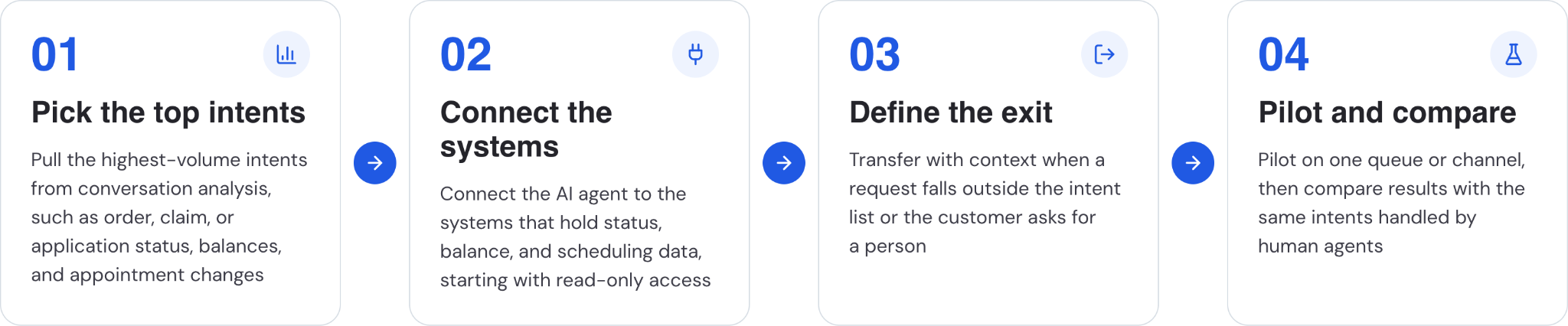
Xanterra, one of the largest operators of lodges, restaurants, and concessions in U.S. national parks, followed a similar rollout for Cresta AI Agent. They started with routine guest inquiries over chat, but that was enough to drive a 74% containment rate. During working hours, they then implemented a Glacier National Park AI agent, “Skye”, which reached an 84% containment rate.
Customers need identity-verified account changes
Payment-date changes, address updates, and similar requests require verifying the caller before anything changes.
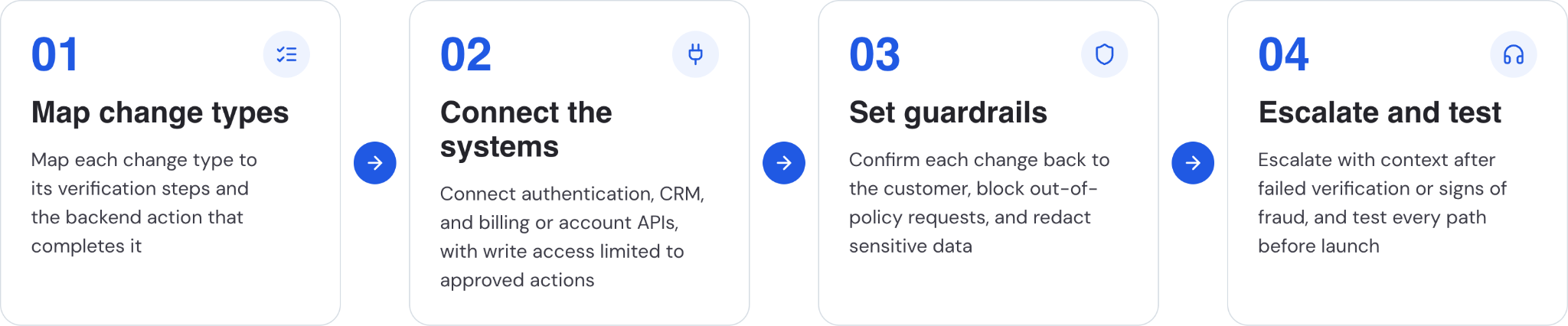
You can use an AI agent with authentication and backend actions to handle these multi-step workflows.
Here's how to implement it:
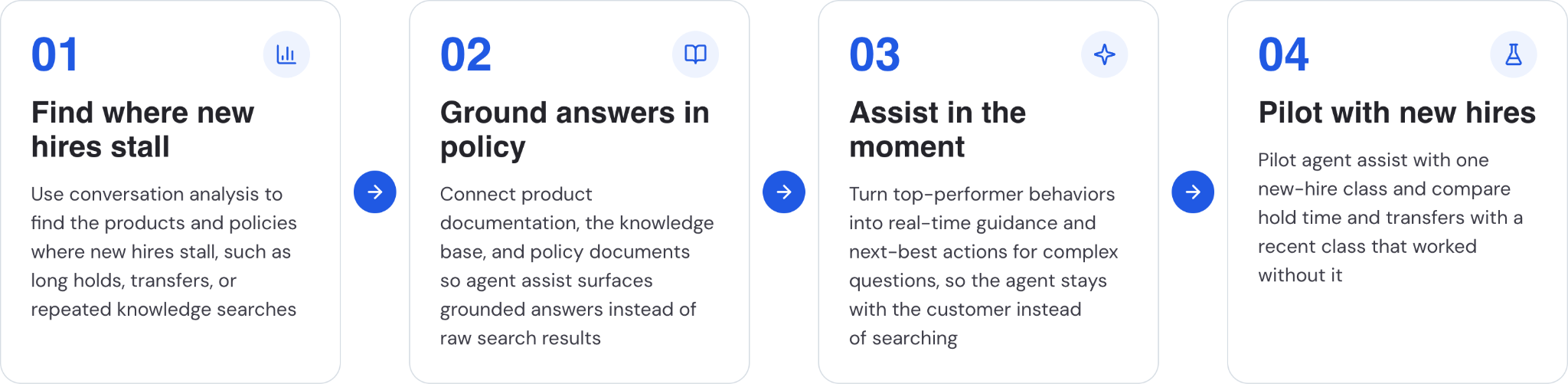
New agents ramp slowly on complex products and policies
Your new hires on complex products and policies may spend early calls searching for answers or putting customers on hold.
The customer still needs a person here, so the job is to augment the agent in the moment via agent assist.
Here's how to implement it:
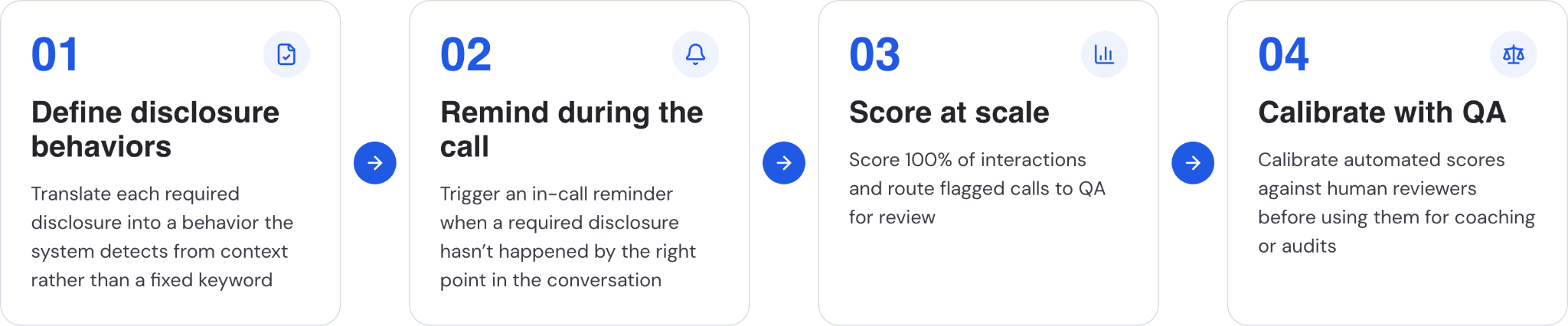
Every call has required disclosures
Regulated calls often require specific disclosures, verification steps, or scripted language. Manual QA catches misses only after the fact, and only on a small share of interactions.
With that in mind, you’ll need agent assist in the moment and automated QA scoring after the call.
Here's how to implement it:
How to choose a conversational AI platform
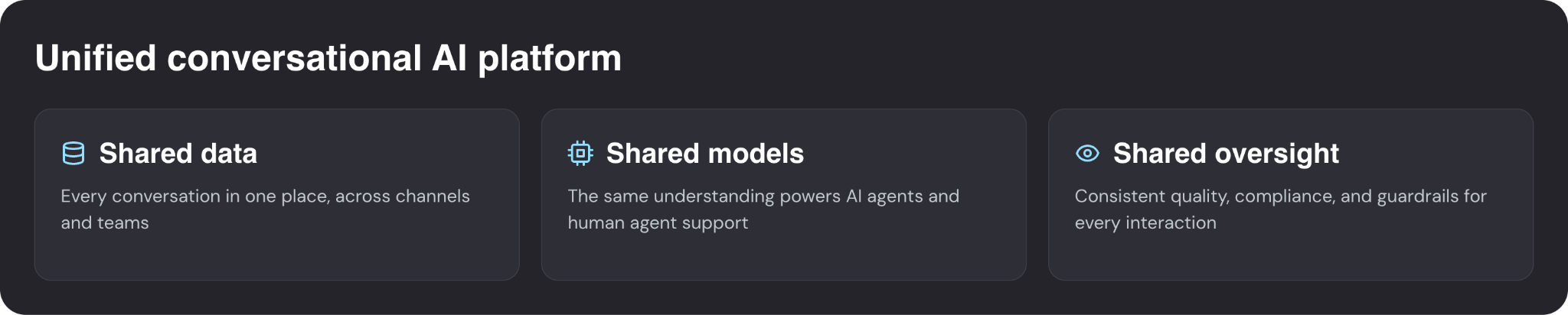
Many organizations start with one narrow use case, then discover that automation, human augmentation, and analytics all need the same conversation data, customer context, and governance.
That's why architecture matters more than an isolated feature list.
Look for a unified system that can share data, models, and oversight across the full customer journey to improve both AI-handled and human-handled interactions over time.
Questions to ask vendors during evaluation
You also need to evaluate contact center AI beyond the demo and test how the system behaves in production conditions.
A strong evaluation should examine architecture, guardrails, handoff design, analytics, integrations, security, and the vendor's ability to support change management inside the call center.
One set of questions should focus on conversation handling. Ask:
- How does the platform maintain context and state across complex workflows?
- Can it orchestrate specialized sub-agents for different tasks?
- What prevents skipped steps, unsafe actions, or hallucinated responses when the workflow becomes more complex?
Another set should focus on collaboration between AI and human agents. Ask:
- What criteria trigger escalation?
- What context transfers during the handoff?
- Does real-time guidance continue for the human agent after escalation?
Optimization questions matter just as much. Ask:
- Does the platform connect performance to business outcomes such as resolution, conversion, or predictive CSAT based on conversation content?
- Does QM cover 100% of AI and human interactions?
- Can leaders compare AI performance and human performance side by side to improve the operation as one system rather than as disconnected tools?
A final set should cover integration, security, and compliance. Ask:
- Which CCaaS, CRM, and knowledge systems do you integrate with natively?
- How do you redact sensitive data and disclose AI use to customers?
How to implement conversational AI in your call center
Your implementation approach has as much impact on ROI as platform selection.
Teams that move too quickly into automation often automate the wrong conversations first, while teams that never define success metrics struggle to prove value even when performance improves.
A stronger approach starts with analysis.
Review existing interactions across your call center to understand contact drivers, performance gaps, and which conversations are best suited for automation or live guidance. From there, sort contact drivers into four groups:
- Conversations to eliminate by fixing root causes, such as unclear policies or broken digital journeys
- Routine, clear-goal conversations to automate with AI agents
- High-emotion, high-value conversations where AI augments a human agent behind the scenes
- Proactive conversations, such as reminders and outreach, that AI makes economical at scale
Success metrics also need to be explicit before deployment begins. Set baselines for the metrics your leadership team already tracks, so you can show what changed and why.
And finally, you’ll need to treat implementation as a workflow change program supported by technology.
This means agents need to know how the new tool fits into their workflows; supervisors need to know how to use AI-generated signals effectively; quality teams need to be comfortable moving from sampled review toward broader pattern analysis, and so on.
Related: How to build a business case for contact center AI
Run conversational AI across your call center with Cresta
Cresta, the AI operating system for CX, offers one shared conversation layer for human and AI agents and covers all your conversational AI requirements by offering:
- Cresta AI Agent to automate voice and digital conversations end to end
- Deputy Agent, a long-running AI agent that takes on the operational work behind or beyond those conversations
- Agentic Assist to augment human agents in real time with guidance, knowledge, and automated summaries
- Conversation Intelligence to analyze 100% of conversations to power quality management, coaching, and insights.
Because all of them run on the same conversation record, insight from conversations flows into live guidance and into how AI agents are built. Cresta's models are also trained on your data rather than generic inputs, so they reflect how your business runs.