
Conversation Intelligence: The Complete Guide to Conversational Analytics for 2026
.avif)

- Conversation intelligence analyzes every interaction. Not a sample. 100 percent of voice, chat, email, and digital conversations, scored, categorized, and connected to business outcomes.
- It differs from speech analytics in a fundamental way. Speech analytics spots keywords. Conversation intelligence understands behavior, context, and intent, then connects them to outcomes like sales, resolution, and CSAT.
- The three things it enables: discovering what is driving contacts (including root causes and automation candidates), tracking performance against real behaviors and outcomes, and taking action through coaching, quality management, and AI-assisted guidance.
- Traditional QA teams review only a small fraction of calls. Conversation intelligence covers all of them, which changes the economics of compliance, coaching, and process improvement.
- The platforms that deliver lasting value share one architectural trait: a single conversation record that connects analysis, quality management, coaching, and real-time guidance, so insight from every conversation feeds action, and action feeds improvement.
Conversation intelligence is the AI-powered analysis of 100 percent of customer conversations to surface what is happening, why it is happening, and what to do about it. For enterprise contact center leaders, it is the difference between making operational decisions on a 2 percent sample and making them on everything.
This guide is for CX executives, contact center operations leaders, QA managers, and anyone evaluating conversation intelligence platforms or building the business case for complete conversation coverage. It covers how the technology works, how it evolved from early speech analytics, the four operational areas where it delivers measurable ROI, and a structured framework for evaluating platforms.
What is conversation intelligence?
Conversation intelligence is AI-powered analysis of customer conversations at full scale, connecting what is said and how it is said to the business outcomes that matter. It operates across voice, chat, email, and digital channels. It goes beyond transcription or keyword detection to identify behaviors, intents, sentiment, and the conversation patterns that predict sales, resolution, and customer satisfaction.
The term is sometimes used interchangeably with "conversational analytics" or "speech analytics." Those distinctions matter, and they are addressed directly in the related concepts section below. The short version: speech analytics searches for keywords; conversational analytics is a broader analytical framework; conversation intelligence is the complete layer that includes behavioral comprehension, outcome inference, and the ability to turn what you learn into specific action.
Most contact centers can realistically review only a small fraction of their conversations through manual QA. The rest is invisible. Every call in that invisible majority contains information about agent performance, systemic process failures, compliance gaps, and what customers actually need. Conversation intelligence makes that information visible and actionable.
Contact centers handle thousands of conversations every day. The intelligence locked inside them and data around what drives satisfaction, where processes break down, which agent behaviors correlate with sales and retention all stays hidden unless you have the tools to extract it. Leaders end up making decisions based on incomplete data, or spending weeks on manual review to answer questions that should take minutes. Conversation intelligence changes that equation.
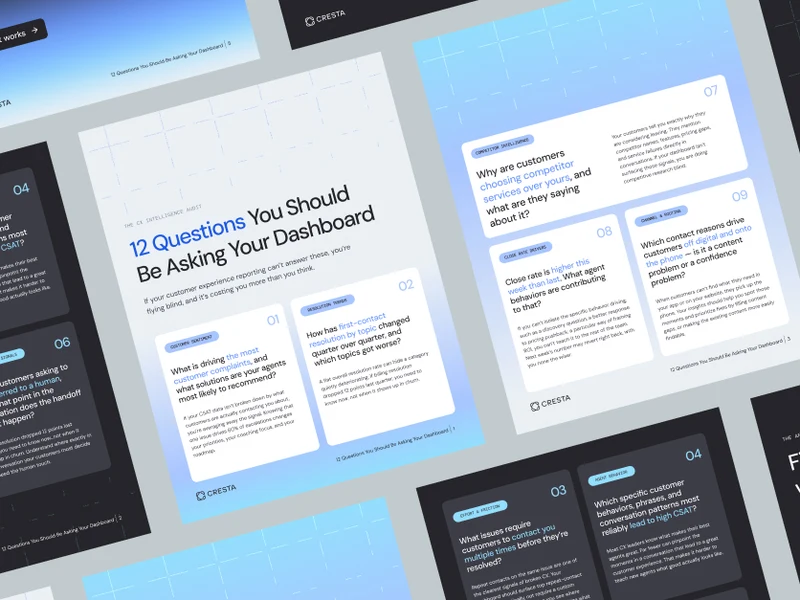
Each vendor needs to answer these 12 questions
How did conversation intelligence evolve?
Understanding where conversation intelligence came from explains why the gap between platforms is so large. Three generations of technology have addressed the same underlying problem with fundamentally different capabilities.
Generation 1: Manual QA sampling
For most of contact center history, quality management meant supervisors listening to a handful of calls per agent per month. The sample was rarely random and seldom representative. A supervisor might catch a compliance violation, but they would miss the behavioral pattern causing 30 percent of retention calls to end in churn. The insight latency was weeks, and coverage never exceeded a small fraction of total volume.
This was not a choice so much as a constraint. With no better tools, manual sampling was the only practical option. The consequence: contact center leaders made consequential decisions about coaching, staffing, process design, and product improvements on data that described a skewed subset of reality.
Generation 2: Speech analytics and keyword spotting
Speech-to-text technology in the mid-2000s made it possible to transcribe calls automatically and search for specific words or phrases. If a regulator required agents to say a particular disclosure, speech analytics could confirm whether the words appeared. If a competitor was being mentioned more frequently, a keyword search would surface it.
This was a genuine step forward on compliance and competitive monitoring. But keyword spotting has a ceiling. A customer can say "I'm done with this service" without using a single tracked keyword. An agent can deliver the required disclosure in a tone that is technically compliant and functionally dismissive. Keyword lists require continuous manual curation and do not capture context, tone, or the behavioral patterns that predict outcome.
Generation 3: Behavioral AI and outcome inference
Modern conversation intelligence replaces keyword matching with behavioral comprehension. Instead of looking for specific words, the system understands what is actually happening in the conversation: whether the agent acknowledged the customer's concern before moving to resolution, whether a retention technique was applied when a cancellation signal appeared, and whether the conversation is trending toward resolution or escalation.
The second structural shift is outcome connection. Legacy systems told you what happened. Current conversation intelligence tells you what it means: in terms of sales, resolution, CSAT, and handle time. Vivint used Cresta Conversation Intelligence to analyze 100 percent of calls, reaching 85 percent QM coverage and a 7 percent lift in close rate. That kind of connection, between a specific agent behavior and a specific revenue outcome, is only possible when the system understands behavior, not just vocabulary.
How does conversation intelligence work?
Conversation intelligence converts raw conversation audio into measurable, actionable intelligence through four sequential processing stages. Each builds on the one before it. Understanding the pipeline clarifies why some platforms deliver genuine insight while others surface data that requires extensive human interpretation before it is useful.
Stage 1: Speech recognition
Speech recognition converts audio into searchable text. In contact center conditions, this is harder than it sounds. Background noise, overlapping speakers, industry-specific terminology, regional accents, and variable audio quality all degrade transcription accuracy. Enterprise-grade speech recognition applies noise suppression, speaker diarization (separating the agent's voice from the customer's), and domain-specific language models trained on actual contact center conversations rather than general language data.
Transcription accuracy at this stage determines the fidelity of everything downstream. A system that misrenders a meaningful share of words produces NLP outputs, behavioral detections, and coaching recommendations that reflect those errors. The quality bar here is not "accurate enough for search" but "accurate enough to detect a specific compliance phrase across millions of interactions."
Stage 2: Natural language processing
NLP applies structure to the transcribed text. At this stage the system identifies what the customer wants to accomplish (intent extraction), key entities relevant to the business context (account numbers, product names, issue types), and the emotional register of the conversation, including sentiment and emotion detection, such as frustration, satisfaction, and confusion, at both the customer and agent level.
Modern NLP models applied to contact center conversations are trained on large volumes of labeled conversation data from the relevant domain. The difference between a generic NLP model and one trained on financial services or insurance conversations is substantial. Intent categories that map to an enterprise's actual contact reason taxonomy require training data from that enterprise's real interactions.
Stage 3: Behavioral conversation intelligence
This is the layer that separates conversation intelligence from speech analytics. Where NLP identifies what was said and how it sounded, behavioral conversation intelligence identifies whether specific, outcome-relevant behaviors occurred in the conversation.
A behavior is not a word. It is a pattern: did the agent acknowledge the customer's concern before moving to resolution? Did the agent apply a retention technique when a cancellation signal appeared? Did the agent complete the required disclosure sequence in the right order? Behavioral detection requires comprehension of context across multiple turns of conversation, not a scan for a character string.
Cresta builds behavioral models by training on each customer's own conversation data, which means the behavioral library reflects what actually works in your operation, your product context, and your customer base, rather than generic industry patterns.
Stage 4: Outcome analytics and aggregation
Individual conversation analysis becomes operationally useful when aggregated across thousands of interactions. The analytics engine connects behavioral patterns to outcomes, identifying which specific behaviors correlate with higher close rates, lower handle times, better CSAT scores, and first-call resolution. It surfaces anomalies, trends, and root causes at scale, turning individual conversation signals into decisions about coaching priorities, process changes, and what to automate.
The output is not a transcript or a scorecard. It is a decision instrument: a clear signal about which behaviors to promote, which processes to fix, and which contacts should not exist because they reflect a systemic issue the business should address at its source.
How does conversation intelligence differ from speech analytics and related tools?
Conversation intelligence sits at the top of a capability stack that includes speech analytics, conversational analytics, conversation mining, and voice of customer analytics, and the distinctions matter when evaluating platforms. Not all vendors mean the same thing when they use these terms, and the difference between behavioral comprehension and keyword detection is not a marketing nuance. It determines what the platform can actually tell you.
Conversation intelligence vs. speech analytics: a direct comparison
Speech analytics refers specifically to the audio-to-text transcription and keyword-search capabilities that defined Generation 2 above. It is a subset of what conversation intelligence does. Every conversation intelligence platform includes speech analytics capabilities, but speech analytics alone does not constitute conversation intelligence.
When evaluating vendors, this distinction is worth pressing directly: does the system detect behaviors or keywords? The answer determines whether the platform can identify that a specific agent behavior drove a sale, or whether it can only confirm that a specific phrase appeared in the transcript.
Conversational analytics
Conversational analytics is the broader analytical framework applied to conversation data. It encompasses sentiment analysis, topic detection, trend identification, and performance benchmarking across channels. Conversation intelligence is the AI-powered, outcome-connected layer on top of conversational analytics: adding behavioral comprehension and action-triggering to the analytical foundation. Most enterprise platforms use both terms, but conversation intelligence implies a more specific commitment to behavioral detection and outcome inference.
Conversation mining
Conversation mining is the discovery layer within conversation intelligence: the process of surfacing unknown-unknowns from unstructured conversation data. Rather than confirming what you already track, conversation mining reveals what you did not know to look for — a new complaint category emerging at scale, an unexpected competitor appearing in retention calls, a product confusion driving contacts that do not map to any existing issue category.
Cresta's Topic and FAQ Discovery capability automates this process, scanning conversation patterns to surface themes that fall outside existing categories and quantifying how frequently they appear.
Voice of customer analytics
Voice of customer (VoC) analytics is the practice of extracting customer needs, preferences, and perceptions from customer-generated data. Surveys, reviews, and social listening are the traditional VoC inputs. Conversation intelligence is the operational mechanism behind enterprise VoC programs at contact center scale: every call and chat interaction is a direct, unprompted customer expression, captured at a volume no survey methodology can match.
The practical advantage: conversation intelligence-based VoC captures what customers say without the self-selection bias inherent in survey response rates. Customers who call with a frustration will say what it is. Customers who answer a post-call survey are a self-selected subset, skewed toward the strongly positive and strongly negative.
Contact center analytics
Contact center analytics is the broad category of measurement applied to contact center operations: handle time, first-call resolution, abandonment rate, occupancy, CSAT, and similar metrics. Conversation intelligence sits within this stack as the analytical layer applied to the content of conversations, rather than operational metrics about the structure of the contact. A contact center analytics platform without conversation intelligence can tell you that handle time went up. Conversation intelligence tells you why.
AI quality management
AI quality management uses machine learning models to score agent conversations automatically against a defined rubric, replacing or supplementing the manual call-listening process. It is a core use case within conversation intelligence, covered in depth in the AI quality management section below. The key capability: 100 percent coverage, consistent scoring, and automatic connection to coaching workflows.
Predictive CSAT
Predictive CSAT infers customer satisfaction from conversation signals rather than waiting for survey responses. The model is trained on conversations with known CSAT outcomes, then applied to all conversations to produce a satisfaction estimate in real time or immediately post-call. This enables QA and CX teams to prioritize follow-up on conversations where satisfaction is predicted to be low, rather than waiting for survey data that may arrive days later or not at all. Cresta Conversation Intelligence includes predictive CSAT as part of its Outcome Insights capability.
Customer conversation analytics
Customer conversation analytics is the intersection of conversational analytics and customer experience measurement. It focuses on what conversations reveal about customer needs, friction points, satisfaction drivers, and root causes of contact volume. The term is often used by CX leaders and analysts; "conversation intelligence" is the more common product-category framing. The capabilities overlap substantially.
Where does conversation intelligence create the most value?
Conversation intelligence creates measurable value in four operational areas. Each has a distinct mechanism and a distinct set of outcomes.
Quality management and agent coaching
Quality management in most contact centers still depends on manual sampling. A QA analyst listens to a small fraction of recorded calls, scores them against a rubric, and provides feedback that reaches the agent days or weeks after the conversation occurred. When feedback finally arrives, agents often cannot reconstruct the specific situation being discussed. The delay breaks the coaching loop before it starts.
Conversation intelligence changes the economics of QA in two ways. First, it scores every interaction automatically, eliminating the sampling constraint. Second, it surfaces coaching opportunities when they are still actionable: while the conversation is recent and specific feedback is meaningful.
Oportun implemented Cresta Conversation Intelligence and reached 100 percent QM coverage with a 50 percent workload reduction for the QA team. Vivint used the same platform to reach 85 percent QM coverage and saw a 7 percent lift in close rate: a direct connection between the behaviors the coaching system reinforced and the revenue outcomes the business cares about.
The structural lesson: when QA coverage moves from a sample to 100 percent, the system can identify the specific behaviors that separate high-performing agents from the median, then coach toward those behaviors systematically across the team.
Customer experience optimization and voice of customer
Traditional CX measurement relies heavily on post-call surveys. Survey data has two structural problems. Response rates for post-call surveys are typically low, and respondents are not representative: customers with strongly positive or negative experiences are more likely to respond than those in the middle. The result is a customer satisfaction signal that overweights the extremes and underrepresents the majority.
Conversation intelligence replaces the sample with the full population. Every interaction produces a satisfaction signal, inferred from the conversation itself rather than solicited from a self-selected respondent. Teams can identify what is actually driving satisfaction and dissatisfaction across the entire customer base, then act on it before survey data arrives.
Alaska Airlines used Cresta Conversation Intelligence to move from weeks-long issue identification cycles to same-day identification, and pinpointed five specific drivers of long handle times. That shift from "we have a handle time problem" to "here are the five specific causes and their relative magnitude, identified today" is what converts conversation data into a leadership decision instrument rather than a retrospective report.
Compliance and risk management
Regulated contact centers in financial services, healthcare, and insurance face a structural compliance challenge: the obligation to monitor every agent interaction for required disclosures, prohibited statements, and procedural adherence, combined with the operational impossibility of listening to all of them manually. Manual sampling catches some violations. It does not catch systemic patterns, and it cannot produce the complete-coverage evidence that regulators and internal audit teams increasingly expect.
Regulatory expectations in consumer financial services, for example, increasingly require firms to demonstrate proactive monitoring practices rather than reactive response to complaints. Conversation intelligence changes compliance from a statistical best-effort into a complete-coverage operation: every required disclosure confirmed or flagged, every prohibited statement identified, patterns of non-compliance surfacing before they become regulatory events.
For risk management, the implication is direct: a compliance team can demonstrate to regulators that 100 percent of calls are reviewed, not that a sample was reviewed and the remainder assumed compliant.
Automation discovery
The fourth value category is the one most commonly overlooked: using conversation intelligence to identify which conversations should be automated, which should be improved through better human augmentation, and which reflect a systemic problem that should be fixed at its source.
Some contacts exist because of broken processes, unclear communications, or product issues. Deploying an AI agent on them is an expensive band-aid. The right response is to identify the root cause through conversation intelligence and fix it so those contacts stop happening. Others are routine, high-volume, and well-suited for automation. Identifying which is which requires the kind of behavioral and intent analysis that only full conversation coverage can provide.
Cresta's Automation Discovery capability assigns an Automation Readiness score to each contact topic, based on volume, complexity, and conversation patterns. Topics that score high are exported with a one-click path to an AI Agent prototype.
United Airlines uses Cresta's AI Analyst capability to replace what previously required approximately 160 hours of manual call listening per operational change. That efficiency, from weeks of manual analysis to same-session insight, changes what is operationally feasible. Teams can ask and answer questions about conversation patterns that were previously too expensive to answer at all.
What are AI quality management and predictive CSAT?
AI quality management and predictive CSAT are the two conversation intelligence capabilities that most directly connect conversation analysis to outcome improvement. Both represent meaningful departures from what legacy QA platforms deliver.
AI quality management
Traditional QA platforms automate scoring through rule-based logic: if the transcript contains a specific phrase, award the point. The limitation mirrors the speech analytics ceiling: compliance with the letter of a script does not equal quality performance. An agent can technically include the required words in an order and tone that undermines the intent entirely.
AI quality management uses behavioral models to evaluate quality in context. It scores not just whether behaviors occurred, but whether they were appropriate to the specific conversation moment and consistent with the intended outcome. This requires the same behavioral comprehension layer described in Stage 3 of the technical pipeline: comprehension of context across multiple conversation turns, not character matching.
Cresta's Quality Management capability covers 100 percent of conversations with automated scoring, hybrid human-AI review workflows that allow QA analysts to focus on the highest-priority interactions, calibration and audit tools for maintaining scoring consistency, an appeals process, and process scorecards that track adherence to defined workflows.
The connection to coaching is direct. When QM scoring runs on the same conversation record that powers the coaching platform, insights from quality reviews automatically surface as coaching plans. Agents receive feedback connected to specific recent conversations, not a delayed summary of a sampled call from three weeks ago.
Predictive CSAT
Predictive CSAT closes the gap between what customers tell agents and what they report on surveys, or do not report at all.
The model infers satisfaction from conversation signals including sentiment trajectory, resolution indicators, handling behaviors, and language patterns. It produces a satisfaction estimate for every conversation immediately after it ends.
For QA and CX leaders, this changes the prioritization logic for follow-up. Instead of waiting for survey returns to identify dissatisfied customers, teams can flag low-predicted-CSAT conversations for same-day review and potential outreach. Instead of learning about a dissatisfaction spike a week after it occurred, operations teams detect it in the same shift.
Cresta includes predictive CSAT within its Outcome Insights suite, alongside sales conversion inference, resolution detection, and handle time analysis, so all of these outcome signals draw from the same conversation record.
How should you evaluate conversation intelligence platforms?
The gap between platforms that demo well and platforms that deliver results comes down to five structural questions. These criteria are drawn from the failure modes observed in enterprise deployments: the patterns that look fine in a proof of concept and surface only after rollout.
The Conversation Intelligence Evaluation Framework
Two additional criteria for regulated industries
Audit trail and explainability. In regulated environments, automated QM scoring must be defensible. Verify that the system can produce a specific, human-readable explanation for any automated QM score, not just a score value. Regulators and internal audit teams will ask why a particular call was flagged or cleared.
Data residency and security posture. Contact center conversations contain PII, financial data, and health information. Verify data residency, encryption standards, and access control architecture before contracting. Ask for the vendor's SOC 2 Type II report and applicable compliance certifications.
The sales vs. contact center distinction
Buyers searching "conversation intelligence" will encounter two distinct markets. One is built around sales team coaching: platforms like Gong, Clari, and Allego that analyze sales rep calls for pipeline management and rep development. The other is built around enterprise contact centers: platforms designed for high-volume customer service, compliance monitoring, 100 percent coverage QA, and the full suite of operational analytics described in this guide.
The capabilities look similar in a vendor pitch. The underlying architectures, the coverage models, the compliance tooling, and the integration patterns are different. Clarify early in an evaluation which operational context the vendor has been built and optimized for.
How does Cresta Conversation Intelligence work?
Cresta Conversation Intelligence is not a standalone analytics tool. It is the analytical layer within a unified Customer Experience AI platform, which means the insight it generates flows directly into how human agents are guided in live conversations, how AI agents are built and improved, and how quality management and coaching are executed. Because all three share one conversation record, improvement from one layer compounds across the others.
100 percent coverage with outcome-driven prioritization
Every conversation is analyzed. Not the highest-risk ones, not a statistically significant sample. Every interaction, scored, categorized, and connected to business outcomes.
The outcome connection is what turns coverage from a data volume problem into an operational advantage. Discovery, tracking, and action in Cresta Conversation Intelligence are prioritized by impact on metrics the business cares about: sales, retention, resolution, CSAT, and average handle time, not by volume alone. A high-volume contact topic with no measurable outcome impact gets treated differently from a lower-volume behavior that predicts churn. That prioritization logic is what prevents the platform from producing a large volume of low-signal findings that require analyst interpretation before they are usable.
The answer ownership loop
One conversation record powers live agent guidance through Agent Assist, QM scoring, coaching assignment, and AI agent design and optimization. Cresta describes this as the answer ownership loop: build a behavioral rule once and it deploys everywhere.
The operational implication is significant. QA findings become coaching inputs automatically. Coaching results feed back into behavioral models. Insights from analyzing every conversation flow directly into what agents see during live interactions and into how AI agents are designed and improved. Platforms that silo these functions require duplicate effort to achieve the same result, and it never fully works because the underlying data does not connect.
AI Analyst: natural-language deep research on conversations
Cresta AI Analyst is a natural-language research interface built into Conversation Intelligence that allows operations and insights teams to ask questions about conversation patterns and receive grounded, evidenced answers drawn from actual conversation data.
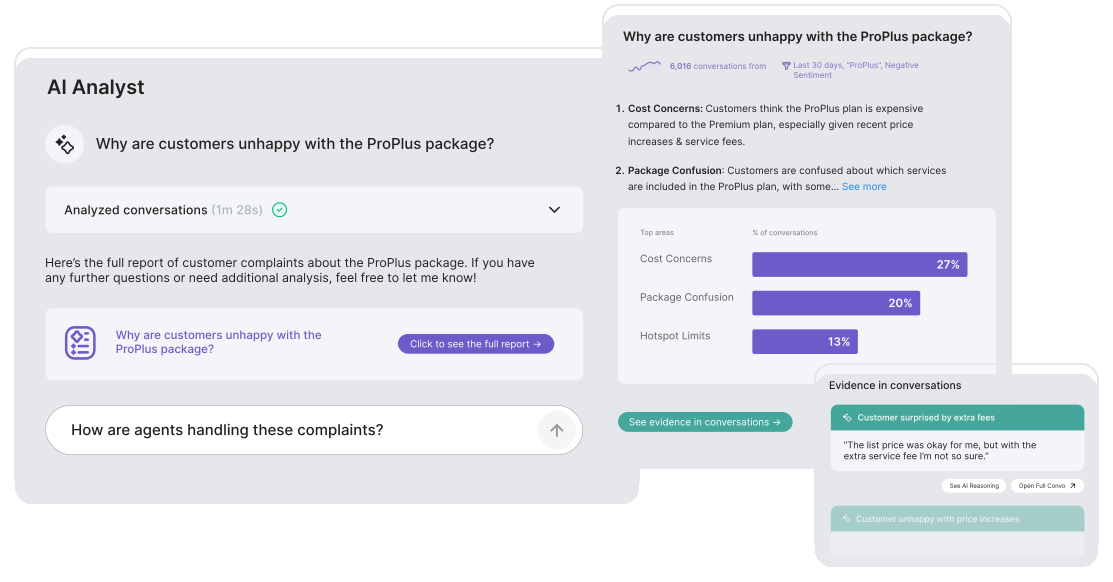
The capability was designed to address the failure modes that plague general-purpose AI research on large conversation datasets: context rot (losing relevant context as the conversation set grows), irrelevance (pulling evidence that matches keywords but not meaning), and hallucination (generating plausible-but-unsupported summaries). Cresta AI Analyst uses a parallel per-conversation analysis approach with relevance checking and fact grounding.
United Airlines uses AI Analyst to replace what previously required approximately 160 hours of call listening per operational change. Research cycles that once took weeks now complete in the same session, which changes what operations teams can afford to investigate.
How it connects to the rest of the platform
Cresta Conversation Intelligence is one of three core products on the Cresta platform, alongside AI Agent and Agent Assist. They share one conversation layer.
AI Agent handles dynamic, multi-intent customer conversations autonomously: complex resolution scenarios that do not require a human, built from real conversation data with enterprise guardrails. Agent Assist augments human agents during live conversations with real-time behavioral guidance, knowledge access, and automated summaries. Conversation Intelligence is the analytical foundation: the layer that reveals what is happening across all interactions and drives continuous improvement in both human and AI agent performance.
Automation Discovery within Conversation Intelligence creates a direct path from insight to action: an Automation Readiness score for each contact topic and a one-click export to an AI Agent prototype, so the operational loop from "analyze" to "automate" closes without a separate engineering project.
Conclusion
Customer conversations contain the clearest signal of what customers need, what agents need, and what the business needs to improve. Yet most organizations still rely on limited samples, surveys, and manual analysis to understand what is happening across the customer experience.
Conversation intelligence changes that by analyzing every interaction, uncovering the behaviors, intents, and patterns that drive outcomes. It enables leaders to move from assumptions to evidence, from reactive decisions to proactive improvement, and from isolated insights to continuous optimization.
As customer expectations rise and operations become more complex, the ability to learn from every conversation is becoming a competitive necessity. The organizations that can turn conversation data into action will be best positioned to improve customer experience, empower agents, reduce costs, and drive better business outcomes.
Cresta is dedicated to helping businesses of all sizes make informed decisions. We adhere to strict editorial guidelines to ensure that our content meets and maintains our high standards.