
How to Create a Call Center Agent Performance Scorecard in 7 Steps
.avif)

- A call center agent performance scorecard pairs KPIs like CSAT, FCR, and AHT with observable behaviors, weighted to your business goals
- Most scorecards fail because of vague criteria and inconsistent scoring
- Build criteria from the behaviors your conversation data ties to resolution, satisfaction, and conversion
- Binary "performed / not performed" behaviors are easier to score consistently than 1–5 ratings
- A scorecard only improves performance when its results feed a regular coaching cadence
A call center agent performance scorecard is only useful if it gives the same result no matter who's doing the evaluating.
When the criteria are vague, two supervisors can use the same scorecard on the same call and land on different scores. Agents stop trusting the feedback, and coaching stalls.
To help you avoid this, we'll walk through how you can create a call center agent performance scorecard successfully. But first, let's align on the basics.
What is a call center agent performance scorecard?
It's a scorecard that evaluates customer interactions against consistent criteria, including empathy, problem-solving, and process adherence. Managers review it alongside KPIs, like average handle time (AHT), to get the full picture of an agent’s performance.
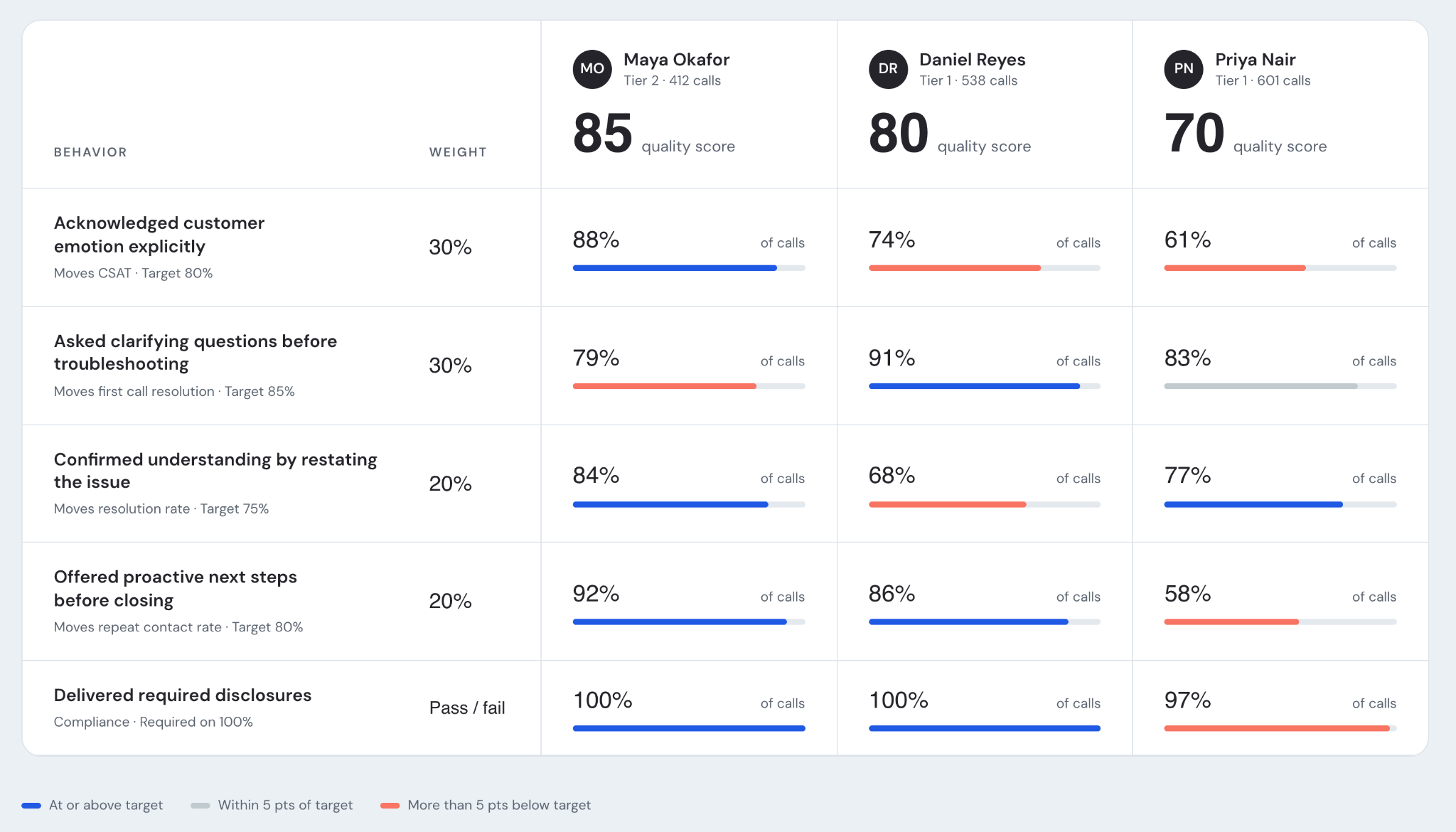
Many scorecards weigh each criterion by importance, multiply its rating by that weight, and sum the weighted scores to calculate an overall result.
That said, criteria, weights, scoring scales, and pass/fail rules vary across contact centers based on service goals, customer needs, and compliance requirements.
Why agent scorecards are important for call center performance
Building and using call center scorecards can be a lot of work, but if they’re used effectively they can benefit agents in a variety of ways.
Here are just a few benefits:
- Spots strengths and gaps: Shows which behaviors each agent handles well and where targeted coaching can help
- Standardizes evaluations: Shared criteria help supervisors assess calls consistently across teams and prevents biased feedback
- Makes coaching actionable: Connects feedback to observable behaviors so agents know what to repeat or improve
- Finds performance patterns: Compares results over time and across agents to identify recurring trends a few calls may miss
- Early warning on team-wide gaps: when many agents miss the same criterion, it's a training issue that the supervisor can address in team-wide meetings
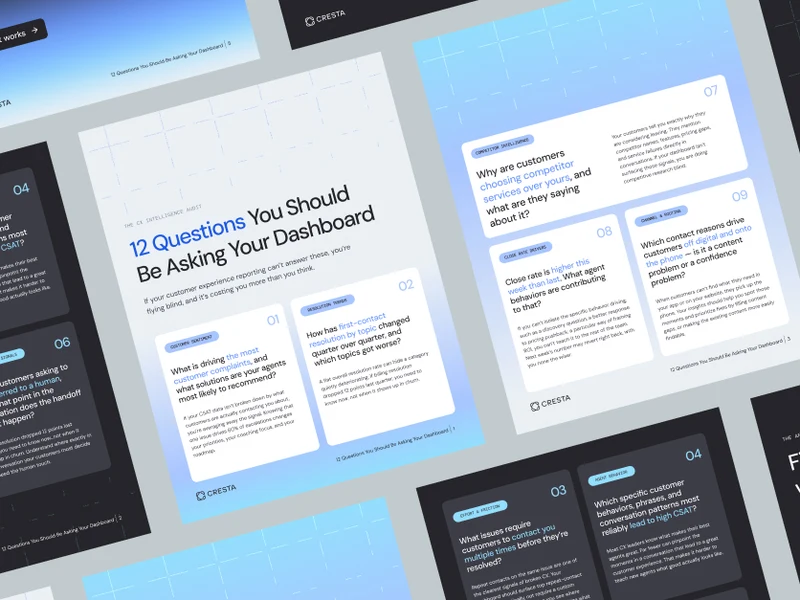
Tie agent behaviors to real outcomes by asking your dashboard these questions
Key components that make scorecards effective
Strong scorecards balance three types of criteria. Each one answers a different question about the call.
Getting these three components right requires a structured approach, starting with your business objectives and working through to calibration and coaching integration.
How to create a call center agent performance scorecard
Building an effective scorecard is a sequential process, and each step builds on the last.

We’ll walk through each.
1. Define objectives
The scorecard creation process begins by defining objectives aligned with business goals.
For service quality scorecards, that might be resolution and satisfaction; for sales, the scorecards might use a split weight between conversion outcomes and the behaviors that drive them; and for compliance-focused scorecards, you might want to treat regulatory requirements as pass/fail items, not weighted points.
2. Select core KPIs and behavioral criteria
Once you've defined your primary objective, select behavioral criteria that drive those outcomes. This is where many scorecards go wrong: teams pick criteria that seem reasonable (greeting quality, closing technique) without knowing whether those behaviors correlate with results.
The better approach is to analyze your conversations and identify which specific behaviors separate high performers from average ones. What do agents who achieve high CSAT or strong conversion rates do differently? An AI for CX platform can surface these correlations across every conversation.
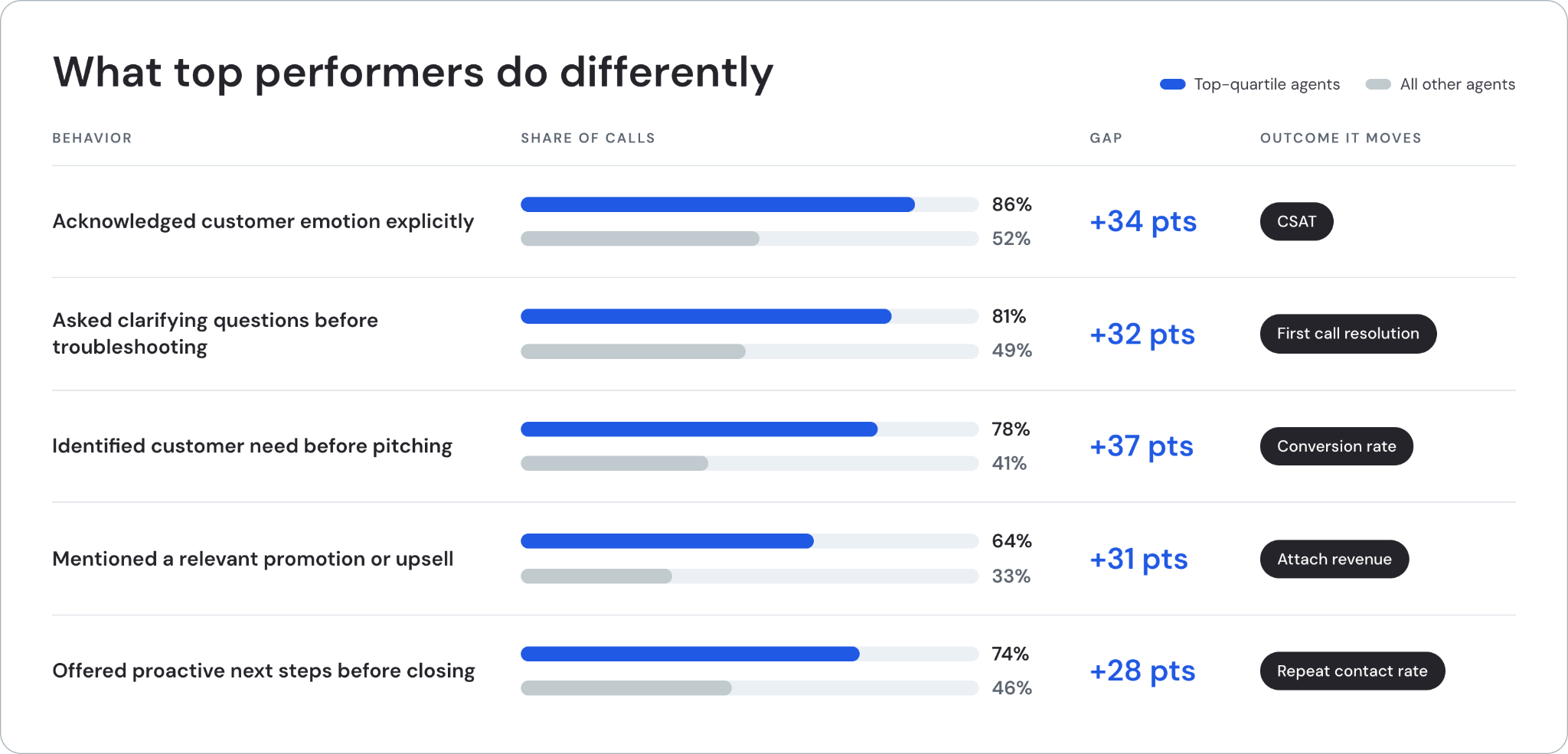
Once you've identified the behaviors that matter, focus on making them observable and specific. Describe exactly what excellent, adequate, and poor performance looks like for each criterion so evaluators can score consistently.
3. Determine which criteria can be auto-scored versus manually evaluated
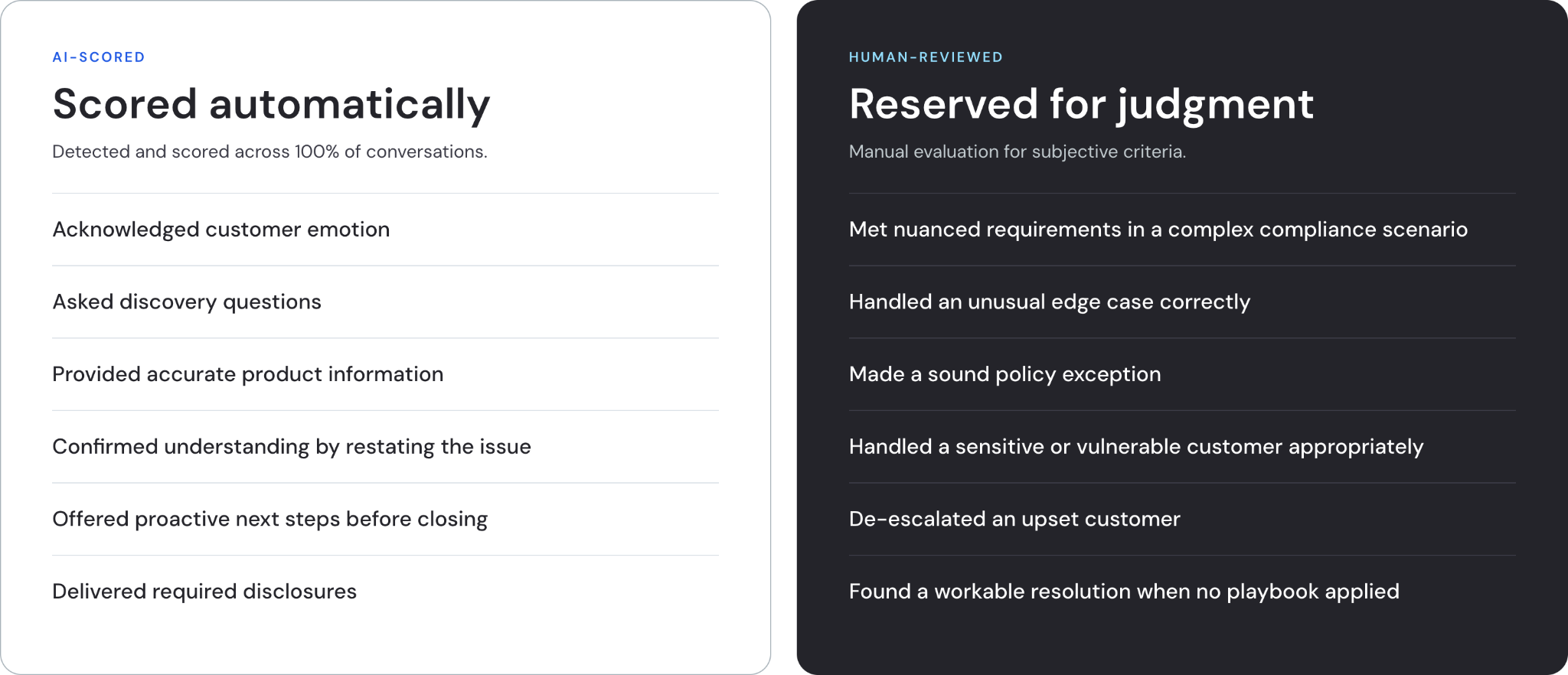
Many behavioral criteria, even subtle and contextual ones, can now be evaluated automatically by AI.
For example, behaviors like "acknowledged customer emotion," "asked discovery questions," or "provided accurate product information" can be detected and scored across 100% of conversations without manual review.
This changes how you approach scorecard design. Rather than building detailed rubrics for every criterion, identify which behaviors AI can reliably score and which require human judgment. Reserve manual evaluation for subjective criteria, like complex compliance scenarios with nuanced requirements.
We’ve seen this approach benefit our customers. Oportun, a financial services company, moved from sample-based QA to scoring 100% of interactions with Cresta's automated Quality Management solution. The shift cut its QM team's workload by 50%.
4. Design weights and rubrics for your criteria
Assign each criterion a percentage weight based on business impact, whether it’s scored by a human, by AI, or calculated from system data. For example, a service scorecard might weight problem resolution at 30% and communication skills at 20%.
Then define a clear scale. A typical 0 to 5 scale looks like this:
- 5, exceptional: consistently exceeds all standards
- 4, above standard: meets all requirements with added strengths
- 3, meets standard: satisfactory performance
- 2, below standard: needs improvement
- 1, unsatisfactory: significant gaps
- 0, critical failure: complete failure or compliance violation
You’ll also need to define what each score means for each criterion. This keeps human reviewers consistent and gives AI scoring a rubric to follow.
Finally, set auto-fail rules. A weighted sum can hide serious problems, since an agent who fails compliance could still score above 80%. For critical criteria, define an auto-fail rule so a score of 0 caps or zeroes the overall score.
Related: How to use AI in your CX analytics
5. Pilot test and calibrate with your quality team
Before rolling out your scorecard broadly, pilot test and calibrate with your quality team. Select sample calls representing diverse interaction types, and have multiple quality evaluators independently score the same interactions using your draft scorecard.
Then compare the results to check inter-rater reliability. Set a tolerance before you start, for example overall scores within 5% of each other, and refine any category that varies by more than 10%.
Use the feedback to sharpen language, add behavioral examples, and clarify vague criteria. Then retest with a new sample to confirm the fixes worked.
6. Establish ongoing calibration processes
Once your scorecard is live, schedule regular calibration sessions where your quality team scores identical interactions together. You can choose to hold weekly sessions during the first two months, then transition to bi-weekly sessions after initial stabilization, and finally, monthly sessions for mature programs.
A standard calibration session includes evaluators:
- Independently scoring sample calls
- Comparing scores to calculate variance
- Discussing calls with the highest variance
- Reaching consensus on correct scores
- Updating scoring guidelines based on decisions
AI scoring lightens the calibration load because the model applies the same rubric to every conversation. Calibration time would just shift to checking AI scores against human judgment, edge cases, and appeals.
7. Connect scorecards to coaching and development
Scorecards only drive improvement when they feed directly into coaching conversations. They allow managers to show agents specific patterns in their performance and work on targeted development.
Use aggregated scorecard data in bi-weekly or monthly one-on-ones with human agents to chat through trends rather than isolated incidents.
The coaching conversation itself should follow a consistent structure:
- Review scorecard trend lines to identify areas of strength and weakness
- Perform gap analysis comparing the agent's performance to team averages
- Chat about specific skill development opportunities
- Document improvement commitments with measurable targets
Finally, watch for patterns that point to systemic issues. If most agents score below standard on the same criterion, you have a training gap that one-on-one coaching can't fix.
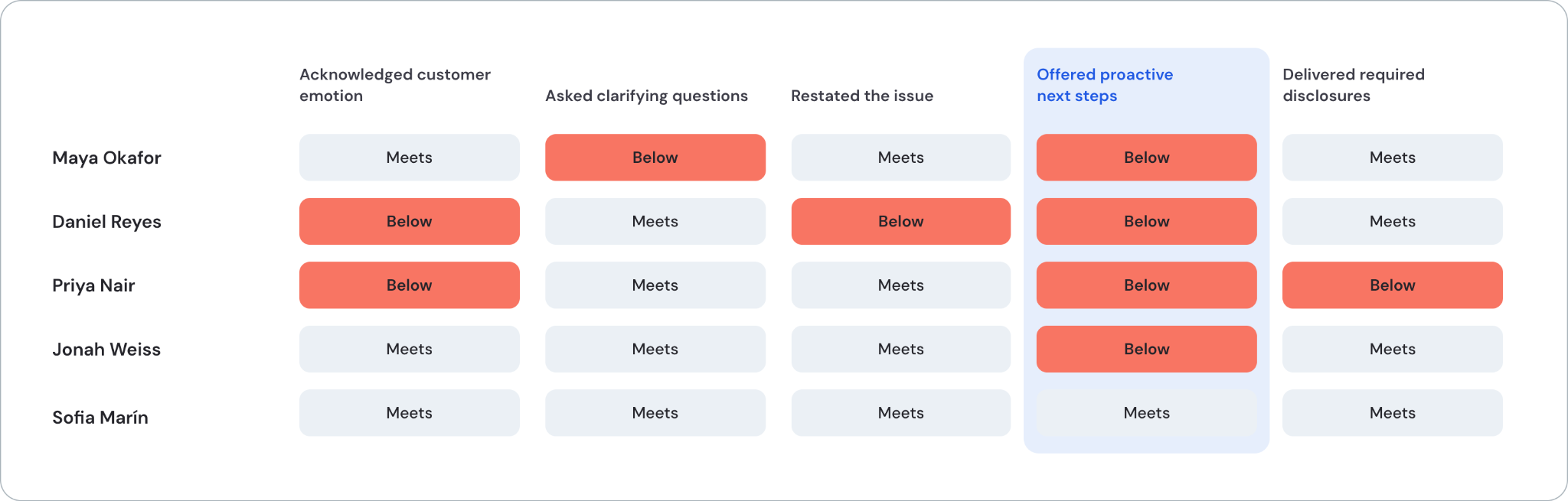
Build team-level training for it, then use scorecard data to check whether the training worked.
Image idea: coaching one-on-one agenda card
Call center agent scorecard templates
With the build process in place, the next question is what each line on the scorecard should measure.
To help you brainstorm and craft your scorecards, here are some templates you can leverage across contact center teams.
Customer service scorecard
Rather than broad categories, evaluate specific behaviors that correlate with resolution and satisfaction:
Sale scorecard
For sales conversations, focus on actions that may improve conversion and revenue.
Retention scorecard
For retention conversations, assess whether the agent uncovers risk, connects action to customer value, and builds a clear path forward.
Score every conversation and coach what matters with Cresta
Scorecards that improve performance get two things right: they score the right behaviors, and they’re easy to score at scale.
Cresta, the AI operating system for CX, lets you do both.
Conversation Intelligence analyzes 100% of conversations. And Cresta Quality Management auto-scores them against your scorecard, with calibration, audit, and appeals workflows for the reviews that still need people.
Cresta lets you put scorecard findings straight into coaching plans in Cresta Coach. And Agent Assist can augment agents with real-time guidance on those same behaviors during live calls.