
Build or buy AI support agents? Here's how to choose


- This decision has lasting consequences, since it shapes your speed to market, your control over data and customer experience, and your engineering capacity
- Build only when the agent is your edge, meaning it's your product, your workflows are unusual, and you have a mature AI team
- Most enterprises go hybrid. This involves buying the foundation and building workflows, integrations, and policies on top
Enterprise support teams around the globe are being told to deploy AI agents in chat and voice.
One of the first questions this ask precipitates is whether to build the AI agents internally with engineering resources or buy them from a vendor.
This decision has lasting consequences. It determines how quickly you can take your agents to market, how much control you keep over your data and customer experience, the amount of engineering capacity left for everything else, and more.
To help you navigate this exercise, we’ll cover the challenges of building it in-house and when each path fits.
Challenges of building AI support agents
Customer support agents are difficult to build and maintain for several reasons.
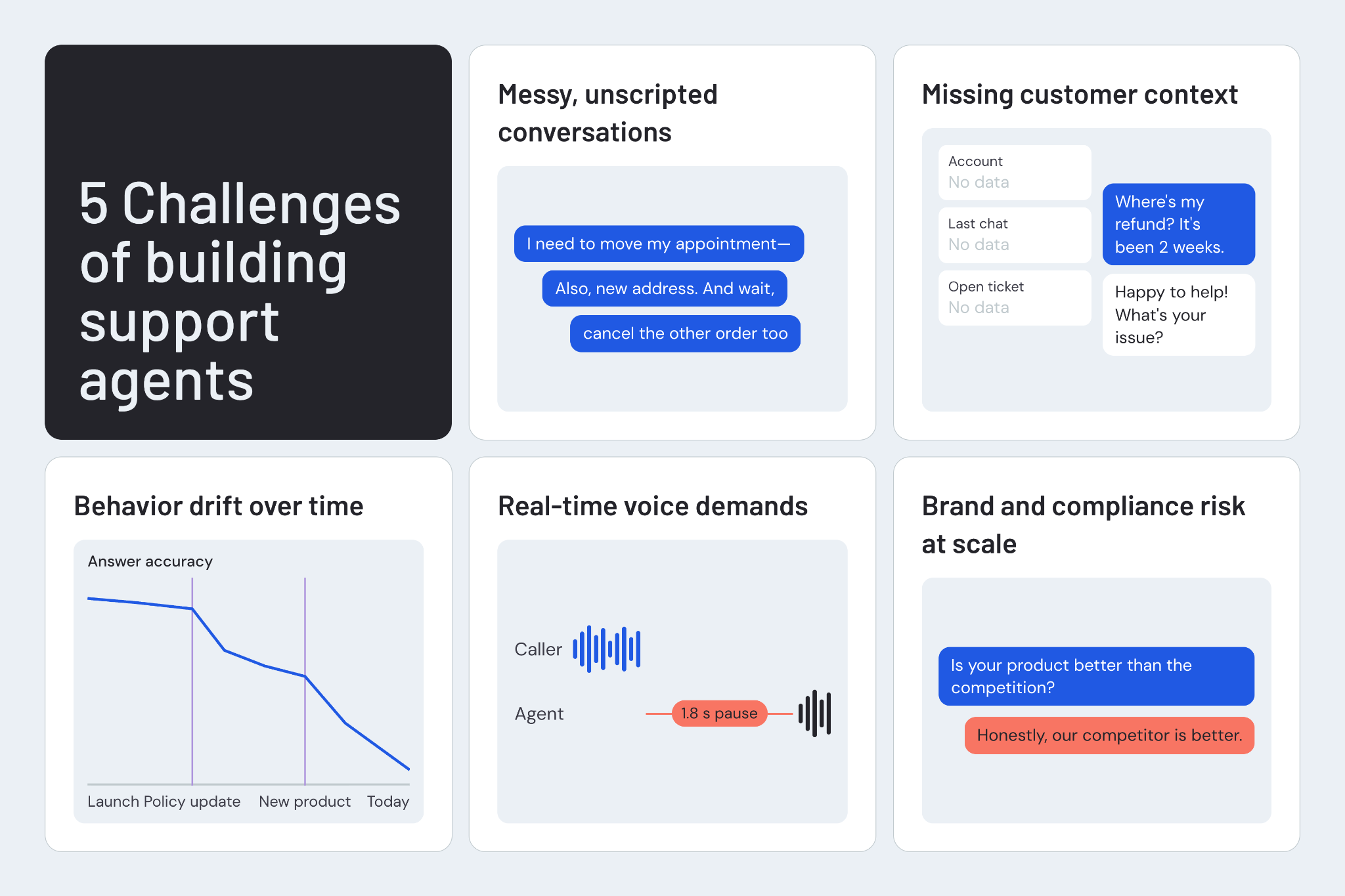
- Messy, unscripted conversations: Customers interrupt, change topics, and stack several requests into one call, which breaks agents designed around clean flowcharts
- Missing customer context: An agent that can't see the account, the last chat, or the open ticket gives generic answers that frustrate customers
- Behavior drift over time: Policy updates, new products, and shifting customer behavior quietly degrade accuracy unless someone is testing continuously
- Real-time voice demands: Live conversations leave no room for latency, awkward pauses, or mishandled interruptions
- Brand and compliance risk at scale: One off-brand or noncompliant reply, repeated across a busy support day, can quickly erode customer and regulator trust
If you build, each of these becomes a job your team owns. That's why build vs. buy for support agents is really a choice about who carries this risk.
Related: How to evaluate AI support agent platforms
What it takes to build a customer support AI agent
With the risks in view, here's what an in-house build has to cover.
Training data that reflects real support conversations
An agent learns how to behave from the examples you give. If those examples come from support scripts and help articles, it can break when a customer goes off-script.
Custom support agents work best when they're built from your own past support conversations. That means collecting call recordings and chat transcripts, labeling them, and studying what your top live agents do.
Labeling involves tagging each conversation with its intent and outcome, like "billing dispute, resolved." It can be slow, it often needs subject experts, and it usually has to be repeated as your business changes.
Voice and chat channel demands
Customer support runs on two very different channels. Each one adds its own build work on top of the agent's logic.
For a voice AI agent, you’ll need to account for:
- Telephony and CCaaS connection: The agent plugs into your phone lines, IVR (interactive voice response) menus, and contact center as a service (CCaaS) platform
- Speech recognition and text-to-speech: It turns caller speech into text and replies in a clear, natural voice that fits your brand
- Low response delay: Pauses that feel normal in chat can feel broken on a call, so every step has to respond quickly
- Interruptions and accents: Callers talk over the agent, change their minds, and speak with many accents, and the agent has to keep up
- Transfers with context: When a call moves to a live agent, the transcript and account details have to arrive with the caller
A chat agent has a different set of demands:
- Web, app, and messaging channels: The agent runs in your website chat, mobile app, and messaging apps your customers already use
- Async conversations: Customers pause, leave, and come back later, so the agent has to resume without losing the thread
- Rich actions: Chat can send links, forms, buttons, and secure payment steps that a phone call can't show
- Consistent behavior across channels: The same policy, tone, and answer should show up whether a customer calls or chats
Integrations and context across support systems
A support agent can only resolve what it can see and change.
That means you’ll need to connect it to several key systems:
- Identity tools: Confirm who the agent is talking to and what that person is authorized to access, and let it run verification steps or reset credentials before it takes any sensitive action
- CRM: Gives the agent the customer's profile, history, and preferences so it can personalize its answers, and lets it update contact details, log notes, and record outcomes
- Ticketing tool: Shows open cases and past conversations so the agent can pick up where things left off, and lets it create, update, escalate, and close tickets
- Order and billing systems: Provide the facts behind most requests, such as order status, charges, and refund eligibility, and let the agent act on them by changing orders, issuing refunds, or adjusting subscriptions
An AI agent from a CX platform usually provides many of these connectors out of the box, while a build means writing and owning each one.
Testing, guardrails, and governance
Before an agent talks to customers, you need proof that it behaves as expected across every potential scenario.
This means you’ll need to run the agent through realistic customer scenarios before it goes live.
- Regression tests: Checks that rerun after every change to confirm support flows that worked before haven't broken
- Versioning: A saved record of every agent version so you can roll back quickly when something goes wrong
- Real-time guardrails: Rules and monitoring models that block unsafe, off-policy, or off-brand replies to customers during live conversations
- Audit trails: Logs of what the agent said and did, which regulated teams often need for oversight and compliance
An AI agent platform often includes these tests out of the box, while a build means designing, tuning, and proving them yourself.
Escalation to live agents
Some support conversations need a person.
When they do, the handoff to a human agent should pass the full conversation, the customer's details, and the reason for escalation, so the customer doesn't repeat themselves.
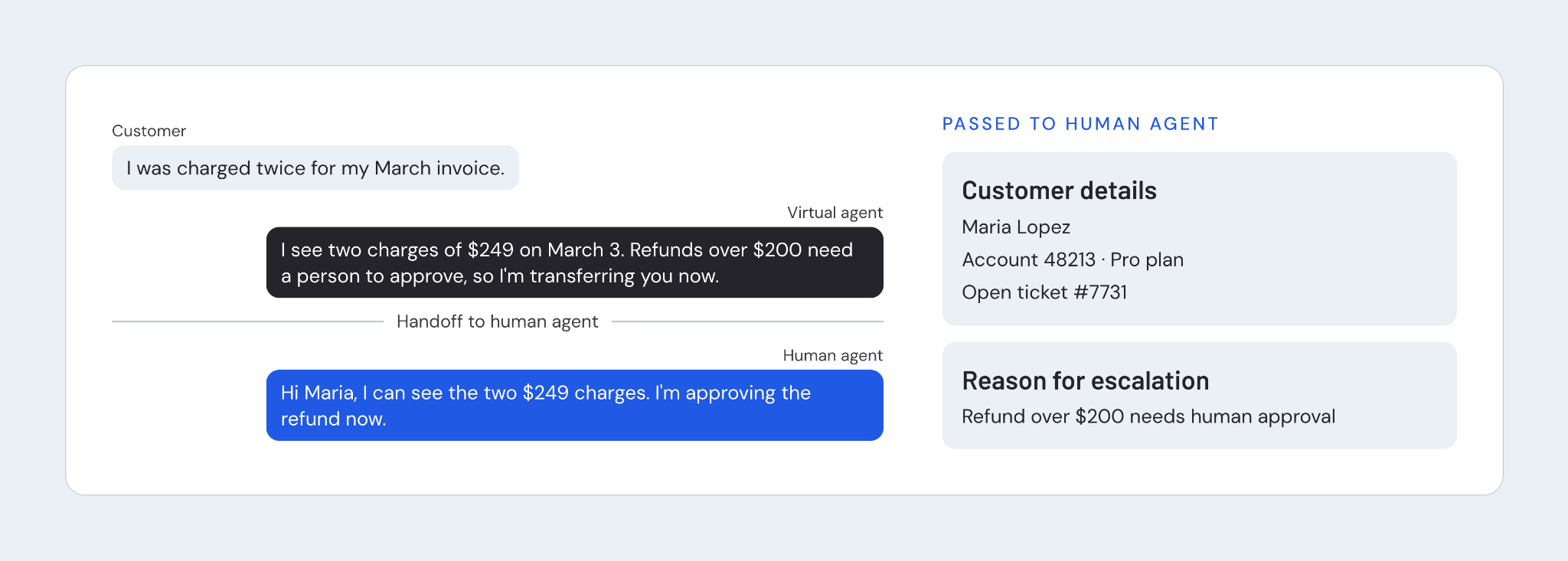
Building this means two more connections beyond the systems mentioned earlier.
The agent has to work with the routing and queues in your contact center platform so conversations reach the right team on both voice and chat. It also has to connect to your agent desktop so that context appears on the live agent's screen before they pick up.
Ongoing operations after launch
Launch is where the long-term work begins.
Someone has to tune prompts, update the agent when support policies change, and watch for drift.
Drift, which is when an agent's answers degrade over time as customers, products, or inputs change, can be especially difficult to handle in-house. It requires reviewing real conversations on an ongoing basis, finding where answers are slipping, and fixing the cause before customers notice.
This steady upkeep work is where costs also tend to creep up.
Deloitte warns that teams can face unplanned effort and cost when putting agents into operation. And because each fix competes with other projects on the engineering backlog, improvements can slow down while customers keep calling.
When building and buying make sense
All of the time and resource costs of building in-house doesn’t mean it’s the wrong approach. It’s just a choice that has to match your support goals, your team, and your timeline.
To help you better assess build vs buy, let’s cover how they perform across three paths (hybrid involves building certain components and outsourcing others) and take a closer look at when to prioritize each.
When to build
Building is typically the right choice when your support experience itself is what makes your business different.
- The agent is your product: If you sell AI-driven support as your core offer, owning the stack protects your intellectual property
- Your support workflows are unusual: Some service processes are so specific that no platform covers them, even with heavy configuration
- You have a mature AI team: You'll need machine learning engineers, conversation designers, voice specialists, and QA staff funded for the long term
If all of these are true, building can pay off. If only some are, the hybrid path is usually a better fit.
When to buy
Buying is often the better option when you need to resolve support conversations well, at scale, without becoming an AI vendor yourself.
- You face support peaks: Seasonal rushes, outages, and billing cycles need a platform that's already proven under load across voice and chat
- You're regulated and need proven controls: Regulated teams weigh control over sensitive data, which leads some to build, against needing proven guardrails, audit trails, and compliance controls
- You need value soon: Ready-made testing, guardrails, and integrations let you launch without creating each layer first
The hybrid path
You can buy the parts that don't set your support agent apart and take a long time to build from scratch, such as the phone and chat connections, speech recognition, testing, and safety controls. Then you can build the parts that make the agent differentiated, such as your support workflows, system integrations, and policies.
This compromise lets your engineers spend their time on what's specific to your customers instead of on plumbing. The vendor can also keep the foundation current as models and channels change.
Build on a proven foundation with Cresta AI Agent
Cresta, the AI operating system for CX, fits the hybrid path because it covers the foundation you'd rather not build and gives your team room to build the rest.
Cresta offers:
- A ready foundation: Cresta AI Agent resolves conversations end to end across voice and digital channels. And teams can test it before launch with Synthetic Customers and Soundcheck
- Layered guardrails and live oversight: The Agent Operations Center lets supervisors monitor live conversations, guide the agent, and take over when it matters
- Room to build on top: Technical teams get Cresta Opera for no-code orchestration, Conductor to design and debug agents, and Cresta CLI to deploy changes through release pipelines
- One shared conversation record: AI Agent doesn't work alone. Agentic Assist takes over with full context at handoff, Conversation Intelligence feeds insights back into the agent, and Deputy Agent completes follow-through like refunds and claims