
AI customer experience analytics: a complete guide for 2026


- Sampling hides what matters. Contact centers review under 2% of calls, missing the real drivers of churn and sales. AI analyzes 100% of conversations
- Conversations link behavior to outcomes. AI shows which agent behaviors drive resolution, satisfaction, and conversion, so coaching focuses on what works
- Data and ROI are the hurdles. 81% of leaders cite integration as the top barrier, and with budgets nearly flat, AI must be tied to business outcomes
Many businesses still make critical decisions from a small sample of their customer feedback. Case in point: research shows that contact centers use less than 2% of calls.
This means the feedback that holds the real reasons customers churn and the behaviors that win sales are missed. It also introduces bias: the small sample may overrepresent unusually good, bad, or atypical feedback rather than reflecting the customer experience as a whole.
You can use customer experience (CX) analytics to close that gap.
This guide covers what customer experience analytics is, the AI capabilities behind it, how to measure ROI, and the CX analytics vendors you should evaluate. But first, let’s align on what customer experience is.
What is AI customer experience analytics?
AI customer experience analytics uses AI to analyze customer interactions and feedback across the journey, revealing what customers need, how they feel, and what drives their behavior.
Most programs draw on four types of data:
- Feedback data: CSAT, NPS, and open-text comments from surveys
- Behavioral data: web activity, purchases, and product usage
- Operational data: handle time, transfers, resolution rates, and repeat contacts
- Conversation data: voice calls, chats, emails, and messages between customers and agents
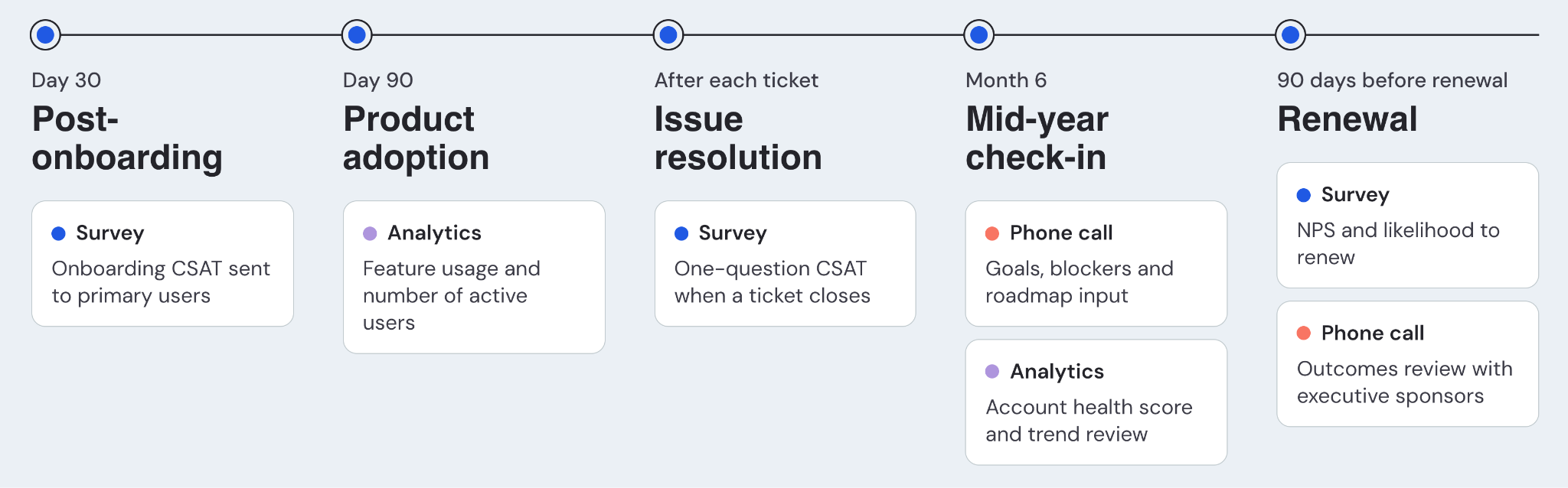
As our intro mentioned, conversation data is often the richest; it tells you why the customer called, what the agent said, and where the interaction went wrong (or right).
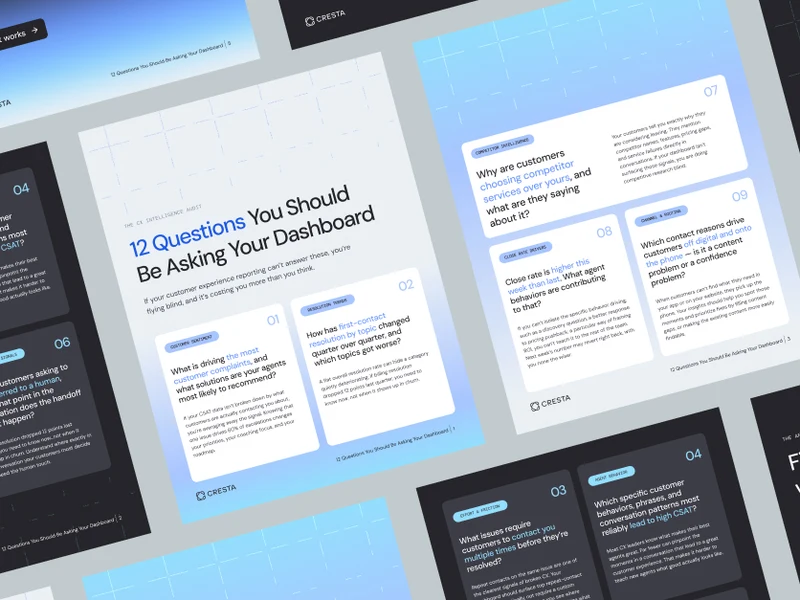
Test your dashboard with 12 questions
Why customer experience analytics matters
The cost of a poor experience is direct. According to PwC's 2025 Customer Experience Survey, 29% of US consumers stopped using or buying from a brand because of a poor customer experience. The same survey found 83% of executives say they need better tools to measure what's driving purchases.
Customer experience analytics helps teams with the above, along with other KPIs that stretch the customer journey, by enabling them to:
- Build a complete customer picture: Bring together feedback, behavioral signals, operational metrics, and customer interactions for a connected view of the experience
- Find the drivers of repeat contacts: Use repeat contacts, transfers, and resolution rates alongside calls, chats, emails, and messages to uncover recurring issues and process gaps
- Spot churn signals early: Watch for lower CSAT or NPS, negative survey comments, and shifts in web activity, purchases, or product usage as possible signals to reach out
- Turn insights into action: Translate patterns into targeted coaching, in-the-moment support, or changes to processes and customer journeys
- Coach behaviors tied to outcomes: Use customer-agent interactions to identify behaviors that support resolution, satisfaction, retention, or conversion, then focus coaching on what matters
- Measure what changes: Track operational measures such as handle time, transfers, resolution rates, and repeat contacts alongside customer feedback to understand whether improvements are working
Core capabilities of AI in customer experience analytics
AI-powered customer experience analytics have moved well beyond basic keyword tracking into capabilities that address operational challenges contact center and CX leaders face every day.
Conversation intelligence
With AI, you can analyze 100% of customer interactions across voice, chat, and digital channels. That gives managers a complete dataset instead of the small sample manual QA reviews.
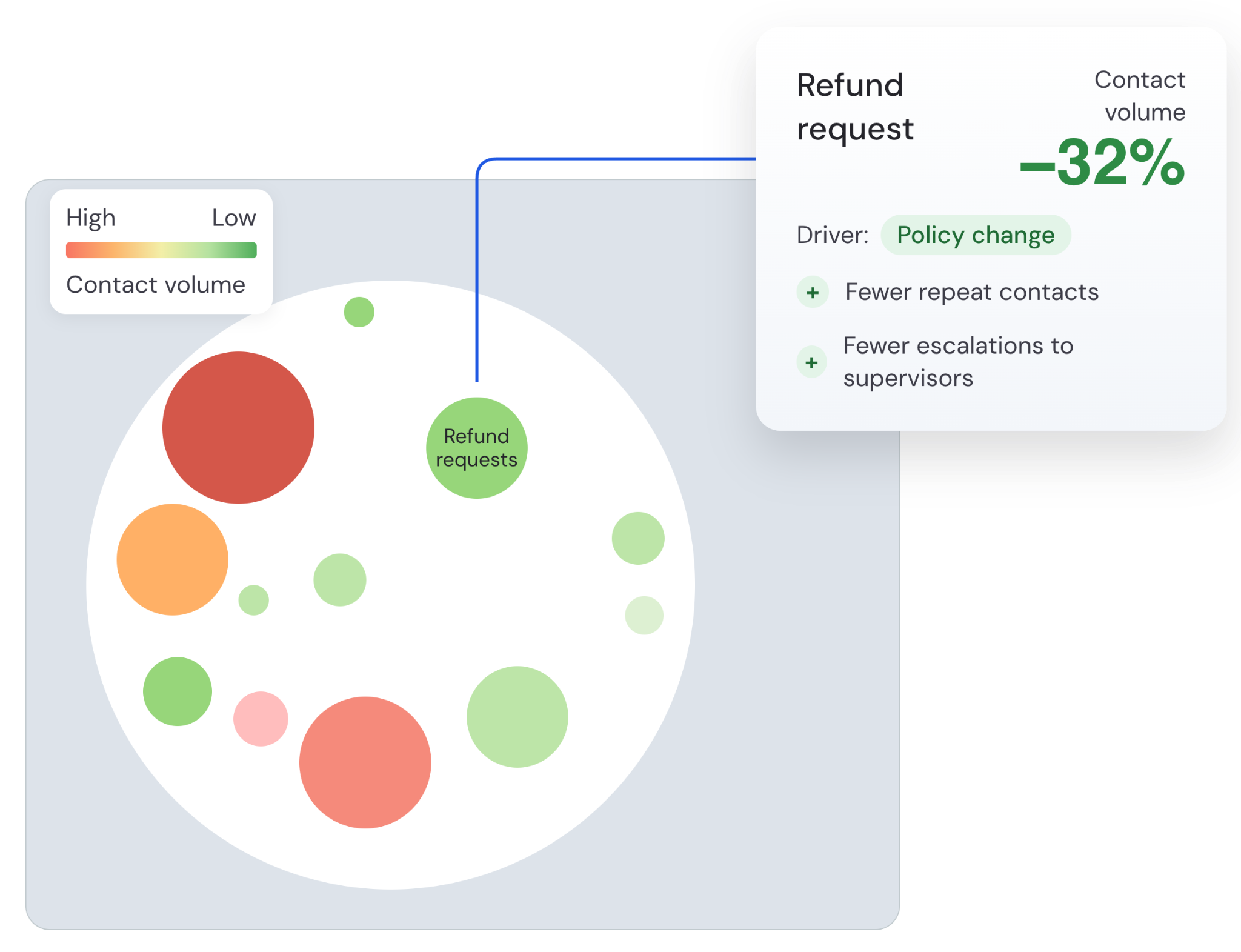
Unlike traditional speech analytics, which relies mainly on keyword spotting, conversation intelligence uses AI models to understand context, sentiment shifts, and agent behaviors. Patterns previously invisible, such as a policy change driving repeat contacts or a product issue increasing negative sentiment, become visible almost immediately.
Sentiment detection
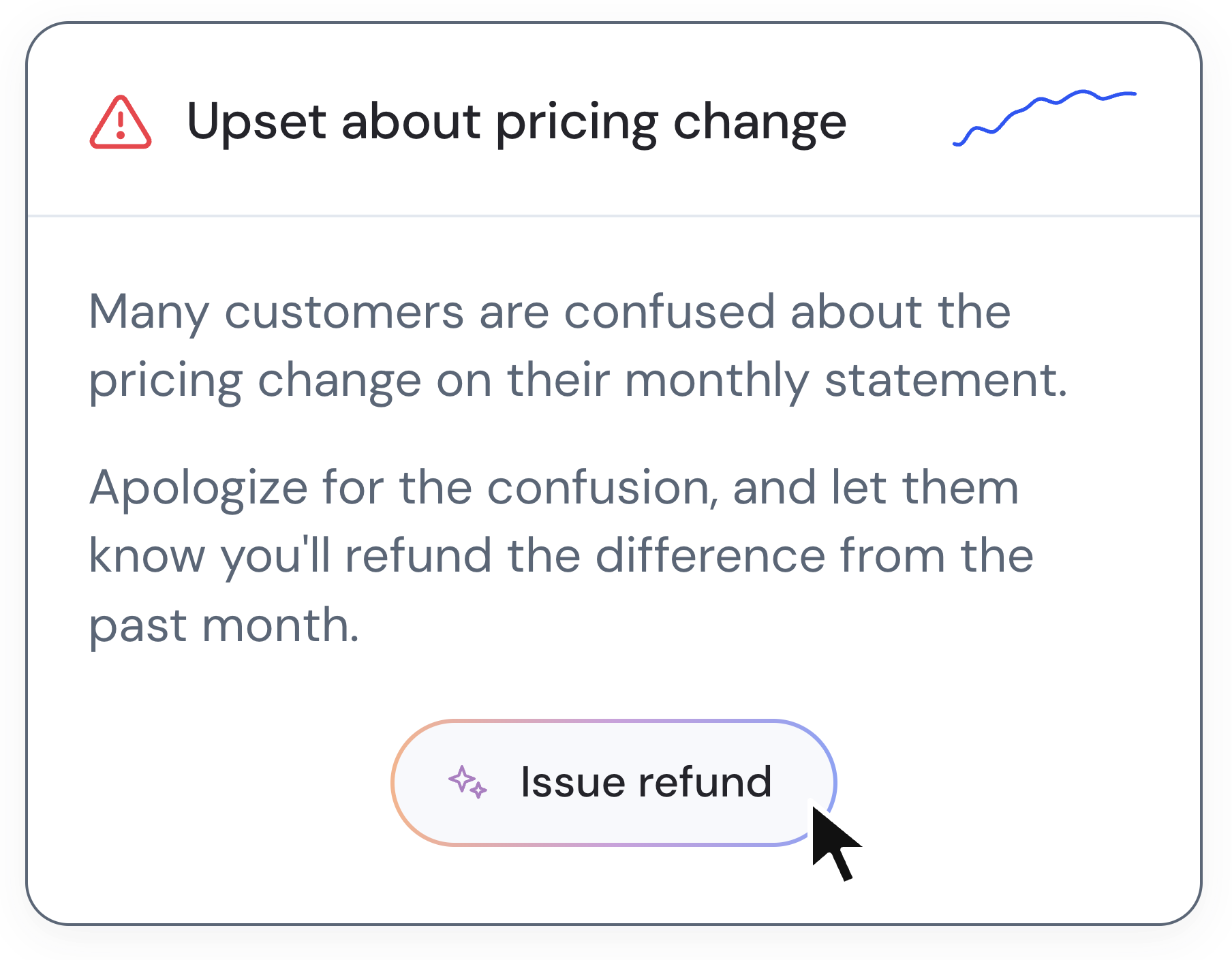
Sentiment detection analyzes conversational signals within each interaction. AI identifies shifts in customer sentiment based on content and language, and some tools recommend actions for agents in real time.
Customer sentiment often changes several times during a single interaction. Tracking those shifts gives agents and supervisors a clearer picture of what happened and where the conversation turned. Real-time analytics can also feed proactive answers and workflows to agents during live conversations.
Predictive analytics
Predictive analytics moves contact centers and CX programs from reactive to proactive.
AI analyzes historical interaction data to anticipate customer needs, predict escalations, and identify at-risk customers based on interaction patterns and sentiment trends. This gives teams time to intervene before customers decide to leave or proactively deliver a better experience.
Related: A guide to predictive CSAT
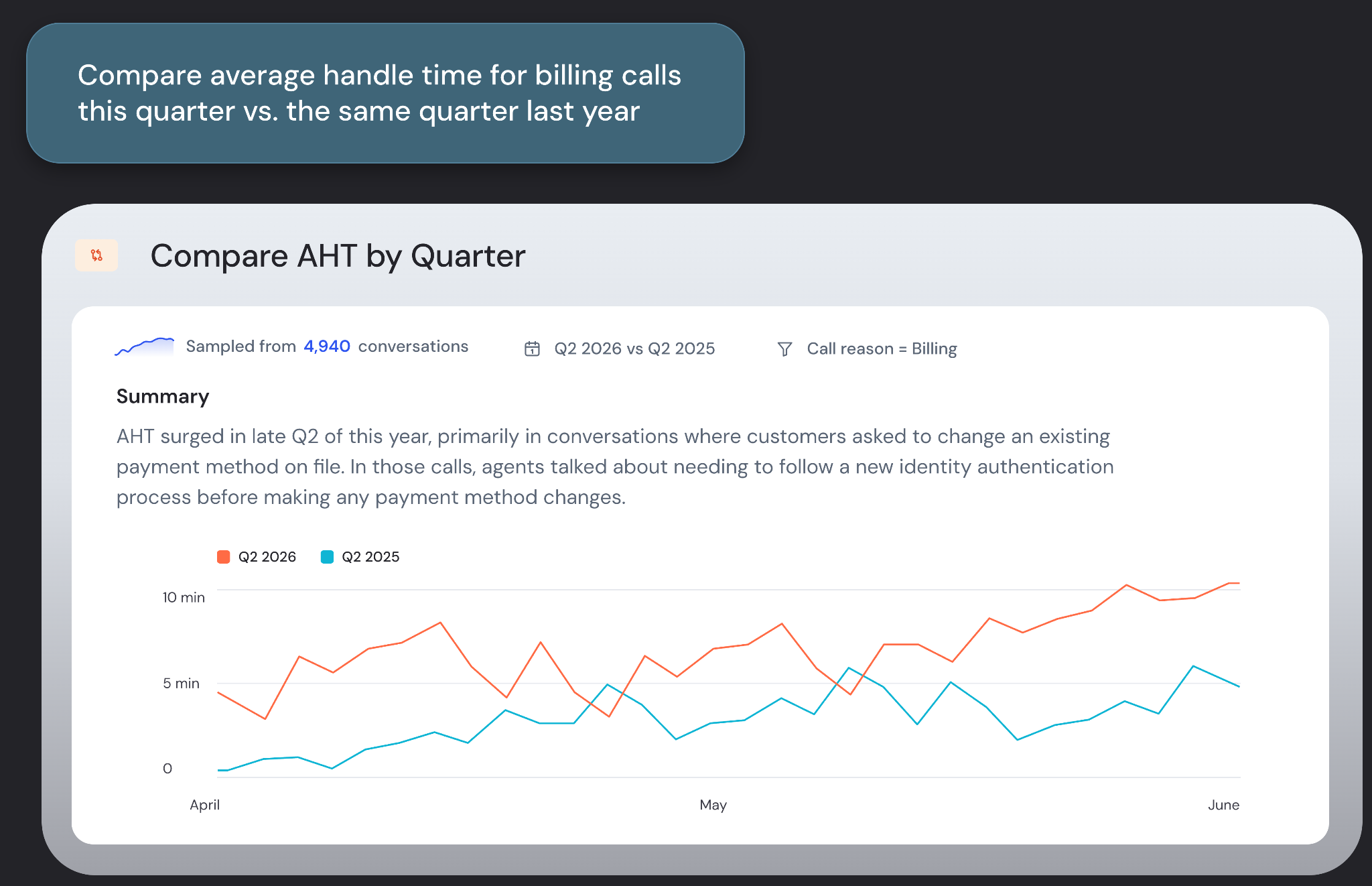
Natural language querying of conversation data
Most CX analytics workflows require analysts to define what they're looking for before they start, meaning questions nobody thought to ask never get answered.
Natural language querying removes that limitation by letting any team member ask questions across all of their customer data and get structured, evidence-backed answers in minutes.
For example, Cresta AI Analyst answers any questions with explanations and cited evidence. It also supports follow-up questions, root-cause exploration, and cross-channel comparisons without requiring a data team to rebuild a query each time.
Quality management automation
Quality management (QM) automation replaces manually scoring a tiny fraction of calls with consistent evaluation of every interaction.
Automated scoring applies the same standards to every conversation, making performance evaluations more defensible and coaching conversations more productive.
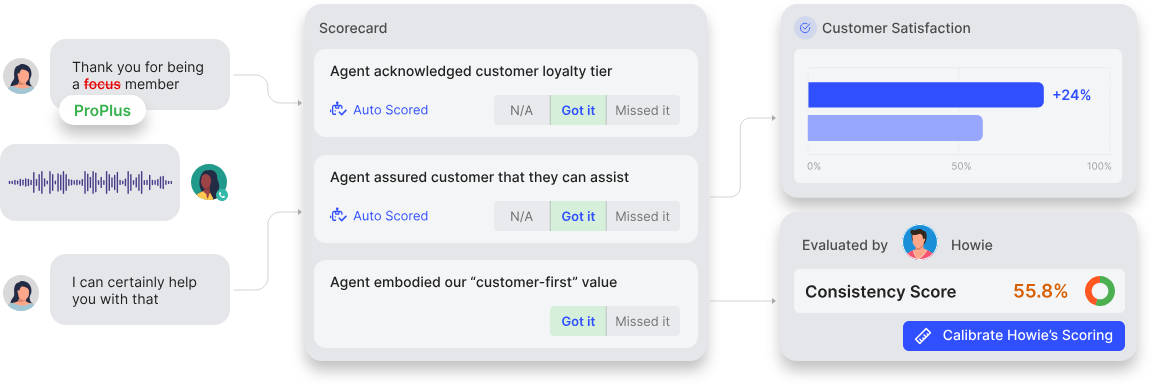
Real-time guidance and knowledge delivery can also reduce preventable errors before they appear in QM results and drastically reduce training costs.
For example, Brinks Home, a home security and alarm monitoring company, cut QM costs by 50% with automated QM and AI-driven coaching plans after deploying Cresta.
Agent performance analytics
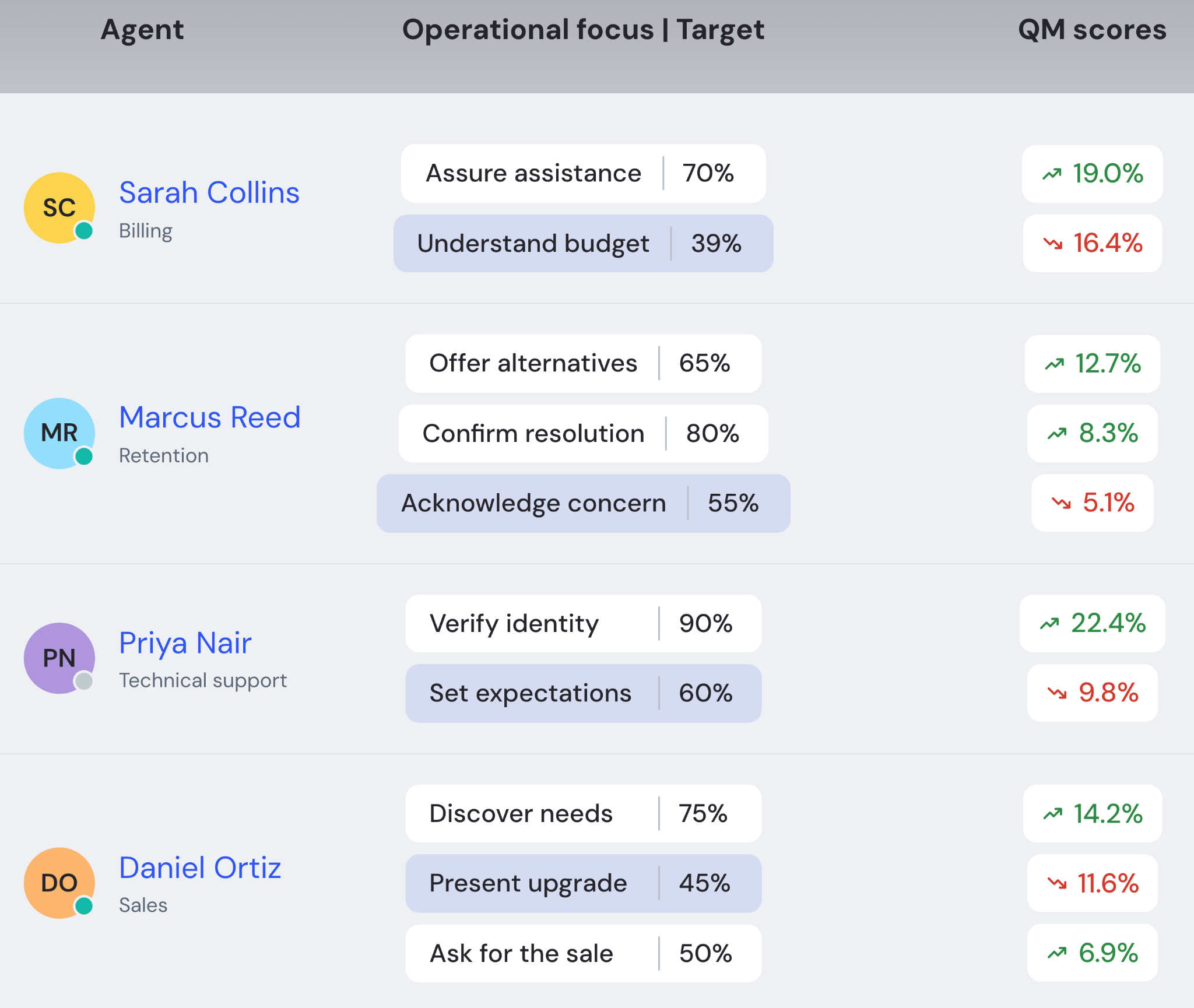
AI-powered conversation analytics can connect behaviors to outcomes. It identifies which behaviors correlate with higher resolution rates, better satisfaction scores, stronger sales conversion, etc. and which have the opposite effect.
This lets managers identify areas of improvement across their human agents and deliver more personalized coaching.
Related: How to build contact center scorecards
Challenges of using AI customer experience analytics
Unfortunately, the process of collecting, analyzing, and acting on customer data successfully with AI is easier said than done.
Here are just a few common challenges to be aware of.
Making customer data accessible and reliable
AI is only as useful as the data it can access. Poor CRM hygiene, inconsistent metadata, incomplete customer histories, and outdated knowledge bases can undermine the accuracy and usefulness of AI insights.
Integration is a major readiness hurdle. In our CX Workforce Report, which surveyed hundreds of CX leaders, 81% identified integration complexity as the top barrier to AI adoption, while only 7% said they could easily access their own conversation data.
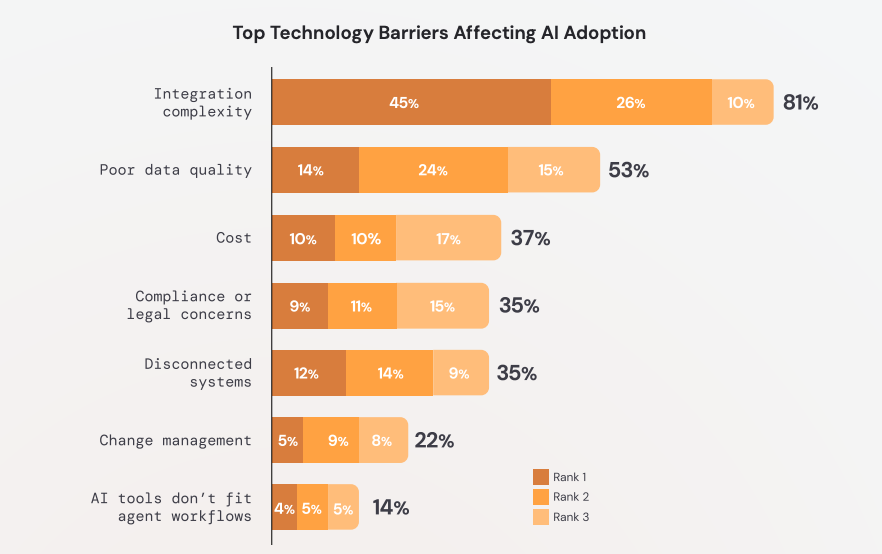
Organizations need to connect systems and establish reliable data foundations before expecting AI to deliver consistent results at scale. Otherwise, valuable conversation data remains siloed, and AI use cases are more likely to stay isolated.
Proving business value and ROI
Gartner reports that support and service teams increased their AI spending by 38% while overall service and support budgets grew by only 2%.
This means that AI is claiming a growing share of a nearly flat budget, so leaders are under pressure to show it delivers results. Many teams still can’t, because their metrics track activity and sentiment rather than business outcomes.
A strong case pairs hard ROI metrics, like lower QA costs, reduced handle time, faster agent ramp, and revenue gains, with softer benefits like satisfaction, lower attrition, and better compliance.
Preparing for more complex human work
As AI takes on routine interactions, the human queue can become more demanding.
Our CX Workforce report found that 93% of leaders say human-handled calls are becoming more complex, while 9% of conversations are fully handled by AI alone.
Agents increasingly need to handle exceptions, sensitive situations, and high-value customer moments. That requires judgment, empathy, critical thinking, and problem-solving, alongside the ability to use AI effectively.
Organizations need to update coaching, training, staffing, and escalation models to match the work that remains with people.
Leading CX analytics platforms in 2026
To help you overcome the challenges above and leverage customer experience analytics successfully, you can use a 3rd-party solution.
Here’s a breakdown of the best solutions across focus areas.
Enterprise VoC and journey analytics: Qualtrics and Medallia
For established, survey-led Voice of the Customer programs, Qualtrics and Medallia belong on the shortlist. They offer mature CX platforms with baseline journey views and pre-contact agent context.
Qualtrics and Medallia are a natural fit for organizations running survey-led VoC programs that need journey views and pre-contact agent context.
Analytics within an established CCaaS suite: Genesys and NICE
When continuity with an existing contact-center platform is the priority, evaluate Genesys and NICE. They are mature CX incumbents with customer-journey capabilities, including journey views and pre-contact context.
Genesys or NICE are ultimately ideal when you’re standardized on one of those platforms and want analytics close to contact-center workflows.
Conversation intelligence and coaching: Cresta
Cresta is the best fit when the goal is to analyze customer conversations and operationalize what the analysis reveals. Insights from Conversation Intelligence can guide Quality Management and Cresta Coach, while Agent Assist and AI Agent workflows help teams apply those learnings in live customer interactions.
Pick Cresta when you want analytics, guidance, and automation working from a shared context (100% of your customer conversations).