
12 examples of call center coaching feedback that improve performance


- Most call center coaching feedback fails because it's too vague. "Improve your tone" or "lower your handle time" doesn't tell an agent what to do differently on the next call
- Effective feedback ties a specific behavior from a real call to a measurable outcome, so the agent leaves with a repeatable technique
- Different call types need different coaching. De-escalation calls need feedback on empathy, while troubleshooting calls need feedback on clear, step-by-step explanations
- Timing matters as much as specificity. Feedback delivered days later feels abstract, so coach while the call is still fresh
Call center coaching feedback only changes behavior when it's specific.
Compare "be more empathetic" with "When the customer said she'd been transferred twice, you went straight to account verification." The second version points to a moment the agent can replay and fix.
To help you consistently give feedback agents can act on, we'll review what call center coaching feedback is and what makes it work. Then we'll walk through 12 call center coaching feedback examples across positive, constructive, AI-informed, and situational scenarios to help you navigate any situation.
What is call center coaching feedback?
It’s specific, evidence-based guidance a supervisor gives a human agent about a real conversation. It names what the agent did, explains the effect, and suggests what to repeat or change on the next call.
.png)
Call center coaching feedback will only matter more as AI handles routine contacts. Case in point: In our 2026 CX Workforce Report, 93% of 300 CX leaders say human-handled calls are getting more complex.
What makes call center coaching feedback work
Before a supervisor can start giving feedback, they need to separate feedback that sticks from feedback that's forgotten.
Effective contact center coaching feedback combines four elements:
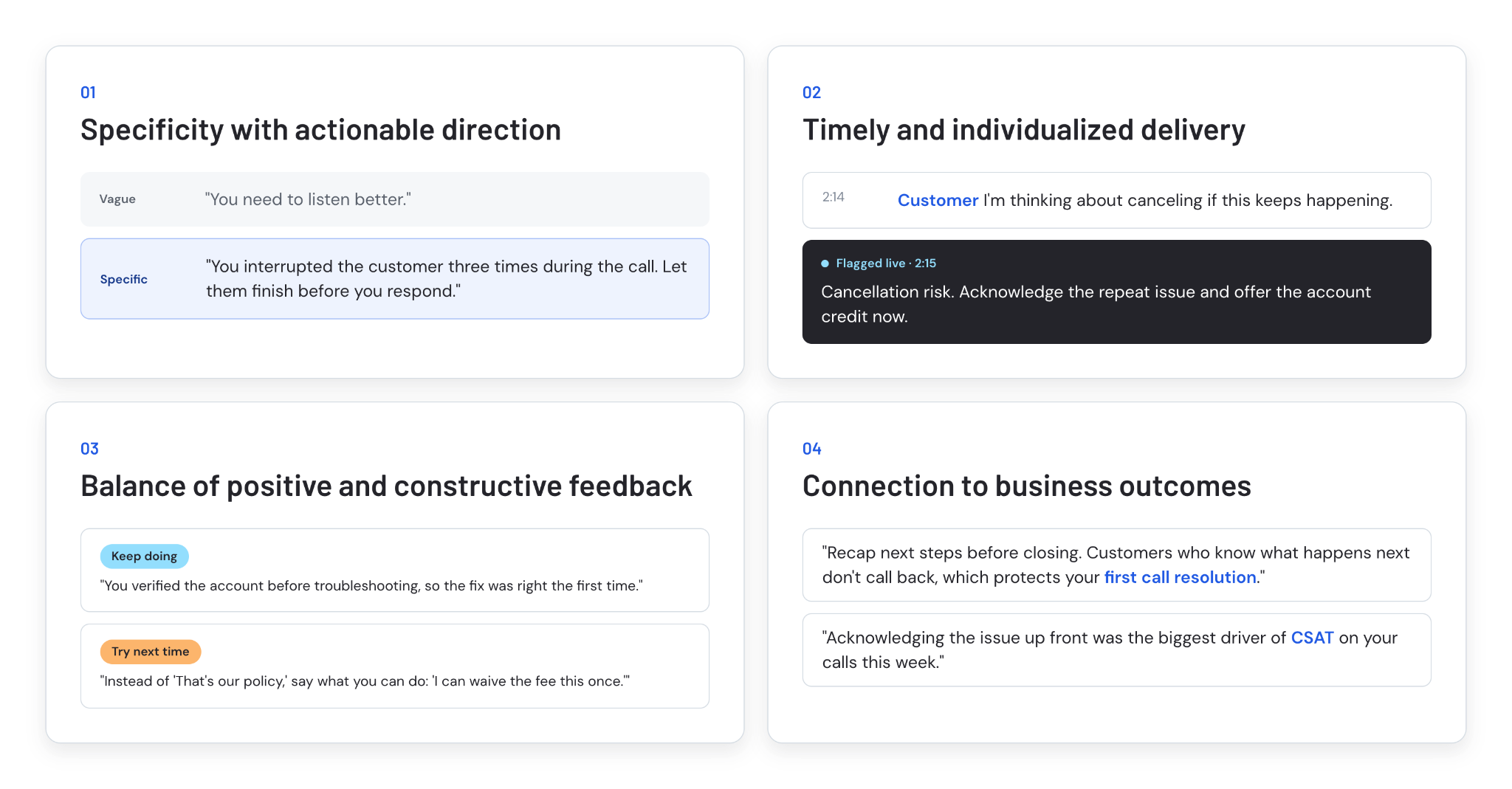
- Specificity with actionable direction: Feedback needs to reference observable behaviors from actual conversations, not general impressions. "You interrupted the customer three times during the call" is actionable, while "You need to listen better" isn't
- Timely and individualized delivery: Feedback delivered days after a conversation feels abstract. Fortunately, agent assist tools can flag coachable moments in real time, when the context is fresh and the behavior can still be corrected
- Balance of positive and constructive feedback: Recognizing effective behaviors reinforces what works. Constructive feedback names the gap and offers a specific alternative
- Connection to business outcomes: Agents need to know why a behavior matters, so tie feedback to CSAT, first call resolution, or compliance
Call center coaching feedback examples
With those elements in place, here's what effective feedback sounds like across four common coaching situations.
Positive coaching feedback examples
Positive feedback is the easiest place to start, because it tells agents which behaviors to keep. Make praise as specific as criticism. Name the moment, the behavior, and the result.
Taking ownership of a multi-step fix
On yesterday's call about the duplicate charge, you told the customer, "I'll stay on the line until this is fixed," and you did. You checked the billing system, confirmed the refund, and summarized next steps before ending the call. That ownership is why the customer didn't need to call back.
Showing empathy on a cancellation call
When the customer said she was canceling because of a family move, you paused the retention offer and said, "I'm sorry, moving is a lot to manage." She relaxed, stayed on the line, and agreed to transfer service to her new address. Keep leading with acknowledgment before offers.
Delivering a required disclosure naturally
On your Tuesday sales call, you read the required disclosure word for word but kept it conversational. You said, "Before we finalize, there's something I'm required to share with you," and the customer stayed engaged. That's a clean way to stay compliant without sounding scripted.
Related: How to create a call center agent performance scorecard
Constructive coaching feedback examples
Constructive feedback works the same way, but it pairs each gap with a specific alternative the agent can try on the next call.
Leaving customers in silence during holds
At the 4:30 mark, you put the customer on hold for almost two minutes without an update. When you came back, they asked whether they'd been disconnected. Next time, check in every 30 to 45 seconds with something like, "Thanks for waiting, I'm still pulling up your order history."
Using jargon the customer doesn't know
When you explained the outage, you said "the node is degraded" twice, and the customer asked what that meant. Try plain language instead, such as "the equipment that serves your street isn't working right now." Before ending the call, ask, "Does that make sense?" to confirm they understood.
Skipping a verification step
On this morning's account-change call, you updated the mailing address before completing the security questions. Even when the caller sounds legitimate, that step protects the customer and the business. Let's practice explaining verification so it feels routine, like "I just need to confirm a couple of details first."
AI-informed coaching feedback examples
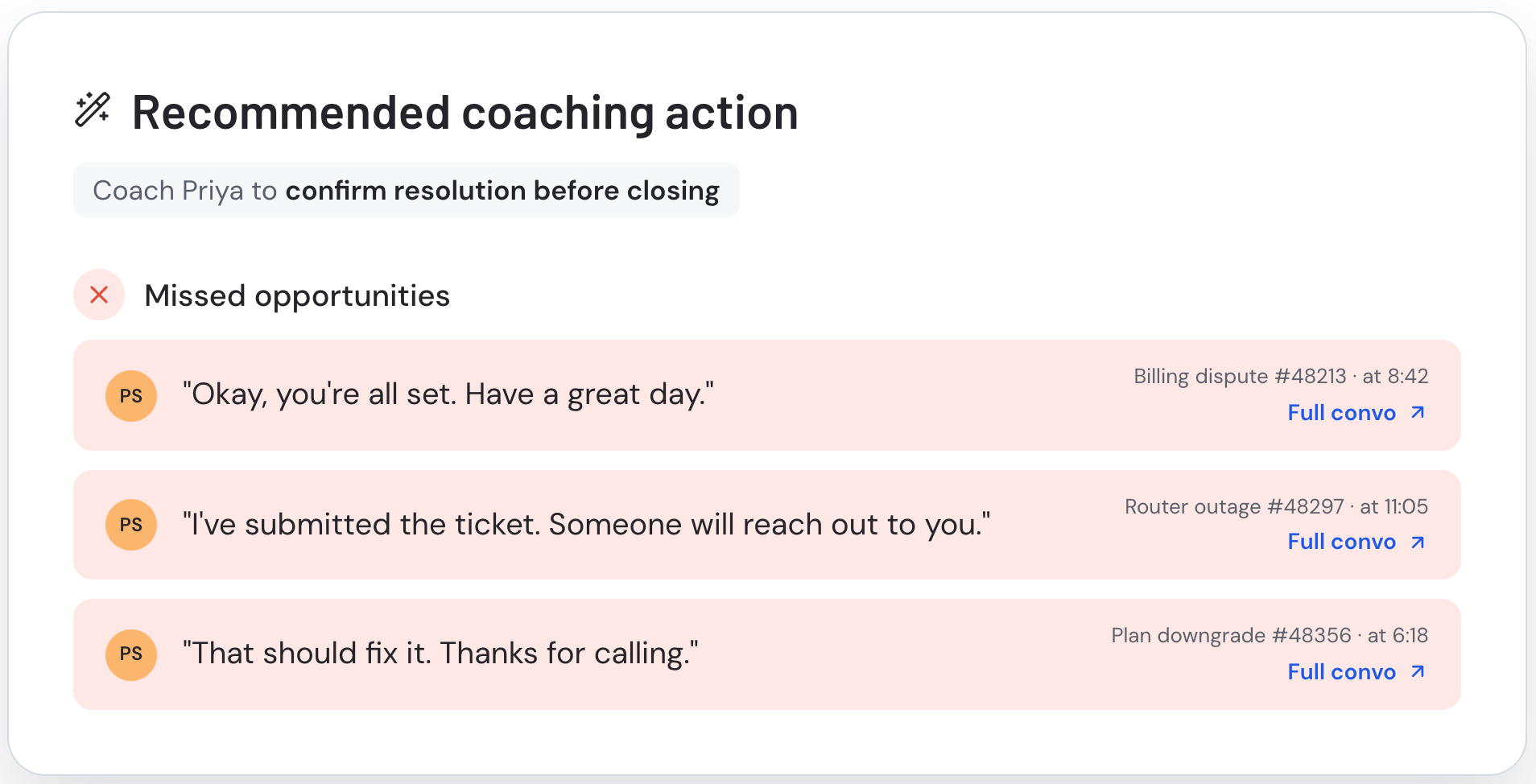
The examples so far depend on a supervisor finding the right call. AI-informed coaching tools remove that constraint by auto-scoring every conversation for compliance and performance and flagging the biggest opportunities across their agents.
Supervisors can even ask the AI tool follow-up questions to see the exact calls where the coaching moments happened.
Behavior pattern discovery
Your first-call resolution rate is significantly higher on billing questions than on technical troubleshooting.
Let's listen to a few of your strongest billing calls and pinpoint what you do there, like gathering information upfront. Then we'll apply the same approach to technical issues. Building on strengths you already have could improve your technical call outcomes.
Outcome correlation insights
When you use phrases like "I can hear this is urgent for you" during escalations, your CSAT scores are significantly higher than when you skip that acknowledgment.
Notice the call recording from Tuesday where you used that phrase and how the customer's tone shifted within seconds. That simple phrase creates a measurable impact.
Consistency gap identification
Your opening greeting compliance is significantly higher during morning shifts, but drops during afternoon shifts after 3 PM. You're still delivering great outcomes, but this consistency gap could affect quality scores.
Let's talk about what changes in the afternoon, whether that's call volume, complexity, or fatigue, and build a strategy to maintain your morning performance throughout the day.
Related: How to scale quality management across every conversation
Situational coaching feedback examples
The examples above show how to structure feedback. The content still needs to match the situation, because each call type tests different skills.
Angry customer calls demand coaching focused on de-escalation techniques and empathy communication, while complex troubleshooting calls require coaching centered on technical knowledge delivery and clear step-by-step guidance.
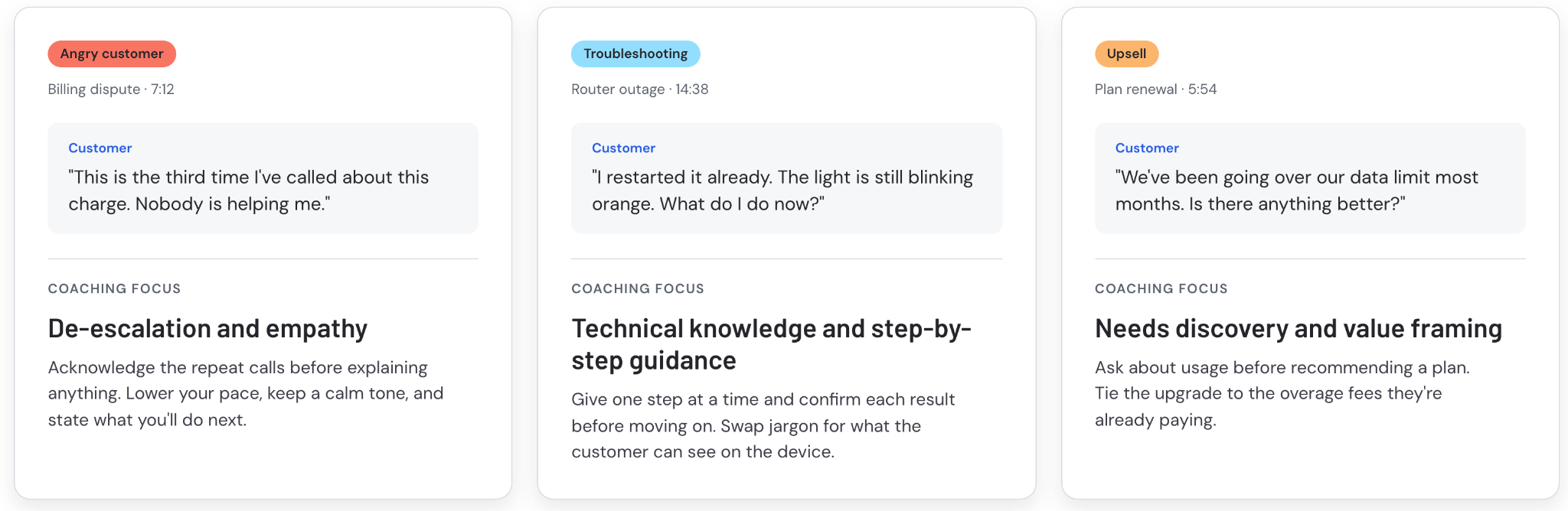
We’ll go over common scenarios that call for specific techniques.
Angry customer scenario
Let's listen to this call together. When the customer raised their voice about the delayed refund at the 2:15 mark, your response, "That's our policy," came across as dismissive. I noticed the customer's tone got even more heated after that.
Agents who acknowledge the customer's frustration directly and offer to explore an expedite consistently see better outcomes in these situations. Something like "I understand your frustration about waiting 7 days for your refund. Let me check if we can expedite this for you" is what that looks like in practice.
Complex troubleshooting scenario
I reviewed your troubleshooting call from yesterday regarding the network connectivity issue. You did an excellent job checking the customer's router settings systematically. One opportunity for improvement is when you discovered the issue was on the customer's end, you moved quickly to the solution without explaining why.
Explaining the underlying cause adds a little handle time, but it helps prevent a repeat call on the same issue.
Upsell opportunity scenario
Great job resolving the customer's billing question efficiently. When the customer mentioned they're working from home three days a week, that was a perfect opening to mention our upgraded internet package.
Here's how you could transition naturally:
"Since you're working from home regularly, have you experienced any slowdowns during video calls? Our business-class package includes priority bandwidth that many of our remote workers find valuable."
You don't have to push. Just plant the seed.
Related: How to improve first call resolution
Turn every conversation into a coaching opportunity with Cresta
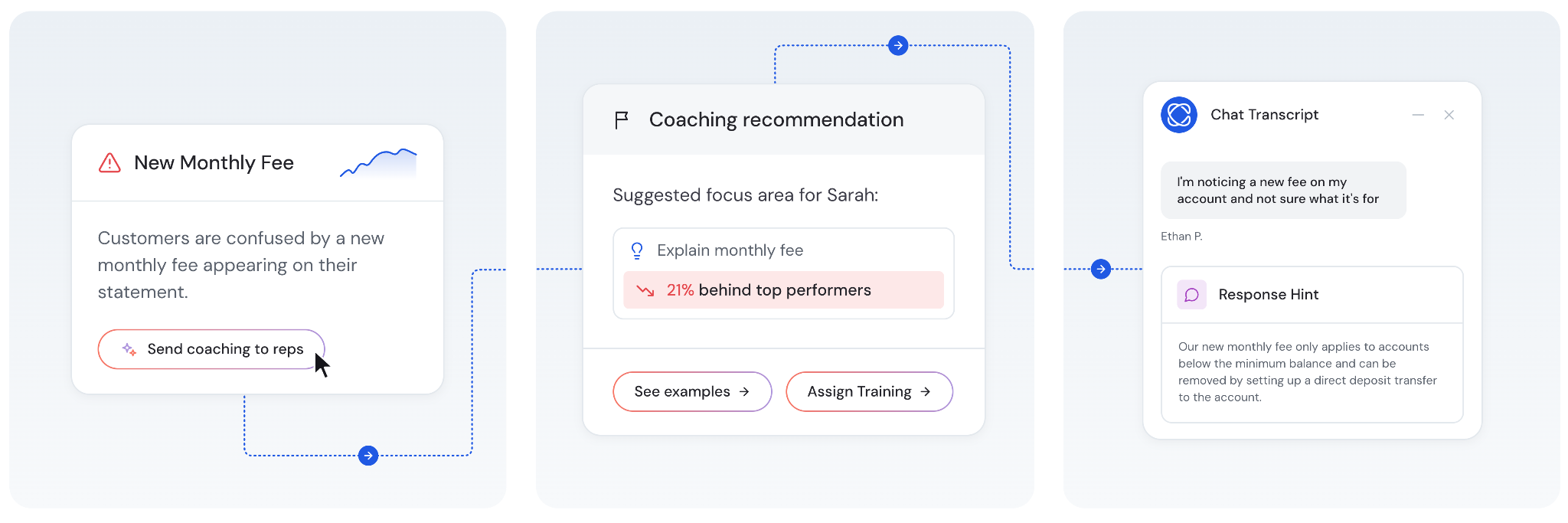
Delivering this kind of feedback at scale takes a platform that connects analysis, coaching, and in-the-moment guidance.
Cresta, the AI operating system for CX, offers Conversation Intelligence to analyze 100% of conversations, and Cresta Quality Management auto-scores each one so coachable moments surface without manual sampling.
Cresta Coach turns those insights into targeted coaching recommendations for each agent and reports on which coaching changes behavior. And Agentic Assist augments agents with real-time guidance, so they can apply coaching during live calls.
The largest and most innovative companies across industries rely on Cresta to train and enable human agents. CVS Health for example went from scoring 5% of calls to 100% with Cresta, enabling predictive CSAT on every conversation.
Request a demo to see how Cresta can make every conversation a coaching opportunity at your call center.