
What is Conversation Mining and How to Use It


• Contact centers generate thousands of conversations every day that contain valuable intelligence about what frustrates customers, what top agents do differently, and where processes break down. Conversation mining is how organizations extract that intelligence at scale rather than leaving it buried in recordings no one reviews.
• Sample-based review leaves the vast majority of conversations unanalyzed. Conversation mining analyzes 100% of interactions automatically, making patterns visible that would stay hidden until they surface as compliance violations, customer churn, or coaching opportunities that arrived too late.
• The insights only matter if they reach the right people at the right time. The guide covers how findings flow to quality managers as coaching recommendations, to supervisors as real-time alerts during live conversations, and to agents as in-the-moment guidance while the outcome can still change.
• Compliance monitoring is one of the clearest use cases. Reviewing 2-5% of calls means violations in the remaining 95% go undetected until a customer complaint or regulatory audit surfaces them. Full coverage catches missed disclosures and prohibited language as they happen rather than weeks later.
• The operational value extends beyond the contact center floor. When conversation mining surfaces patterns across thousands of interactions, it reveals the upstream self-service failures, policy gaps, and product issues driving unnecessary contact volume in the first place.
Contact center leaders face a visibility problem that seems absurd when you stop to think about it. Your team handles thousands or tens of thousands of customer conversations every week, yet traditional quality management evaluates only 2-5% of those interactions. The other 95-98%? A complete blind spot hiding critical customer issues, compliance risks, and improvement opportunities.
Traditional QA made sense when manual review was the only option. Organizations built sampling methodologies that balanced coverage with available analyst time, accepting that they could only spot-check a fraction of what actually happened. But the approach leaves modern organizations making decisions based on incomplete information about what really happens when agents talk with customers.
This article covers what conversation mining actually means, how the technology works through capture, analysis, and action phases, where it delivers the biggest ROI, and how to make it work for your organization.
What is conversation mining?
Conversation mining is an AI-powered analysis of customer interactions across voice, chat, email, and messaging channels to extract actionable insights. The technology uses natural language processing (NLP), machine learning, and speech recognition to automatically identify patterns, sentiment, compliance indicators, customer feedback, and performance metrics across your entire interaction dataset.
The established market category, according to Forrester, is "conversation intelligence," which emphasizes using interaction data to recommend next-best actions. Rather than sampling conversations and hoping you catch important patterns, conversation mining processes everything to show what actually drives performance, revenue, and satisfaction.
Here's what this looks like in practice. A health insurance contact center handles 200,000 calls monthly. Traditional quality management (QM) samples around 2-3% of those calls for manual review, producing aggregate quality scores but missing almost everything else.
Conversation mining, on the other hand, analyzes all 200,000 interactions automatically, discovering that thousands of calls mention a specific claim-processing issue that frustrates customers, identifying the agents who consistently resolve it on the first call, and surfacing the exact language those successful agents use so everyone else can replicate it.
See what 2M+ hours of conversation data showed us
How conversation mining works through capture, analysis, and action
Conversation mining operates through a systematic three-stage process that transforms raw customer interactions into actionable findings.
1. Capture everything
Modern conversation intelligence platforms capture 100% of customer interactions across every channel where customers reach you. Speech recognition AI trained on contact center audio automatically transcribes voice calls, while live chat and messaging platforms feed their transcripts directly into the system. Additionally, email exchanges flow through the same pipeline.
The capture phase happens automatically without manual intervention or selective sampling. Modern platforms integrate with your existing telephony, chat, and email systems to capture conversations as they happen, converting speech to text with high accuracy when models are fine-tuned on your specific audio quality and business vocabulary.
2. Analyze for patterns and findings
AI and natural language processing examine captured data to identify patterns, sentiment, topics, and operational findings across your entire conversation volume. The analysis goes far deeper than simple keyword spotting.
Advanced systems understand customer intent, meaning they recognize why customers contacted you even when they describe issues in different ways. Sentiment analysis detects frustration and satisfaction signals as conversations unfold, giving supervisors visibility into customer experience and feedback in real time.
The same system verifies regulatory adherence and script compliance automatically, while assessing agent performance based on actual behaviors and outcomes rather than supervisor observations of a handful of calls. When unusual patterns emerge across conversations, the platform surfaces them before they explode into major problems.
This happens through multiple specialized models working together. One model might identify when customers express frustration, another flags required compliance disclosures, and a third recognizes when agents successfully overcome objections. The analysis runs automatically across every conversation, building aggregate insights that reveal opportunities across your entire organization.
3. Act on what you discover
The insights only matter if you actually do something with them. The system delivers insights to different stakeholders in formats aligned with their roles.
Quality managers see prioritized coaching recommendations tied to specific behavior patterns, while supervisors get real-time alerts when live interactions need intervention. Agents themselves receive guidance in the moment, exactly when it can change the outcome of a conversation.
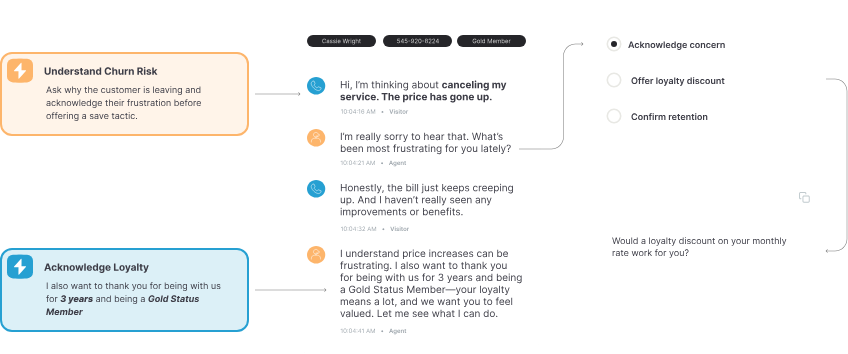
Beyond the contact center floor, the data reshapes how other teams work. Training programs get rebuilt around the actual gaps and opportunities the analysis reveals rather than assumptions about where agents struggle.
Product teams gain a direct line into customer friction, seeing detailed feedback on defects, feature requests, and experience issues that would otherwise stay buried in call recordings that nobody has time to review.
The same insights also inform AI agent design. When you can see exactly how top performers handle specific situations and which behaviors drive resolution, sales, or satisfaction, you can build AI Agents that replicate those patterns. Rather than programming automation based on outdated SOPs, leaders use real conversation data to design AI Agents that handle interactions the way their best human agents do.
Cresta's platform shows how these phases work in practice. The system auto-scores every conversation for compliance and performance, identifies what distinguishes top performers through AI-powered behavior tracking, and delivers coaching recommendations backed by actual conversation evidence. Supervisors spend less time manually reviewing random call samples and more time acting on insights that move metrics.
4 benefits of conversation mining that actually move your numbers
Organizations implementing AI-powered conversation analysis document substantial improvements across quality management, agent efficiency, customer satisfaction metrics, and better AI agent design.
1. Quality management costs drop dramatically
When you shift from manual sampling to automated analysis, organizations achieve comprehensive coverage while dramatically reducing the labor hours QM teams spend listening to calls. Your QM analysts move from mechanical call grading to higher-value work like calibration, coaching support, and identifying systemic issues.
Oportun, a mission-driven fintech serving 2 million members, faced exactly this challenge with limited QM resources and largely untapped data from their sampling-based approach. After implementing Cresta Conversation Intelligence, they achieved 100% QA coverage while cutting their QM workload in half.
Their quality managers now spend time on analysis and coaching rather than manually listening to random call samples, uncovering compliance risks and improvement opportunities that their previous 2-5% sampling completely missed.
2. Agent efficiency improves through targeted coaching
The improvement comes from targeting coaching based on actual performance data rather than generic training. According to Cresta's State of the Agent Report, personalized AI coaching is nearly 3x more effective than one-size-fits-all coaching. That effectiveness gap shows up in retention too: 91% of agents receiving personalized coaching report being happy at work, compared to just 57% with standard approaches.
Given how directly agent satisfaction correlates with attrition, that 34-point happiness gap has real cost implications for organizations constantly cycling through recruitment and training.
Systems identify behaviors correlated with successful outcomes and show managers which agents need help with which skills. This addresses a critical gap in most contact centers. Per CCW Digital's study, while 93% of leaders say the ability to train and coach agents is essential for supervisors, only 14% believe their supervisors will demonstrate these competencies within 6 months.
Conversation mining closes that gap by identifying which behaviors correlate with successful outcomes and showing managers exactly which agents need help with which skills.
New hires benefit even more dramatically. AI-powered coaching cuts typical onboarding time from four weeks to two, getting agents to full productivity faster while freeing experienced team members from extended shadowing and mentoring duties.
3. Customer satisfaction rises through better execution
Better coaching and compliance monitoring matter, but the bigger CSAT impact comes from catching problems before they spread. When you're analyzing every conversation, you spot a confusing policy change frustrating customers in the first week rather than the first quarter. You see a product defect generating repeat contacts before it affects thousands of customers. The visibility lets teams address root causes rather than treating symptoms one escalation at a time.
Snap Finance saw this play out during a period of 40-50% year-over-year growth. The consumer financing provider needed to scale operations without proportional headcount increases, which typically means service quality suffers.
Instead, after implementing Cresta's platform, they increased customer satisfaction by 23% while reducing average handle time by 40%. They automated 100% of their QA process and increased their deflection rate from 6% to 33%, handling more volume with better outcomes because they could finally see what was actually happening across every interaction.
4. AI Agent design improves through real conversation data
Most AI agent vendors ask for your SOPs and turn them into automation. The problem is that those SOPs are often completely divorced from how your best agents actually handle conversations. Top performers find shortcuts, adapt to edge cases, and resolve issues in ways that documentation never captured.
Conversation mining closes that gap. When you can see exactly which behaviors drive resolution, sales, or satisfaction across thousands of real interactions, you can build AI agents that replicate what actually works rather than what a process document says should work. The same insights that power coaching for human agents become the foundation for AI agents that handle routine interactions the way your best people do.
This matters because AI agents built on real conversation patterns achieve better outcomes from day one. They handle the situations your customers actually bring, using approaches proven to work in your specific context.
Where conversation mining delivers the most value
Six core use cases have been validated through industry deployment for conversation mining in contact centers.
Automated quality management
Automated QM replaces manual sampling with 100% interaction scoring. Organizations can now analyze patterns across all conversations instead of extrapolating from tiny samples, eliminating the visibility gap that previously hid coaching opportunities and compliance vulnerabilities.
Holiday Inn Club Vacations, a resort company with 28 properties across the U.S., struggled with limited visibility into agent conversations. Their legacy tools required an external request process just to get call recordings, which meant any coaching came weeks after the conversation happened.
After implementing Cresta, managers gained immediate visibility into performance patterns across their 500+ agents, enabling real-time coaching that drove a 30% increase in bookings conversion and cut agent attrition in half.
Real-time agent coaching
Traditional coaching happens days after a conversation, when the context has faded, and the feedback feels abstract. Real-time guidance flips that model by delivering support exactly when agents need it, during the interaction itself.
This is what agents actually want. According to Cresta's State of the Agent Report 2024, 65% of agents want to use real-time AI hints and suggestions during customer interactions, and 81% say they perform better because of the technology available to them. The gap between that demand and current reality is significant: the same research found that less than half (49%) of agents report receiving effective on-the-job coaching today.
Cresta Agent Assist addresses that gap by surfacing behavioral guidance, knowledge articles, and compliance reminders at the right moments, turning every conversation into a coaching opportunity rather than waiting for a scheduled session that may never come.
Compliance monitoring and risk management
Sample-based QA creates real compliance exposure. When you're reviewing 2-5% of calls, violations in the other 95%+ go undetected until a customer complaint or regulatory audit surfaces them. Conversation mining makes compliance monitoring comprehensive by automatically flagging missed disclosures, detecting prohibited language, and tracking regulatory requirements across every interaction.
The value is clearest in heavily regulated industries. Financial services organizations use it to monitor TCPA and FDCPA compliance while verifying script adherence on collections calls. Snap Finance, mentioned earlier, specifically valued the ability to monitor 100% of calls from both a quality and compliance perspective in real time.
Healthcare contact centers validate HIPAA requirements across all patient interactions with the same comprehensive coverage. The shift from "spot-check and hope" to complete visibility fundamentally changes the risk profile.
Customer journey analysis
Customer journey analysis maps actual experiences by analyzing 100% of customer interactions. You can identify where customers struggle, which self-service attempts failed before they called, and what happens after the conversation ends. With customer experience (CX) analytics built on every interaction, teams discover recurring issues, process bottlenecks, and product problems that sampling-based approaches miss.
Behavior tracking and replication
Every contact center has top performers, but most organizations can't explain exactly what those agents do differently. They might handle objections better, ask different discovery questions, or use specific language that builds trust. Without visibility into 100% of conversations, these patterns stay invisible, locked in individual performance rather than becoming organizational capability.
Conversation mining fixes this by correlating specific behaviors with outcomes like sales conversion, first-call resolution, and customer satisfaction. Once you can see what actually drives results, you can systematically replicate those approaches across the team.
Brinks Home, one of North America's largest home security companies, saw this dynamic firsthand. After implementing Cresta's platform, they identified friction points in customer interactions that their previous approach had completely missed. Within six weeks, transfer rates dropped from 30% to 8%, average handle time (AHT) fell by 8%, and NPS increased by 30 points.
The gains came from finally seeing what was happening across every conversation and replicating what worked.
AI agent design
Conversation mining helps leaders answer two critical questions before deploying AI agents: what should we automate, and how should the AI handle those interactions?
For the first question, analyzing 100% of conversations reveals which interaction types are straightforward enough for automation based on actual complexity patterns, not assumptions. You can see where human agents resolve issues quickly and consistently versus where they need judgment, creativity, or empathy to navigate difficult situations.
For the second question, conversation mining surfaces the specific behaviors, language, and workflows that drive successful outcomes in those automatable conversations. Instead of guessing how an AI agent should respond, you extract what already works from thousands of real interactions.
The insights continue after deployment, too. Ongoing conversation analysis shows where AI agents succeed, where they struggle, and how human agent techniques can inform continuous improvement.
Making conversation mining work for your organization
Your contact center generates thousands of customer conversations every month that contain answers to your most pressing questions. Which process changes would actually reduce handle time without degrading satisfaction? What specific agent behaviors drive revenue versus just activity? Where are compliance violations happening that nobody catches during sampling? Those answers already exist in the conversations happening right now.
Cresta delivers conversation mining at enterprise scale through a platform structured around three pillars that share data, models, integrations, and governance. Named a Leader in The Forrester Wave for Conversation Intelligence (Q2 2025) with the highest score in the Current Offering category, the platform connects analysis, real-time guidance, and automation in a single system.
Cresta Conversation Intelligence analyzes every interaction to surface what actually drives performance, with capabilities including AI Analyst for natural language queries, predictive CSAT scoring, and Outcome Insights that correlate behaviors with results.
Cresta Agent Assist delivers real-time guidance during live conversations so agents can act on those insights in the moment. And Cresta AI Agent handles routine interactions autonomously, with containment rates ranging from 58% to 84% across enterprise deployments, freeing human agents for the complex work where they add the most value.
The platform ties it all together by correlating specific behaviors with outcomes, then translating those patterns into coaching and guidance that scales across your entire operation.
Visit our resource library to learn more about how conversation mining transforms contact center operations, or request a demo to see how the platform works with your existing infrastructure.