
Conversational AI for Call Scoring: Complete Guide for 2026
.avif)

• Most contact centers score only a small fraction of calls, which means coaching is built on a biased, incomplete sample. AI-powered call scoring evaluates 100% of conversations and closes that gap entirely.
• Scoring more calls only matters if the scorecard is measuring the right things. The guide covers how to validate scoring criteria against actual business outcomes like customer satisfaction, resolution, and revenue rather than internal process assumptions.
• There's an important distinction between real-time scoring and post-call scoring. The guide explains how each works and when each approach delivers the most value for different contact center needs.
• Agent trust is a make-or-break factor in rollout. Teams that treat scoring as a surveillance tool stall out, while those that tie it to evidence-based coaching and bring agents along from the start see lasting behavior change.
• The goal is a closed loop where insights from one call translate into better handling of the next, connecting scoring to coaching workflows and real-time guidance rather than just adding more data to a dashboard.
Most contact centers grade only a small fraction of their calls, and the coaching notes from those reviews often arrive too late to shape the next conversation. Before deploying Cresta, Vivint could listen to fewer than 1% of its calls (roughly 30 out of 5,000 per day) before adopting AI-powered conversation intelligence. That's where the case for conversational AI call scoring begins.
Contact centers build every coaching and compliance decision on that sliver of data, creating a structural limitation, not just a resourcing problem. This guide covers where traditional QM falls short, how AI call scoring works in practice, what to evaluate in a platform, and how to get deployment right.
Why traditional quality management falls short in contact centers
Traditional QM gives only a small subset of agents feedback in any given review cycle, and that pattern repeats every month. The shortcomings of this approach show up in three reinforcing ways. Each one limits what supervisors can see, and together they explain why traditional QM struggles to drive real performance change.
Coverage gaps leave blind spots
Contact centers devote real budget to quality monitoring but still review only a small fraction of conversations. The calls that go unexamined contain patterns, compliance gaps, and coaching opportunities that stay invisible. And because the reviewed sample is so small, a single missed behavior on one call rarely surfaces as a trend, even when it's happening on hundreds of others.
Sampling bias distorts the picture
Even within that limited coverage, the selection process introduces its own problems. Random monitoring treats every call the same, but calls vary by type, complexity, and customer intent. When QM analysts choose which calls to grade, cherry-picking compounds the problem further.
QM scores and customer outcomes don't always align
Coverage and sampling are not the only issues. Traditional scorecards tend to measure whether agents followed internal procedures rather than whether customers left satisfied. Contact centers may grade agents highly on behaviors that have no proven link to actual outcomes. This disconnect means the scores feel arbitrary to agents, and coaching based on those scores feels equally arbitrary.
These problems add up to a process where supervisors spend more time preparing to coach than actually coaching. The result is that finding, listening to, and grading calls takes longer than coaching the conversations themselves.
How conversational AI call scoring actually works
Manual review does not scale across the volume of conversations a contact center handles each month, and the gap between what supervisors can listen to and what actually happens on the floor only widens as call volume grows. Conversational AI closes that gap by stacking several technologies on top of each other, each one building on the layer before it.
Automatic speech recognition (ASR)
The process starts with ASR, which converts call audio into text in real time or after the call ends. Transcription accuracy varies across accents, audio quality, and industry-specific vocabulary. That variance matters because sentiment detection, behavioral scoring, and summarization all start with the transcript. If the words are wrong, everything built on top of them is wrong too.
Natural language processing (NLP)
Once a transcript exists, NLP interprets what was actually meant, not just what was said. AI-driven QM platforms flag compliance risks, detect negative sentiment, and identify moments where agents could benefit from coaching, all based on meaning and context. This is what separates conversation intelligence from keyword spotting.
Behavioral pattern scoring
Understanding meaning, however, is only useful if the platform can tie it to results. Generative AI scores agent behaviors against known business outcomes instead of simply matching keywords. The feedback gets specific enough to show each agent exactly where to improve and what to change. Cresta uses this approach so that managers can see, for example, which discovery questions correlate with higher close rates and then coach agents to ask them.
Generative AI summarization
With behaviors scored, the next challenge is making sense of all that data at scale. Generative AI produces post-call summaries and evaluations from transcripts at a volume no manual team could match. Beyond documenting what happened, it assesses things like whether the agent addressed the root cause or just the surface complaint, criteria that keyword-based tools could never evaluate.
Real-time vs. post-call scoring
These technologies can operate at two different points in the conversation lifecycle. Real-time scoring surfaces guidance and compliance alerts during the conversation itself, while post-call scoring produces full quality evaluations and coaching inputs afterward. The strongest platforms do both, because an agent needs different help mid-call than a supervisor needs during a coaching session.
Test what your scores can explain by asking these questions
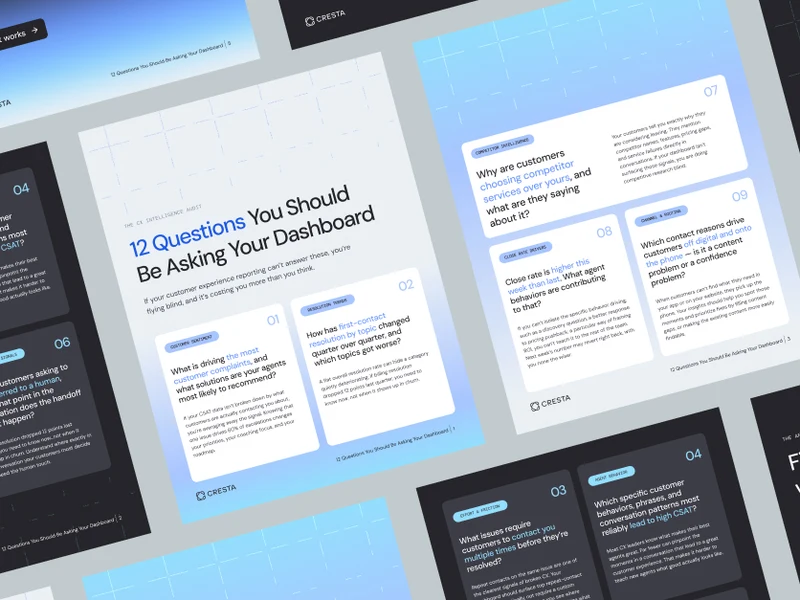
The impact of scoring 100% of calls instead of a sample
Full-coverage scoring changes what leaders can act on. Instead of inferring patterns from a fraction of conversations and waiting weeks to see whether coaching landed, they can work from the complete picture in near real time.
When every call gets scored, guessing ends. Managers can see which specific behaviors correlate with faster resolution, then build coaching around those findings and measure whether agents actually adopt the behavior.
The shift toward full-coverage scoring reflects a broader industry trend. According to the CCW Digital Market Study (January 2024), 92% of contact center leaders prioritize agent assist and AI for knowledge management as their top AI investment to improve employee experience. That priority reflects how clearly these leaders see the gap on the floor every day.
The numbers from companies already using this approach back up that investment. Snap Finance increased deflection from 6% to 33% after deploying Cresta. That kind of impact shows what becomes possible when scoring and coaching cover the full volume of conversations instead of a sample.
What to look for in an AI call scoring platform
Most AI scoring platforms can transcribe and tag calls. Fewer can tell you which of those tagged behaviors actually changed a customer outcome, and fewer still close the loop back to coaching. That's where evaluations tend to get stuck. A dashboard scores every call but doesn't help a supervisor decide what to do on Monday morning.
These four capabilities are worth pressure-testing in any platform demo.
Scoring accuracy and outcome correlation
The platform should show which agent behaviors actually predict satisfaction, resolution, and revenue, not just check whether agents followed a script. Cresta's Outcome Insights does this by analyzing which behaviors appear in high-performing conversations and which are absent from poor ones. Supervisors see a ranked list of behaviors worth coaching, not a generic scorecard built from assumptions.
Coaching integration
Accurate scores only matter if they lead to action. Scoring data that never reaches a coaching conversation is data that never changes anything. Look for closed-loop workflows that track whether agents actually improved on specific behaviors after receiving feedback.
According to Cresta research, only 49% of agents report receiving effective on-the-job coaching. Personalized AI coaching is nearly 3x more effective than one-size-fits-all approaches. Cresta Coach generates AI-powered recommendations personalized to each agent and tracks the impact of coaching plans over time.
Real-time guidance
Scoring and coaching workflows address performance over time, but agents also need support during the conversation itself. Real-time guidance puts suggestions, knowledge, and compliance reminders in front of agents while the interaction is still happening. Cresta Agentic Assist provides behavioral hints and compliance alerts during live calls.
Compliance monitoring
Finally, no evaluation of an AI scoring platform is complete without considering compliance. The calls that go unreviewed in traditional QM represent a structural compliance blind spot, and full-coverage scoring closes that gap.
Oportun reached 100% QM coverage with Cresta and reduced QM workload by 50%, giving the team more capacity to act on insights instead of spending hours assembling them.
How to deploy AI call scoring successfully
Rollouts that stall rarely fail because of the technology. The scorecard was never validated, the agents were never brought along, or the timeline assumed software would do work that only people and process changes can do. Four practices make the difference.
Validate your quality framework first
Before configuring any scoring model, map each existing scorecard item to a documented business outcome. One common example is the industry habit of requiring agents to use a customer's name three times per call, a behavior never grounded in empirical research. Items that cannot connect to outcomes are candidates for removal.
Build agent trust early
With a validated framework in place, the next priority is earning buy-in from the people the system will evaluate. AI scoring programs fail most often when agents experience them as surveillance. At the same time, resistance is easy to overstate.
According to Cresta's State of the Agent Report (2024), 65% of agents want to use real-time AI hints during customer interactions, and 75% actively seek more visibility into the data used to judge their performance. Involving agents in evaluating AI accuracy during testing builds confidence and supports adoption.
Plan for a realistic timeline
Even with agent trust established, results will not appear overnight. Successful AI deployments depend mostly on people and process changes, with algorithms and data infrastructure playing smaller roles. The most meaningful improvements take six to twelve months to materialize. Contact centers that expect faster results from technology alone tend to stall.
Calibrate continuously
The work does not end once the system is live. AI models trained on historical data will drift as products, policies, and customer expectations change. Comparing AI evaluations against human assessments must become a standing process, not something the team does once during launch and never revisits.
Close the loop between call scores and agent performance
The fundamental problem with traditional quality management is not a lack of standards. It is that the process rarely connects what it finds to measurable improvement. When scoring ties agent behaviors to actual outcomes, supervisors stop coaching from assumptions and start coaching from evidence.
Cresta's platform supports that shift by linking full-conversation scoring to coaching workflows and real-time agent guidance, so insights from one call translate into better handling of the next. That closed loop is what earned Cresta recognition as a Leader in The Forrester Wave™ for Conversation Intelligence Solutions for Contact Centers, Q2 2025, receiving the highest score in the Current Offering category.
Ready to see how full-coverage scoring, outcome-based coaching, and real-time guidance can work together in your contact center? Request a demo to explore how Cresta closes the loop between call scores and agent performance, or visit the resource library for case studies, research reports, and best practices from teams already making the shift.
Cresta is dedicated to helping businesses of all sizes make informed decisions. We adhere to strict editorial guidelines to ensure that our content meets and maintains our high standards.