6 Best Voice AI Agents for Telecom & Utility Providers
.avif)
.jpg)
• Telecom and utility contact centers face a specific combination of pressures that general-purpose voice AI wasn't built for: unpredictable volume spikes during outages, complex billing systems that require deep integration, and customers who churn when they hit friction.
• Deep integration with BSS and OSS infrastructure isn't optional in these industries. A voice AI agent that can't access billing systems and network diagnostics in real time can't actually resolve the interactions that matter most.
• Response latency is a practical evaluation criterion that demos often hide. Noticeable lag kills call quality in voice interactions, so testing under realistic call loads with actual system integrations is essential before committing to a platform.
• What happens after escalation is where most platforms fall short. More than half of customers report having to call back multiple times, and broken handoffs between AI and human agents are a major driver of that repeat contact problem.
Billing inquiries often spike when rates change. Call volumes surge during outages with little warning and strain your staffing. Customers who encounter high friction when contacting their provider tend to churn at higher rates. Amid these operational challenges, agents are toggling between many applications, making it challenging to handle a single interaction efficiently. Phone calls still comprise roughly two-thirds of inbound contact center interactions according to the ContactBabel CX guide.
For providers trying to absorb this volume without proportionally scaling headcount, voice AI agents are a cost-effective lever to add capacity. The question is which platform fits the operational reality of telecom and utility environments. Here are six worth evaluating alongside what to look for and where the tradeoffs lie.
Before comparing platforms, it helps to ground the evaluation in what actually matters for these sectors.
Integration with billing and operational systems
Telecom and utility operations depend on complex BSS (business support system) and OSS (operations support system) infrastructure. A voice AI agent needs access to billing systems and network diagnostics in real time to effectively handle routine customer inquiries about billing and payments. The same applies to outage status. If your contact center lacks a unified view of the customer across channels, that gap becomes a dealbreaker when AI agents cannot pull the data needed to actually resolve issues.
Full quality monitoring coverage
Regulated industries cannot afford the costly compliance blind spots that come with reviewing only a small fraction of interactions. Agents may miss required disclosures, and service quality can drift without anyone noticing when monitoring relies on random samples. Platforms should score every interaction automatically and flag compliance risks in real time.
Post-handoff visibility
Even well-designed AI agents will escalate a meaningful percentage of conversations to human agents, particularly for complex billing disputes or technical troubleshooting. The ContactBabel CX guide found that 53% of customers report having to call back multiple times "very often" or "fairly often," and broken handoffs between AI and human agents only make that worse. Platforms that lose visibility at the escalation point create blind spots in the customer journey and prevent organizations from identifying where the full interaction breaks down.
Low-latency voice performance
Voice interactions expose delays immediately. Customers expect responses fast enough that conversations feel natural, and noticeable lag causes higher call abandonment and frustration. When evaluating platforms, test actual response times under realistic call loads rather than relying on vendor-reported benchmarks or demos that don’t use system integrations.
The 6 best voice AI agents for telecom and utility providers
Platform capabilities change frequently. This evaluation reflects information available as of February 2026.
At-a-glance comparison
| Platform | Best Fit | Unified CI + AI Agent + Agent Assist | 100% Automated QM | Post-Handoff Visibility | Telecom/Utility Focus |
|---|---|---|---|---|---|
| Cresta | Enterprises wanting one platform across AI and human agents | Yes | Yes | Yes | Horizontal with telecom deployments |
| Cognigy | Structured, on-rails workflows | No | No | Limited | Horizontal |
| Google CCAI | Teams already on Google Cloud with engineering capacity | No | No | Limited | Horizontal |
| Kore.ai | Self-service deployments in banking, healthcare, retail | No | No | Limited | Not telecom or utility specific |
| SoundHound (Amelia) | Utility-specific workflows like outage triage | No | No | Limited | Utility integrations |
| Oracle Utilities Customer Platform | Existing Oracle Utilities Customer Cloud customers | No | No | Limited | Utility-specific |
1. Cresta
Cresta provides a unified AI platform where Cresta AI Agent, Agentic Assist, and Conversation Intelligence share data, models, integrations, and governance. Cresta was named a Leader in the Forrester Wave report, scoring highest in Current Offering with top marks across 16 criteria. Cox Communications saw a 20-30% increase in revenue per chat for residential sales and reduced new hire ramp time by two weeks after deploying Cresta Agentic Assist and Cresta Coach across its digital channels.
For telecom and utility environments, the connection between conversation intelligence and AI agent design matters most. Automation Discovery analyzes real conversations to identify which topics are strong automation candidates before any AI agent gets built. After deployment, the Agent Operations Center provides centralized monitoring with four layers of enterprise guardrails, and quality management scoring applies to both AI-handled and human-handled interactions.
After AI escalation, the platform continues supporting human agents through real-time behavioral hints and compliance reminders while Knowledge Agent surfaces relevant information, meaning visibility does not end at the handoff point.
2. Cognigy
Cognigy uses a hybrid rule-based and large language model (LLM) architecture with support for 40+ languages.
Cognigy's on-rails approach provides predictability for structured conversation workflows, which works well for routine interactions that follow expected paths. The tradeoff is that this structure may constrain flexibility when interactions deviate, which can happen in telecom troubleshooting when calls start with authentication and billing questions, then shift into technical diagnosis. As NICE + Cognigy seek to more deeply integrate their separate products, support for other contact center as a service (CCaaS) platforms may fall behind.
3. Google CCAI
Google's Contact Center AI provides cloud-native AI components with native Google Cloud integration. The platform supports retrieval-augmented generation (RAG) and can scale to high call volumes, making it a suitable consideration for large telecom and utility providers already invested in Google Cloud infrastructure.
Google CCAI provides building blocks rather than a complete, pre-integrated platform. Organizations need internal engineering resources to design and build the full experience. For providers with strong teams already on Google Cloud, this works well. For those without dedicated AI capacity, assembly adds significant implementation time and maintenance overhead.
4. Kore.ai
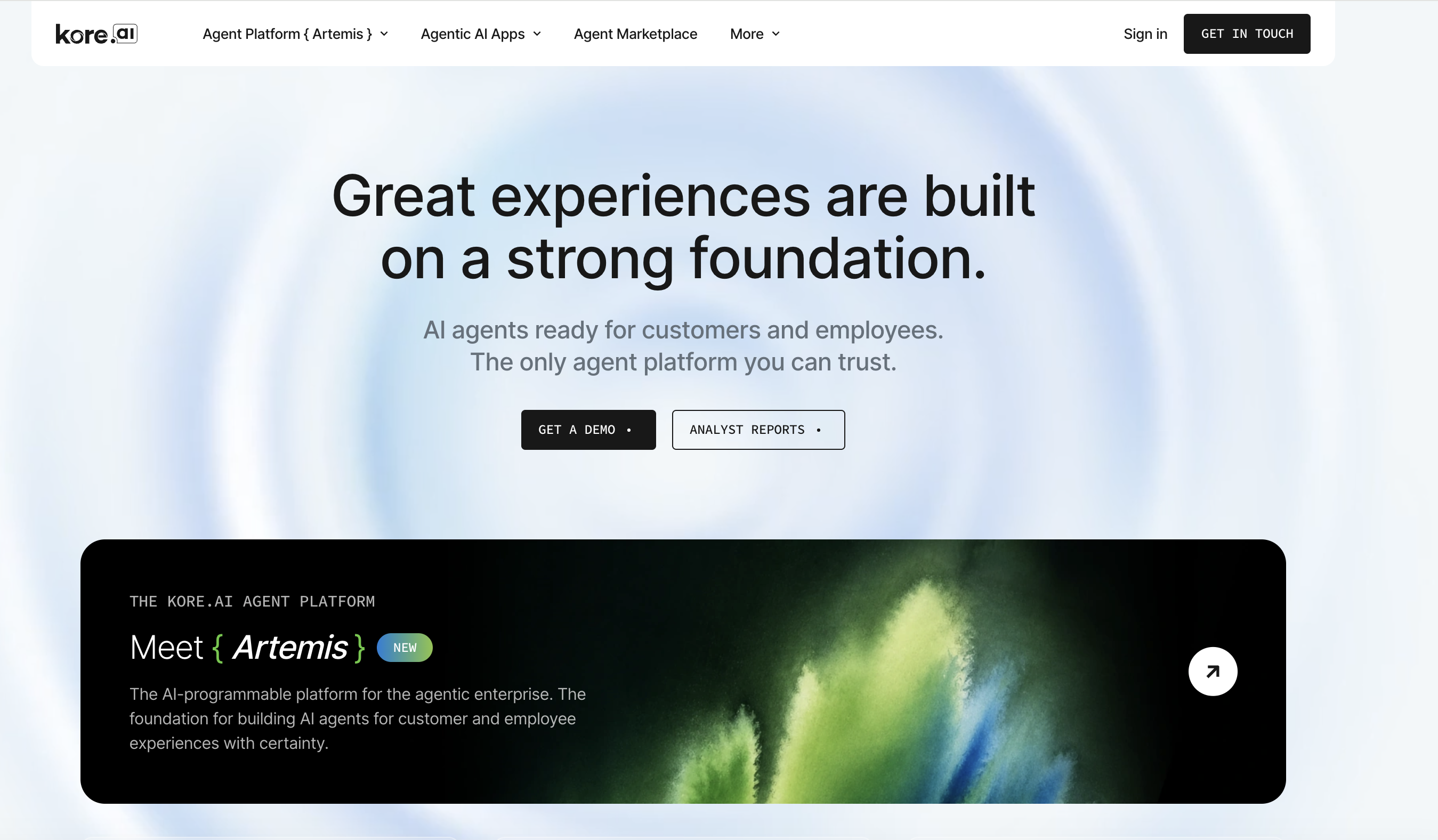
Kore.ai offers a self-service, no-code conversational AI platform with pre-built industry templates for banking, healthcare, and retail.
The templates can accelerate initial deployment for common use cases. Self-service platforms require organizations to build agents themselves, and without visibility into what conversations look like and which behaviors drive outcomes, teams risk building AI agents based on assumptions rather than data.
5. SoundHound AI (Amelia Platform)
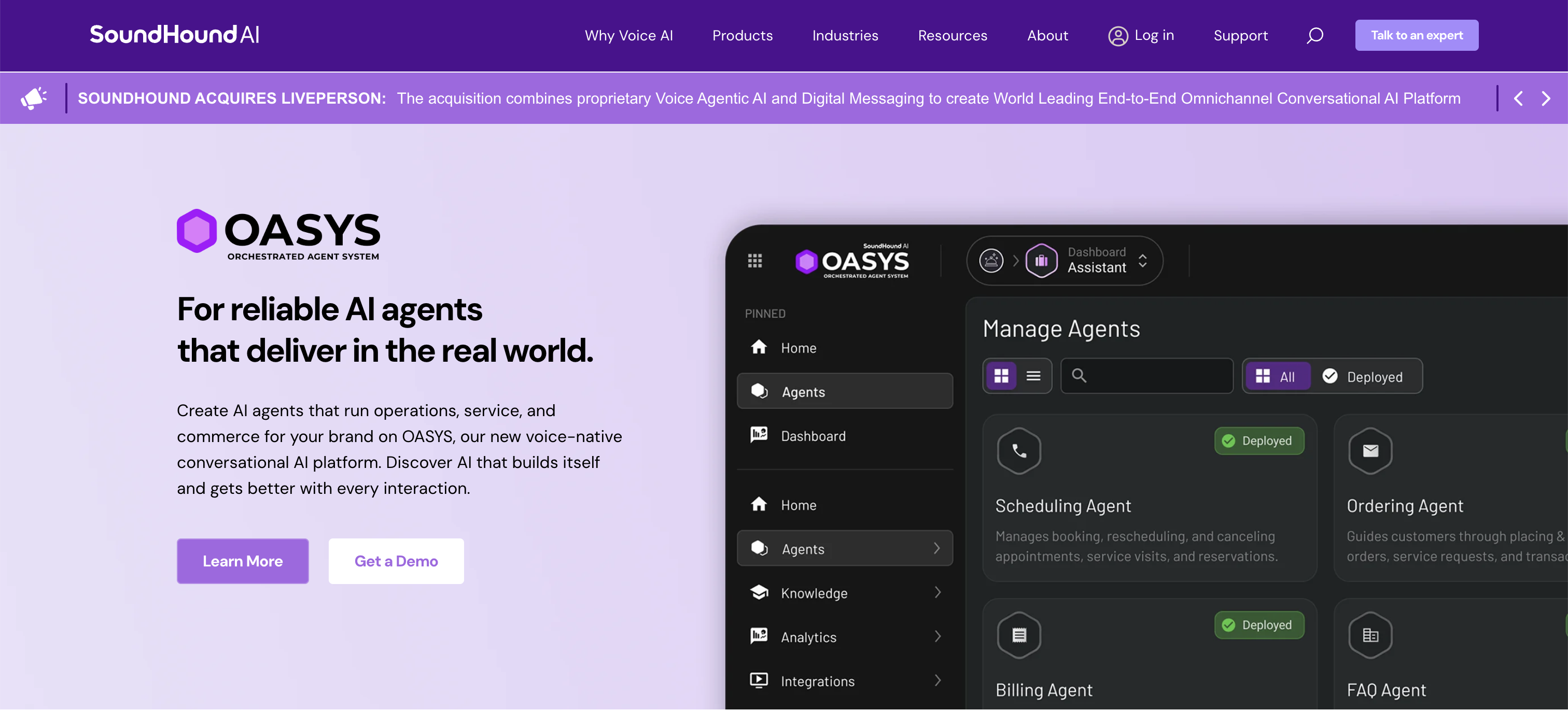
SoundHound's Amelia platform offers pre-built integration connectors specifically for utility platforms, and its Agentic+ AI supports reasoning and planning for complex workflows like outage triage and payment-plan setup, with support for energy-efficiency enrollment.
The utilities-specific integrations are a clear advantage for providers in that vertical, though organizations should assess how the platform handles non-deterministic workflows and whether visibility extends to human agent performance after escalation.
6. Oracle Utilities Customer Platform
Oracle launched a utility-specific platform in May 2025 with AI call summarization. The platform is available at no additional cost to existing Oracle Utilities Customer Cloud Service customers.
For utilities already on Oracle infrastructure, the key question is whether the platform's AI capabilities match the level of performance needed to effectively handle customer interaction. Gaps in real-time agent coaching and automated quality management will limit visibility into behaviors-linked outcomes across interactions.
Choosing the right voice AI platform for your environment
The platforms on this list range from purpose-built vertical tools to full enterprise AI platforms, and the right fit depends on your operational reality. For telecom and utility organizations managing complex billing systems alongside unpredictable volume spikes and multi-channel customer journeys, the evaluation criteria at the top of this guide matter more than any individual feature comparison.
Cresta brings conversation intelligence and AI agent automation together in a single platform for contact center conversations. For telecom and utility providers, AI agents are built on real conversation data, monitored through the same quality management as human agents, with coaching that continues after the handoff. Request a demo to see how it works in practice.