Updated September 17, 2026
Which agent behaviors move CSAT the most? How do you coach every agent, not just a sampled few? How do you close the performance gap without piling manual work onto stretched teams?
These are just a few of the questions that define contact center performance management, which heavily influences your customer satisfaction, loyalty, and operational efficiency.
But as your contact center's interaction volume rises faster than headcount, your managers can be too busy to manage performance proactively, if at all.
We’ll walk through several tips that can help your managers if they're strapped for time, as well as foundational guidance worth implementing as soon as possible. But let’s start by defining how contact center performance management works.
What's Contact Center Performance Management?
Contact center performance management is the ongoing practice of setting goals, measuring agent performance against them, and coaching agents to improve. It ties KPIs, monitoring, analytics, and feedback into one continuous cycle.
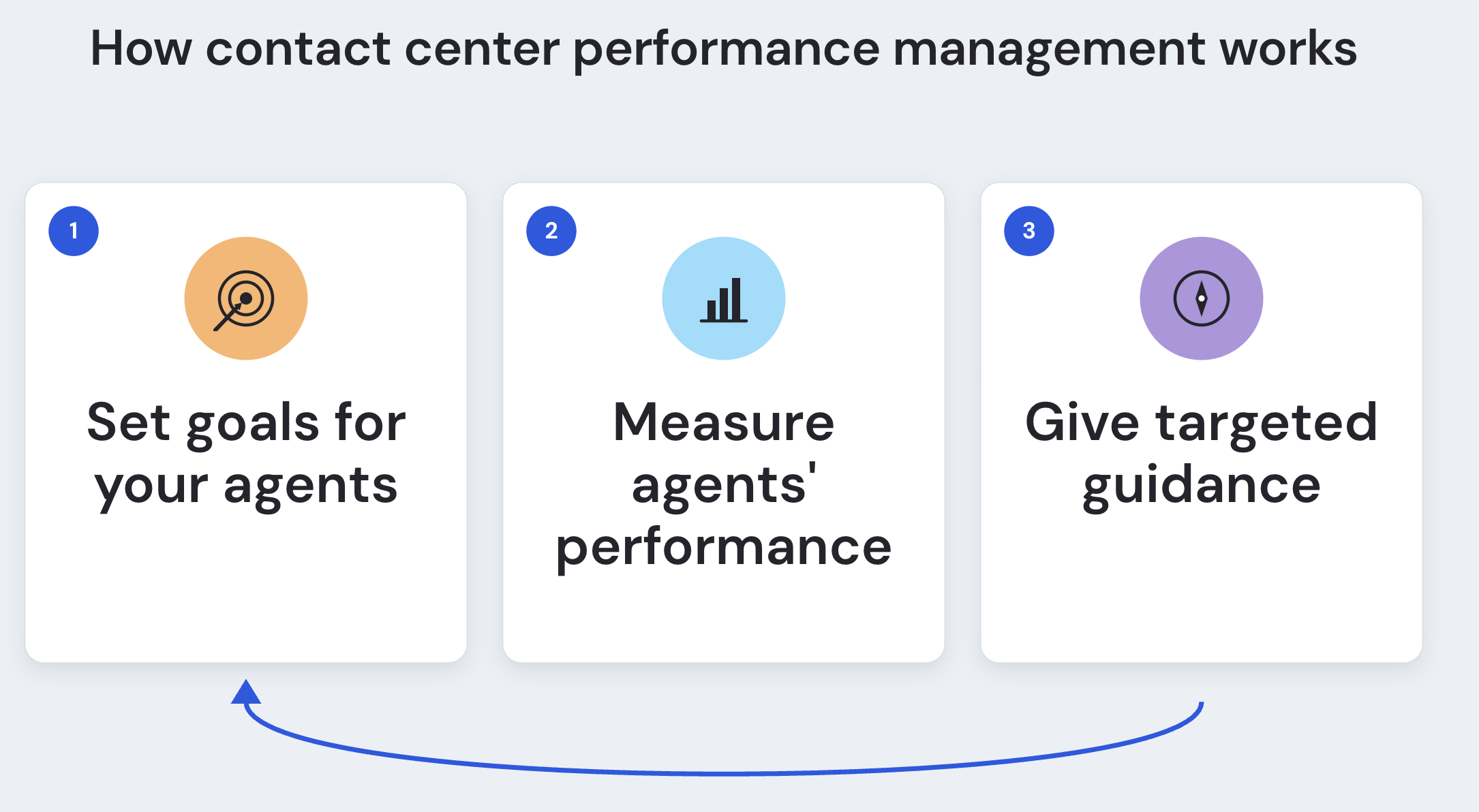
Done well, it lifts CSAT and first-call resolution while protecting revenue and reducing agent churn. Done poorly, small gaps compound across thousands of interactions.
It also spans the full agent lifecycle, from onboarding to daily coaching to quarterly reviews.
1. Set Clear, Measurable Goals That Ladder Up to Business Objectives
To raise performance, agents need to know which outcomes matter and how success is measured.
Key performance indicators worth tracking include average handle time (AHT), first call resolution (FCR), customer satisfaction (CSAT), QA score, and conversion rate. For a fuller list, see our guide to the 15 critical contact center KPIs.
Whichever you pick, align your contact center goals with larger business objectives so that agents fully grasp the impact of their efforts.
.png)
This is harder than it sounds. According to Gallup (2024), only 2% of Fortune 500 CHROs strongly agree their performance management system inspires employees to improve.
Download: The 3-step playbook for driving revenue in the contact center
2. Provide Continuous Training and Development
Equipping agents to keep skills sharp is central to thoughtful performance management.
This can include regular training, workshops, or one-to-one coaching. You'll also need to cover soft skills like empathy and assuming the sale, plus technical skills like new software and specific objections.
Continuous training paired with real-time guidance helps newer agents reach proficiency faster. And coaching the middle 60% of agents can close the agent performance gap and lift performance up to 19%, according to our research.
Document a simple coaching cadence, so training happens on a schedule rather than only after a bad week. And pair each session with a specific behavior to practice and a metric to watch.
3. Implement Real-Time Performance Monitoring
Outdated quality management methods like call sampling are slow and largely ineffective. And coaching agents on conversations from days or weeks ago, when the details are hard to recall, won't work either.
You can use real-time performance monitoring tools to help managers track performance as it happens, without extra manual work. An AI for CX platform can also analyze 100% of conversations, so feedback and coaching happen immediately.
Full coverage beats sampling in practice. For example, Oportun, a finserv company that provides loans, moved from sample-based QA to monitoring 100% of interactions with Cresta. Real-time dashboards then surfaced key metrics and pinpointed where to improve, at the individual and team level.
When you evaluate monitoring tools, ask how much of each conversation they actually score and whether alerts reach managers in time to change the outcome. The right tool shortens the gap between a moment and the coaching.
4. Use Advanced, AI-Driven Analytics
AI-driven analytics reveal patterns in agent performance that human managers miss.
These patterns can reveal the behaviors that drive measurable contact center outcomes, including higher first-contact resolution, lower average handle time, improved customer satisfaction scores, and fewer escalations.
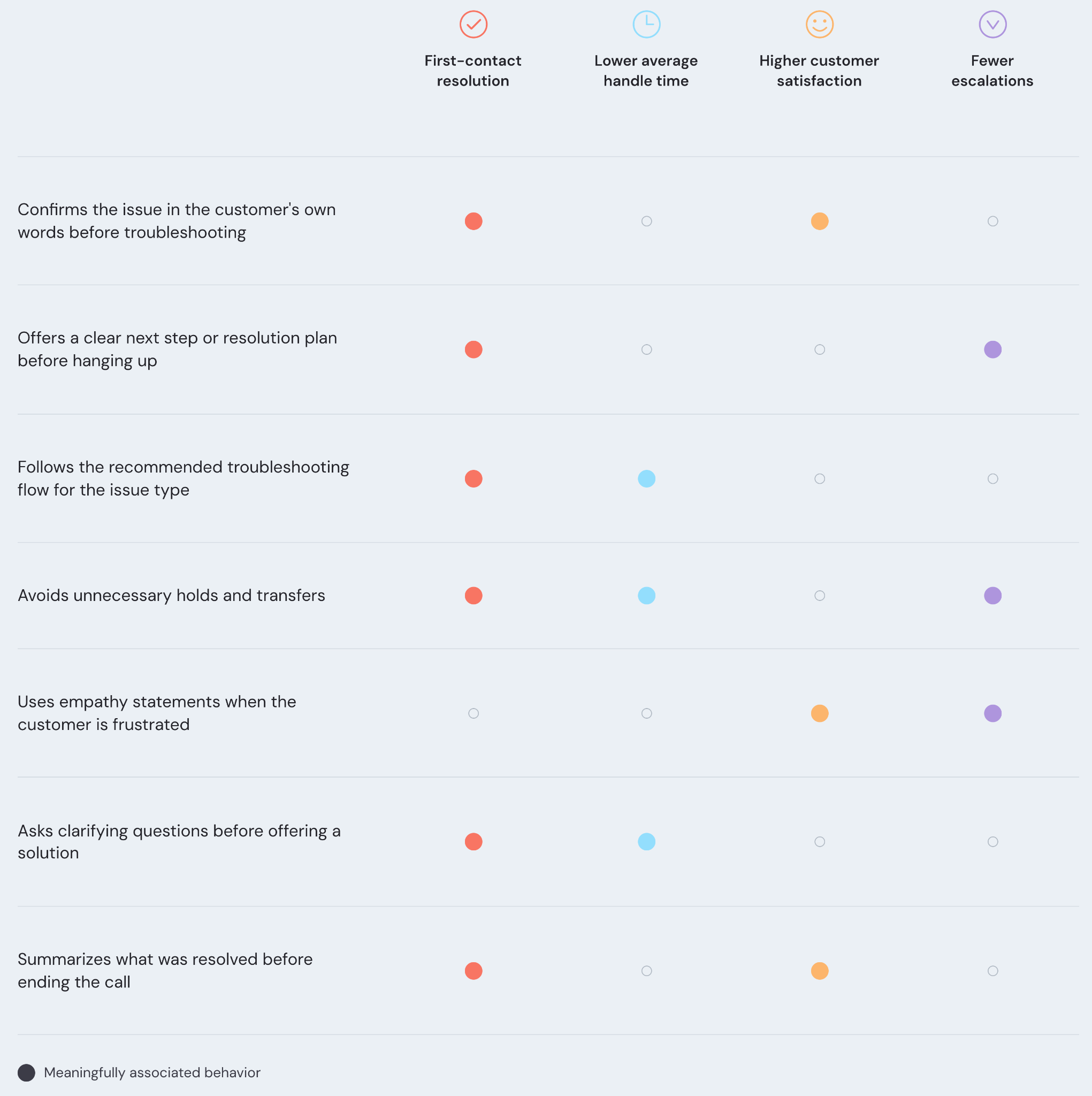
They can also identify reps who aren’t consistently demonstrating those behaviors, so managers can target coaching where it’s needed most.
5. Prioritize Employee Experience
Employee experience is overlooked in many performance plans, yet a positive, supportive environment lifts agent performance.
Gallup's Q12 Meta-Analysis (2024) found highly engaged business units see 78% lower absenteeism and 23% higher profitability than the least engaged. Put simply, happier agents perform better.
To address employee experience, provide personalized coaching so agents feel supported. Add gamification to daily work, and invest in tools that offload the rote tasks that drive burnout.
6. Put Coaching and Feedback Processes on Autopilot
A better employee experience depends on steady, useful feedback. But in most contact centers, managers can't give constructive, personalized feedback to every agent.
Feedback matters, and Gallup-Workhuman (2024) found employees who receive valuable feedback are 48% less likely to be looking for another job.
Human bandwidth can't scale to every agent, so automated coaching fills the gap. Cresta Coach, for example, delivers AI-driven coaching so agents track progress toward goals, get guidance in the moment, and receive consistent feedback.
Turn Every Interaction Into a Learning Opportunity With Cresta
Cresta’s Agent Assist and Conversation Intelligence products give human agents real-time guidance during live interactions and managers consistent performance insights afterward.
Taken together, Cresta can help your team move beyond lagging metrics, identify coaching opportunities at scale, and focus training where it will have the greatest impact.
Request a demo to see how Cresta can make performance management more proactive and measurable at your contact center.
Contact Center Agent Performance Management FAQ
In case you have any more questions on improving your contact center agent performance management, we've answered several more commonly-asked questions below.
What KPIs matter most?
The core KPIs are average handle time (AHT), first call resolution (FCR), and customer satisfaction (CSAT). Many teams also track QA score and conversion rate. Choose the ones tied to your business goals.
How often should managers review agent performance?
Review performance continuously, not just in monthly or quarterly check-ins. Real-time monitoring lets managers coach in the moment, while periodic reviews track trends over time.
How many calls should QA evaluate?
Traditional QA reviews only a small sample of calls. AI-driven quality management can score 100% of conversations. That removes blind spots and makes coaching fairer.
How do you prevent agent burnout?
Offload rote tasks with automation, give agents real-time guidance, and coach them consistently. A supportive employee experience lowers absenteeism and attrition.