
The contact center is entering a new phase, one where AI isn’t just assisting agents, but actively reshaping how customer experience is delivered.
For leaders, the question is no longer if they adopt AI, but how they do it effectively.
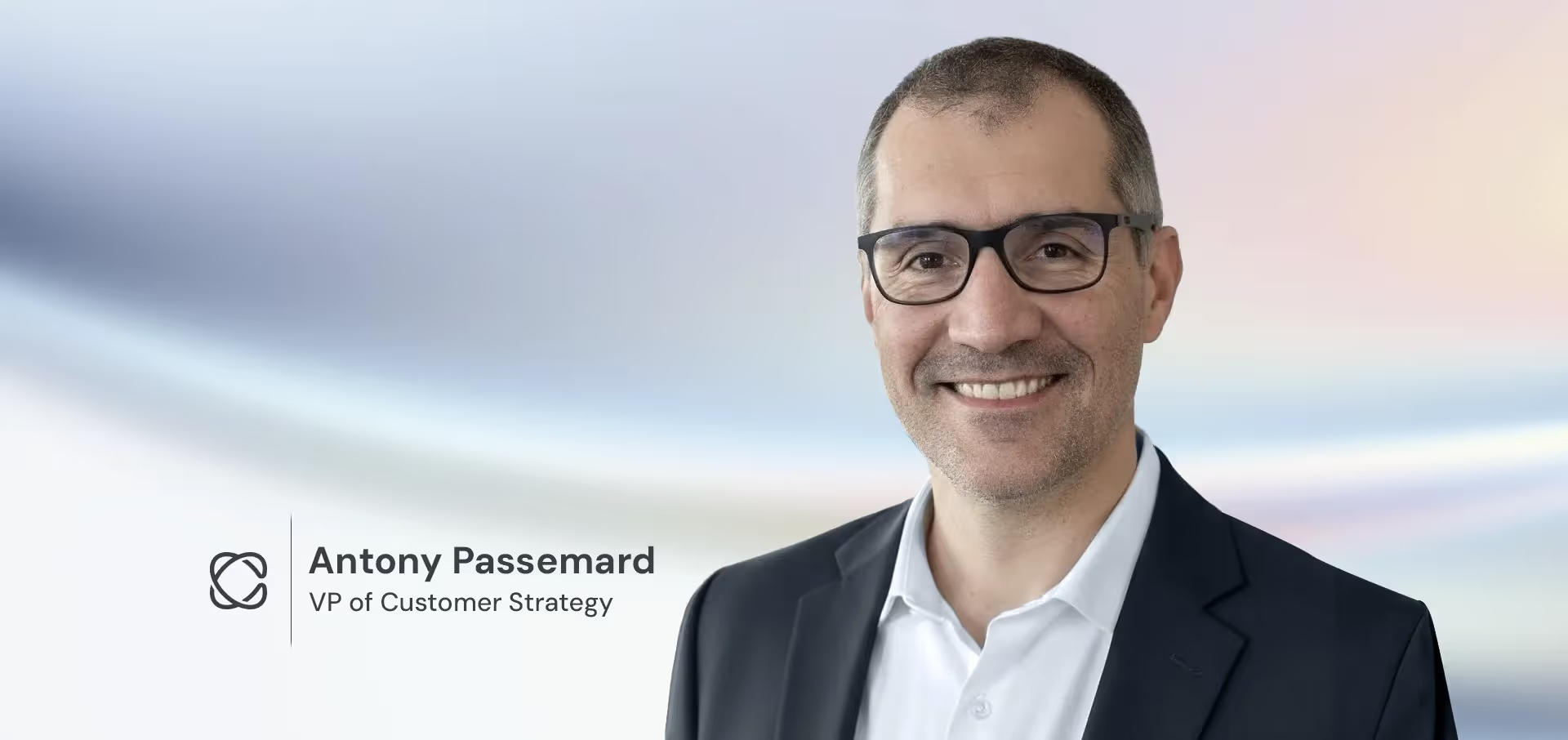
That’s the problem Antony Passemard is focused on solving at Cresta.
We recently welcomed Antony as VP of Customer Strategy, bringing deep experience from Google Cloud and years at the forefront of contact center AI innovation.
We sat down with Antony to talk about his journey into customer experience (CX), why he joined Cresta, and how he sees AI continuing to transform the industry.
Tell us about your career journey. What brought you into customer experience and AI?
I came into the contact center space somewhat by chance. I joined Salesforce during the rise of cloud and SaaS, and ended up on the Service Cloud team. It was a really exciting time; companies were moving away from legacy, on-prem systems, and Service Cloud quickly became one of the fastest-growing parts of the business.
From there, I started following different waves of innovation. Around 2013, I got interested in Internet of Things (IoT): how connected devices could transform customer experience by predicting issues before customers even called. That led me to AWS, and later to Google, where I worked on launching Google Cloud IoT.
Eventually, I came back to the contact center space with CCAI at Google. At the time, it was still very early—just the basic Dialogflow ES—but the rise of Transformers created an opportunity to fundamentally change how customer conversations are handled using AI. That’s where I spent a lot of time helping build out the platform and bring it to large enterprise customers.
What inspired your move from Google to Cresta?
I saw another major wave of innovation happening with the advent of Agentic systems.
But more importantly, I have a strong belief that humans are still going to be a critical part of the contact center. There’s a lot of thinking in the market that AI will replace everything, but I don’t believe that’s the right direction, at least in the next 2 to 3 years.
What we’ll see instead are smaller, more efficient teams that are powered by AI and can handle highly complex issues efficiently. Humans will be more effective, enjoy their work more, and deliver better experiences. Humans will be a brand choice for companies who value their customers.
Cresta really understands that balance. The combination of AI agents with deep insights into what humans are doing, and how to improve it, is incredibly powerful. The data fabric woven through Cresta’s entire platform is highly differentiated, and is uniquely positioned to understand the customers’ behaviors and where and how the experience can be optimized.
Your title is VP of Customer Strategy. How do you define that role?
There are really two sides to it.
The first is helping customers define their AI strategy. The pace of innovation is extremely fast—new models and capabilities are coming out constantly—and most companies can’t keep up. They’re trying to figure out where to start, what ROI to expect, and how to actually implement AI in a meaningful way.
That’s where Cresta can help. We’ve seen a wide range of use cases and deployments, and have built the right muscle over those many years to know what pitfalls should be avoided. We can guide customers on how to approach AI transformation in a practical way.
The second part is internal: helping Cresta define how we position ourselves, how we go to market, what else we need to build, and how we continue to show that we’re leaders in this space.
You spent years in product leadership. Why make the shift into customer strategy?
Over time, my role naturally evolved.
I started as a product leader, but as I led larger teams, I spent more time with customers and less time building directly. I became the bridge between product and the customer, understanding their needs, identifying gaps, and helping shape what we should build next.
That’s really what customer strategy is. It’s about representing the product in front of customers, mapping it to their needs in a clear and actionable way, as well as bringing customer insights back into the product and engineering teams.
Where do you see the biggest disconnect today between the promise of AI in CX and the reality?
There’s a big gap between demos and production.
You see these AI agents in demos that are incredibly impressive: empathetic, efficient, solving complex problems. But when you put them into production, things get much harder.
Contact centers require compliance management, policies, and control. Generative AI introduces flexibility, but companies still expect determinism in many cases. And that’s where things break down.
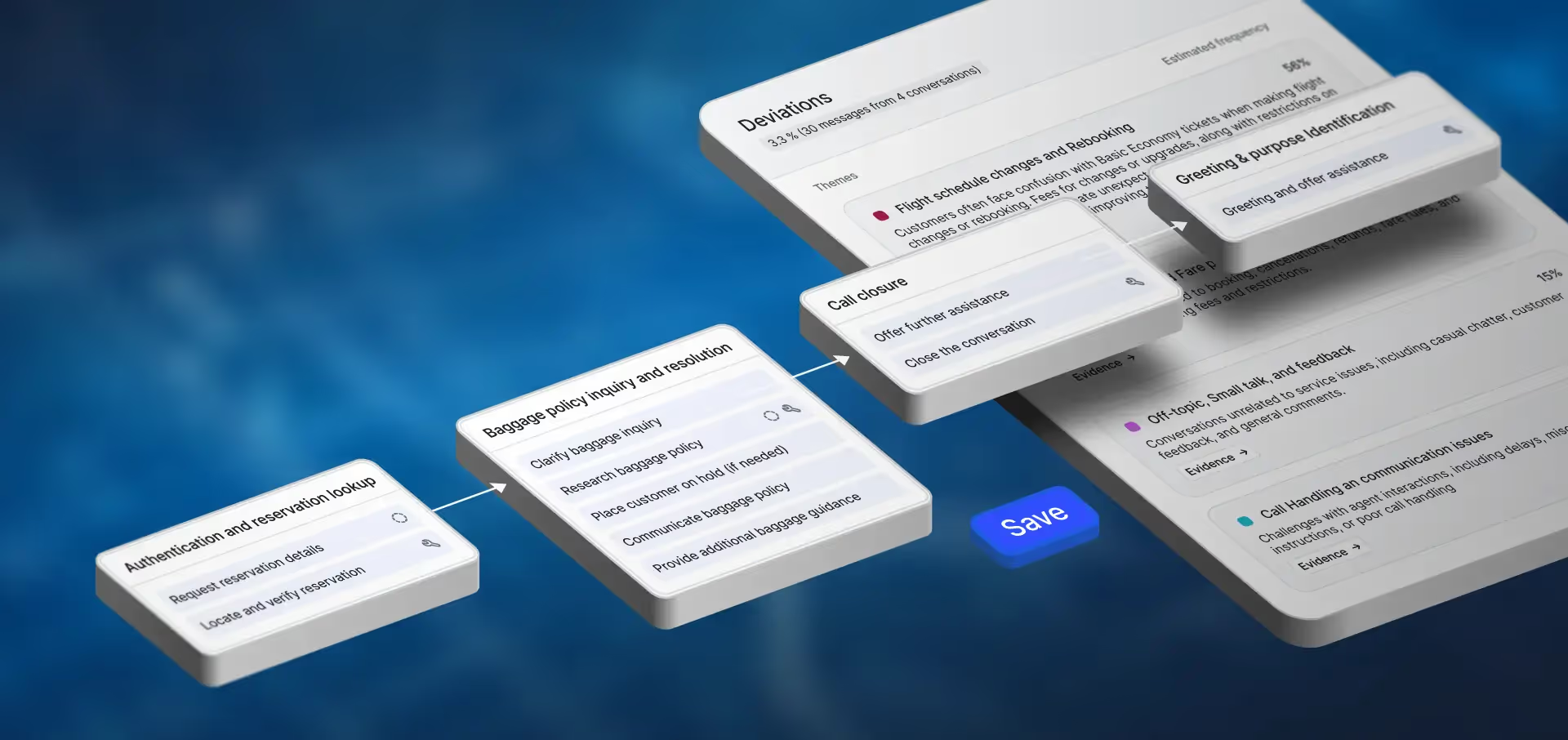
AI agents can hallucinate or make decisions they shouldn’t, like offering a discount when it’s not allowed. So you need visibility into what the AI is doing, why it’s making decisions, and how to control that behavior. The deep understanding of 100% of the conversation that Cresta provides allows our customers to stay in the loop and stay in control. Building AI agents without data and understanding first is a recipe for failure.
What separates companies that successfully adopt AI from those that struggle?
It comes down to mindset.
The companies that succeed are willing to experiment. They understand that AI won’t be perfect from day one, and they’re comfortable learning and iterating in production.
If you wait for everything to be perfect, you’ll never move forward. The better approach is to treat AI agents like human agents: launch them, monitor them, and continuously improve them over time.
Looking ahead, what’s one big bet you have for the future of AI in customer experience?
We’ll start seeing AI agents acting on behalf of customers.
Instead of a human calling a contact center, it could be their AI agent interacting directly with the company’s AI agent or even human agents.
That’s going to fundamentally change how interactions work and what capabilities are needed. It’s a big shift that organizations should start preparing for now.
What should CX leaders be doing today to prepare for that future?
The most important thing is being prepared, not surprised.
AI systems will make mistakes. That’s inevitable. But organizations need strong monitoring, real-time analytics, and processes in place to catch issues quickly, fix them, and communicate clearly with leadership.
It’s about having a contingency plan. You know things won’t be perfect, so the questions are: how quickly can you respond, what does the response look like, and how well can you stay in control?
What do you enjoy doing outside of work?
I like to stay active, taking advantage of the beautiful San Francisco Bay Area—mountain biking and skiing are big ones for me. I also enjoy building things, I’m creative and a builder by nature.
I spend a lot of time traveling with my family, and I’m also a big fan of French and Belgian graphical novels.