




The Hybrid AI Future
The future of enterprise contact centers is AI agents and human agents working seamlessly together. But here's where most deployments break: teams assume AI quality is the limiting factor. It's not. The real bottleneck is integration.
Here's what that looks like in practice: An AI agent handles a customer's routine inquiry autonomously: password reset, order status check, simple FAQ. When the conversation becomes complex (escalation, exception handling, high-emotion situations), the AI transfers to a human agent–but not with a cold handoff. The human agent sees a complete conversation summary, customer context, and recommended next actions pop up on their computer screen as they receive the call (powered by Agent Assist), while the call itself flows through their existing contact center infrastructure.
The result: human agents don't start from scratch. They start informed.
This seamless handoff is only possible when you solve voice integration at a fundamental level, supporting both autonomous AI and AI-assisted humans on the same platform infrastructure.
The Integration Challenge
Most enterprises can't (and won't) rip out their existing contact center infrastructure to adopt AI. They need AI that works with what they already have—whether cloud platforms, decades-old on-premise systems, or complex hybrid environments with diverse agent setups (desktop softphones, hard phones, virtual desktop environments, remote workers).
Most AI vendors take a simpler approach: build their own telephony infrastructure and ask customers to switch. That works for greenfield deployments. For enterprises with significant infrastructure investments, switching is technically feasible—but rarely practical given the high costs, system overhauls, and organizational change required.
At Cresta, we made a different choice: meet enterprises where they are.
Why This Is a Business Decision, Not Just a Technical One
Building AI that works inside your existing stack changes the economics of adoption:
- Avoid vendor lock-in: Your AI investment isn't tied to a specific contact center platform. Switch CCaaS vendors without rebuilding your AI deployment.
- Control costs and timeline: No infrastructure replacement means no multi-million dollar migration project, no business disruption, and deployment in weeks instead of quarters.
- De-risk adoption: Start with agent assist or AI agents independently, prove ROI, then expand. The flexibility to deploy incrementally reduces implementation risk.
The Three Pillars of Voice Integration
Despite the diverse ecosystem of contact center platforms—different APIs, protocols, deployment models—every voice integration comes down to the same three pillars:
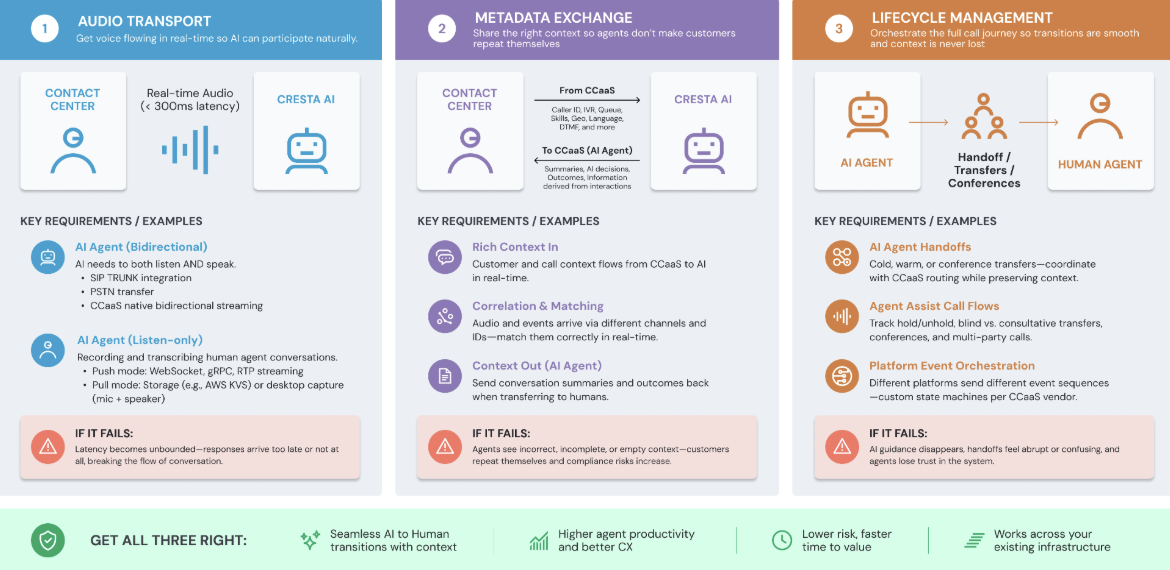
1. Audio Transport
This layer determines whether AI can participate in conversations naturally—or feel laggy and disconnected.
Getting voice flowing between the contact center and AI in real-time. The requirements differ by use case:
AI Agent (bidirectional): AI agents need to both listen AND speak, which requires real-time two-way audio with sub-second latency (typically <300ms for natural conversation flow). This is achieved through:
- SIP TRUNK integration: Generic SIP protocol connection where the AI agent acts as a SIP endpoint
- PSTN transfer: Traditional telephony transfer to AI agent phone numbers
- CCaaS native bidirectional streaming: Platform-specific APIs for real-time two-way audio streams.
Agent Assist (listen-only): Recording and transcribing human agent conversations—one-way dual-channel capture. Platforms deliver audio through different mechanisms:
- Push mode: CCaaS pushes audio to Cresta via WebSocket streaming, gRPC streams, or raw RTP packets—low latency, real-time
- Pull mode: Cresta fetches audio from CCaaS intermediate storage (e.g., AWS KVS) or captures directly from agent desktops (microphone + speaker audio). Some CCaaS platforms charge significantly for cloud streaming APIs, making desktop capture more cost-effective for certain deployments, especially at scale.
If audio transport fails: latency effectively becomes unbounded; responses arrive too late or not at all, breaking the flow of conversation and immediately degrading the customer experience.
2. Metadata Exchange
This layer determines whether agents receive usable context, or force customers to repeat themselves.
Audio alone isn't enough; we need context. This involves bidirectional metadata flow:
- From CCaaS: Caller's phone number, IVR selections, queue routing, skill assignment, geo location, language, DTMF digits for authentication.
- To CCaaS (AI Agent): Conversation summaries when transferring to humans, AI decisions, outcomes, information the AI Agent derives from the customer interactions.
- The correlation challenge: Audio streams and call metadata frequently arrive via separate channels with mismatched identifiers, necessitating precise, real-time correlation. Failing to synchronize these streams feeds inaccurate context to agents and severs the data return path to the CCaaS. Overcoming these platform variations demands custom integration logic for every vendor. For example, Genesys Cloud requires matching AudioHook WebSocket session IDs with disparate Notification API conversation IDs. Executing this real-time correlation before an agent answers dictates the success or failure of the entire integration.
If metadata exchange fails: Agents see incorrect, incomplete, or entirely empty customer context, forcing customers to repeat themselves. In regulated industries, this creates compliance and data security risks.
3. Lifecycle Management
This layer determines whether call transitions are orchestrated smoothly or break the customer experience.
Handling the messy reality of production contact centers, beyond simple start/stop:
AI Agent: Properly orchestrating handoffs to humans: cold transfer (direct handoff), warm transfer (AI introduces the human before dropping off), or conference transfer (AI stays on to brief the human, then exits). Each requires coordinating with CCaaS routing logic while maintaining conversation context. This is where the promise of hybrid AI—seamless transitions between AI and human agents—either succeeds or fails.
Agent Assist: Tracking human agents through advanced call flows: hold/unhold events, blind vs. consultative transfers, multi-party conferences. We maintain AI guidance as agents consult supervisors, transfer between departments, or merge calls.
Different platforms send different event sequences for the same action, requiring custom state machines per CCaaS vendor. Example: a consultative transfer in Cisco UCCE fires a different event sequence than the same action in Five9 or NiCE CXone. Each needs its own state machine to keep AI guidance attached to the right call leg as agents consult, transfer, and merge.
If lifecycle management fails: AI guidance disappears mid-call, handoffs feel abrupt or confusing, and agents lose trust in the system. The seamless experience becomes fragmented.
The Competitive Difference
Many AI vendors build autonomous agents but skip agent assist. Why? Agent assist requires solving harder problems: desktop software deployment, dual audio capture, and complex state tracking across diverse agent setups. Others focus on cloud-only deployments and avoid on-premise complexity. Most don't handle the AI → human handoff with context preservation.
Cresta built a full stack across the contact center landscape:
- Both products on one platform: AI Agent (autonomous) and Agent Assist (AI-assisted humans), deployed independently or together.
- Cloud-native CCaaS: Five9, Genesys Cloud CX, NICE CXone, Amazon Connect, 8x8, Twilio Flex, Talkdesk, Vonage, Gladly, TCN, RingCX, Avaya Infinity.
- On-premise and hybrid: Cisco (UCCE, PCCE, UCCX), Avaya, Genesys Engage, plus SIPREC across Oracle, Ribbon, Avaya SBC, and Cisco CUBE.
Supporting both SIPREC-based infrastructure and desktop capture across cloud and on-premise systems requires fundamentally different architectures. Most vendors choose one. We built both.
This also gives you migration flexibility. Planning to migrate from on-premise Cisco to cloud-based Five9? Or weighing Genesys against Talkdesk as you switch from one CCaaS to another? Cresta supports both your old system and new system simultaneously, de-risking your migration and giving you control over your timeline.
Deploy both products seamlessly. Start with Agent Assist, add AI Agent later (or vice versa). The integration layer supports both use cases on the same platform infrastructure, with no replacement required.
The Bottom Line
Hybrid AI isn't limited by model quality, but rather by integration. Beneath the chaos of platforms and protocols lies a simple structure: Audio, Metadata, and Lifecycle Management.
When these three pillars are solved against your existing infrastructure rather than around it, hybrid AI moves from theory to production. Deploy Agent Assist first, AI Agent first, or both together. The flexibility is built in.
The future of customer experience is hybrid. Get integration right, and you deploy AI in weeks while competitors take quarters.
Next Steps:
- See it on your stack. Schedule a demo to walk through integration against your specific CCaaS setup and see real-world deployment results.
- Go deeper on the architecture. Read our technical blog posts on voice integration, latency optimization, and AI agent engineering.
- Join the team. We're hiring people who love solving integration challenges.