
6 Best AI Voice Agents for Customer Service in 2026


- Vendor demos all look convincing; this guide focuses on what separates platforms in real production
- The six platforms span different architectures, from automation-first managed services to unified platforms built on shared conversation data
- AI agents built from real conversation data outperform those built from templates or assumptions once they hit production
- Post-escalation visibility is an underweighted differentiator; losing the conversation at handoff creates blind spots in your highest-risk interactions
Every vendor in this space can show a convincing non-production demo. The harder question is what happens when the same system handles thousands of conversations daily, with edge cases, policy changes, and dynamic customer conversations.
Leaders keep asking three questions: which platform holds up in production, what happens to a conversation after it escalates, and how do you stay compliant across thousands of automated calls? Results vary significantly by platform. That choice compounds over time in ways that are hard to undo.
Gartner projected in 2022 that conversational AI would reduce contact center agent labor costs by $80 billion in 2026, which is why platform choice carries real weight.
This guide covers the evaluation framework contact center leaders should apply, profiles the six leading platforms, and provides the questions worth asking before committing.
What is an AI voice agent for customer service?
An AI voice agent is software that holds real, spoken customer conversations using speech recognition, large language models, and text-to-speech. It understands caller intent and resolves requests end to end, rather than routing callers through fixed menu trees. Unlike a traditional IVR, which deflects callers through preset keypad or menu options, an AI voice agent interprets natural speech and can carry a multi-step conversation to resolution.
See what to look for before you buy
How to evaluate enterprise AI voice agent platforms
Before evaluating individual platforms, contact center leaders need a clear framework for what matters. Four capabilities consistently separate enterprise-grade deployments from tools that look impressive in demos but fail under production pressure. For each one, a direct question will surface quickly whether a vendor can deliver.
Conversation intelligence foundation
If you don't know what your conversations look like and what top performers do during them, you'll build AI agents grounded in assumptions instead of evidence. By looking at thousands of interactions systematically, the behaviors that separate your best agents from the rest become clear. That includes how they handle objections, de-escalate frustrated customers, and guide calls toward resolution.
Ask vendors how the AI agents are designed: from real conversation data showing what top performers do, or from templates and assumptions about what conversations should look like.
Human-AI handoff continuity
Phone is still the dominant customer service channel: YouGov found nearly 70% of Americans use phone support. Any AI deployment will still produce conversations that exceed the agent's scope and need to transfer to a human. Platforms where visibility ends at escalation leave supervisors without context, force customers to repeat themselves, and cut off the data that would help you understand which conversations are escalating and why.
Shared visibility across AI and human-handled conversations closes that loop and gives quality management a complete picture of the customer journey. Ask vendors what data and context transfer to the AI agent handoff to a human, and whether the platform continues augmenting the human agent after the handoff or visibility ends at that point.
Enterprise guardrails
Purely prompt-driven agents break down on edge cases and adversarial inputs, and on conversations that deviate from what the original prompt anticipated, which happens continuously at enterprise scale. The regulatory exposure compounds that operational risk. Under the Telephone Consumer Protection Act (TCPA), each violation carries $500 in statutory damages, rising to $1,500 for willful violations, with no aggregate cap. At thousands of AI-handled calls per day, a single policy gap can generate significant liability. In February 2024, the FCC ruled that AI-generated voices are "artificial" under the TCPA, so outbound AI voice calls require the same prior consent as other automated calls.
Enterprise-grade platforms address this through layered defense architectures instead of relying on prompt design alone to catch everything. Ask vendors how supervisory guardrails intercept non-compliant outputs in real time and whether they run adversarial simulations before production deployment.
Quality management at scale
Traditional quality management (QM) relies on manual sampling of conversation analytics, which is workable when human agents are doing the work. According to RingCentral, only about 1-2% of conversations get reviewed. When AI agents handle thousands of interactions daily, that same sampling rate creates a near-complete blind spot. Containment rate, the percentage of conversations an AI agent resolves without transferring to a human, is the headline metric most vendors lead with, but a 2% QM sample gives almost no reliable signal about whether those resolutions are good.
Generative AI agents behave non-deterministically, so even a small shift in how questions are phrased can produce different outputs, and spot checks won't catch that. Platforms with 100% automated QM coverage catch compliance gaps and performance errors before they affect large numbers of customers. Ask vendors whether quality monitoring covers 100% of AI agent interactions with automated scoring, and whether AI and human agent performance can be benchmarked side by side.
The 6 best AI voice agents for customer service
Each platform below is evaluated against the framework above, with a best-for designation to help leaders quickly identify fit. The profiles cover primary use case and key differentiation, along with the tradeoffs worth understanding before signing a contract.
At a glance
1. Cresta
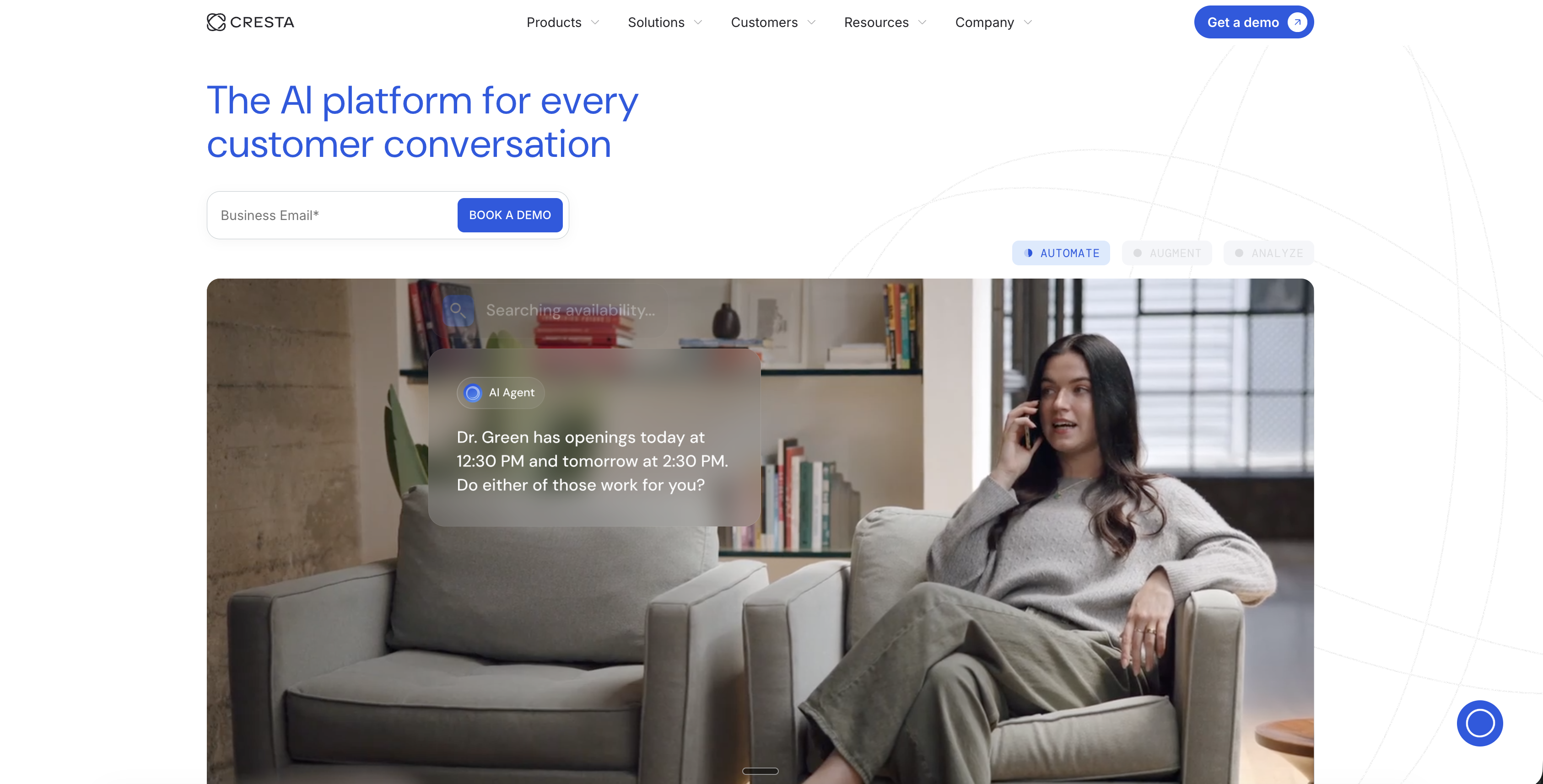
Cresta provides a unified platform where Cresta AI Agent and Cresta Agentic Assist share the same foundation as Cresta Conversation Intelligence. Teams get shared visibility whether AI or humans handle conversations, and quality monitoring and coaching continue after AI-to-human handoffs.
Key Features
- Multi-model architecture with task-optimized models and sub-agent routing for multi-intent conversations
- Conversation-grounded agent design built from real human interactions
- Automation Discovery (Early Access) for identifying and exporting proven flows as agent prompts
- Four-layer enterprise guardrails spanning system protection, supervisory monitoring, adversarial testing, and 100% behavioral QM
- Agent Operations Center (Early Access) for real-time supervisor visibility and intervention
- SOC 2 Type II certification and 30+ language support
Strengths and Weaknesses
Strengths:
- Proven containment gains at Snap Finance, growing from 6% to 33% (5.5x) alongside a 23% lift in predictive CSAT
- Measurable CX impact at Brinks Home, with a 30-point NPS increase and 73% reduction in transfer rates
- 74% containment at Xanterra using Cresta AI Agent
- Forrester Leader in The Forrester Wave for Conversation Intelligence, Q2 2025, with the highest Current Offering score
- Unified foundation across AI Agent, Agentic Assist, and Conversation Intelligence that preserves context through handoffs
Best For: Enterprise contact centers that need to automate mid-to-high complexity conversations, coach human agents in real time, and ground both on real conversation data.
See Brinks Home CEO, William Niles, put the Cresta AI agent to the test
2. Decagon
Tool Overview
Decagon builds AI agents designed to resolve customer inquiries across voice and digital channels. Its architecture is built on large language models from the ground up.
Key Features
- LLM-native architecture built from the ground up
- Agent generation from uploaded transcripts
- Duet for post-deployment monitoring and iteration
- Natural language–driven reporting for quality management
Strengths and Weaknesses
Strengths:
- Agent generation directly from transcript sets
- LLM-native foundation
- Post-deployment monitoring and iteration via Duet
Weaknesses:
- Requires significant engineering investment or ongoing iteration with Duet to perform well in production
- Configuration choices for varied conversation types go beyond surface-level adjustments
- No analysis of top-performing agent behavior or guidance on which calls to use for automation design
- Deployment often begins without a clear picture of what good conversations look like or which resolution paths are optimal
- Lighter, natural language–driven QM falls short of the systematic evaluation generative agents require at enterprise scale
- No connection between AI Agent conversations and the human side of the operation, limiting real-time coaching use cases
Best For
Organizations prioritizing end-to-end AI resolution with resources to self-serve configuration and ongoing refinement.
3. Cognigy.AI Platform
Tool Overview
Cognigy builds voice and digital AI agents using a hybrid architecture that combines rule-based flow logic with large language model (LLM) capabilities. NICE acquired Cognigy in 2025.
Key Features
- Hybrid rule-based and LLM architecture
- Low-code flow editor for direct control over conversation structure
- Predictable, auditable conversation paths
- Tighter NICE ecosystem integration following the 2025 acquisition
Strengths and Weaknesses
Strengths:
- Low-code flow editor for direct control over conversation structure
- Predictable, auditable conversation paths with real operational appeal over fully generative behavior
- Tighter NICE ecosystem integration for existing NICE customers
Weaknesses:
- Platform roadmap now tied to a larger, slower CCaaS provider's strategic priorities
- Structured flows create friction when conversations deviate from anticipated paths, which happens frequently at enterprise scale
- Custom enterprise pricing, typically six figures annually
Best For
Global enterprises needing structured, predictable conversation workflows, particularly those already in the NICE ecosystem.
4. Kore.ai
Tool Overview
Kore.ai offers a self-service AI agent platform with a no-code builder and pre-built templates for verticals including banking and retail, as well as healthcare.
Key Features
- No-code builder with pre-built templates for banking, retail, and healthcare
- Graph-based retrieval-augmented generation (RAG) for knowledge retrieval
- Enterprise-grade monitoring
- Self-owned configuration without vendor-led implementation
Strengths and Weaknesses
Strengths:
- Self-service no-code builder
- Pre-built industry templates for banking, retail, and healthcare
- Self-owned configuration without reliance on vendor-led implementation
Weaknesses:
- Templates reflect generalized assumptions rather than your actual conversations
- No conversation intelligence layer to ground agent behavior in top performer paths, so the starting point may not map to your customer base
- Custom enterprise pricing with no publicly available rates
Best For
Enterprises seeking pre-built industry templates over custom development.
5. Google CCAI
Tool Overview
Google Contact Center AI provides cloud-native conversational AI capabilities with native Google Cloud integration. The platform gives organizations speech recognition and natural language understanding components, along with virtual agent frameworks, which they assemble into their own voice AI experience.
Key Features
- Cloud-native conversational AI with native Google Cloud integration
- Speech recognition and natural language understanding components
- Virtual agent frameworks for assembling a custom voice AI experience
- CX Agent Studio lower-code builder
Strengths and Weaknesses
Strengths:
- Native Google Cloud integration
- Virtual agent frameworks for building custom voice AI experiences
- CX Agent Studio as a lower-code option
Weaknesses:
- CX Agent Studio is less capable in deterministic workflows
- Substantial implementation investment, with ongoing maintenance falling on internal resources rather than the vendor
- Quality AI requires manual training on scored conversations, and conversation intelligence is a collection of less cohesive tools
- Less sophisticated coaching capabilities that require separate tooling
- Added complexity on top of an already technically demanding build
Best For
Organizations on Google Cloud with internal technical resources to design and build custom implementations.
6. Sierra
Tool Overview
Sierra offers AI agents with a vendor-led deployment model. The platform handles implementation and configuration on behalf of the customer, along with ongoing updates, which lowers the internal technical burden and shortens time to initial deployment.
Key Features
- Vendor-led implementation and configuration model
- Vendor-managed ongoing updates
- Ghostwriter self-serve experience for describing and generating agents
- Automation-first platform design centered on AI agent deployment
Strengths and Weaknesses
Strengths:
- Lower internal technical burden and faster time to initial deployment
- Ghostwriter self-serve experience for describing and generating agents
- Accelerated build and edits through Ghostwriter
Weaknesses:
- Limited proven customer deployments for Live Assist
- Ghostwriter assumes curated transcripts and artifacts are already representative, with no help validating that assumption
- No guidance on what to automate or whether customer-supplied artifacts are the right ones
- Live Assist is a capability added onto an automation-first platform, not one built on years of agent coaching and QM expertise
Best For
Brands comfortable with vendor-managed implementations who prioritize speed to deployment over direct internal control.
Choosing the right AI voice agent for your contact center
Selecting an AI voice agent platform is one of the higher-stakes decisions a contact center leader makes, because the cost of getting it wrong compounds quickly. A platform can perform in a controlled pilot but lack the production guardrails, QM infrastructure, and conversation intelligence to operate at enterprise scale. Those gaps consume budget and attention for months before they become undeniable.
Cresta AI Agent is built on the same platform as Cresta Agentic Assist for human agents and Cresta Conversation Intelligence across all interactions. That means the quality management rigor, outcome inference models, and coaching infrastructure built over years of working with human agents apply directly to AI agent oversight.
The Agent Operations Center (Early Access) gives supervisors real-time visibility into AI-handled conversations, with the ability to intervene and improve performance without losing context or switching tools. Automation Discovery (Early Access) identifies which conversations in your current operation are strong candidates for automation, based on complexity, deviation patterns, and tool dependencies. That way, AI agent design starts from data instead of guesswork.
Visit Cresta's resource library to explore how enterprise contact centers are deploying AI agents alongside human teams, or request a demo to see how Automation Discovery and the Agent Operations Center work in your operational context.
Cresta is dedicated to helping businesses of all sizes make informed decisions. We adhere to strict editorial guidelines to ensure that our content meets and maintains our high standards.