Will AI Replace Contact Center Agents?
.avif)

• The data doesn't support the replacement narrative. When Gartner surveyed customer service leaders, only 20% reported AI-driven headcount reduction. The majority maintained stable staffing while handling higher volumes with the same team.
• Contact center work is uniquely divisible, which changes the entire calculus. Organizations can automate a subset of conversations, measure the impact, and expand incrementally. AI adoption becomes reversible rather than an all-or-nothing bet.
• As AI handles routine volume, the interactions that escalate to human agents become more complex, emotionally nuanced, and high-stakes. The agent role doesn't disappear, it shifts toward work where judgment, empathy, and relationship-building matter most.
• The bigger opportunity is often overlooked. AI enables entirely new categories of customer engagement that weren't economically viable before, including proactive outreach, asynchronous service, and multilingual support at scale.
• The organizations seeing the best results treat AI as a way to make their people better, not a way to have fewer of them. Human agents equipped with AI tools consistently outperform those without.
Your contact center agents are asking whether AI will replace them. Your leadership team is pressuring you to cut costs with automation. And every vendor pitch deck promises that AI agents will handle customer conversations better, faster, and cheaper than humans ever could.
The anxiety is understandable. Contact centers employ millions of human agents globally, and every technology wave for the past two decades has promised to shrink that number. Offshore outsourcing was supposed to make domestic agents obsolete. IVR was supposed to eliminate the need for live agents altogether. Neither prediction played out, and the data suggests AI won't either.
But the data tells a different story. When you look at what's actually happening inside Fortune 500 contact centers, you don't see mass layoffs. You see teams handling more volume with the same headcount. You see agents equipped with AI tools outperforming those without. You see organizations that rushed to full automation quietly walking it back after customer satisfaction (CSAT) cratered.
The question has shifted from whether AI will eliminate contact center jobs to how the role will evolve, which tasks will shift to automation, and what leaders need to do now to help their teams thrive.
This guide covers what "AI replacing agents" means in practice, which tasks AI handles versus which remain human, how the agent role is evolving, and how to introduce AI without losing your best people.
What "AI replacing contact center agents" actually means
Headlines warning about AI taking jobs miss what actually happens at scale. When GPT-4 launched in 2023, many predicted humans would be gone from contact centers within two or three years. That timeline has proven far too aggressive.
"The reality is I don't think anyone knows for sure," Cresta CEO Ping Wu said on a recent episode of Sequoia's Training Data podcast. "The transformation, especially for existing Fortune 500 companies, will probably take way longer than a lot of people think."
The data backs him up. When Gartner surveyed 321 customer service leaders about the actual impact of AI on their operations, only 20% reported AI-driven headcount reduction. The majority, 55%, maintained stable staffing while handling higher volumes with the same team. Forrester's outlook is similar, predicting AI-powered augmentation for 20% of jobs over the next five years rather than outright elimination.
The distinction that matters is between automation and augmentation. Automation means AI handles entire interactions independently, like a chatbot resolving a password reset without a human involved. Augmentation means AI assists agents during conversations, making them faster and more accurate. These aren't competing strategies. Contact center work is uniquely divisible, so you can automate the conversations that are ready for it while using AI to support agents on everything else. The organizations seeing the best results are doing both.
How do contact centers use AI today?
So if AI isn't replacing agents wholesale, what is it actually doing? Walk into any modern contact center, and you'll see AI working alongside agents in specific, documented ways.
Conversational AI and customer-facing AI agents
AI agents now handle far more than FAQ deflection and basic routing. Modern AI agents manage mid-complexity conversations that require system access, conditional logic, and contextual judgment: guided troubleshooting, reservation changes, prescription refills, billing inquiries, and account modifications. These go well beyond knowledge base retrieval.
They also enable conversations that most contact centers can't staff for today, like proactive renewal outreach, lead qualification, and appointment reminders. In many of these cases, the AI agent handles the structured portion and hands off to a human agent with full context when the interaction moves into high-value territory. For human agents, this means less time on repetitive volume and more opportunity to focus on work where their judgment and empathy matter most.
Real-time agent assist
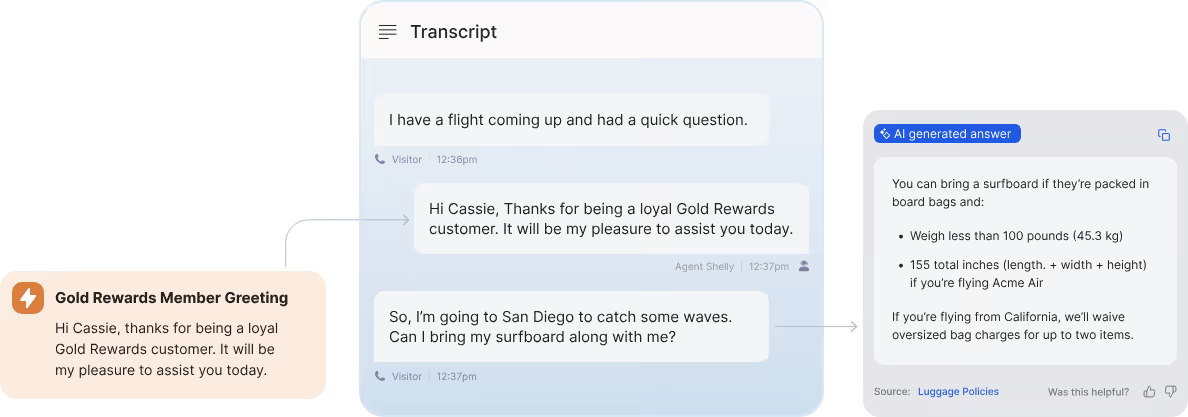
These systems provide information retrieval, suggested responses, and contextual guidance during active customer conversations. Rather than replacing the agent, the technology makes the agent faster and more accurate. For example, Cresta Agent Assist delivers real-time behavioral hints and compliance reminders that help agents say the right thing at the right time.
The best agent assist tools also handle knowledge retrieval proactively, surfacing exact answers with cited sources so agents can respond without context-switching or searching through documentation. And live notes that update continuously throughout conversations, paired with AI-generated summaries that push to CRM systems when calls end, effectively eliminate after-call work.
Quality management automation
This has fundamentally changed how contact centers monitor performance. The old approach meant manually reviewing 1-3% of interactions, the industry standard for decades. That random sampling missed almost everything.
Modern AI-driven quality management systems now score 100% of conversations using behavioral detection models, identifying compliance violations, sentiment patterns, and coaching opportunities that would otherwise go undetected. And as AI agents handle more conversations, the same quality frameworks apply to them too, so leaders have consistent visibility into performance whether the conversation was handled by a human or by AI. Cresta's approach, for example, analyzes behaviors and outcomes across all interactions to surface what's actually driving results across the entire operation.
Intelligent routing
AI-powered routing now goes beyond skills-based assignment to analyze customer data and intent for predictive matching. The system can detect emotional cues and route frustrated customers to experienced agents, or match complex technical issues with specialists who have the right expertise. The result is fewer transfers and faster resolution.
Manager coaching tools
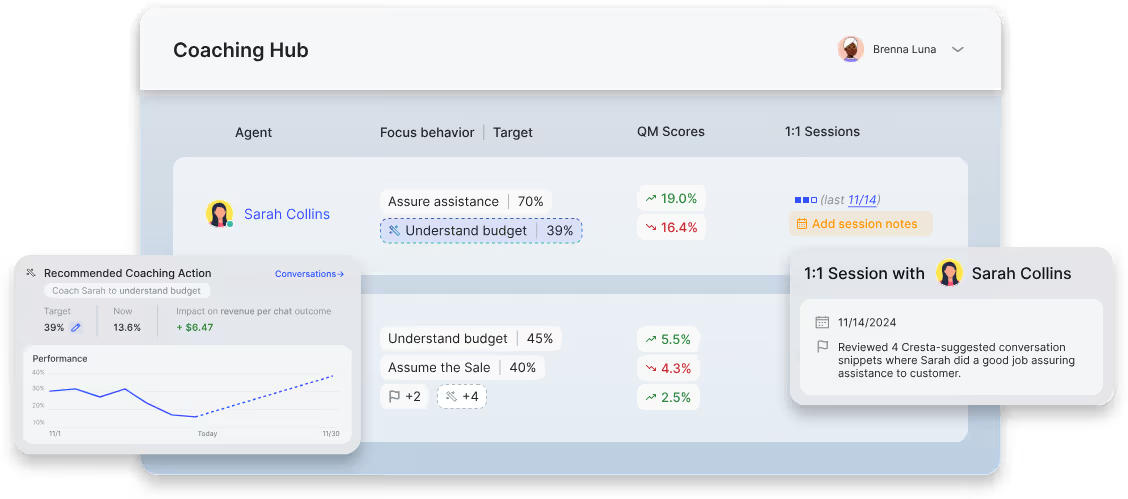
These have evolved from subjective assessments to data-driven recommendations. AI-powered coaching platforms now analyze behaviors and outcomes for every agent and interaction to pinpoint what actually drives results. Cresta Coach, for example, delivers personalized recommendations based on organizational goals, tracks 1:1 coaching sessions, and measures their impact on performance. This closes the gap between identifying what works and actually teaching it systematically across the team.
Which tasks AI handles versus which remain human
Understanding which tasks AI can actually handle versus which require human expertise matters more than any prediction about future automation. And contact center work has a characteristic that makes it uniquely suited for incremental AI adoption.
Ping Wu drew a contrast with self-driving cars, where partial automation doesn't deliver economic value: "For contact centers, what we find is very unique is that the work is very divisible."
This divisibility changes the entire calculus. Organizations can automate a subset of conversations, measure the impact on containment, escalation quality, and customer satisfaction, and then decide whether to expand. If something isn't working, they can pull it back. AI adoption becomes incremental and reversible rather than an all-or-nothing bet.
AI agents handle a wider range of conversations than most people expect. Simple tasks like authentication, password resets, and order tracking are table stakes. But today's AI agents also manage mid-complexity conversations that require system lookups, conditional logic, and multi-step resolution: guided troubleshooting, billing inquiries, prescription refills, reservation changes, and account or plan modifications. These aren't scripted decision trees. They require the AI to navigate deviations and edge cases in real time.
But customer preferences reveal where humans maintain a clear advantage. According to ContactBabel's research, 74% of customers prefer speaking with a human agent even if outcomes and wait times would be identical with automation.
That preference intensifies for specific interaction types: 41% choose phone for high-emotion interactions like incorrect orders, 40% for high-complexity issues like mortgage applications, and 38% for high-urgency situations. Self-service only becomes competitive for straightforward, urgent queries where speed matters most.
Human agents continue to own emotionally sensitive interactions. Customer complaints involving frustration, bereavement notifications, health-related matters, service failures requiring a genuine apology, and crisis situations requiring emotional support all demand human touch. Agents should focus on these uniquely human skills: the ability to be creative, demonstrate empathy in difficult situations, and apply sound ethical judgment.
Complex problem-solving requiring judgment also remains firmly in human territory. This includes:
- Multi-issue problems requiring root cause analysis
- Situations requiring exception-making or contextual policy interpretation
- Cases involving conflicting data or unclear information sources
And here's a scenario that's easy to overlook: customers already frustrated by unsuccessful AI interactions need skilled human agents who can recover the relationship. This is why real-time human oversight matters. Cresta's Agent Operations Center lets supervisors monitor AI agent conversations as they happen and intervene when an interaction needs a human touch, before frustration escalates.
The key insight is that human involvement in high-stakes interactions represents a strategic advantage, not a limitation of the AI. Humans and AI working together outperform either working alone, particularly for complex troubleshooting, collections, and retention scenarios.
How AI is reshaping the agent role
If AI handles the simple stuff and humans handle the more nuanced areas, what happens to the agent's day-to-day experience? AI creates a paradox. It makes an agent's job both easier and more challenging, and altogether more engaging.
More demanding work, better-equipped agents
On one hand, AI tools like automated assistants and real-time feedback make agents more successful at resolving interactions. On the other hand, smarter self-service means the interactions agents handle become more demanding. As AI successfully handles routine inquiries, the remaining interactions escalated to human agents represent increasingly complex, emotionally nuanced, and high-stakes customer issues.
The abundance mindset
The framing of this shift matters enormously. When asked what's overhyped and underhyped in contact center AI, Ping Wu's answer was direct: "Job displacement, I think, in the short term is probably a little overhyped. And what's underhyped is the mindset of abundance."
That abundance mindset focuses on new experiences that AI enables rather than existing jobs it might eliminate. Think about interactions that businesses simply cannot afford today because of staffing constraints. Can customers talk directly to an AI agent on a website or app? Can synchronous interactions become asynchronous, where you tell an airline app what you need and it calls you back when the task is complete? Can multilingual support scale to customers previously underserved?
These represent entirely new categories of customer engagement that weren't economically viable before.
The coaching imperative
This evolution requires new competencies.Agents must master critical thinking for complex interactions AI can't resolve, like a billing dispute that involves conflicting data across multiple systems or a customer threatening to cancel over a service failure that doesn't fit standard retention offers. The agent who can work with AI effectively handles more volume at higher quality than one who fights against it.
Coaching becomes critical to this transition. According to Cresta's State of the Agent Report, 91% of agents receiving personalized coaching reported happiness at work, compared to just 57% with standard coaching. That 34-point difference directly impacts retention and performance. Yet less than half (49%) of contact center agents report receiving effective on-the-job coaching.
Agents who do receive personalized coaching say it's nearly 3x more effective than one-size-fits-all approaches. The challenge is delivering that personalized coaching at scale, which is where AI changes the equation.
Making AI work for agents, not against them
The evidence is clear: AI won't replace contact center agents the way headlines suggest. But it will change what agents do, how they're managed, and what it means to be effective in the role.
Cox Communications illustrates what this shift looks like in practice. Serving over 6.5 million customers, they needed their remote agents to perform better with minimal supervision while meeting growing revenue targets. After implementing Cresta Agent Assist and Cresta Coach, they saw a 20% increase in revenue with 40% improvement in supervisor efficiency. The platform enabled managers to oversee 14 agents instead of 10, while new hires reached 100-200%+ revenue attainment for the first time ever.
And the benefits extend beyond productivity. In a labor market where contact center turnover far outpaces other industries, offering better tools helps attract and retain talent. Agents notice when companies invest in technology that makes their jobs easier.
Ping Wu compared AI's trajectory to electricity: something that eventually disappears into the background. "It will disappear into workflows, and I think 20, 30 years later, no one will realize that they may actually be talking to AI or is a human assisted by AI."
The organizations that thrive will be those that treat AI as a way to make their people better, not a way to have fewer of them. That's the principle behind Cresta's unified platform, which combines AI agents, real-time agent assist, and conversation intelligence with shared data, models, and analytics. Because it supports both AI and human agents on a single platform with shared data, models, and analytics, every conversation improves the next one, whether it's handled by AI, a human, or both.
Visit our resource library to explore workforce transformation approaches, or request a demo to see how AI augmentation works in practice.