
The Best Agent Coaching Platforms in 2026: Top 5 for Real-Time Contact Center Coaching


- The best agent coaching platforms fix a timing problem: feedback that arrives days late can't change a conversation that already happened.
- The gap in sales-conversion rate between top- and bottom-quartile performers in the same contact center reached 230 percent in McKinsey's analysis.
- Platforms vary widely. This guide ranks five on how well they tie coaching behaviors to business outcomes, not activity metrics.
- Coverage matters. Scoring 100% of conversations shows the full picture; sampling leaves most performance gaps invisible.
- Strong evaluation criteria help buyers skip checkbox comparisons and focus on what moves outcomes.
The average difference in sales-conversion rate between top- and bottom-quartile performers in the same contact center reached 230 percent, according to McKinsey, and traditional coaching programs have not closed it. One reason is timing. Feedback delivered days or weeks after a conversation cannot change what happened during that conversation, and by the time an agent sits down for a coaching session, the context has faded.
That leaves CX and contact center leaders asking hard questions. Which platform moves CSAT and conversion? How disruptive is deployment to existing infrastructure? Will agents adopt it? The best agent coaching platforms answer these by guiding agents with context-aware prompts during live interactions, turning every customer conversation into a coaching moment.
Results back this up. A 2023 Stanford and MIT study found that contact center agents with AI assistant access were 14% more productive overall, with the least experienced agents resolving 35% more chats per hour. Cresta's own State of the Agent Report (2024) found that personalized AI coaching is nearly 3x more effective than one-size-fits-all approaches, and that 65% of agents actively want real-time AI hints and suggestions during customer interactions. The demand exists on both sides of the equation.
This guide evaluates five of the best agent coaching platforms across their core capabilities, integration models, and tradeoffs. It then covers the evaluation criteria that matter most when choosing between them.
What Are Agent Coaching Platforms?
An agent coaching platform is software that helps contact center managers improve agent performance by analyzing customer conversations and delivering targeted guidance. The best systems work in two directions: real-time prompts during live calls and structured coaching plans built from what those conversations reveal. The goal is to turn every interaction into a source of measurable improvement.
These platforms differ from traditional post-call quality assurance in one decisive way: timing. Legacy QA reviews a handful of recorded calls and returns feedback days or weeks later, after the moment has passed. Agent coaching platforms deliver guidance in the moment. They tie it to automated quality management that scores every conversation, so feedback reflects an agent's full body of work.
Real-time agent assist and structured coaching software are not an either/or choice. They are complementary parts of one loop. Agent assist augments representatives during live conversations with behavioral hints and knowledge, while coaching software uses the same conversation data to plan longer-term development. Insight from every call feeds guidance, and guidance changes what the next call looks like.
This matters now because the pressure on agents is rising. Deloitte Digital's 2024 Global Contact Center Survey found that average annual agent attrition hit 52% in 2023. It also found that 76% of leaders say agents are overwhelmed by systems and information. The same survey found that companies using GenAI are 35% less likely to report agents overwhelmed during calls, evidence that the right tooling reduces the strain.
Platform comparison at a glance
| Platform | Primary focus | Best for | Key tradeoff |
|---|---|---|---|
| CrestaFeatured | Unified platform for real-time coaching, quality management, and conversation intelligence | Organizations that need coaching tied to outcome data, with visibility across AI and human interactions | Requires enterprise-level commitment and forward-deployed partnership model |
| NICE CXone | Real-time coaching within broader CCaaS ecosystem | Organizations already running NICE infrastructure who want native coaching integration | Coaching capabilities tied to NICE ecosystem and proprietary models |
| Genesys Cloud CX | Supervisor-driven coaching within CCaaS platform | Organizations already on Genesys who want coaching without adding vendors | Coaching intelligence focuses on activity data rather than automated behavior-to-outcome correlation |
| Balto | Specialized real-time agent guidance | Organizations that want to add coaching prompts without replacing existing infrastructure | Narrower scope around behavior-to-outcome analysis |
| Observe.AI | QA/QM-focused analytics with real-time guidance added | Organizations that prioritize historical performance analysis and personalized coaching plans | Real-time in-conversation capabilities are less mature than post-interaction strengths |
Platform capabilities and features may change. Verify details directly with vendors for the most current information.
1. Cresta
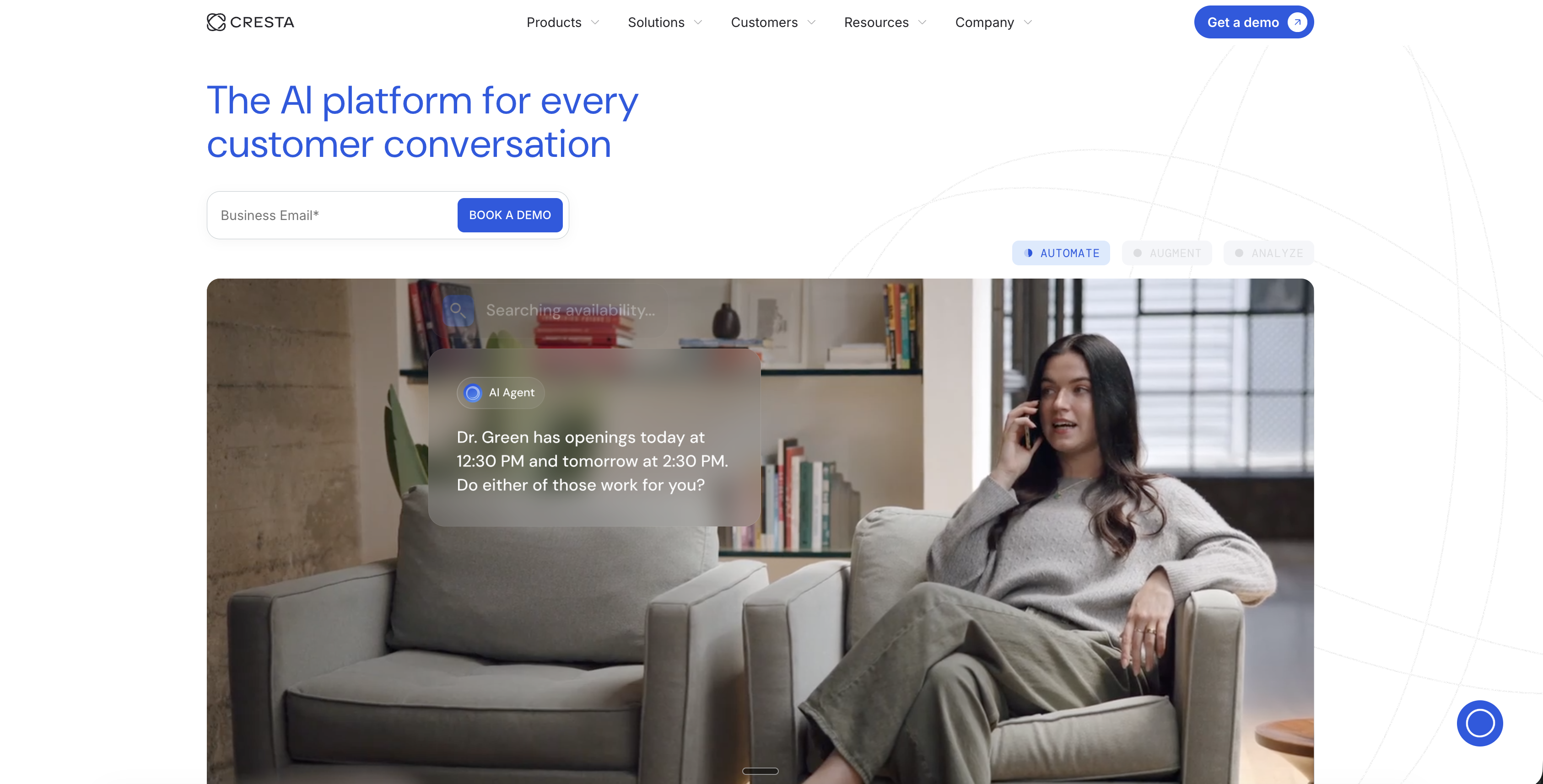
Cresta is a leading Customer Experience AI company that brings together Conversation Intelligence, Agentic Assist, and AI Agent within a single unified system built on shared data, models, integrations, analytics, and governance. The platform deploys alongside existing contact center technologies rather than replacing them.
What sets Cresta apart is how its Conversation Intelligence layer informs what agents get coached on and what guidance they see in live conversations. Rather than building coaching rules based on assumptions, Cresta's Outcome Insights use proprietary outcome inference models to identify which specific agent behaviors correlate with business results like customer satisfaction (CSAT), resolution, and sales conversion. Cresta is the only platform in this comparison that uses AI-inferred outcome data across both post-conversation coaching and in-conversation real-time guidance.
Key features:
- AI-targeted coaching suggestions analyze behaviors and outcomes for every agent and interaction, giving managers data-driven recommendations on who to coach and what to coach them on
- Automated quality scoring across 100% of conversations, with coaching plans personalized to each agent and a conversation library for curating best-practice examples
- Cresta Agentic Assist delivers real-time behavioral hints and compliance reminders during live conversations across voice and chat
- Cresta Agentic Assist hints can be targeted to individual agents based on their adherence to key behaviors
- Live assist gives supervisors real-time transcripts, hand-raise escalation, and proactive whisper guidance
Who it's for: Customer experience teams that want coaching informed by outcome data rather than activity metrics. With more than seven years building quality management and coaching tools, Cresta works for organizations that need real-time guidance, automated quality scoring, and behavior-to-outcome analysis on a single platform. Holiday Inn achieved a 30% increase in bookings conversion after deploying Cresta's real-time coaching, while agent attrition dropped from 120% to 60% and employee satisfaction jumped from 47% to 70%.
2. NICE CXone
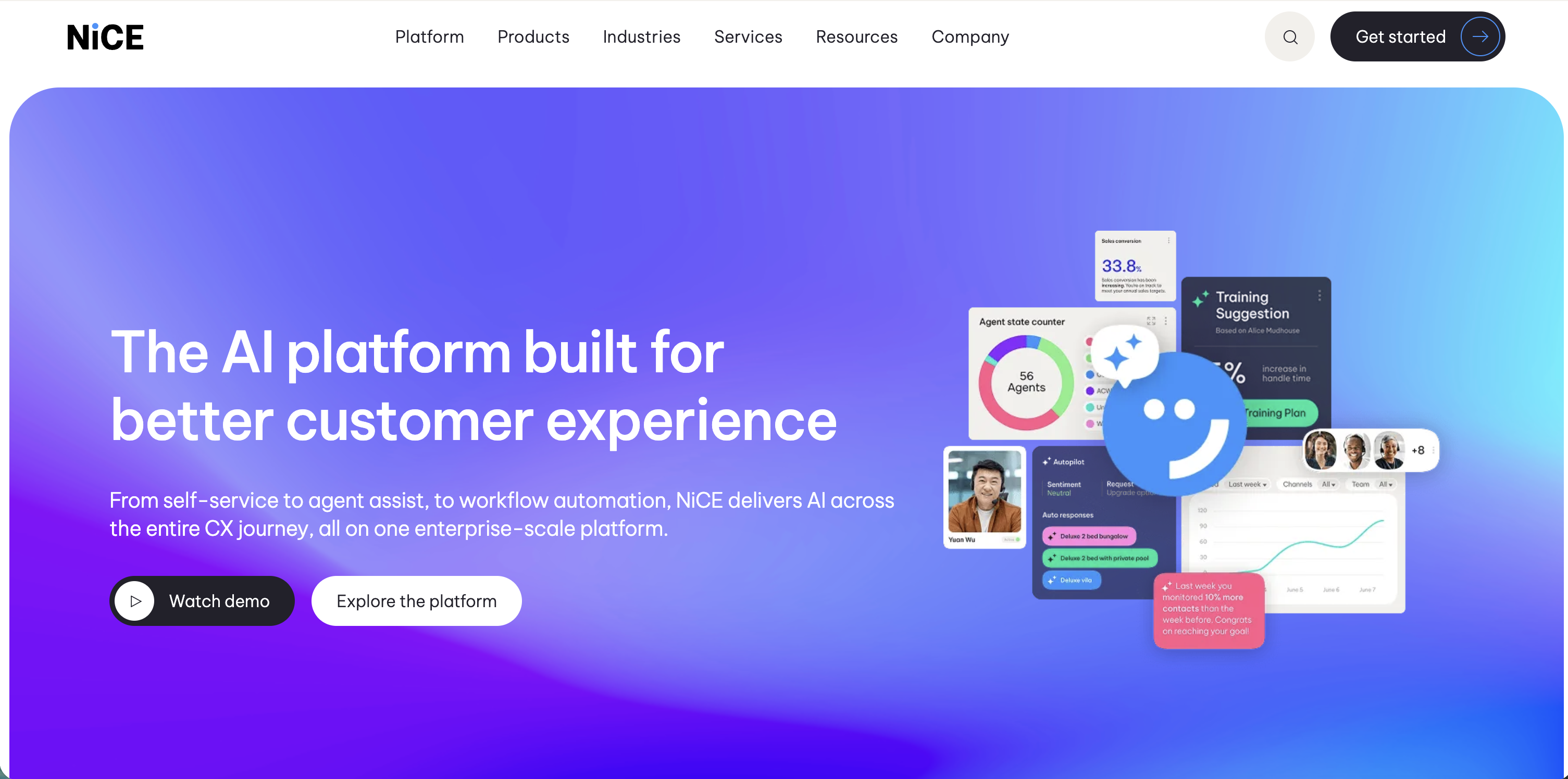
NICE CXone delivers real-time agent coaching through its Real-Time Interaction Guidance (RTIG) feature, powered by Enlighten AI behavioral models. RTIG measures customer satisfaction and likelihood-to-buy behaviors during live conversations and scores agents on the selected behavior set as the conversation unfolds, while other guidance is phrase- and keyword-based.
Key features:
- Live sentiment analysis, next-best-action prompts, and compliance alerts during active interactions
- Native integration with CXone quality management capabilities including automated evaluation scoring and performance scorecards
- Enlighten AI behavioral models for soft-skill measurement and scoring
Who it's for: Organizations already running NICE infrastructure who want real-time coaching without adding another vendor. The tradeoff is ecosystem commitment. RTIG also supports integrations for Salesforce and Microsoft, and the coaching intelligence is tied to NICE's proprietary Enlighten AI models rather than allowing custom outcome measures.
3. Genesys Cloud CX
Genesys Cloud CX integrates real-time agent coaching into its broader CCaaS platform, combining AI-powered agent assist with supervisor coaching tools across multiple intervention modes.
Key features:
- Supervisor intervention modes for voice interactions ranging from silent monitoring to direct coaching to barge-in
- Conversation scanning with knowledge base suggestions, speech and text analytics, and AI-generated conversation summaries
- External AI connections through its Interaction Widget framework for incorporating third-party tools
Who it's for: Organizations already running Genesys infrastructure who want coaching natively integrated without adding vendors. The tradeoff is that Genesys's coaching intelligence focuses on coaching workflows rather than automated behavior-to-outcome correlation. The platform flags moments for review but does not automatically identify which specific agent behaviors drive CSAT or conversion.
4. Balto

Balto specializes in real-time agent guidance during live calls, pairing speech analytics with dynamic prompts that give agents immediate coaching as conversations happen. The platform deploys alongside existing CCaaS infrastructure rather than requiring platform replacement.
Key features:
- Dynamic prompts and guidance during live conversations
- Supervisor tools for identifying coaching opportunities and reviewing call moments
- Integration with existing contact center systems
Who it's for: Organizations that want to add real-time coaching prompts without replacing existing infrastructure. The tradeoff is scope, particularly around behavior-to-outcome analysis.
5. Observe.AI
Observe.AI combines quality management and post-interaction analytics with real-time agent guidance, using historical performance data to personalize coaching for individual agents rather than delivering the same prompts to everyone.
Key features:
- Personalized real-time guidance tailored to each agent's past performance patterns
- Structured coaching sessions with recommendations from historical agent performance data
- Supervisors can add relevant interactions directly to coaching session agendas
Who it's for: Customer experience (CX) leaders who prioritize historical performance analysis and personalized coaching plans. The tradeoff is real-time execution. Observe.AI has historically focused on post-interaction analytics, and its in-conversation coaching is less mature than purpose-built real-time platforms. The platform also lacks outcome inference models, meaning coaching targets are based on configured rules rather than data-proven behavioral correlations.
What To Prioritize When Evaluating Platforms
Choosing a real-time coaching platform involves more than comparing feature lists. McKinsey has found that traditional coaching often falls short because supervisors spend too little time coaching and base feedback on only a handful of an agent's monthly calls. The criteria below separate the platforms that produce lasting performance improvement from those that generate activity without impact.
Integration Architecture
Integration architecture determines whether a platform enhances your existing infrastructure or forces you to replace it. CCaaS-native coaching tools from NICE and Genesys integrate deeply within their own ecosystems, while some capabilities also extend through supported integrations. Specialized tools like Cresta and Balto deploy alongside existing infrastructure, which reduces migration risk but requires evaluating how well the tool connects with your current telephony, customer relationship management (CRM), and quality management systems. The wrong fit here creates friction that undermines adoption regardless of how good the coaching intelligence is.
Behavior-To-Outcome Correlation
This is the evaluation criterion that creates the widest gap between platforms. Some platforms track what agents say and flag moments for supervisor review. Others go further and identify which specific agent behaviors correlate with business outcomes like CSAT, first call resolution (FCR), and sales conversion. The difference matters because coaching agents on behaviors proven to drive results produces measurably different outcomes than coaching based on assumptions about what good looks like.
Vivint, a smart home security provider handling roughly 60,000 calls per week, saw this distinction play out in practice. After deploying Cresta Agentic Assist, Vivint achieved a 7% higher closed-won rate during its pilot, and managers reclaimed more than five hours per week previously spent on manual quality assurance (QA), redirecting that time toward strategic coaching conversations. The gains came not from coaching more, but from coaching on the right behaviors.
Quality Management At Scale
Traditional quality management programs review only a small sample of conversations through manual sampling. According to COPC Inc., most teams review just 2% to 5% of interactions. The Cresta State of the Agent Report (2024) found that 75% of agents actively seek more visibility into the data used to judge their performance, which makes sense when you consider that a random sample might misrepresent how any individual agent is performing. Platforms that score 100% of conversations automatically change quality management from a sampling exercise into a continuous performance system, and give agents confidence that their coaching reflects their full body of work rather than a handful of cherry-picked calls.
Compliance Monitoring
Compliance monitoring frameworks matter for contact centers handling sensitive customer data. Platforms should support regulations including the General Data Protection Regulation (GDPR), the Health Insurance Portability and Accountability Act (HIPAA), the Payment Card Industry Data Security Standard (PCI-DSS), the Telephone Consumer Protection Act (TCPA), and any industry-specific requirements. Look for role-based access controls, call encryption, audit trails, and real-time violation flagging during live interactions.
Organizational Readiness
The right platform for any organization depends on existing infrastructure, the specific performance gaps that need closing, and how much organizational change the operation can absorb at once. Starting with a pilot of 20 to 30 agents on one or two high-impact use cases, with formal reviews every two to four weeks, consistently produces better outcomes than full-scale deployment from day one.
How To Choose The Best Agent Coaching Platform
The right platform depends on your existing infrastructure and the outcomes you need to move. A few scenarios map cleanly to the options in this guide.
If you already run a CCaaS platform and want coaching integrated natively, NICE CXone and Genesys Cloud CX keep coaching inside the ecosystem you operate. If you want to add real-time prompts without replacing your infrastructure, Balto deploys alongside existing systems and focuses on in-call guidance. If you need coaching tied to outcome data, Cresta connects real-time guidance, automated scoring, and coaching on one data foundation, with quality management scoring 100% of conversations across AI and human interactions.
Whichever direction fits, start small. A pilot of 20 to 30 agents on one or two high-impact use cases, with formal reviews every two to four weeks, is the recommended first step. It lets you measure real outcomes before a full rollout. It also gives agents and supervisors time to build the coaching habits that make any platform work.
Making Real-Time Coaching Work In Practice
The platforms in this guide take different approaches to real-time coaching, but the ones that produce lasting results share a common trait. They connect coaching to outcomes rather than treating coaching as an activity. When coaching is informed by data that shows which behaviors drive CSAT, resolution, and revenue, the feedback agents receive during live conversations becomes more precise and more impactful.
Cresta is built for this approach. The platform connects Cresta Agentic Assist for real-time coaching with Cresta Conversation Intelligence for automated quality scoring and behavior-to-outcome analysis, so the coaching agents receive during conversations is grounded in data from 100% of interactions rather than assumptions or small samples. Cresta Coach then ties performance to structured coaching plans, giving managers visibility into which agents need support and what specific behaviors to focus on. Because these capabilities share a unified data foundation, coaching insights, quality scores, and performance trends reinforce each other rather than living in separate systems.
Visit our resource library to explore more on real-time coaching and agent performance, or request a demo to see how Cresta Agentic Assist delivers coaching during live conversations.
Cresta is dedicated to helping businesses of all sizes make informed decisions. We adhere to strict editorial guidelines to ensure that our content meets and maintains our high standards.