
Real-Time Sentiment Analysis for Contact Centers
.avif)

• Post-call sentiment review tells you what went wrong after the customer has already hung up frustrated. Real-time sentiment analysis detects frustration as it builds, fast enough for supervisors to intervene and agents to adjust before the conversation ends badly.
• The technology goes well beyond basic positive or negative scoring. Modern systems recognize nuanced behavioral patterns like a customer expressing frustration about wait time or an agent successfully overcoming a pricing objection, using semantic understanding rather than keyword matching.
• Sentiment detection during live conversations serves two audiences simultaneously. Agents see guidance on their screens when the system detects a moment that needs a different approach. Supervisors get visibility across all conversations and can send coaching or intervene without the customer knowing.
• The same sentiment layer that supports human agents also shapes how AI agents respond in autonomous conversations, enabling dynamic, context-aware responses when the system detects that the interaction is heading somewhere difficult.
• Sentiment data is most valuable when it connects to action rather than just reporting. The guide covers how detected patterns feed into coaching recommendations, real-time behavioral hints, and broader operational improvements based on what's actually happening across every conversation.
Somewhere in yesterday's calls, customers signaled they were about to cancel. Agents struggled with issues no one caught. Product problems sparked complaints that will repeat today, tomorrow, and next week. Multiply that across every day of the year, and you see the scale of what contact centers are missing. But with most organizations reviewing only 2-3% of conversations, these signals stay buried until they surface in a monthly report, long after hundreds of customers have already churned or escalated.
Real-time sentiment analysis offers a better approach. Instead of discovering problems after the fact, the technology detects customer frustration as it happens, fast enough for supervisors to intervene and agents to adjust before conversations end badly. The shift from post-call review to in-the-moment awareness turns contact centers from reactive operations into places where issues get resolved while customers are still on the phone.
This guide covers how real-time sentiment analysis works in enterprise contact centers, the benefits for supervisors and agents, implementation steps, and compliance requirements.
What is real-time sentiment analysis?
Real-time sentiment analysis is the detection of customer emotions during live conversations, fast enough for supervisors to intervene before customers hang up angry. The system listens to calls as they happen, spots when customers get frustrated or confused, and alerts the right people on time. This applies to every conversation in the contact center, including those handled by AI Agents, giving supervisors a unified read on customer sentiment regardless of who or what is managing the interaction.
The difference from traditional analytics comes down to timing. Post-call systems analyze recordings hours or days later, useful for coaching and trend identification, but offering no opportunity to change the course of a live conversation. On the other hand, real-time systems surface insights while customers are still participating in the conversation, creating a window to intervene before situations escalate. Supervisors can step in immediately, and agents can adjust their approach before interactions end poorly. This timing distinction determines what you can actually do with the insights. Post-call analysis tells you what went wrong, while real-time detection lets you fix it.
See what conversations reveal and learn how to use your conversation data
How does real-time sentiment analysis work?
Understanding the underlying technology helps explain what these systems can and can't do. The process involves multiple AI components working together fast enough to deliver guidance while conversations are still happening.
The foundation is speech recognition that converts audio into text in real time. Generic speech models struggle with industry terminology, regional accents, and the specific vocabulary your customers use. Production-grade systems like Cresta's Custom ASR achieve over 92% transcription accuracy by training on your actual call recordings and business-specific vocabulary, with continuous improvement as the system learns from corrections.
As words are spoken, speech recognition converts them to text in a few hundred milliseconds. Behavior and intent models then analyze the transcribed text in chunks alongside the surrounding context. That analysis immediately feeds the guidance layer, surfacing hints, alerts, or supervisor notifications while the conversation is still unfolding. This goes beyond simple keyword matching or basic sentiment scoring.
Cresta trains small language models to recognize nuanced behaviors like "customer expressing frustration about wait time" or "agent successfully overcoming a pricing objection" using semantic understanding rather than rigid rules. These models learn to identify the patterns that matter for your specific operation.
The system then triggers contextual guidance for human agents based on detected behaviors and intents. The same detection layer also shapes AI Agent prompting, enabling dynamic, relevant responses when conversations are handled autonomously. When the models recognize a situation where intervention would help, agents see relevant assistance on their screens.
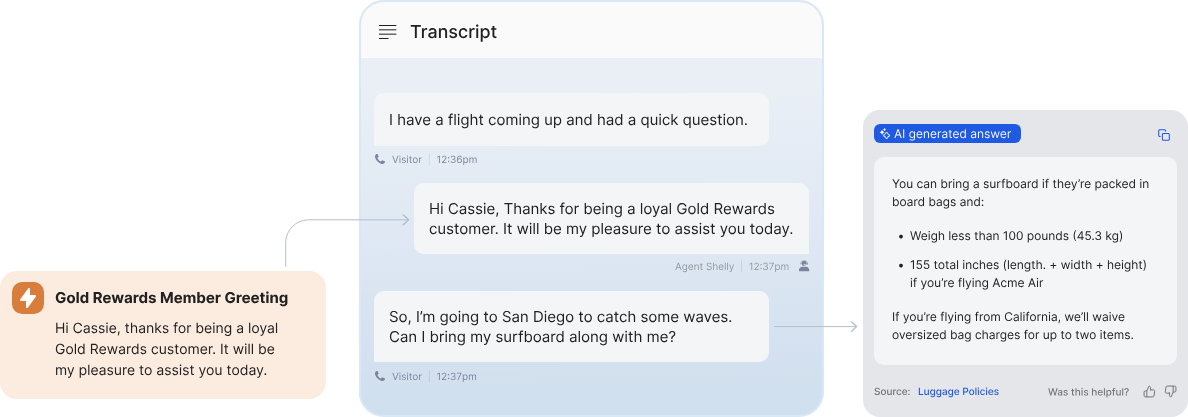
This might appear as a behavioral hint suggesting a de-escalation approach, a checklist walking through required compliance steps, a knowledge article addressing the specific issue the customer raised, or a guided workflow for handling complex scenarios. Each type of guidance appears differently to match the nature of the coaching moment.
For supervisors, the system surfaces conversations that need attention through the Agent Operations Center. Live transcripts and behavioral indicators let managers monitor what's happening across their team, whether conversations are handled by human agents or AI Agents, and send guidance through channels invisible to customers. The same visibility extends to AI Agent conversations, giving supervisors real-time oversight and intervention capability across both human and autonomous interactions.
Cresta's architecture combines 20+ specialized language models, including proprietary, fine-tuned open source, and third-party models, into task-specific systems optimized for each use case.
This multi-model approach pairs advanced LLMs with deterministic systems, balancing AI flexibility with rule-based reliability. The no-code workflow engine, Cresta Opera, lets you define behaviors, intents, and actions without engineering resources, then test and refine triggers based on how they perform against actual conversations.
What are the benefits of real-time sentiment analysis?
The operational value of real-time sentiment analysis becomes clear when you examine how it changes daily work for each role in the contact center. First-contact resolution consistently ranks as the most important factor in customer experience. ContactBabel research found that 83% of contact center leaders place it in their top three priorities. Real-time sentiment analysis directly supports this goal by giving supervisors visibility into struggling conversations, agents the support to resolve issues before they escalate, and customers faster paths to resolution.
Supervisors gain visibility that was previously impossible
Traditional quality monitoring forced supervisors to work from samples. Post-call review meant analyzing a tiny fraction of conversations days after they happened, with no opportunity to influence outcomes.
Real-time analysis changes this dynamic entirely by letting supervisors see what's happening across their full team as conversations unfold, with behavior and intent detection flagging the moments that need attention. They can identify struggling agents during shifts rather than discovering problems in weekly reviews, and they can step into crisis situations before customers demand escalation.
This visibility becomes especially valuable given the 30-45% annual turnover typical in contact centers. New agents inevitably struggle, but supervisors can't hover over every call. Behavior-based alerts let experienced supervisors focus coaching attention where it will actually prevent customer churn rather than spreading their time across random samples.
Cresta operationalizes this visibility through the Agent Operations Center, which gives supervisors a single dashboard showing every conversation happening in real time. Alerts fire when the system detects behaviors that warrant attention, such as customer frustration, compliance risks, or escalation signals, letting supervisors intervene at the moments that matter most.
When conversations reach critical thresholds or the system detects crisis-level language like threats to cancel or mentions of legal action, routing logic can direct interactions to specialists trained for high-stakes recovery.
The same logic applies to AI Agents. When an AI Agent encounters a situation requiring consultation, confirmation, or approval, or when a customer becomes visibly frustrated, the system can route the conversation to a supervisor for real-time guidance or intervention. This keeps AI Agents from operating in isolation during high-stakes moments while preserving containment whenever possible.
Beyond reactive intervention, real-time data can also improve how calls get routed in the first place. Rather than treating all incoming calls identically, routing engines can match customers showing signs of frustration or those with a history of negative experiences to agents with proven de-escalation track records.
Agents get the support they actually want
The assumption that agents resist technology doesn't hold up to scrutiny. According to Cresta's State of the Agent Report, 65% of agents want to use real-time AI hints and suggestions during customer interactions, and 81% report performing better because of the technology available to them. Agents recognize that good tools make their jobs easier and their outcomes better.
The challenge is that most contact centers aren't delivering on this expectation. CCW Digital research shows 90% of contact centers prioritize empathy and soft-skills training as interactions become more complex. Yet according to Cresta's State of the Agent Report 2024, less than half (49%) of agents report receiving effective on-the-job coaching. The same research found that personalized AI coaching is nearly 3x more effective than one-size-fits-all approaches.
Real-time behavior detection bridges this gap by delivering coaching based on what's actually happening in conversations rather than assumptions about what agents might need.
The impact on agent satisfaction shows up clearly in the data. Agents receiving personalized coaching reported happiness at work at 91% versus only 57% with standard coaching, a 34-point gap driven largely by the quality of real-time support they receive. Meanwhile, the same sentiment detection runs across AI Agent conversations, ensuring that when autonomous interactions show signs of customer frustration, the system can escalate or adjust before the experience breaks down.
Customers experience faster, better resolution
When supervisors can intervene during conversations rather than discovering problems days later, more issues get resolved on the first contact. The customer experience improvements follow directly from the operational changes happening on the agent and supervisor side.
Brinks Home demonstrates this connection clearly. The home security provider was transferring 30% of their calls, fragmenting the customer experience and driving up costs. After deploying Cresta Agent Assist and Conversation Intelligence, they reduced their transfer rate to just 8%, a 73% improvement that directly reflects more issues resolved on first contact. The result was a 30-point NPS increase alongside the operational gains.
The multi-modal approach gave agents emotional context during live conversations, allowing them to adjust based on how customers actually felt rather than guessing from words alone. As AI Agents handle a growing share of routine interactions, applying the same sentiment analysis to those conversations ensures that automation doesn't create a blind spot. Customers receive the same level of emotional awareness whether they're speaking with a person or an AI Agent.
How to implement real-time sentiment analysis without disrupting operations
Rolling out real-time sentiment analysis across an entire contact center at once creates unnecessary risk. A phased approach lets you prove value, refine configurations, and build organizational confidence before committing to full deployment.
1. Start with an assessment
Before selecting agents or configuring thresholds, establish your strategic foundation. Evaluate three dimensions: your organization's appetite for AI migration speed, your customers' channel preferences, and your vision for how the agent role should evolve. These factors shape pilot scope and success criteria.
Plan to start with a single team or use case, large enough to generate meaningful data but focused enough to maintain close oversight. Focus on one or two specific call types like billing inquiries or technical support, where sentiment patterns are relatively consistent. If your operation already uses AI Agents for certain interaction types, include those conversations in your pilot to establish unified sentiment baselines across both human and autonomous handling. Additionally, define the improvement thresholds that would justify expansion, and establish baseline metrics across CSAT, first contact resolution (FCR), average handle time (AHT), and escalation identification time.
You should also set realistic timeline expectations from the start. CCW Digital research shows that 84% of contact center leaders believe teams need at least 6 months to develop essential competencies for AI-era work. Organizations that underestimate this timeline create frustration among agents and supervisors who aren't adequately prepared for new workflows.
2. Run a controlled pilot
Deploy sentiment analysis only to your selected agent cohort and track performance against a control group. The metrics that matter include CSAT score improvements (targeting 15-20 point increases), FCR rate changes, AHT impacts, quality management score improvements, agent satisfaction ratings, and escalation or transfer rate reductions.
Pay attention to qualitative feedback alongside the numbers. Agents and supervisors who use the system daily will identify workflow friction, false-positive patterns, and threshold adjustments that metrics alone won't reveal.
3. Validate before expanding
Before moving beyond the pilot, confirm that the minimum criteria are met:
- Improvement in at least one key metric
- Positive agent feedback
- Demonstrated technical stability
- Validated ROI projection
- Security compliance validation
If the pilot falls short, you have options beyond abandoning the initiative. You might extend the pilot with adjusted parameters, switch platforms if technical limitations are identified, or select different interaction types that might be better suited to the technology. The pilot exists precisely to surface these issues before enterprise-wide commitment.
4. Expand in phases
Following successful validation, expand deliberately rather than all at once. First, add additional call types while keeping the original pilot agents as your experienced user base. Second, deploy to additional agent teams with training programs informed by pilot learnings. Third, roll out enterprise-wide while integrating with broader customer experience initiatives and establishing ongoing governance for model refinement. As you scale, ensure sentiment analysis covers new AI Agent use cases alongside human agent expansion, maintaining consistent quality oversight as your automation footprint grows.
Throughout expansion, invest heavily in change management. Address agent concerns about surveillance directly by communicating how sentiment analysis will be used for coaching rather than punishment. Agents who fear constant monitoring will game the system or resist adoption, undermining results before the initiative gets traction.
Making real-time sentiment analysis work for your operation
Real-time sentiment analysis has moved from experimental technology to foundational contact center infrastructure. Organizations implementing these capabilities achieve meaningful ROI through customer retention value and efficiency gains when sentiment detection combines with automated quality management and real-time coaching.
The path to value runs through controlled pilots that prove results before expansion, privacy-by-design architecture that addresses compliance from day one, and vendor partnerships that support change management alongside technology deployment.
Cresta demonstrates how real-time sentiment analysis changes contact center operations when combined with the right coaching delivery mechanisms and supervisor oversight. Cresta Behavioral Guidance provides targeted hints, checklists, and workflows at precisely the right moments throughout conversations, reinforcing behaviors that impact CSAT, sales, and compliance.
And for supervisors, the Agent Operations Center brings unified visibility into both AI and human-led conversations, with the ability to guide or intervene at critical moments without switching between tools.
Visit our resource library to explore conversation intelligence and agent assist capabilities, or request a demo to see how real-time sentiment analysis works in practice for your contact center.