
How to Improve Contact Center Efficiency in 2026
.avif)

• Contact center leaders are being asked to handle more volume without adding headcount at the same rate, while meeting compliance requirements and keeping satisfaction scores up. The guide covers how to approach that structural challenge across workforce management, knowledge systems, coaching, automation, and analytics.
• First call resolution is the most reliable efficiency lever because it uniquely affects both cost and satisfaction at the same time. Every repeat contact is work the team already did once, so improving FCR reduces total handling cost while also improving the customer experience.
• Knowledge access during live conversations is one of the most underinvested efficiency opportunities. When agents search across multiple systems mid-call, every tab switch and hold translates into longer handle times and lower resolution rates.
• Agent experience is an efficiency lever in its own right, not a separate HR concern. Contact centers that reduce cognitive burden, eliminate after-call work, and give agents tools that actually help them succeed see lower turnover and better performance across the board.
• The highest-leverage efficiency gains often come from fixing the self-service flows that drive calls in the first place. Preventing an unnecessary contact costs less than optimizing how it gets handled once it arrives.
Contact center efficiency improvements start with a simple truth: you're being asked to handle more volume without letting satisfaction slip, while meeting compliance requirements, and without adding headcount at the same rate. The competing demands are structural. Better management alone won't resolve them.
This guide covers how to approach contact center efficiency across workforce management, knowledge systems, coaching, automation, analytics, and several often-overlooked operational levers, where each creates measurable impact, and how to connect them into a system that improves over time.
What is contact center efficiency, and why does it matter?
Cost per contact anchors most efficiency conversations because it captures the real unit economics of support. For operations handling millions of annual contacts, even a $1 reduction per contact translates to significant annual savings.
But cost per contact only tells part of the story. According to Cresta's State of the Agent Report 2024, each new agent hire costs $10,000 to $21,000 in training and recruiting, plus lost productivity during ramp-up. With annual turnover running between 30 and 45%, the financial drag compounds fast. Contact centers that reduce friction for agents keep them longer, and those that improve response quality see satisfaction scores climb. Efficiency and experience reinforce each other.
This reflects a broader shift. Customer experience as a primary competitive factor nearly doubled for B2C companies between 2021 and 2023, rising from 20% to 38%. Many contact centers now evaluate performance across operational, customer, and workforce measures rather than speed and cost alone.
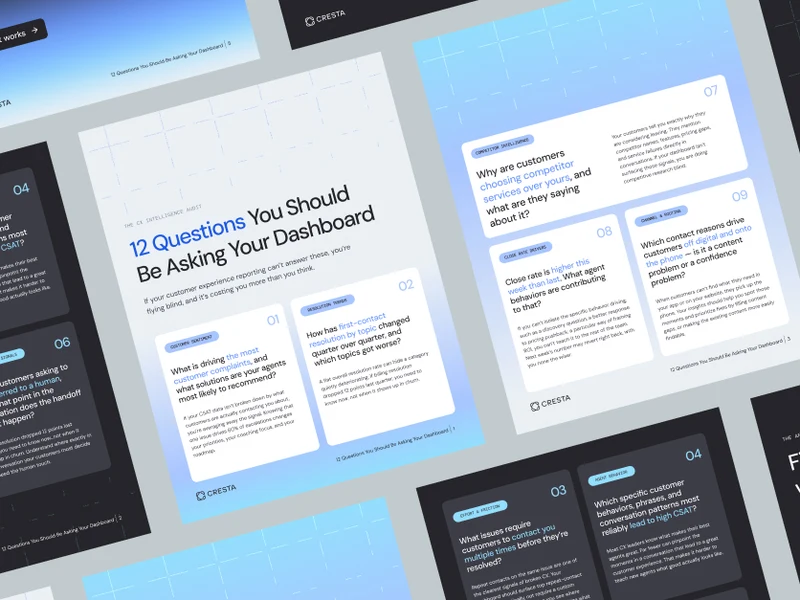
Start by asking your dashboard these questions
How should you measure contact center efficiency?
First call resolution (FCR) stands out as a premier efficiency metric because it connects cost and quality in a single number. When FCR goes up, repeat contacts go down and CSAT tends to improve. Every repeat contact is work your team already did once, so improving FCR reduces total handling cost while sparing customers from calling back.
Core KPI framework for contact center efficiency
Each KPI captures a different dimension of performance and they often pull in opposite directions. The table below covers the core KPIs most enterprise contact centers track.
These metrics interact with each other, and optimizing one in isolation often moves others in the wrong direction.
Why average handle time alone can mislead
Focusing solely on reducing AHT can hurt FCR. When agents rush to hit handle time targets, they often fail to resolve the underlying issue. A Cresta IQ analysis of tens of thousands of conversations found that in industries where average AHT is under 7 minutes, conversations that result in sales clock in at over 20 minutes. Pushing agents toward shorter calls can leave money on the table and problems unresolved.
The occupancy and burnout tradeoff
High occupancy rates signal utilization but demand careful management. Sustained overload creates fatigue, higher error rates, and eventually increased turnover. Efficiency gains at the expense of sustainable workloads tend to reverse themselves as experienced agents leave.
Continuous improvement with conversation analytics
Most contact centers make decisions based on a thin slice of what actually happens. Traditional QM programs typically sample only a small percentage of conversations, and CSAT surveys capture only a small, self-selecting group. That leaves the vast majority of interactions unanalyzed.
Why sampling falls short
QM analysts might review 100 calls out of 10,000 on a given day, leaving patterns, coaching opportunities, and compliance risks invisible across the other 9,900. Survey response rates compound the problem, meaning the picture you're working from is incomplete in both directions.
What 100% conversation coverage changes
This is how CVS Health went from scoring 5% of calls to 100% with AI. They now measure predictive CSAT on 100% of calls, turning weeks of delay into an immediate signal. As Srikant Narasimhan, VP and Head of Enterprise Customer Experience & Insights, put it, "It gives us credibility using operational data and scale… We don't need to ask. We know what's wrong."
With full conversation coverage, organizations can correlate specific agent behaviors with business outcomes like sales conversions, resolution rates, and satisfaction, building quality scorecards around what the data proves drives results.
Workforce management and staffing optimization
Labor dominates contact center budgets, so measurable cost impact starts here. The fundamental challenge is prediction accuracy. Machine learning based forecasting can narrow the error range, reducing both waste and burnout. The most effective strategies layer multiple approaches:
- Core scheduled workforce covers baseline demand for predictable volume patterns.
- Part-time and flex agents absorb volatility without fixed full-time cost.
- Self-service scheduling lets agents pick up premium shifts, improving coverage and agent control.
- Skills-based staffing uses conversation analytics to identify which agents excel at specific conversation types, extending skills-based routing logic to schedule planning.
- Performance-based shift bidding gives top performers priority on preferred shifts, rewarding results and retaining high-impact agents at low cost.
Routing matters just as much as headcount. When a billing question lands with a technical support agent, or a complex call goes to a new hire, the result is predictable: longer calls, more transfers, lower FCR. Skills-based routing paired with unified analysis across voice and chat gives leaders a clearer picture of where mismatches occur.
Agent training and real-time coaching
The performance gap between top agents and everyone else represents one of the largest efficiency opportunities. A 2018 Harvard Business Review article on employee experience confirmed that differences in capability and engagement materially affect service outcomes and business performance. Closing even a fraction of that agent performance gap would move the needle on virtually every KPI.
Why traditional coaching falls short
Managers spend hours reviewing recorded calls and preparing feedback, yet by the time agents receive guidance, the moment has passed. Coaching arrives too late and too generic to help agents improve in the flow of work.
How real-time guidance changes the equation
Cresta Agentic Assist provides contextual next-best-action recommendations and compliance reminders that adapt to conversation flow in the moment. Paired with Knowledge Agent, which reduces the cognitive load of information retrieval, agents can focus on the conversation itself.
This is how Cox Communications improved performance after implementing Cresta:
- 20 to 30% increase in revenue per chat in residential sales
- Manager-to-agent ratio improved from 10:1 to 14:1
- New hire ramp time reduced by two weeks
- All new hires reached 100 to 200%+ of revenue attainment goals for the first time ever
Better guidance changes more than what agents do. It changes how the team is staffed and supported.
How proactive knowledge delivery replaces agent knowledge search
Agents lose time hunting for information mid-conversation. Every search, tab switch, and hold translates into longer handle times and lower resolution rates. System fragmentation makes this worse: customer data lives in CRMs, policies in knowledge bases, and workflows in separate tools. This constant switching creates a productivity tax.
Cresta recently launched Knowledge Agent, an agentic assistant that continuously listens and delivers precise answers in real time, grounded in both conversation and on-screen context. It operates through a persistent browser sidebar that follows agents across tabs, identifying intent from the conversation while reading relevant on-screen data such as account status or order history. It surfaces precise, cited answers, links to sources, and step-by-step guided workflows with no prompting required.
The result is that generalists can handle a wider range of issues without transfers or holds. In the launch announcement, Cresta described the product as eliminating guesswork while improving both employee satisfaction and FCR.
Generative Knowledge Assist, Cresta's existing capability within Agentic Assist, continues to provide proactive knowledge during conversations. Knowledge Agent extends this further by incorporating real-time browser context through a persistent sidebar experience.
Agent experience as an efficiency driver
Burnout, workload complexity, lack of schedule control, and insufficient recognition all contribute to costly turnover. Agent experience is an efficiency lever in its own right, not a separate HR concern.
Contact centers that invest in schedule flexibility, reduce cognitive burden, minimize after-call work, and recognize performance beyond handle time metrics retain experienced agents longer. Those agents resolve issues faster, escalate less frequently, and require less supervision, compounding into measurable savings.
IVR optimization as an efficiency and revenue lever
Interactive voice response (IVR) systems shape the customer experience before a conversation begins. A well-designed IVR resolves straightforward requests autonomously while routing complex issues to the right agent and capturing intent data that speeds up the conversation.
IVR systems that incorporate customer data can eliminate the first 30 to 60 seconds of every call where agents ask "How can I help you?" and "Can I get your account number?" Operations leaders should also consider how IVR flows connect to self-service and digital channels, offering paths to chat, app, or web self-service when IVR completion fails.
Contact center self-service strategy beyond automation
Self-service and AI automation are related but distinct. Automation focuses on AI resolving conversations end-to-end, while self-service gives customers tools to resolve issues on their own, often before contact. Poorly implemented self-service often creates more contacts than it prevents.
Effective self-service starts with understanding which issues customers can and want to resolve themselves. The measurement side matters too: without measuring whether self-service channels actually resolve issues, organizations cannot distinguish deflection from frustration.
Omnichannel orchestration without repetition
The real efficiency question for multichannel support is whether context travels with the customer. When a customer starts in chat, escalates to voice, and re-explains from scratch, you've doubled handling cost for a single issue.
Omnichannel orchestration means preserving identity, intent, prior actions, and conversation history across channel transitions. Cresta supports this through context-rich handoffs between Cresta AI Agent and Cresta Agentic Assist. When an AI agent escalates to a human, full conversation context transfers with it, and Agentic Assist continues supporting the agent with real-time guidance informed by everything before the handoff.
AI-powered automation in the contact center
Today's AI agents go beyond FAQ deflection. They manage complex interactions involving system lookups, conditional logic, multi-step resolution paths, and multi-intent conversations. The goal is autonomous resolution where conversation data supports it, measured by resolution quality rather than deflection volume alone.
Good automation candidates tend to be lower in complexity with high resolution rates and low customer frustration. But category alone is rarely the right filter. An outbound collections call might seem like a poor candidate, but customers can find it easier to engage with AI on sensitive financial topics. Identifying the right conversations requires analyzing real data rather than working from assumptions.
Cresta approaches this through Automation Discovery, which surfaces candidates based on actual conversation patterns, and Cresta AI Agent, which handles autonomous conversations with a Sub-Agent Architecture and enterprise guardrails. Cresta's product direction pairs agentic assistants like Knowledge Agent alongside autonomous AI agents so automation and augmentation work together.
Customer journey mapping and avoidable contact reduction
Some of the most valuable efficiency gains come from removing the need for contact altogether. Identifying avoidable contacts requires analyzing what customers actually say at scale, not just tagging call reasons in a CRM dropdown.
United Airlines provides a clear example. Through Cresta's conversation intelligence, United identified an app flow friction point driving customers to call. They fixed it, resulting in millions of dollars in annual savings. This type of upstream fix removes entire categories of volume rather than making individual contacts slightly more efficient.
Compliance, security, and governance in efficient operations
The same sampling limitation that weakens QM programs applies to compliance monitoring. Automated compliance monitoring across 100% of conversations reduces labor cost while improving coverage. Real-time compliance reminders reduce violations before they happen.
For regulated industries, automatic PII redaction, proper consent management, and audit-ready records are operational necessities. Cresta supports this through real-time compliance reminders within Agentic Assist, automated PII redaction, and security certifications including SOC-2 Type 2, HIPAA, PCI-DSS, and ISO 42001.
Implementation roadmap for operations leaders
Sequencing matters. A phased approach produces better results than deploying everything simultaneously.
Phase 1, establish baseline visibility. Deploy conversation analytics across 100% of interactions to understand performance patterns, identify top and bottom performers, and surface the behaviors that drive outcomes.
Phase 2, augment human agents. Deploy real-time guidance and knowledge tools including Agentic Assist and Knowledge Agent. Making every agent more effective before introducing automation creates a higher bar for what you automate against.
Phase 3, automate where the data supports it. Deploy AI agents for strong automation candidates with clear escalation paths and context transfer. Measure containment rates and resolution quality, not just deflection volume.
Phase 4, optimize and govern continuously. Connect analytics, coaching, and automation into a feedback loop. Establish governance around efficiency metrics across operations, QM, CX, and IT to prevent siloed execution.
Start with understanding, then augment, then automate, then optimize. Each phase builds on the one before it.
Ownership model for sustained efficiency gains
Efficiency initiatives stall when accountability is unclear. Operations owns staffing and routing, QM owns scoring, CX owns satisfaction, IT owns the stack, and revenue leaders own conversion. When each group optimizes independently, results conflict and nobody owns the system-level view.
A clear governance model that defines metric ownership, cross-functional tradeoff resolution, and prioritization authority separates organizations that sustain gains from those that plateau after the first quarter.
Turning strategy into results with Cresta
Cresta AI Agent, Cresta Agentic Assist, Cresta Conversation Intelligence, and Knowledge Agent share the same underlying data, models, and integrations. Insights from 100% of conversations inform real-time agent guidance, and the unified data layer means visibility continues across AI and human agent interactions.
Because all products share the same governance layer, improvements compound across the board. Each capability covered in this guide operates within that shared architecture rather than as a standalone tool.
Visit our resource library to explore more approaches to contact center efficiency, or request a demo to see how the platform works in practice.