
4 Agentic AI Use Cases Producing Results in Contact Centers
.avif)

• Agentic AI in contact centers goes beyond what previous automation waves could deliver. These systems reason through problems, take actions across multiple systems, and adapt based on conversation context, which is why organizations are achieving meaningful containment rates while simultaneously improving customer satisfaction.
• Real-time agent assistance is one of the most immediately deployable agentic applications because it enhances existing workflows rather than replacing them. Organizations commonly see measurable improvements within weeks rather than months.
• Handoff continuity is what separates implementations that deliver sustained value from those that stall. Systems that lose visibility when conversations escalate can not measure end-to-end resolution quality or use post-escalation outcomes to improve future automation.
• The implementations that succeed treat agentic AI as operational transformation rather than software deployment. Change management, process redesign, and getting teams on board typically determine outcomes more than the technology itself.
Every contact center leader knows the gap between what AI promises and what most implementations actually deliver. You're under pressure to reduce costs while improving satisfaction scores, scale contact volume without proportionally expanding headcount, and close the performance gap between your best agents and everyone else. The traditional playbook of hiring more agents, adding training, and implementing rigid scripts isn't working.
Agentic AI represents a fundamentally different approach than the chatbots that have frustrated your customers for the past decade. These systems reason through problems, take actions across systems, and adapt in real time. But the impact of this technology extends beyond autonomous customer interactions.
The same AI architectures that power autonomous agents also enable real-time guidance for human agents, automated quality management across every conversation, and intelligent routing that matches customers with the right resource. For situations that require a human touch, autonomous systems escalate to human agents with full context rather than forcing customers to start over.
Contact centers using agentic AI are achieving meaningful automation rates while simultaneously improving customer satisfaction, something previous automation waves couldn't deliver.
This article covers what agentic AI actually does in contact centers, the specific use cases producing measurable ROI, and the implementation factors that separate success from the projects that stall out before delivering value.
What is agentic AI for contact centers?
Agentic AI systems are autonomous digital workers that can reason through problems, take actions across multiple systems, and adapt their approach based on conversation context. They operate fundamentally differently from the flow-based chatbots and scripted interactive voice response (IVR) systems.
Traditional automation relies on decision trees and keyword matching. A customer asks a question, the system matches it to a pre-written response, and if the conversation doesn't follow the expected path, everything breaks down. The customer gets transferred, has to repeat themselves, and leaves more frustrated than when they started.
Agentic AI handles the complexity that breaks traditional systems. Advanced platforms use multi-agent architectures where specialized sub-agents collaborate on different aspects of a conversation. A routing agent identifies intent and selects the appropriate sub-agent. Each sub-agent handles specific tasks like authentication, diagnostics, or resolution execution.
Plus, deterministic state management uses code alongside the LLM to track each customer's progress step-by-step, ensuring the system triggers the right queries at the right moments and correctly uses information already collected in prior steps. This prevents the skipped steps and inconsistent responses that plague simpler architectures, so customers don't have to repeat themselves.
One of the key architectural differences is dynamic prompting versus static scripts. Rather than following rigid decision trees, agentic systems adapt their approach based on what's actually happening in the conversation. They can handle multi-intent requests where a customer asks about billing, then pivots to a technical issue, then wants to upgrade their service, all in one interaction.
Enterprise-ready agentic AI also includes layered guardrails that prevent hallucinations, enforce compliance requirements, and escalate appropriately when conversations exceed the system's authority.
Unified platforms maintain visibility across the full customer journey, not just the automated portion. When escalation happens, the human agent receives full context, including conversation history, entities extracted, and actions already taken, so the customer doesn't start over. Post-escalation outcomes then flow back into the system, creating a feedback loop that improves both AI and human performance over time.
How agentic AI works in practice
Here’s a simple example of how agentic AI works in contact centers. A customer contacts your center about a billing issue. A traditional chatbot pulls up the account balance and reads it back.
An agentic AI system works differently. It assesses the customer's history, checks for recent service changes, and identifies a billing anomaly from a plan migration three weeks ago. It then validates that a credit is appropriate based on company policies and approval thresholds, applies the adjustment within its defined authority, confirms the change with the customer, and updates the CRM. All of this happens within a single interaction.
When something falls outside the AI's decision authority, like a customer requesting an exception that requires manager approval, the system escalates to a human agent with full context. The agent sees the conversation transcript, the customer's account history, the specific issue identified, and the actions already attempted. They can immediately help rather than starting from scratch.
This handoff continuity represents a critical capability gap in many automation platforms. Systems that lose visibility when conversations escalate can't measure end-to-end resolution quality or use post-escalation outcomes to improve future automation.
4 agentic AI use cases delivering measurable outcomes right now
Four categories of AI applications are creating a measurable impact in contact centers today. Some are fully autonomous, like AI agents that resolve customer issues end-to-end. Others augment human performance, such as agent assist, which provides real-time guidance during live conversations, or automated quality management that analyzes every interaction for coaching and compliance.
Still others optimize operations behind the scenes, like intelligent routing that matches customers with the right resource before the conversation begins. All benefit from the same underlying advances in AI reasoning and adaptability.
1. Agent assist gives your team real-time guidance during customer calls
Real-time agent assistance represents one of the most immediately deployable agentic AI applications. These systems watch conversations as they happen and provide agents with relevant information, compliance reminders, and behavioral prompts exactly when needed.
Cresta Agentic Assist delivers this through generative AI that surfaces instant knowledge during customer interactions, automates after-call summaries, and provides real-time coaching prompts based on conversation context.
Cox Communications shows what this looks like at scale. The digital home solutions provider serves 6.5+ million customers and faced a challenge familiar to most contact center leaders: remote agents needed to perform better with minimal supervision while hitting growing revenue targets. Their previous approach couldn't scale. Managers could only coach so many agents, and the lag between a conversation and feedback made coaching abstract rather than actionable.
After deploying Cresta Agentic Assist, Cox saw a 20-30% increase in revenue per chat across their residential sales team. Manager span of control increased 40%, from a 10:1 to 14:1 agent-to-manager ratio, because real-time guidance handled much of what supervisors previously did manually.
New hires reached 100-200%+ of revenue attainment goals for the first time, with ramp time reduced by two weeks. The system prompted agents when customers showed buying signals or when compliance requirements applied, delivering the right information at the moment it mattered.
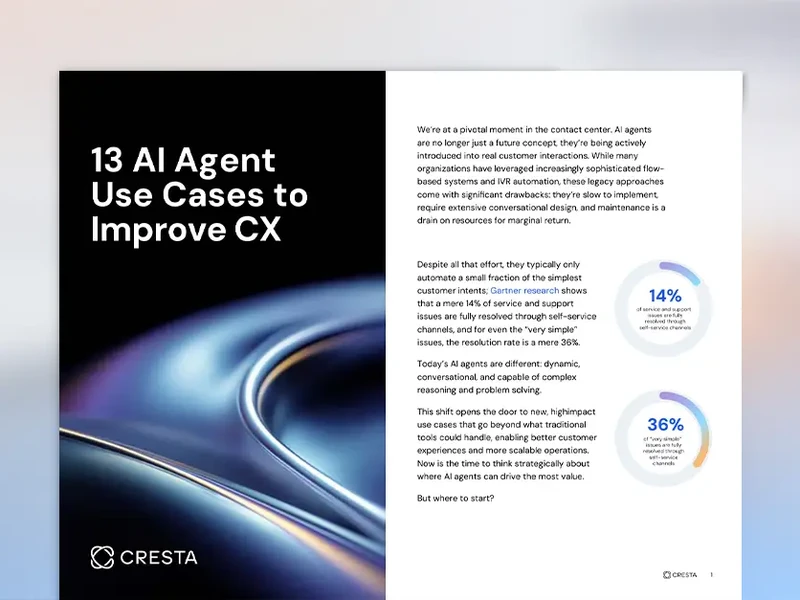
See 13 impactful use cases to figure out where to start
2. AI agents resolve customer inquiries at scale
AI agents handle customer service resolution, with containment rates varying based on use case complexity and implementation maturity. One architectural difference from traditional chatbots is the ability to reason through problems rather than match keywords to scripts.
Xanterra Travel Collection demonstrates what this capability unlocks. The company operates lodges across America's most iconic national parks, from Yellowstone to the Grand Canyon. Managing reservations, cancellations, and guest inquiries across multiple properties with seasonal demand spikes created a scaling challenge that traditional staffing couldn't solve economically.
After deploying Cresta AI Agent, Xanterra achieved a 74% average containment rate across properties, with Glacier National Park's AI agent "Skye" reaching 84%. The AI agents:
- Handle reservation modifications
- Answer property-specific questions
- Process routine requests autonomously
When conversations require human judgment, like complex itinerary changes or guest complaints, the system escalates with full context so agents can help immediately. Xanterra also deployed Cresta Agentic Assist alongside their AI agents, reinforcing sales behaviors across their human agent teams. This drove a $3.3 million increase in revenue, demonstrating how automation and augmentation work together.
3. Automated quality management finally covers 100% of interactions
Traditional quality management samples only 1-2% of interactions, creating blind spots in compliance, satisfaction, and performance. According to a CCW Market Study, 83% of contact center leaders say agents exert too much time and effort on simple interactions, yet most organizations lack visibility into where that time actually goes.
When you're only reviewing a handful of calls per agent per month, you're making decisions based on incomplete data. Issues fester for weeks before anyone notices patterns.
CVS Health, the largest pharmacy healthcare provider in the U.S., faced this exact problem. Coordinating customer experience insights across multiple large business lines meant relying on traditional survey-based feedback with low response rates and delayed signals. Agents were burdened with manual note-taking, and leadership waited weeks for insights that arrived too late to act on.
After implementing Cresta Conversation Intelligence, CVS moved from scoring 5% of calls to 100%. The shift from weeks to immediate time-to-insight changed how they operated; instead of reacting to problems after damage was done, they could identify emerging issues and address them proactively. As their VP of Enterprise Customer Experience put it: "We don't need to ask. We know what's wrong."
4. Intelligent routing connects customers to the right resource immediately
Traditional IVR systems force customers through static menus that often frustrate more than they help. A customer with a simple billing question navigates the same decision tree as someone with a complex technical issue, and neither gets to the right place efficiently.
AI agents can replace or augment IVR as the first point of contact, performing intelligent routing through natural conversation rather than menu selections. Instead of "Press 1 for billing, press 2 for technical support," the AI agent assesses context dynamically. It can pull CRM data to proactively ask about known intents, resolve simple requests directly, or route complex issues to the right human agent or specialized workflow.
This approach improves containment by handling routine interactions that don't need human involvement, reduces internal transfers by getting routing right the first time, and lowers handle times by collecting relevant information before any handoff occurs. Within AI agent conversations, a routing agent continues this work by identifying intent shifts and selecting the appropriate sub-agent for each task.
Multilingual routing adds another layer, automatically detecting a customer's language and directing them to the appropriate experience. Each routing decision generates data that helps optimize which interactions should be automated and which benefit from human expertise.
How Cresta makes agentic AI work at enterprise scale
Most contact centers cobble together point solutions for automation, agent guidance, and analytics.
Each tool generates its own data, requires its own integration, and operates in its own silo. When an AI agent escalates to a human, the analytics platform can't see what happens next. And when conversation intelligence surfaces a coaching opportunity, there's no connection to the real-time guidance agents receive.
The result is fragmented data, duplicate integrations, and insights that never translate into action.
Cresta solves this with a unified platform where AI agents, real-time agent assistance, and conversation intelligence share data, models, and infrastructure. Insights from analyzing conversations feed directly into improving both AI agent responses and human agent guidance. When an AI agent escalates, Agentic Assist picks up with full context and continues supporting the human agent through resolution. Post-handoff outcomes flow back into the system, so automation gets smarter based on what actually works.
This architecture creates compounding value. Cresta Conversation Intelligence identifies which agent behaviors drive outcomes. Agentic Assist reinforces those behaviors in real time. Cresta AI Agent automates the interactions where those behaviors are well-established. Each component makes the others more effective, rather than operating as disconnected tools that happen to share a vendor name.
The multi-model AI architecture reinforces this advantage. Cresta's multi-model architecture deploys task-optimized models fine-tuned on contact center conversations. Different models handle speech recognition, intent detection, response generation, and quality scoring, each purpose-built for its specific job. The result is accuracy on industry terminology and conversational patterns that general-purpose AI can't match.
Cresta integrates with major CCaaS platforms like NICE, Genesys, Cisco, Twilio, and Amazon Connect, plus CRM systems including Salesforce, so organizations can add these capabilities without replacing existing infrastructure.
Visit our resource library to explore implementation guides and customer stories, or request a demo to see how the platform works in your specific contact center environment.