
7 Best Omnichannel Customer Experience Solutions in 2026


• Fragmented data is the core problem. When channels, AI agents, and human agents run on separate systems, context breaks at every transfer, forcing customers to repeat themselves and leaving supervisors with only a partial view of interactions.
• Offering multiple channels isn't the same as running them together. This guide compares seven platforms specifically on how well they close the context gap across voice, chat, and digital channels.
• There are two distinct buyer paths. If the main need is replacing legacy telephony and routing, a full CCaaS platform is the right starting point. If channels already exist but CX still breaks across teams, the focus shifts to shared data, handoffs, analytics, and coaching.
• Cresta's differentiation is a shared data model. Agentic Assist, AI Agent, and Conversation Intelligence all run on the same conversation data, meaning analytics insights feed directly into coaching, real-time guidance, and AI agent optimization without integration gaps.
• The strongest fit is in travel and hospitality, healthcare and insurance, and financial services, where conversation complexity, multilingual demand, and compliance pressure make a unified AI and human agent view most valuable.
An omnichannel solution closes that context gap. It connects channels through a shared data model and orchestration layer. With that foundation in place, conversation history, customer context, and support tools carry forward from one interaction to the next. In CCW Digital's 2024 Future of Contact Center Employees market study, 73% of contact center leaders said agents waste too much time looking up knowledge. That is a direct symptom of disconnected channels and tools.
Platforms in this category are not all the same, and the differences shape every downstream decision. Some are complete contact-center-as-a-service platforms, or CCaaS platforms, built around routing and channel management. Others add conversation intelligence, quality management, or AI automation on top of an existing stack. The distinction matters because deployment complexity, governance, and long-term outcomes depend more on architecture and operating model than on feature lists.
Comparison table
This comparison table gives you a quick way to separate unified intelligence and automation platforms from CCaaS platforms, AI platforms for customer experience, and point solutions. The biggest differences show up in context persistence across channels, how AI and human agents share data, and whether quality management covers every interaction or only a sample.
If your team runs a hybrid workforce of AI and human agents, these memory and context gaps rapidly compound. Some tools focus on routing and channel management. Others extend into conversation intelligence, coaching, and AI-driven automation on a shared foundation.
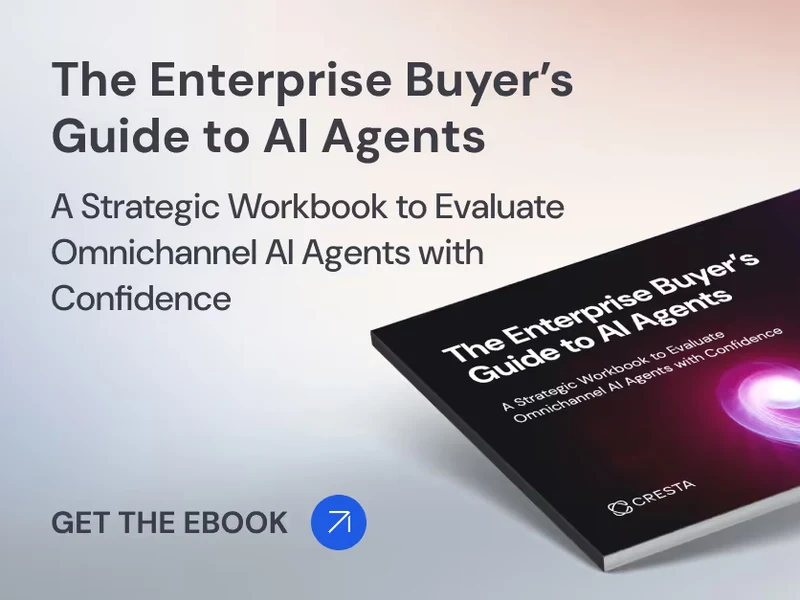
Use our checklist to compare vendors with confidence
7 best omnichannel customer experience solutions
The vendors below span a maturity spectrum from unified intelligence and automation platforms to full CCaaS stacks and narrower point solutions.
Use this section to match platform scope to your primary gap. If you need routing, telephony, and channel management, several CCaaS options fit. If you need context persistence across AI and human agents plus analytics and quality management on one foundation, the field narrows quickly.
1. Cresta
Cresta is an enterprise generative AI platform built around three connected products. Cresta Conversation Intelligence handles analytics, insights, and quality management across conversations. Cresta Agentic Assist supports human agents in real time. Cresta AI Agent automates conversations across voice and digital channels. The platform also includes Opera, a no-code orchestration engine for building and refining workflows. Because the products share a data model, AI Agent can channel-switch mid-conversation (for example, guiding a customer on a call while sending links or images via SMS). It can also hand off to a human agent with full context intact, so customers are not asked to repeat themselves when channels or agents change.
Key features
Beyond the three connected products introduced above, the platform shares a set of foundational capabilities that work across all of them.
- Opera, a no-code orchestration engine for building and refining workflows
- Omnichannel experience across voice, chat, and SMS, with shared conversational memory and the ability to blend channels in a single interaction
- Transfer summaries that give the next human agent the context needed to pick up where the previous handler left off
- Past conversation view for full life-cycle visibility on any customer, including prior interactions, internal transfers, and consultations
- Multilingual AI Agents in 30+ languages, with language detection and routing at the start of every conversation
- Unified analytics across AI and human interactions
- Outcome inference models that link human and AI agent behavior to CSAT, resolution, and revenue
- Four-layer guardrails covering system, supervisory, adversarial testing, and automated behavioral QM
- Multi-model AI architecture with 20+ task-optimized models
- Shared data, integrations, and governance across AI Agent, Agentic Assist, and Conversation Intelligence
Strengths
- Automation, human guidance, and post-conversation analysis operate on one platform instead of separate systems
- Unified analytics, outcome inference models, layered guardrails, and a multi-model AI architecture are the main reasons to consider it
- Strongest for enterprise contact centers running a hybrid workforce of AI and human agents across multiple channels
- Layers on top of existing contact center and CRM environments without requiring a full platform replacement
Best for
Cresta fits best for enterprises with 250+ employees and high contact center volume. The strongest fit is in travel and hospitality, healthcare and insurance, and financial services, where conversation complexity, multilingual demand, and compliance pressure make a unified AI and human agent view especially valuable. The model works because outcome inference, real-time guidance, and 100% QM coverage all run on the same conversation data. That means insights from analytics feed straight into coaching, agent assist, and AI agent optimization. The Forrester Wave Q2 2025 for Conversation Intelligence Solutions named Cresta a Leader with the highest Current Offering score among evaluated vendors.
2. NICE CXone
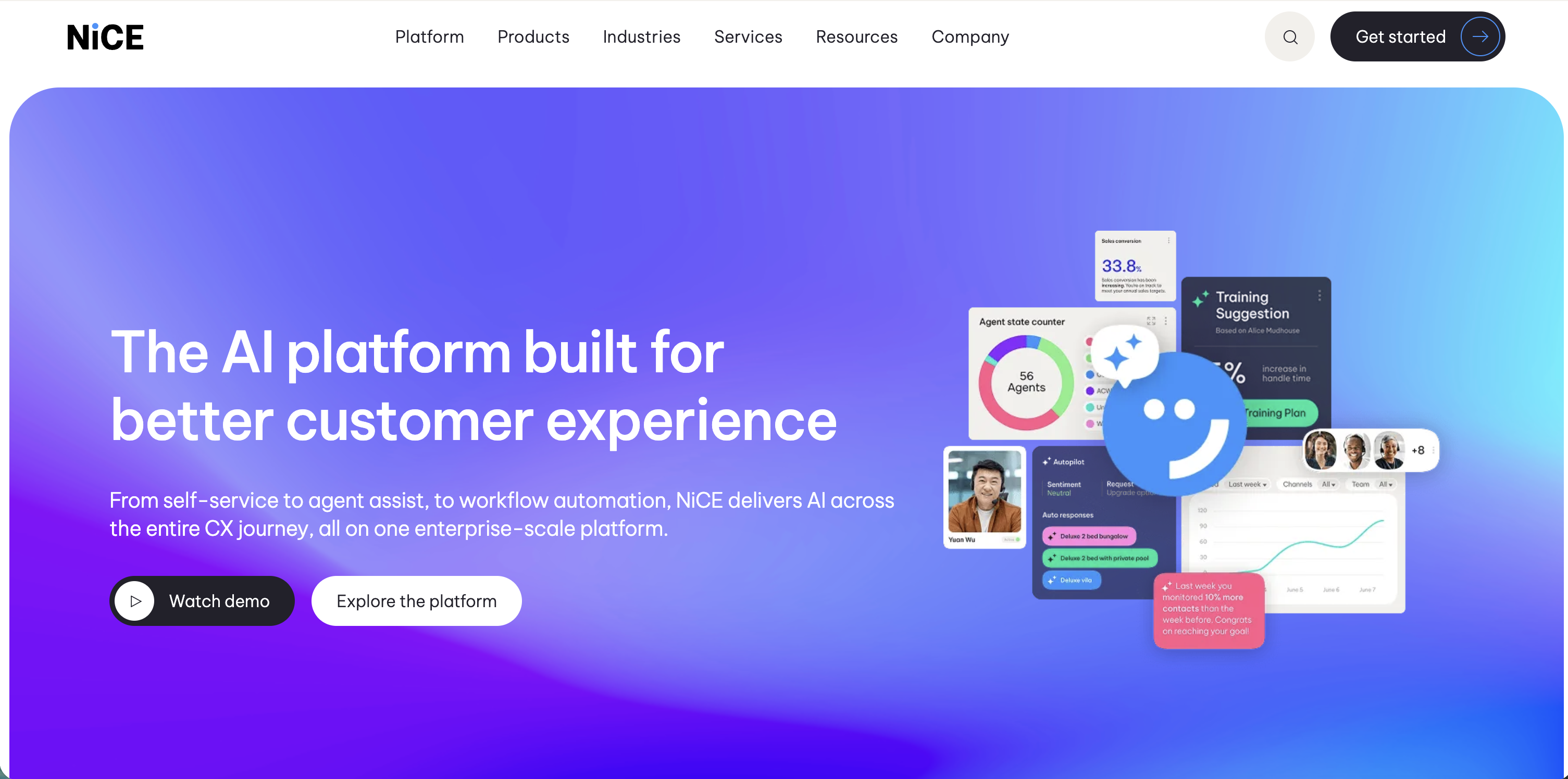
Where Cresta sits above the stack, NICE CXone represents the full CCaaS path. It is a CCaaS platform focused on omnichannel routing, workforce optimization, and analytics. Its value in this list comes from breadth across those three areas.
Key features
The platform's capabilities are distributed across routing, workforce, and analytics functions within a single CCaaS stack.
- Omnichannel routing
- Workforce optimization
- Analytics
Strengths
- Breadth across routing, workforce optimization, and analytics within a single-vendor CCaaS stack
- Deep workforce engagement management capabilities
Weaknesses
- That breadth is also the main tradeoff. A platform covering routing, workforce management, and analytics will not be equally strong in every area, and some functions may not fit every buyer's operating model
Best for
NICE CXone is best suited to large global enterprises that want a single-vendor CCaaS stack and view workforce engagement management depth as a primary selection criterion.
3. Genesys Cloud CX
Genesys Cloud CX takes a different route through the full CCaaS category. It is a cloud-native CCaaS platform supporting a broad set of customer channels through an API-first architecture. That approach leans more on extensibility than on out-of-the-box breadth.
Key features
The capabilities center on channel breadth and API-first extensibility.
- Cloud-native CCaaS architecture
- API-first design
- Broad set of supported customer channels
Strengths
- Flexibility
- Broad set of customer channels supported through an API-first architecture
Weaknesses
- Shifts more orchestration responsibility to the customer
- Integration breadth does not guarantee a unified customer experience, especially in deeply customized legacy environments
Best for
Genesys Cloud CX fits contact centers with deeply customized legacy environments. For those buyers, the key evaluation criteria are reporting and workflow fit, not the number of available integrations.
4. Five9
Five9 takes a different route through the CCaaS category. It is a cloud-based CCaaS platform with a strong emphasis on voice and outbound operations. That makes it a fit for teams running high-volume outbound campaigns or voice-heavy operations, where dialer sophistication and call reliability outweigh digital channel depth or AI automation maturity.
Key features
That focus comes through in the feature set, which is tied to outbound operations and global voice infrastructure.
- Predictive, progressive, power, and preview dialing modes
- Global Voice network with localized Voice Edges for low-latency, region-specific call routing
- Multi-carrier routing, route advance, and bring-your-own-carrier (BYOC) options
- VoiceStream API for real-time audio streaming to third-party voice biometrics, speech analytics, and agent assist tools
Strengths
- Strong case in this list is outbound operations and global infrastructure
- Dialer coverage across predictive, progressive, power, and preview modes
- Global redundancy and CRM integrations
Weaknesses
- Buyers should test whether current AI capabilities match their automation goals
- Buyers should confirm that digital channel depth is sufficient for their environment
Best for
Five9 is a stronger fit for large enterprises running high-volume outbound or voice-heavy operations, where dialer sophistication, global voice infrastructure, and carrier flexibility outweigh digital channel depth or built-in AI maturity.
5. Verint
Verint takes the conversation in a different direction by introducing a layered approach. It is an Open CCaaS option for companies that want to keep existing channel vendors. A centralized AI and analytics layer sits on top of what they already run, so they do not have to replace it.
Key features
The capabilities reflect Verint's open, layered approach across existing channel vendors.
- Open CCaaS model
- Centralized AI and analytics layer
- Compatibility with existing channel vendors without a rip-and-replace project
Strengths
- Appeals to enterprises in multi-vendor contact center environments that do not want a full rip-and-replace project
- Retains existing channel vendors while adding a centralized AI and analytics layer
Weaknesses
- Integration and governance are more complex. A centralized data layer is only as useful as the source integrations feeding it
Best for
Verint fits best when a contact center wants to keep existing channel vendors while adding a unifying layer. It suits teams that want a unifying layer without replacing existing channel tools.
6. Observe.AI
Observe.AI started in the conversation intelligence and quality management layer, then expanded into voice and chat AI agents plus AI Copilots for human agents. Today it positions itself as an intelligent workforce platform, though its core strength remains auto QA and post-interaction analytics.
Key features
The capabilities now span intelligence, coaching, and AI agent automation.
- Auto QA scoring across 100% of voice and chat interactions
- AI Copilots for agent, coaching, and insights use cases
- Voice and chat AI agents
- Omnichannel and screen recording
Strengths
- Deep auto QA conversation intelligence
- Recent expansion into AI agents brings automation alongside analytics
Weaknesses
- Does not include routing or telephony, so it still pairs with a CCaaS platform for full operations
- Newer AI agent offering is still maturing compared to its core CI-QM product
Best for
Observe.AI fits contact centers where the primary need is automated QM, coaching, and analytics, with optional AI agent expansion on top of an existing CCaaS stack.
7. Kore.ai
Kore.ai rounds out the list as the template-driven AI automation option. It is a no-code conversational AI platform with pre-built templates for banking, healthcare, and retail. Multi-channel deployment across voice and digital touchpoints positions it as a faster path for well-defined use cases.
Key features
The platform's capabilities center on no-code tooling and industry-specific templates.
- No-code conversational AI platform
- Pre-built templates for banking, healthcare, and retail
- Multi-channel deployment across voice and digital touchpoints
Strengths
- Fit for enterprises with defined and repeatable conversation patterns that want template-driven deployment
- Templates and no-code tooling can accelerate setup
Weaknesses
- Templates reflect generic patterns, and often still need customization to meet the specific needs and variations of a given operation
- Companies may need to build and maintain agents themselves
- Without conversation intelligence, teams often optimize from assumptions rather than evidence
Best for
Kore.ai fits enterprises with defined and repeatable conversation patterns that want template-driven deployment.
Choosing the right omnichannel customer experience solution
With those seven vendors on the table, the most important decision is which architectural gap you need to solve first. Three patterns cover most buyers.
- Some contact centers need a system of record for routing, telephony, and channel management.
- For others, the channels already exist and the real gap is visibility. Conversation intelligence and quality management sit at the center of that evaluation.
- A third group needs a platform that connects AI automation, human agent support, and shared analytics on one foundation, a unified-first approach.
Buyers often group these together under omnichannel software, but they solve different problems.
That framing translates directly into how to evaluate vendors:
- If your main requirement is replacing legacy telephony and routing, a CCaaS platform may be the right starting point.
- If channels already exist but customer experience still breaks across teams, focus instead on how the vendor handles shared data, handoffs, analytics, and coaching across every interaction.
That second path is where point solutions, open models, and unified platforms diverge most.
Run AI and human conversations on one operational foundation
Fragmented data is the operational problem behind most omnichannel failures. When channels, AI agents, and human agents run on separate systems, context breaks at every transfer. Customers repeat themselves, and supervisors see only fragments of what is happening across interactions. Cresta addresses that gap by keeping AI Agent, Agentic Assist, and Conversation Intelligence on a shared foundation. Conversation context, outcome data, and coaching signals move with the customer instead of stopping at each channel boundary. The practical result is fewer handoffs that lose information and one operational view across AI and human work.
Conversation Intelligence scores every interaction and feeds those signals back into coaching and AI agent optimization. Request a demo to see how Cresta supports human-centric agentic AI that delights customers with intelligent automation, empowers humans to work smarter and faster, and turns strategic insights into better business outcomes.
Cresta is dedicated to helping businesses of all sizes make informed decisions. We adhere to strict editorial guidelines to ensure that our content meets and maintains our high standards.