The top 5 PolyAI alternatives in 2026
.avif)

- The top PolyAI alternatives in 2026 are Cresta, Sierra, Decagon, Kore.ai and Cognigy
- Consider an alternative if you need to edit agents yourself, want deeper analytics than reviewers say PolyAI offers, or run chat-heavy operations
- PolyAI remains a strong option for natural-sounding voice; reviewers praise how callers can interrupt without breaking the conversation
If you're looking to automate high-volume phone conversations with an AI agent that sounds human, you might consider PolyAI, a voice-first conversational AI platform.
PolyAI supports 45+ languages, 130+ integrations (including major CCaaS platforms), and runs its own audio-native model.
That said, users often report that changes run through PolyAI's team, making it difficult to iterate quickly. And its voice-first heritage may also feel limiting for chat-heavy teams.
To help you decide whether PolyAI is right for your CX program, we’ll compare it to its top alternatives.
How we evaluated the alternatives to PolyAI
We scored the alternatives using third-party review sites (G2, Gartner® Peer Insights), Forrester and Gartner analyst reports, vendor documentation, and our own conversations with prospects and customers.
Here’s the criteria we used:
- Voice conversation quality: Latency and interruption handling decide whether callers stay
- Control over changes after launch: Who can edit, test and ship a change determines how fast the agent improves once real customers use it
- Testing and guardrails: Pre-launch simulation and live oversight make it safer to hand an AI agent regulated or brand-sensitive conversations
- Channel coverage and context continuity: Customers who start in chat and call later expect to be remembered, so cross-channel memory is crucial
- Analytics and outcome measurement: Containment alone hides failed resolutions, so you need reporting tied to resolution, CSAT and revenue
- Fit with your existing CX stack and human agents: Plugging into current telephony and handing off to augmented human agents avoids a rip-and-replace
And here's how the platforms compare based on that criteria.
Top alternatives to PolyAI
1. Cresta
Cresta is the AI operating system for CX. Its AI Agent resolves voice and digital conversations end to end, and hands off to human agents when a conversation needs judgment or empathy.
Highlights
- AI Agent can be tested before launch against Synthetic Customers built from your own conversations, scored by LLM judges calibrated against human expert review
- Shared memory keeps context across channels and through AI-to-human handoffs
- It runs on the same platform as Agent Assist and Conversation Intelligence, so one conversation record feeds automation, live guidance, and quality management
- A broad range of customer case studies on AI Agent with significant ROI metrics

Why choose Cresta over PolyAI
When you need the AI and human agents to improve from the same conversation record, Cresta AI Agent runs on one platform with Agent Assist and Conversation Intelligence.
See how Cresta helps you build AI agents trained on your conversation data by scheduling a demo.
2. Sierra
Sierra is an enterprise AI agent platform for customer service that runs one agent across voice and digital channels. Sierra's product has historically focused on the AI agent itself rather than human-agent guidance or quality management.
Highlights
- AI agents can cover voice, chat, email and WhatsApp in 50+ languages
- Connects to systems of record to take actions such as processing an insurance claim, returning an order, or originating a mortgage
- Ghostwriter, one of their newly-launched products, lets teams build or modify an agent by describing how it should behave
- Over 40% of the Fortune 50 partner with Sierra, highlighting the platform’s enterprise-grade agents
Why choose Sierra over PolyAI
When you want one agent across voice, chat, email and WhatsApp that completes transactions in your systems of record.
Related: The top Sierra competitors
3. Decagon
Decagon is an AI customer service agent platform that's strongest on chat and email and is expanding into voice. Teams configure it with natural-language Agent Operating Procedures (AOPs).
Highlights
- Agent behavior can be defined in plain language through AOPs, making it easy to configure
- Technical teams can version agents with Git-based tracking and keep full ownership of code
- Strong customer proof points. For example, Chime reached 70% chat and voice resolution with Decagon
- Users (like the G2 reviewer below) consistently cite Decagon’s post-sales team as key to getting value from the platform quickly

Why choose Decagon over PolyAI
When you handle mostly chat and email and your ops team wants to edit agent logic in plain language, Decagon's AOPs fit better than PolyAI's historically managed model.
Related: A guide to Decagon alternatives
4. Kore.ai
Kore.ai offers a broad enterprise agentic AI platform, called Artemis, that covers customer service and employee use cases. Kore.ai positions it for complex, high-volume, and regulated workflows.
Highlights
- Kore.ai claims to offer 100% observability, which includes the ability to evaluate, trace and audit every agent session
- Its platform spans customer service and employee use cases, including agent assist for human agents
- Kore.ai is a Leader in the 2026 Gartner® Magic Quadrant™ for Conversational AI Platforms, its fourth consecutive Leader placement
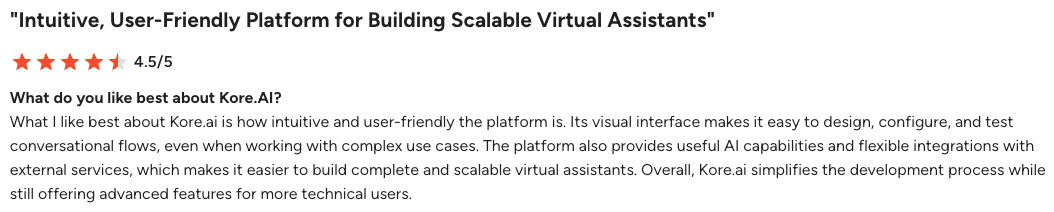
- Its users often cite the UI as intuitive and easy to adopt for building AI agents. The G2 review below is a good example
Why choose Kore.ai over PolyAI
When you need a governed platform that spans customer and employee use cases with full session tracing, Kore.ai covers more ground than PolyAI's dialog-agent focus.
Related: The top Kore.ai alternatives
5. Cognigy
Cognigy is an enterprise conversational and agentic AI platform for contact centers, now owned by NiCE. It pairs low-code building with prebuilt CCaaS integrations.
Highlights
- Comes pre-integrated with Avaya, AWS, Genesys, NiCE, Microsoft and 8x8 to support a broad range of contact-center environments
- Cognigy Insights provides dashboards, drill-down analytics, customizable KPIs, and data exports to support ongoing performance monitoring
- A Leader in The Forrester Wave™: Conversational AI Platforms for Customer Service, Q2 2026, and it ranked highest on Strategy
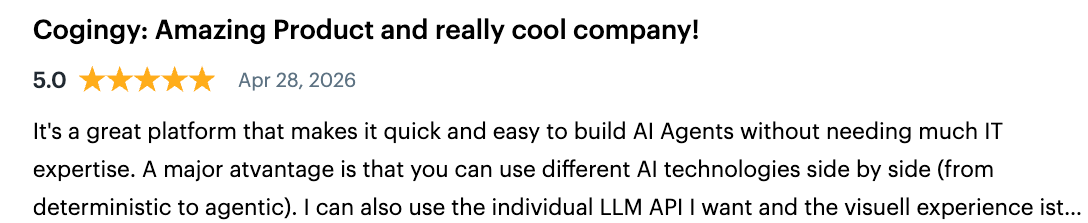
- Users often claim the platform makes it easy to build and deploy AI agents
Why choose Cognigy over PolyAI
When you already run your contact center on Genesys, Avaya, AWS or NiCE and want business users building agents in a low-code UX.
Related: How Cognigy compares with other AI agent platforms
Final thoughts
PolyAI's strength lies in its AI natural voice, but its complaints are as consistent as its praise.
Users report that changes run through PolyAI's team. Its voice-first heritage can also limit chat-heavy teams, and its scope stops at the AI agent, so human-agent guidance and QA sit elsewhere.
If you need to own iteration, measure outcomes beyond containment, or connect AI and human agents, it’s worth looking at the alternatives above.
.jpg)