The top 5 Ada alternatives in 2026
.avif)
.jpg)
- The five Ada alternatives worth shortlisting are Cresta, Cognigy, Kore.ai, PolyAI, and Fin
- Use Cresta to address Ada’s core product gaps, Cognigy for regulated multi-language automation, Kore.ai for vertical AI, PolyAI for voice, Intercom Fin for chat-only teams
- Ada remains a strong choice when digital chat deflection is your primary goal
If your team needs to deflect digital support conversations fast, without an engineering project, you'll likely evaluate Ada, a customer service chat automation platform.
Ada is an established AI chat agent in customer service that’s fast to launch, grounded in an existing knowledge base, and handles pure digital deflection well.
But you’ll need to validate whether its live-agent guidance and analytics cover the specific workflows, channels, and AI- and human-handled conversations you care about, since its public documentation doesn't clearly specify those details.
To help you decide whether Ada fits your CX program, we've compared it to its top alternatives.
Note: This guide was updated on 9/23/2026. The information on this page can change in the future.
How we evaluate Ada alternatives
Our assessments draw on third-party reviews (G2 and Gartner Peer Insights), published analyst research by Forrester and Gartner, and our conversations with prospects and customers who are evaluating these platforms.
We scored every option against the same five criteria:
- Channel Breadth: voice and digital natively, or voice bolted onto chat
- Real-Time Agent Augmentation: whether the platform guides human agents mid-conversation, and what the rep sees at handoff
- Conversation Intelligence and QM: full-coverage scoring tied to outcomes, or a sampled reporting module
- Training Data: trained on your real conversations, or on generic documentation
- Guardrails and Governance: pre-launch testing and live oversight, not just a deck
Based on our assessments, here are the top alternatives and how they stood out:
Top alternatives to Ada
Here are the top Ada alternatives, scored against the five criteria above.
1. Cresta
Cresta is a unified AI for CX platform. It closes all three Ada gaps: voice and digital AI agents, real-time human agent augmentation, and 100 percent conversation intelligence, on one data layer trained on your own conversations.
Highlights
- AI Agent runs autonomous voice and digital conversations with pre-launch testing and live oversight through the Agent Operations Center
- Agent Assist augments human agents mid-conversation with real-time guidance, knowledge, and a transfer summary at every handoff
- Conversation Intelligence scores 100 percent of conversations and drives outcome-linked coaching
- Named a Leader in the Forrester Wave: Conversation Intelligence Solutions for Contact Centers, Q2 2025, with the highest score in the Current Offering category
- Proven in production: Windstar Cruises, for example, a small-ship cruise line, reached 70% chat containment and a 2% conversion increase in six months
Why Choose Cresta over Ada
When voice, real-time augmentation, and full-coverage QM all matter together, on one platform that’s trained on your own conversations.
See how Cresta can transform your CX operations by scheduling a demo.
2. Kore.ai
Kore.ai's XO Platform combines AI agent, agent assist, and analytics on one orchestration layer, with pre-built vertical solutions that shorten time to production.
Highlights
- One architecture spanning automation, assist, and analytics, which answers Ada's missing assist layer without stitching separate tools together
- Pre-built vertical solutions (BankAssist, HealthAssist, SmartAssist) compress deployment in compliance-heavy industries, so regulated teams reach production faster than building from scratch
- Offers both no-code and pro-code build options, which helps business teams and developers build and maintain agents without waiting on the other
- Named a Leader in the 2025 Gartner® Magic Quadrant™ for Conversational AI Platforms, and rated highest for Ability to Execute, which points to reliable delivery at scale
Why Choose Kore.ai over Ada
You're in banking, healthcare, or insurance and need pre-built vertical AI that reduces time to production.
Related: The top Kore.ai alternatives
3. PolyAI
PolyAI is a strong voice-native alternative to Ada, purpose-built for enterprise inbound voice in hospitality, travel, and telecom. That said, it doesn’t have a meaningful chat, agent assist, or conversation intelligence layer.
Highlights
- Designed for voice from the ground up, so it handles prosody, interruptions, and latency better than chat platforms that bolt on a voice channel
- Automates end-to-end customer interactions in 45 languages. This lets global brands serve callers in their own language on the phone
- Deep in hospitality, travel, and telecom inbound voice, so it fits high-volume booking, reservations, and account lines
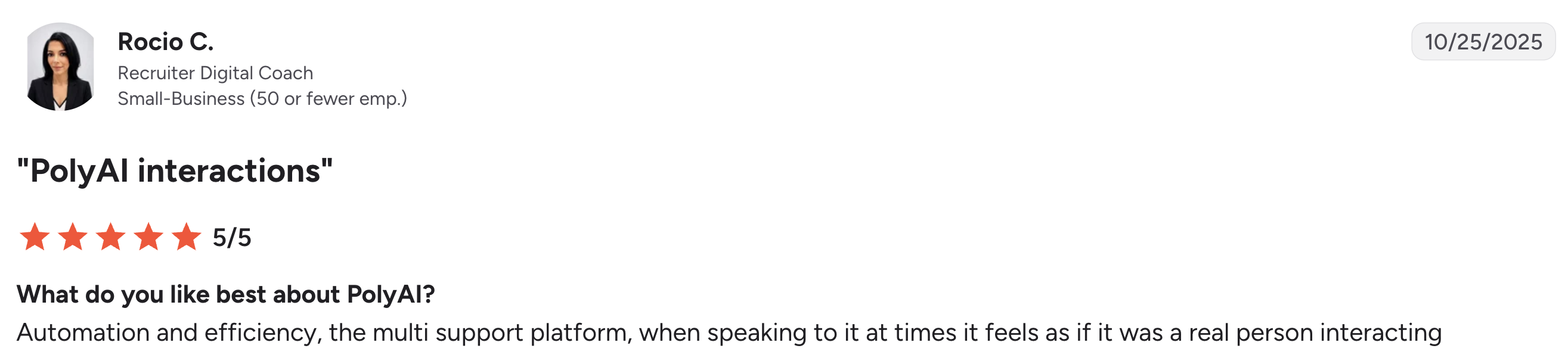
- It’s AI voice agent is often cited on review sites (like the G2 review below) for sounding incredibly real
Why Choose PolyAI over Ada
Voice is your dominant inbound channel and you operate in hospitality, travel, or telecom. Just plan to source agent augmentation, conversation intelligence, and QM from a separate vendor, since PolyAI doesn't provide them natively, and escalated reps get no live guidance.
Related: The top PolyAI alternatives for enterprise CX
4. Fin
Fin is an AI customer-service agent. It answers customer questions using your support content, follows policies, takes certain actions, and resolves issues without a human when possible
Highlights
- Strong digital resolution on unstructured questions, and it activates on an existing account, so chat-led teams see value quickly
- Layers onto an existing helpdesk like Salesforce, HubSpot, or Freshdesk with no migration, so teams can go live without re-platforming
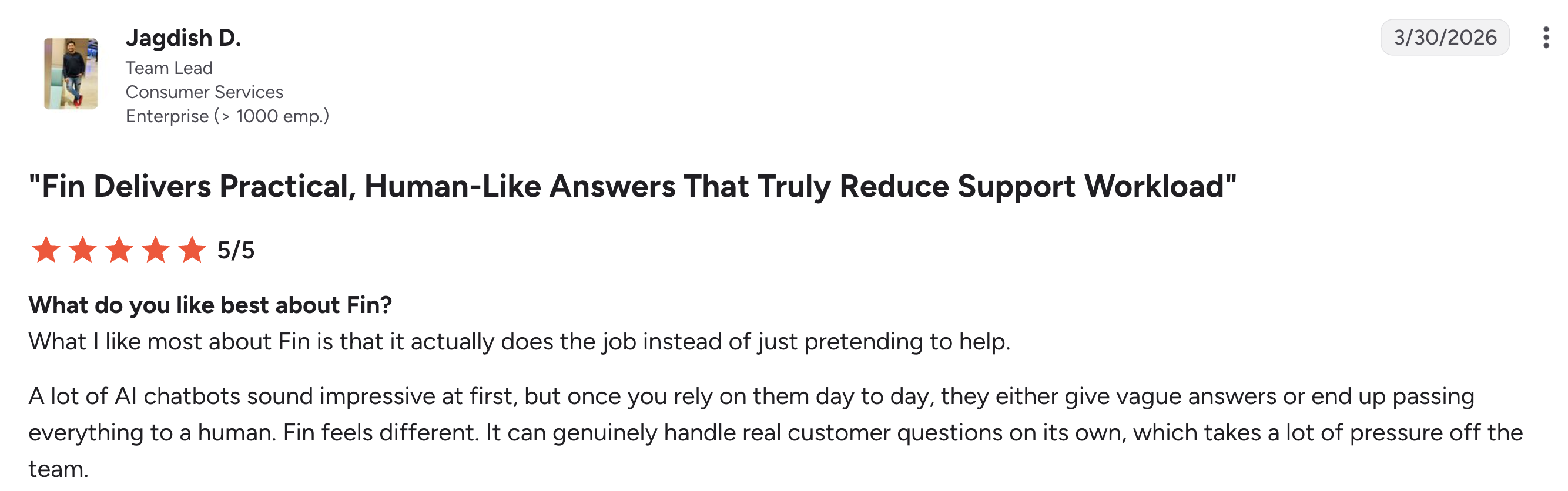
- Reviewers (like the one from G2 below) highlight that it's AI chatbot resolves real issues rather than just deflecting
Why Choose Intercom Fin over Ada
Your team already uses at least one Fin product, your support operation is chat-only, and enterprise governance and QM aren't requirements.
Related: A guide to Fin alternatives
5. Cognigy
Cognigy is an enterprise conversational AI platform for voice and digital automation. It's strongest in regulated, multi-language deployments, with a live-agent interface and an analytics module (Insights).
Highlights
- Supports 100+ languages and complex multi-turn flows across voice and digital, so one deployment can serve a global customer base without building a separate bot per market
- Live Agent hands the full conversation history to a human at escalation, enabling customers to avoid repeating themselves
- Orchestrates AI agents across existing contact-center systems (Genesys, Amazon Connect, NICE), so it drops into your current stack rather than replacing it
- Named a Leader in the 2025 Gartner® Magic Quadrant™ for Enterprise Conversational AI Platforms, its third consecutive Leader placement
Why Choose Cognigy over Ada
You're a large regulated enterprise with a complex multi-language, multi-channel automation requirement. It fits best when real-time agent augmentation is secondary, or can be sourced from a separate tool.
Related: The top Cognigy alternatives
Final Thoughts
Ada offers enterprise AI agents across voice and digital channels. But if your team also needs real-time guidance for human agents and full-coverage conversation intelligence and quality management across human and AI interactions, Cresta combines those capabilities on one platform.
Learn more about Cresta by scheduling a demo with a CX expert.