Guides
AI Agents and CX
Read Time

Contact Center AI: The Complete Guide to AI-Powered Customer Experience

Published:
June 25, 2026
Updated:
June 25, 2026
Devon Mychal
VP, Product Marketing
Key Takeaways
  • Contact center AI is a three-layer system, not a chatbot. It combines AI agents (automation), agent assist (augmentation), and conversation intelligence (analysis) on one shared conversation record. Platforms that connect all three create compounding operational gains; platforms that do not are expensive point solutions.
  • Not every conversation should be automated. The four-bucket triage framework separates interactions that benefit from AI from those that will be damaged by it. High-emotion, high-value conversations still need humans; AI handles the routine and makes humans better at the rest.
  • The correct order of operations is analyze first, then automate. Operators who skip conversation intelligence before deployment automate symptoms rather than causes, and spend more to achieve less.
  • AI agents built from idealized scripts break in production. The systems that scale are trained on real conversation data, surrounded by enterprise guardrails, and governed through live oversight before and after launch.
  • The human+AI operating model is already the operating reality. According to Cresta's 2026 Customer Experience Workforce Report, 78% of customer conversations are already handled by humans and AI working together.

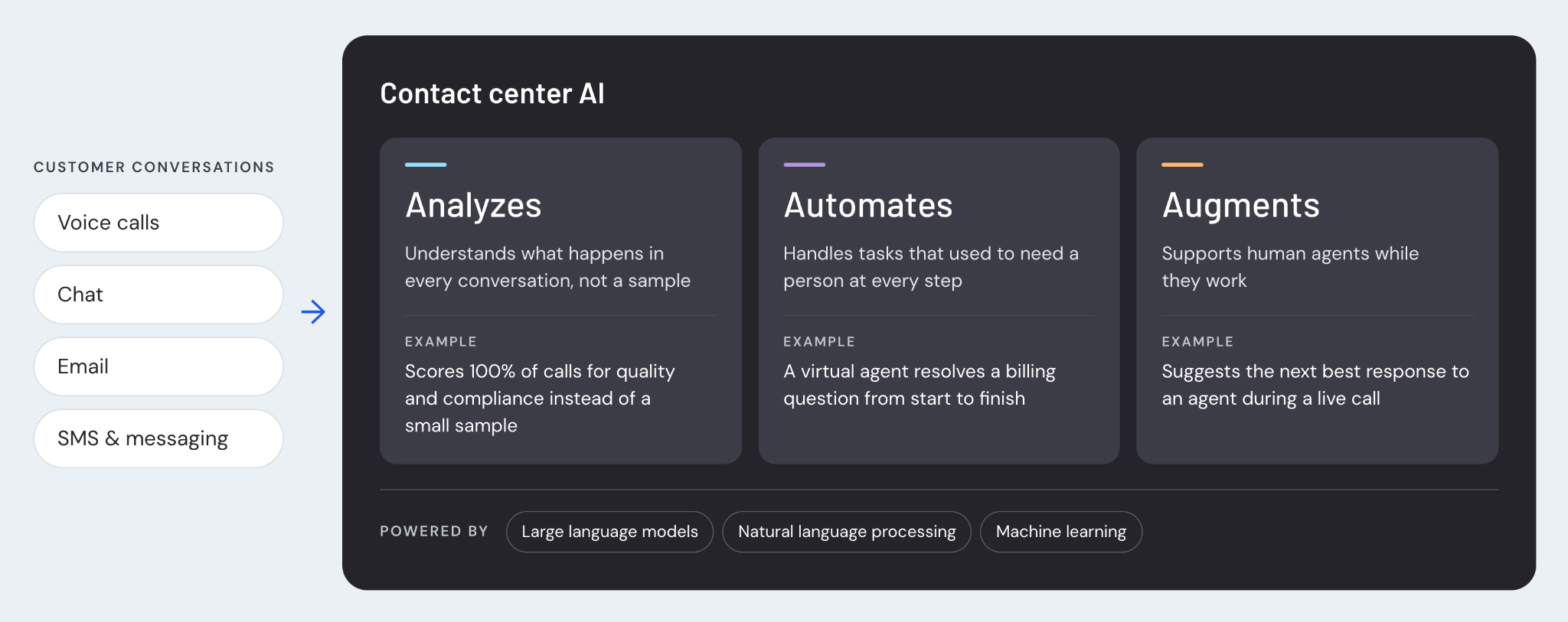
Contact center AI is software that analyzes, automates, and augments customer conversations using large language models, natural language processing, and machine learning. It operates across three functional layers: AI agents that resolve conversations autonomously, real-time agent assist that guides human representatives during live interactions, and conversation intelligence that analyzes 100% of conversations to surface what is happening and why.

The pressure to automate is real and understandable. But the operators who get the most from Customer Experience AI start with a different question than their peers: not which vendor should we buy, but which conversations should AI handle at all. Automating the wrong interactions wastes budget and damages customer relationships. The sequence that works is analyze first, then augment, then automate. That sequence is what this guide is built around.

Who this is for: Contact center directors, VPs of CX, heads of contact center operations, and the IT and digital transformation leaders who own the platform decisions. By the end, you will have a framework for deciding which conversations to give to AI, a checklist for evaluating platforms, and a clear picture of what results to expect and when.

What Is Contact Center AI?

Contact center AI is the software infrastructure that analyzes, automates, and augments every customer conversation in an enterprise contact center, using large language models (LLMs), natural language processing (NLP), and machine learning to replace tasks that used to require human attention at every step.

That definition is broader than most buyers expect. For years, "contact center AI" meant a chatbot in front of a phone tree: keyword-matching, script-bound, and capable of routing but not resolving. Modern Customer Experience AI is architecturally different. It understands intent from full conversational context rather than a keyword match, takes action across backend systems rather than presenting a menu, and analyzes 100% of conversations rather than the 1–5% a manual QA team can sample.

What drove this shift: the consolidation of three previously separate tool categories (bots, assist tools, and analytics) onto unified platforms where insight from analysis feeds live guidance, and live guidance data informs how AI agents are built. The three layers are no longer separate purchases. They are a system.

Conversational AI vs. Agentic AI vs. Generative AI: What the Terms Actually Mean

These three terms describe different layers of the same architecture. Conflating them is the most common source of buyer confusion.

Term What it means Contact center application
Conversational AI The broad layer: understanding and generating natural language in dialogue Every AI system in this category qualifies
Generative AI (LLMs) The engine powering modern conversational AI; generates context-aware responses from full conversation history rather than matching input to a script Handles novel phrasing, multi-intent requests, and mid-conversation pivots
Agentic AI The execution layer: plans and executes multi-step tasks end to end without a human approving each step Understands a complex request, retrieves account context, acts across backend systems, and completes resolution in one conversation

Why the distinction matters for deployment: the level of the architecture determines testing requirements, governance overhead, and what happens when a conversation goes off-script. A conversational AI that fails falls back to a menu. An agentic AI that fails can take a wrong action in a customer's account.

See also: How AI agents work in production, and what makes them fail

How Does Contact Center AI Work? The Three-Layer Model

Contact center AI works across three functional layers (automate, augment, analyze), and the platforms that create lasting operational change connect all three on one shared conversation record.

The three layers are not optional components. They are a system. Insight from analyzing every conversation feeds what agents see in the moment. Live guidance data informs how AI agents are built and refined. AI agent behavior surfaces new patterns for analysis. Operators can start anywhere on the spectrum. The most strategic ones run all three as one operating model.

What "shared conversation record" means in practice: build a behavior rule once in the orchestration layer and it simultaneously drives a real-time hint, a QM score, and a coaching focus area. On separate-tool stacks, that same rule must be rebuilt three times across three systems. On a unified platform like Cresta, it is a single definition deployed everywhere, powered by Cresta Opera, the no-code orchestration engine underneath all three products.

Layer 1: Automate with AI Agents That Resolve Conversations End to End

AI agents handle the full conversation without human intervention, from intent detection through action-taking to resolution.

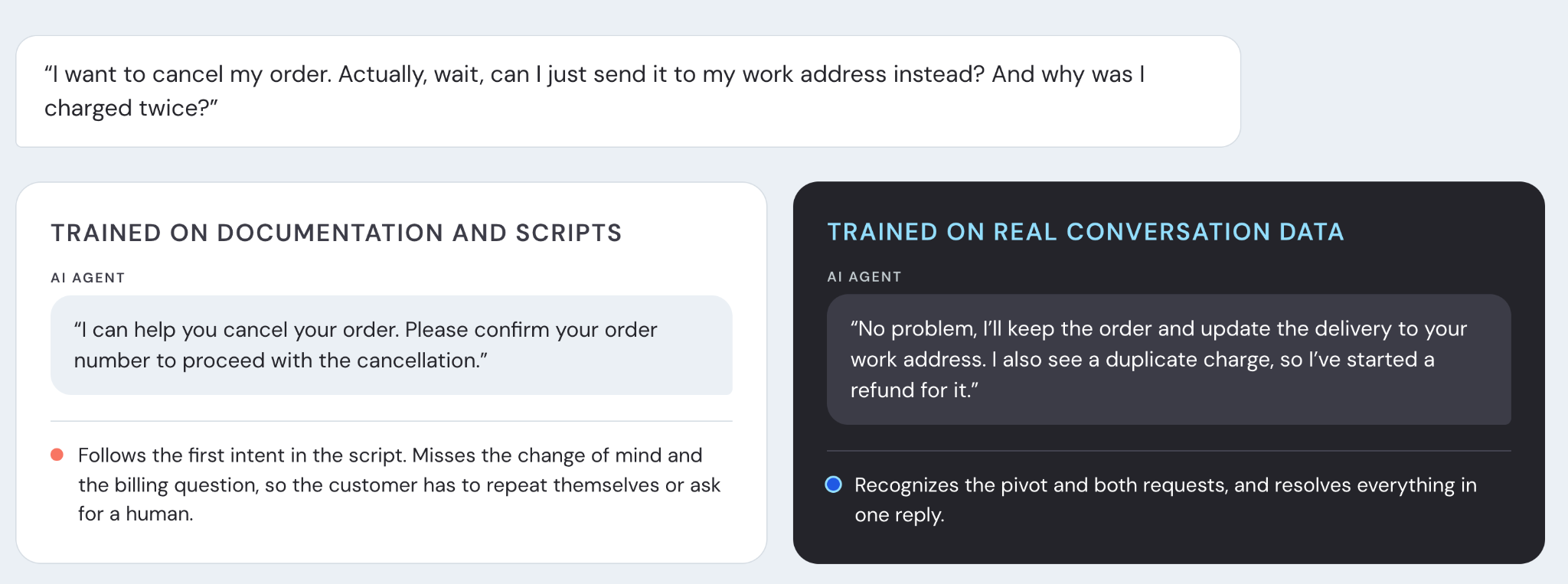
What a production AI agent actually does: it interprets multi-intent requests, retrieves account and policy context, acts across systems (payments, reservations, claims), and adapts mid-conversation when intent shifts. The critical training distinction is data source. Agents built from documentation and idealized scripts perform well in controlled demos. They encounter problems immediately in production, because real customers do not follow scripts. They change their minds, ask two things at once, and phrase requests in ways no internal document anticipates.

Cresta AI Agent is built from real conversation data, which means it has seen the edge cases, the emotional pivots, and the multi-intent requests before it goes live. Propel Holdings reached 58% chat containment and cut after-call work by 50% with Cresta AI Agent.

Ask the vendor: "Show me a conversation where the customer changed intent mid-interaction. What did your AI agent do?"

See also: Cresta AI Agent

Layer 2: Augment with Real-Time Agent Assist for Human Representatives

Agent Assist augments human representatives during live conversations, surfacing answers, guided workflows, and compliance hints before the agent has to search.
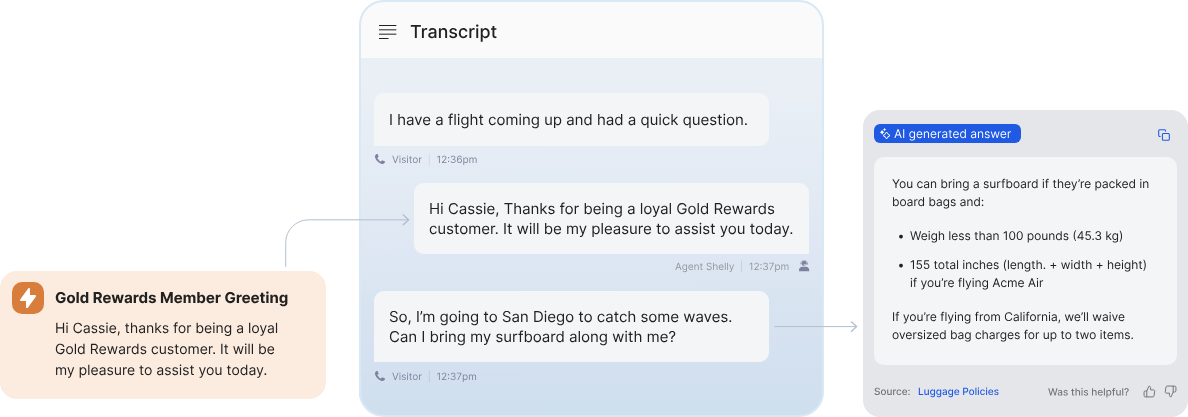
Four traits separate tools that scale from tools that plateau: (1) real-time, not near-time: guidance that arrives after the agent has already answered is a report, not assistance; (2) proactive, not prompted: if the agent has to type a query and wait, the search problem has simply moved; (3) grounded in live and on-screen context: a generic answer is often the wrong answer; (4) closed-loop: the same conversation record that powers live guidance also powers QM scoring and coaching assignment.

United Airlines saw 14.5% lower AHT and 50% lower time to first response with Cresta Agent Assist.

Ask the vendor: "Is guidance proactive or does the agent have to query for it? What is your transcription latency?"

See also: Agent Assist: what it is, how it works, and how to choose

Layer 3: Analyze with Conversation Intelligence Across 100% of Interactions

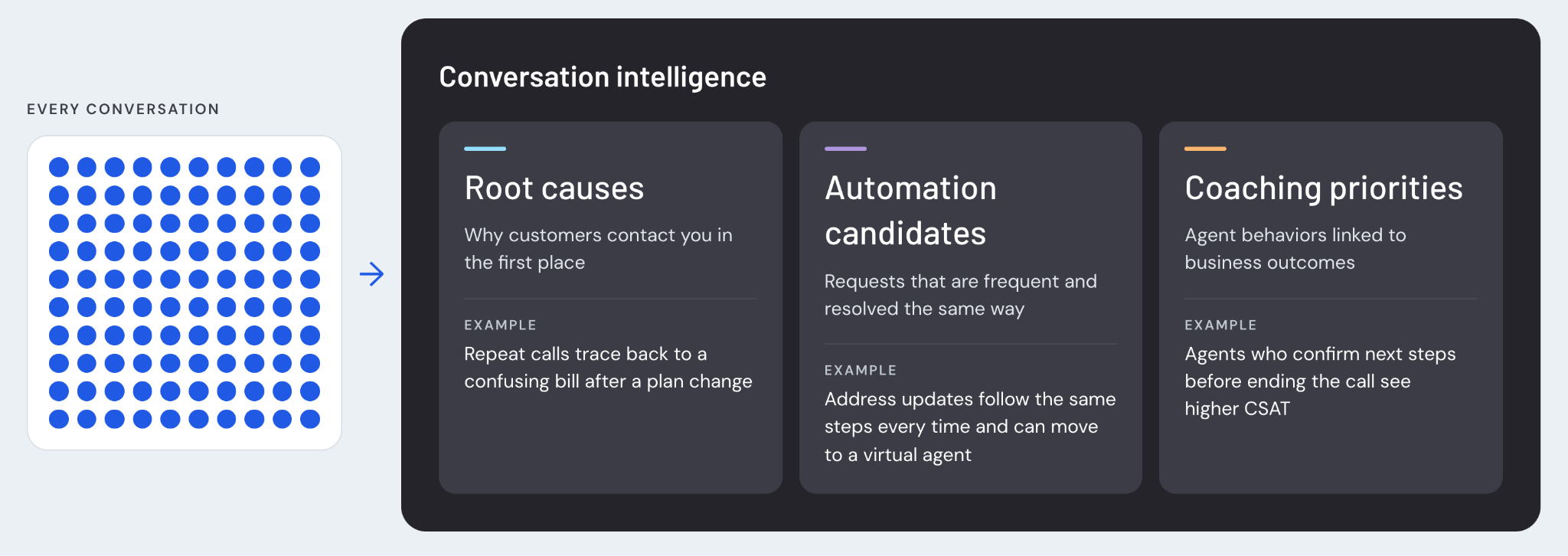
Conversation intelligence can provide full-coverage analysis that surfaces root causes, automation candidates, and outcome-linked coaching priorities.

What 100% coverage changes: you stop managing the sample and start managing the operation. Every compliance miss, every coaching opportunity, and every pattern driving call volume becomes visible. Quality assurance, sentiment analysis, and outcome tracking run as integrated outputs, not separate tools purchased from separate vendors.

Oportun reached 100% QM coverage with a 50% workload reduction using Cresta Conversation Intelligence.

See also: Cresta Conversation Intelligence

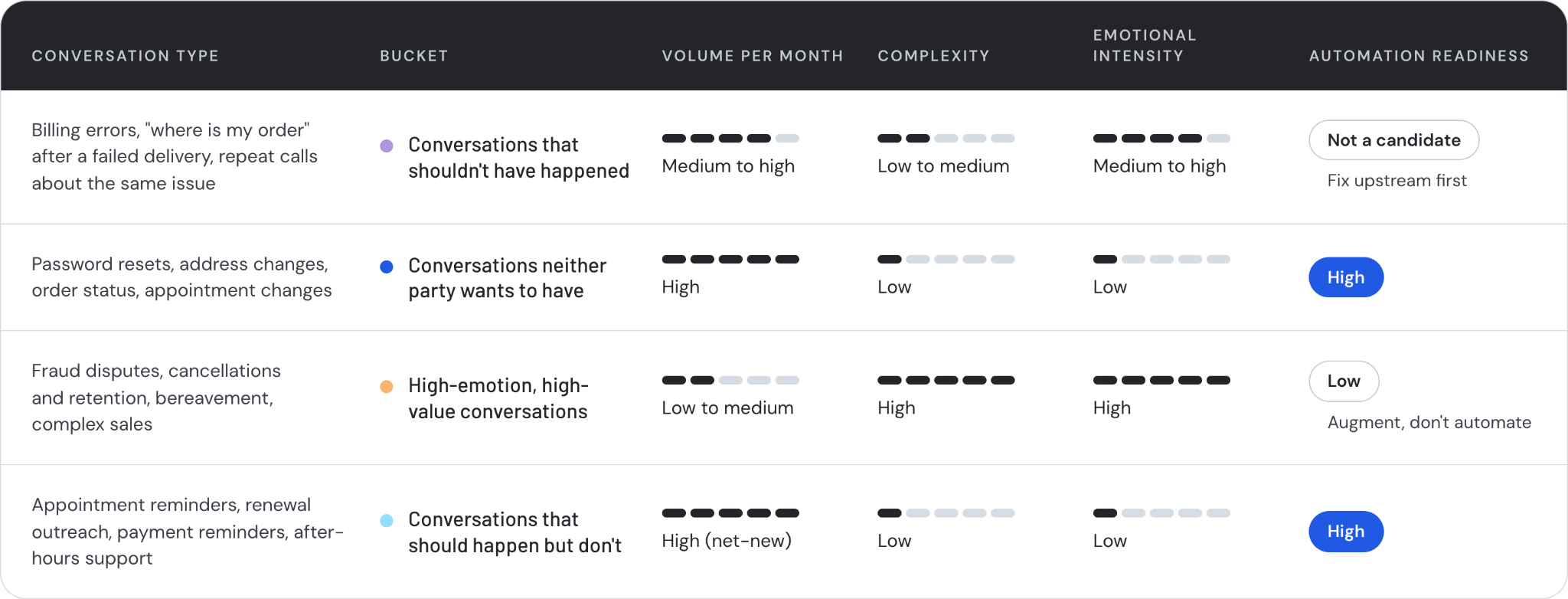
Which Conversations Should You Actually Automate? The Four-Bucket Triage

The decision that determines whether contact center AI improves or damages customer experience is not which vendor to buy. It is which conversations to give to AI at all.

Most vendor evaluations skip this question entirely. The right starting point is your own conversation data, sorted into four buckets before you engage a vendor. Each bucket calls for a different AI response, and routing a conversation to the wrong bucket has specific, predictable consequences.

Bucket Characteristic Right AI Response Risk If Misrouted
Conversations that should not have happened Contacts generated by broken processes or systemic product issues Identify the root cause via Conversation Intelligence. Fix the upstream problem. Automating these scales the failure and masks the signal that would have fixed it.
Conversations neither party wants to have Routine, clear-goal, low-emotion interactions with a single resolution path Deploy AI agents. This is where automation creates the most value at the lowest risk. Low, if complexity is correctly assessed before build.
High-emotion, high-value conversations Moments requiring human judgment, empathy, and trust Keep humans in control. Augment with AI behind the scenes: context retrieval, compliance hints, transfer summaries. Routing these to AI damages customer relationships and brand trust in ways that are difficult to recover.
Conversations that should happen but do not Proactive outreach, reminders, and 24/7 availability not economically feasible at human scale Deploy AI agents for net-new interactions that economics prevent humans from conducting. None — these are additive, not replacements.

Alaska Airlines used Cresta Conversation Intelligence to move from weeks to same-day issue identification, pinpointing five primary drivers of long handle times. That analysis identified which contacts were being generated by fixable upstream problems rather than genuine customer needs.

Cresta's Automation Discovery feature assigns an Automation Readiness score to every conversation topic based on volume, complexity, and emotional intensity. It surfaces the right candidates, not just the highest-volume ones. A high-volume topic with high emotional intensity is not a good automation candidate regardless of how many calls it generates. The score exists precisely to catch that mistake before it ships.

Ask the vendor: "How does your platform help us identify which conversation types we should automate before we build anything?"

Why Do AI Agents Break in Production, and What Prevents It?

Most AI agents that fail in production fail for three structural reasons: the complexity of real conversations, missing context, and insufficient trust infrastructure. Each has a specific engineering response.

Complexity. Real customers do not follow clean flowcharts. Multi-intent requests, mid-conversation pivots, and emotional escalations are among the most common patterns in hard calls, not edge cases. Agents built from documentation and idealized scripts encounter them immediately. The prevention: train agents on real conversation data, including the messy conversations, not just the ones that resolved cleanly.

Context. An AI agent is only as good as the context it carries. Agents without cross-channel memory, CRM integration, and session state management force customers to repeat themselves. Context loss at the AI-to-human handoff is one of the most damaging failure modes in hybrid operations. The prevention: shared memory across channels and a real-time transfer summary delivered to the receiving human agent at the moment of escalation.

Trust infrastructure. A single high-profile failure can freeze an entire AI program. The governance model (guardrails, adversarial testing, versioning, live oversight, rollback) must be designed before launch, not after an incident. Cresta's Agent Operations Center provides live oversight and the ability to intervene without breaking containment. Synthetic Customers and Simulated Visitors test against realistic pre-launch behavior. Expert-aligned LLM judges calibrate quality before agents go live.

Ask the vendor: "Walk me through what your governance model looks like after an agent goes wrong in production. Who intervenes, how fast, and does it break containment?"

See also: AI Agents for Customer Experience: 2026 Guide

Why Does Conversation Intelligence Come Before Automation?

Operators who deploy AI agents before understanding their conversation data automate symptoms. The ones who analyze first automate causes, and spend less to achieve more.

The same principle has emerged from practitioners building AI at enterprise scale. On Sequoia Capital's Training Data podcast, Cresta CEO Ping Wu argues that the biggest mistake organizations make is treating automation as the starting point rather than the outcome. The organizations seeing the strongest results first understand their customer conversations, where friction exists, where AI adds value, and where human expertise remains essential, before deciding what to automate. That philosophy underpins Cresta's Automation Discovery approach: analyze first, automate second.

Is the Human+AI Operating Model Already Here?

Gartner predicts that by 2027, 50% of organizations that expected to significantly reduce their customer service workforce because of AI will abandon those plans, as enterprises recognize that the most effective operating model combines AI with human expertise rather than replacing it. Gartner also found that 95% of customer service leaders plan to retain human agents to strategically define AI's role, reinforcing a "digital first, but not digital only" approach.

This reflects a broader shift in how enterprise leaders think about AI. Cresta CEO Ping Wu states that AI creates the greatest value by expanding what customer service teams can do, not simply replacing human agents. In this "abundance" model, AI automates routine work while enabling entirely new customer experiences that were previously uneconomical, allowing human agents to focus on conversations where judgment, empathy, and trust matter most.

How Do You Evaluate a Contact Center AI Platform? Eight Criteria

Most contact center AI platform evaluations stall because buyers are comparing features rather than asking whether a system can be trusted in production. These eight criteria separate deployable systems from demo-worthy ones.

Use this checklist in your vendor conversations. Every question below should produce a specific, demonstrable answer. Vague responses to concrete questions are diagnostic. The criteria apply whether you are assessing contact center AI software, AI contact center solutions, or an integrated CCaaS-native offering.

The Eight-Criteria Evaluation Checklist

# Criterion What to Look For Ask the Vendor
1 Training data source Model fine-tuned on your real conversation data, not generic off-the-shelf inputs. Generic models reflect how a hypothetical customer behaves, not how yours do. "How much of the model is fine-tuned on our conversation history before we go live?"
2 Production governance Live oversight, adversarial testing, versioning, and rollback without an engineering ticket. "Walk me through your incident response model when an AI agent behaves unexpectedly in production."
3 Context continuity Full context carried across channels and across AI-to-human handoffs. Customer never repeats themselves. "If a customer starts on chat and escalates to voice, what does the receiving agent see?"
4 Closed-loop intelligence One conversation record powering live guidance, QM scoring, and coaching. Not three separate systems. "Show me how a behavior I track in QM becomes a coaching priority and a live hint, without rebuilding it three times."
5 Behavioral recognition Intent detected from full conversational context, not keyword triggers. "Give me an example of a behavior your platform detects that a keyword-matching system would miss."
6 Omnichannel coverage Voice, chat, SMS, and email sharing memory, models, and governance on one platform, not acquired products stitched together at the UI layer. "Is your omnichannel experience one platform or a set of acquisitions integrated at the UI layer?"
7 Automation discovery The platform surfaces which conversations to automate before you build, using volume, complexity, and emotional intensity. "What does your Automation Readiness score look like, and how do we go from that score to a working prototype?"
8 Measurable outcomes Results tied to AHT, containment, FCR, CSAT, or revenue, not activity metrics like interactions handled or deflection volume. "Show me a customer result tied to a business outcome metric, not a platform utilization metric."

What Results Should You Expect, and When?

Contact center AI can deliver near-term operational wins in AHT and containment within weeks. Midterm gains in CSAT, revenue, and retention take longer but compound.

In Cresta deployments, speed gains typically come first. The compounding gains from closed-loop coaching and conversation-driven automation take longer because they require the data flywheel to build momentum. Be skeptical of any vendor that promises full ROI from a production deployment in days rather than months: that is not describing a production deployment. Timeline ranges reflect deployment experience and will vary by volume, use case complexity, and data readiness.

Conclusion

Contact center AI is no longer about choosing between people and automation. The organizations creating the greatest value are building systems where conversation intelligence identifies opportunities, AI automates the right interactions, and human agents focus on the moments that require judgment, empathy, and expertise. Industry research increasingly supports this hybrid approach: Gartner predicts many organizations pursuing fully "agentless" customer service will reverse course as they recognize that AI delivers the greatest impact alongside human teams, not instead of them. The question is no longer whether to adopt AI, it's how to deploy it in a way that improves customer experience, empowers agents, and drives measurable business outcomes.

Connect with our team if you have any questions or would like to learn more.

Experience Cresta with a live demo

Schedule an expert-run, 30 minute tour of the platform.
Learn more

FAQ

What is contact center AI and how does it work?

What is the difference between contact center AI and a basic chatbot?

What does agentic AI mean in a contact center context?

How do AI-to-human handoffs work, and what happens to context?

What should I look for when evaluating contact center AI platforms?