
A Guide to AI for Insurance Contact Center Agents
.avif)

• Insurance contact centers face a specific set of pressures that general-purpose AI wasn't built for. Call volumes keep growing without proportional headcount increases, customer expectations are rising, and regulators demand perfect compliance documentation across every interaction.
• There are three distinct AI capabilities that matter in insurance: real-time guidance for human agents during live calls, automation for routine policy servicing and claims intake, and analytics that monitor quality and compliance across 100% of interactions.
• The conversations that can't be automated, like complex claims, coverage disputes, and underwriting exceptions, are where human judgment is irreplaceable and where real-time AI guidance has the most direct impact on outcomes.
• Compliance can't be an afterthought. State-level AI legislation is evolving rapidly, and organizations that treat compliance as a post-deployment concern consistently face more expensive remediation than those who build governance into the design from day one.
• The strongest ROI cases are built on operational efficiency first, including handle time reduction, after-call work automation, and moving from sampled compliance review to 100% conversation coverage, with revenue and retention improvements treated as additional upside.
Insurance contact centers need AI capabilities designed for the specific demands of the industry, including integration with policy administration systems, regulatory compliance, and the complexity of insurance products. Purpose-built customer service AI addresses these requirements.
Real-time agent assist
Real-time agent assist provides instant policy language interpretation during customer calls, pulling coverage details from policy admin systems while the conversation happens. This includes compliance guardrails configured from policy administration system rules that flag required disclosures, prevent prohibited language, and verify licensing requirements as the conversation unfolds.
The demand from agents themselves is clear. According to Cresta's State of the Agent Report 2024 (survey of 1,000 U.S. contact center agents), 65% of agents want to use real-time AI hints and suggestions during customer interactions, and 81% report performing better because of the technology available to them.
See which use cases pay off first for insurance carriers
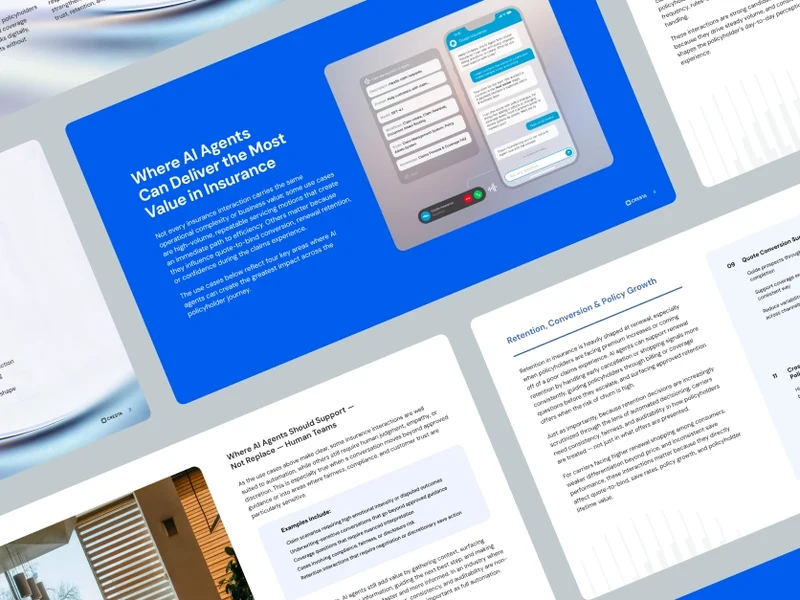
Conversational AI for self-service
Self-service AI handles 24/7 first-line response with guided policy administration interactions. These systems manage complete policy servicing transactions, including address updates and payment method changes, escalating to human agents for complex issues while providing full context. Claims intake represents a major use case where AI handles claims status inquiries, first notice of loss (FNOL) reporting, billing inquiries and payment arrangements, policy cancellation with retention offers, new policy quotes and comparisons, and policy endorsement requests before routing to appropriate adjusters for assessment and decision-making.
Automated documentation and summarization
AI generates conversation summaries automatically, extracting key entities like names, policy numbers, and claim details while redacting sensitive personally identifiable information (PII) for compliance. These summaries push directly to customer relationship management (CRM) systems on the backend, reclaiming the time agents currently spend on manual documentation. Summaries also support handoffs between agents, whether human-to-human transfers or AI-to-human escalations, giving the receiving agent full context without requiring the customer to repeat information.
Compliance monitoring
AI-assisted conversation analysis tracks required disclosures, enforces state-specific regulations, and verifies licensing compliance automatically across 100% of interactions. This moves beyond the traditional approach of sampling a small percentage of calls for quality review. According to emerging regulatory guidance, including frameworks like the NAIC Model Bulletin, AI should act as a support tool in compliance processes rather than the sole decision-maker, with human oversight required for critical decisions.
Cresta combines these capabilities in a unified system. Cresta AI Agent automates routine policy servicing conversations with human escalation paths for complex or sensitive situations, Cresta Agentic Assist provides real-time guidance during live interactions, and Cresta Conversation Intelligence analyzes all customer interactions across channels. Because these share data, models, integrations, and governance, insights from conversation analysis flow directly into agent coaching and automation design, eliminating the silos that occur when analytics, agent guidance, and automation run on separate systems.
How do insurance contact centers deploy AI?
Insurance contact centers deploy AI through three complementary capabilities that work together: automation, real-time agent guidance, and conversation analytics. Most organizations benefit from implementing these in combination rather than isolation. The right approach depends on the complexity, value, and regulatory sensitivity of the conversations you are automating or augmenting.
Agent-assist AI (augmentation)
This model keeps human agents as decision-makers while AI provides real-time support. It works for high-value interactions, complex products, and situations requiring empathy and judgment. During quoting conversations, AI suggests risk scores and pricing to the human agents while they maintain relationship control.
Real-time agent assist has delivered measurable results in high-volume, regulated contact centers. Snap Finance, a consumer financing provider operating under similar compliance requirements, achieved a 40% reduction in average handle time, a containment rate improvement from 6% to 33%, and a 23% increase in customer satisfaction scores after deploying Cresta.
Customer-facing AI (self-service with escalation path)
This model handles routine transactions independently with intelligent escalation to human agents when needed. The system handles complete policy servicing transactions including claims status inquiries, billing and payment arrangements, policy cancellation with retention offers, new policy quotes and comparisons, policy endorsement requests, and FNOL intake with document collection. Complex situations escalate to human agents with full context transfer.
Conversation analytics (quality and compliance monitoring)
Conversation analytics monitors 100% of interactions for quality and compliance rather than sampling a small percentage. This includes tracking required disclosures, verifying licensing compliance, and identifying coaching opportunities. The analytics layer feeds insights back to both agent-assist (improving real-time guidance) and automation (refining which interaction types are good candidates for AI handling). Human managers retain accountability for consequential decisions like underwriting and claims, with AI providing risk summaries and recommendations rather than autonomous approvals.
What results should insurance contact centers expect from AI?
The quantifiable benefits matter more than vendor promises. Contact center leaders building business cases can draw on research and results from AI deployments across regulated industries like financial services and healthcare, where compliance requirements create similar operational challenges.
Operational efficiency gains
The CCW Digital Market Study (January 2024) found that 83% of contact center leaders say agents spend too much time on simple, repetitive interactions. AI-powered knowledge management and automated summarization directly address the two biggest time sinks: knowledge lookup and after-call documentation.
Customer experience improvements
Customer experience gains from AI show up in satisfaction scores, net promoter score (NPS), and transfer rate reductions. In insurance, where claims handling directly influences renewal decisions, these improvements translate to premium retention.
Brinks Home, one of North America's largest home security and alarm monitoring companies, saw these customer experience (CX) improvements firsthand. After implementing Cresta across their in-house agents and business process outsourcers (BPOs), they achieved a 30-point increase in NPS and a 73% reduction in transfer rate, from 30% to 8%. That kind of consistency across internal and outsourced teams is what creates the reliable customer experience that drives renewals.
Agent performance and coaching
Cresta's State of the Agent Report 2024 found that less than half (49%) of agents report receiving effective on-the-job coaching, yet personalized AI coaching is nearly 3x more effective than one-size-fits-all approaches. The ripple effects are substantial: 91% of agents receiving AI-driven personalized coaching report being happy at work versus just 57% with standard coaching.
Compliance and risk management
Regulatory scrutiny of AI use in insurance is intensifying, with frameworks like the NAIC Model Bulletin gaining adoption across states. In that environment, compliance monitoring based on reviewing a small sample of conversations leaves too many gaps. AI-powered quality management that scores 100% of interactions against disclosure requirements and proper procedures is shifting from competitive advantage to operational necessity.
Making AI work in your insurance contact center
The following guidance draws on AI deployment patterns from regulated contact centers in financial services and healthcare. While insurance has unique compliance requirements, the operational considerations translate well.
Start with data infrastructure readiness
Most AI failures in insurance contact centers stem from fragmented systems, unclear data ownership, and poor data quality rather than technology limitations. Before evaluating vendors, assess whether your policy administration systems, CRM, and telephony infrastructure can support the integrations AI platforms require. Clean, accessible data is the foundation on which everything else depends.
Build compliance into the design from day one
Compliance requirements should shape implementation design from the start rather than being addressed post-deployment. The direction across state frameworks is clear: humans must remain accountable for consequential decisions, and AI must operate within documented guardrails. State-level legislation increasingly requires human review of denials and clear AI disclaimers. Insurers need written AI governance programs with clear accountability structures.
Design for flexibility in human-AI collaboration
The right balance between automation and human involvement varies by organization, product line, and regulatory environment. State-level AI legislation is evolving, and requirements differ across jurisdictions. Work with your compliance and legal teams to determine which interaction types and decisions require human oversight in your specific context.
Cresta's Agent Operations Center provides real-time visibility into both AI and human agent conversations, with tools for supervisors to monitor and intervene as needed. This flexibility supports different collaboration models depending on your organization's requirements.
Set realistic return on investment (ROI) expectations
Focus your business case on the metrics where AI delivers the most reliable returns. AHT reduction, resolution rate improvement, quality management efficiency, and the percentage of interactions monitored for compliance (moving from sampled review to 100% coverage) are the strongest proof points. Revenue improvements are real but more variable, though tools like Cresta Outcome Insights can help quantify the revenue impact of conversation quality improvements. Build your case around operational efficiency first, then treat revenue gains as upside.
Bringing it together
Cresta is built for this shift in insurance contact center operations. The platform analyzes every customer interaction across voice and digital channels using AI purpose-built for contact center conversations, not generic models that miss industry terminology and conversational context. Because Cresta AI Agent, Cresta Agentic Assist, and Cresta Conversation Intelligence share data, models, and integrations across the platform, insights flow into frontline action rather than sitting in disconnected systems.
Because these capabilities share the same interaction data and governance layer, insurance teams can measure performance by intent type, refine guidance and automation simultaneously, and maintain a single audit trail for compliance. In practice, that means compliance teams get full visibility into 100% of interactions rather than sampling gaps, agents get real-time guidance, including compliance guardrails during live conversations, and routine policy servicing and claims intake run autonomously via AI Agents with the Agent Operations Center providing human intervention for the situations that need it.
Visit our resource library to explore more insurance-specific AI approaches, or request a demo to see how conversation intelligence, agent assist, and AI agents work in insurance contact center workflows.